Posted on 1 Comment

Edward Weston (1886-1956)

Schermafbeelding 2018-08-13 om 15.36.27

This text comes from a wonderful and beautiful site devoted to Edward Weston and his works. Weston is one of the most important photography artist from last century and this site ( edward-weston.com) is a deserved and “classic” tribute to this great photographer.

Edward Henry Weston was born March 24, 1886, in Highland Park, Illinois.  He spent the majority of his childhood in Chicago where he attended Oakland Grammar School. He began photographing at the age of sixteen after receiving a Bull’s Eye #2 camera from his father. Weston’s first photographs captured the parks of Chicago and his aunt’s farm. In 1906, following the publication of his first photograph in Camera and Darkroom, Weston moved to California. After working briefly as a surveyor for San Pedro, Los Angeles and Salt Lake Railroad, he began working as an itinerant photographer. He peddled his wares door to door photographing children, pets and funerals. Realizing the need for formal training, in 1908 Weston returned east and attended the Illinois College of Photography in Effingham, Illinois. He completed the 12-month course in six months and returned to California. In Los Angeles, he was employed as a retoucher at the George Steckel Portrait Studio. In 1909, Weston moved on to the Louis A. Mojoiner Portrait Studio as a photographer and demonstrated outstanding abilities with lighting and posing.) Weston married his first wife, Flora Chandler in 1909. He had four children with Flora; Edward Chandler (1910), Theodore Brett (1911), Laurence Neil (1916) and Cole (1919). In 1911, Weston opened his own portrait studio in Tropico, California. This would be his base of operation for the next two decades. Weston became successful working in soft-focus, pictorial style; winning many salons and professional awards. Weston gained an international reputation for his high key portraits and modern dance studies. Articles about his work were published in magazines such as American Photography, Photo Era and Photo Miniature. Weston also authored many articles himself for many of these publications. In 1912, Weston met photographer Margrethe Mather in his Tropico studio. Mather becomes his studio assistant and most frequent model for the next decade. Mather had a very strong influence on Weston. He would later call her, “the first important woman in my life.” Weston began keeping journals in 1915 that came to be known as his “Daybooks.” They would chronicle his life and photographic development into the 1930’s.

In 1922 Weston visited the ARMCO Steel Plant in Middletown, Ohio. The photographs taken here marked a turning point in Weston’s career. During this period, Weston renounced his Pictorialism style with a new emphasis on abstract form and sharper resolution of detail. The industrial photographs were true straight images: unpretentious, and true to reality. Weston later wrote, “The camera should be used for a recording of life, for rendering the very substance and quintessence of the thing itself, whether it be polished steel or palpitating flesh.” Weston also traveled to New York City this same year, where he met Alfred Stieglitz, Paul Strand, Charles Sheeler and Georgia O’Keefe.

In 1923 Weston moved to Mexico City where he opened a photographic studio with his apprentice and lover Tina Modotti. Many important portraits and nudes were taken during his time in Mexico. It was also here that famous artists; Diego Rivera, David Siqueiros, and Jose Orozco hailed Weston as the master of 20th century art.

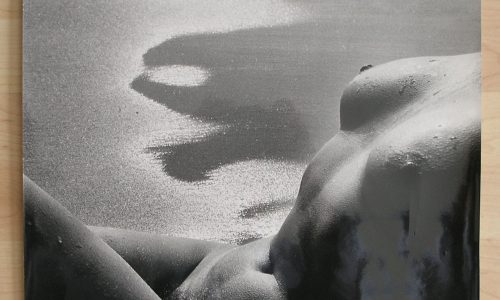
After moving back to California in 1926, Weston began his work for which he is most deservedly famous: natural forms, close-ups, nudes, and landscapes. Between 1927 and 1930, Weston made a series of monumental close-ups of seashells, peppers, and halved cabbages, bringing out the rich textures of their sculpture-like forms. Weston moved to Carmel, California in 1929 and shot the first of many photographs of rocks and trees at Point Lobos, California. Weston became one of the founding members of Group f/64 in 1932 with Ansel Adams, Willard Van Dyke, Imogen Cunningham and Sonya Noskowiak. The group chose this optical term because they habitually set their lenses to that aperture to secure maximum image sharpness of both foreground and distance. 1936 marked the start of Weston’s series of nudes and sand dunes in Oceano, California, which are often considered some of his finest work. Weston became the first photographer to receive a Guggenheim Fellowship for experimental work in 1936. Following the receipt of this fellowship Weston spent the next two years taking photographs in the West and Southwest United States with assistant and future wife Charis Wilson. Later, in 1941 using photographs of the East and South Weston provided illustrations for a new edition of Walt Whitman’s Leaves of Grass.

Weston began experiencing symptoms of Parkinson’s disease in 1946 and in 1948 shot his last photograph of Point Lobos. In 1946 the Museum of Modern Art, New York featured a major retrospective of 300 prints of Weston’s work. Over the next 10 years of progressively incapacitating illness, Weston supervised the printing of his prints by his sons, Brett and Cole. His 50th Anniversary Portfolio was published in 1952 with photographs printed by Brett. An even larger printing project took place between1952 and 1955. Brett printed what was known as the Project Prints. A series of 8 -10 prints from 832 negatives considered Edward’s lifetime best. The Smithsonian Institution held
the show, “The World of Edward Weston” in 1956 paying tribute to his remarkable accomplishments in American photography. Edward Weston died on January 1, 1958 at his home, Wildcat Hill, in Carmel, California. Weston’s ashes were scattered into the Pacific Ocean at Pebbly Beach at Point Lobos.

www.ftn-books.com has some titles with works by Weston available.

Posted on Leave a comment

Ray Smith (1959)

Schermafbeelding 2018-08-10 om 14.42.24

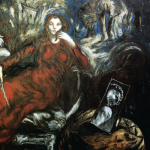
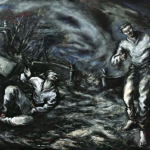
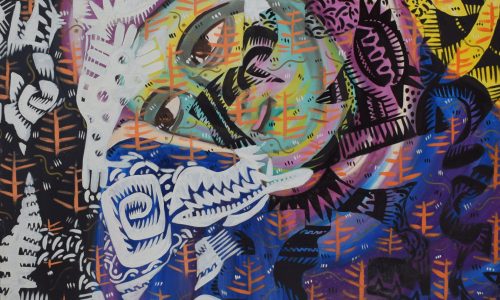
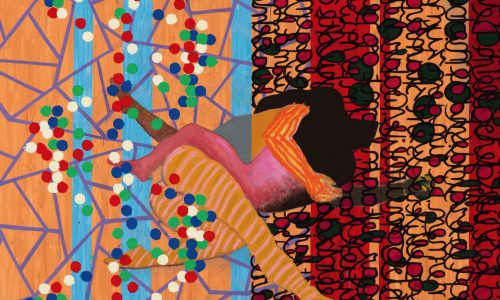
I first encountered the paintings by Ray Smith in 1992 at the Barbara Farber gallery, which catalogue is also available at www.ftn-books.com. These paintings are intense and “Rock and Roll”. Ray Smith could easily be seen as the child of Picasso and Frida Kahlo.

Schermafbeelding 2018-08-10 om 14.40.08

He is a contemporary American artist, best known for his segmented paintings and sculptures combining elements of Cubism, printmaking, art historical reference, and collage into postmodern compositions. Often relating to Surrealism in his unreal juxtapositions, Smith’s work is also characterized by a unique kind of magical realism. He frequently utilizes anthropomorphic animals in his work in a manner akin to Pablo Picasso’s Guernica, stating about the creatures in his work: “They are beasts, but they are directly attached to a blueprint of our own existence.” Born in 1959 in Brownsville, TX on family land that was part of Mexico before the Texas Annexation, Smith grew up in Central Mexico, and continued to retain a cultural and geographic tie to the country. After attending art schools in both the United and Mexico, Smith ultimately settled in Cuernavaca while continuing to travel regularly to New York. Smith’s work can be found among the collections and exhibition histories of the Whitney Museum of American Art in New York, the Centre Pompidou in Paris, and The Metropolitan Museum of Art in New York.

Posted on Leave a comment

Basel…the perfect museum city


We always travel the Alsace in the second half of the year between September and December, visit the Christmas markets and pick up some wine at our preferred wineries. If ever we have some spare time and only if there is a nice exhibition, we go to Basel city. You do not need a special “vignet” if you do not travel beyond the Basel / Bale city limits. Certainly do not lunch or drink a coffee in Basel because prices are far too high, but instead visit one of the 3 famous museums within the Basel city limits. First there is the Beyeler Museum ( By Renzo Piano), which is beside the Gemeentemuseum my favorite museum of all time, second there is the Kunstmuseum and third but not least there is the Tinguely Museum ( by Mario Botta). All worth visiting. Entrance fee of all three museums is steep too, but when you save on your coffee and lunch these three museums are well worth visiting. www.ftn-books.com has publications from all 3 museums available.
beyeler america a

Posted on Leave a comment

Ivan Puni / Jean Pougny (1892-1956)

Schermafbeelding 2018-08-09 om 13.54.27

I had never known this before, but now that i searched for Ivan Puni i found out that Jean Pougny and Puni are one and the same person. I knew that he stayed for most of his life in France and was succesful in France  and that must have been the reason that Puni became Pougny. the catalogue i have in my inventory is one of the best ones Willem Sandberg designed in the Fifties . It is a typical Sandberg designed catalogue and one of the first with tipped in color plates.
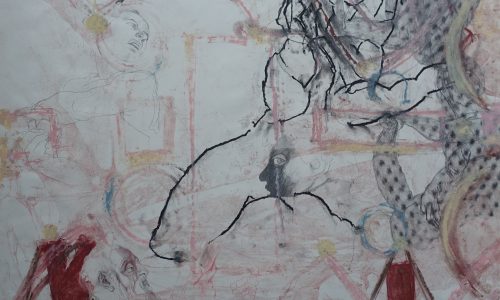
Puni received his formal training in Paris in 1910-11 at the Académie Julien and other schools, where he painted in a derivative fauvistestyle. Upon his return to Russia in 1912, he met, and exhibited with, members of the St Petersburg avant-garde, including Kazimir Malevich and Vladimir Tatlin. He made a second trip to Paris in 1914, returning to St. Petersburg in 1915. At this point, he began painting in a Cubist style reminiscent of Juan Gris. In 1915, Puni, (Aleksandra Ekster, Liubov Popova, Ivan Kliun, Ksenia Boguslavskaya, Olga Rozanova, Nadezhda Udaltsova, Nina Genke and others) formed Supremus, a group of artists dedicated to the promulgation of Suprematism, the abstract art movement founded by Malevich. Malevich and Puni co-authored the Suprematist Manifesto, published in 1916, which proclaimed a new, abstract art for a new historical era. Puni also organized the exhibitions Tramway 5 and 0.10, both held in St Petersburg in 1915, in which Malevich, Tatlin, Popova and others participated, and to which Puni contributed constructions and paintings. In 1915-1916 Puni, together with other Suprematist artists, worked at Verbovka Village Folk Centre. In 1919, he taught at the Vitebsk Art School under Marc Chagall.

Puni and his wife, Kseniya Boguslavskaya, emigrated from Russia in 1919, first to Finland, then in 1920 to Berlin, where the first exhibition consisting entirely of his work was held at the Galerie der Sturm. While in Berlin, Puni also designed costumes and sets for theatrical productions. Puni and Boguslavskaya relocated to Paris in 1924, where his style changed once again to a variant of Impressionism. In France, he signed his work Jean Pougny in an effort to distance his new art practice from his previous one in Russia. In 1946, Puni/Pougny became a French citizen. He died in Paris in 1956.

www.ftn-books.com has Puni/Pougny titles available.

Posted on Leave a comment

Bertien van Manen (1942)

Schermafbeelding 2018-08-09 om 12.30.35

Just a little piece of technical information i picked up from an interview with Bertien van Manen who’s works are known, appreciated and collected worldwide. Even the MOMA in New York has a nice selection of her photographs from the early 90’s.

Mrs. van Manen informed her interviewer that she uses the most simple AUTOMATIC camera’s available. Speed, size and ease of use are a key ingredients to take a successful photograph.

This is nice to know, since for us ….simple amateur photographers it is now with all excellent phone camera’s available as easy to take photographs as it is for professional photographers. All you need is a keen eye for the right subject and composition. Bertien van Manen showed us the way and it is now up to us to create our own portfolio’s with ex excellent photographs. www.ftn-books.com has titles by van Men available.