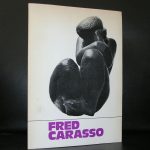
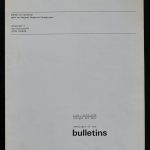
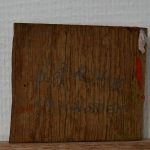
A blog on a very speciual multiple that was published on the occasion of the Henk Peeters Retrospective at the Gemeentemuseum Den Haag in 2011. On that occasion a reprint of the famous Nul/Zero 1964 catalogue was made in a small edition. It is the catalogue with the ZERO presentations by Armando, Peeters and Schoonhoven. All of these legendary artists have now passed away, but Peeters realized the importance of that catalogue and from that facsimile edition Peeters took some 20 copies and made multiples out of them by Stitching the front , back and inner work together and sign them with ECHT PEETERS. This has become one of the rarest of the later Peeters multiples and now one of those multiples is for sale at www.ftn-books.com
Henk Peeters (b. The Hague, 1925-2013)) was the most active member of the Dutch Nul group, notably with regard to the organization; he made the international contacts, organized the international ZERO (Nul) exhibitions at the Stedelijk Museum Amsterdam, and wrote on the theory of art. It was also he who first actively participated in international exhibitions with artist groups such as the German ZERO, the Italian Azimuth, and with artists Yves Klein, Yayoi Kusama and Lucio Fontana. He initiated the (utopian) project “Zero on Sea,” with more than fifty participating artists from over ten countries, and remained true to the fundamental concept of the Nul movement right up to his death in 2013. He sought to use his works of art to make the viewer conscious of his environment; he wanted to bring about a sensitive consciousness-raising, as it were. The materials that Peeters selected for his works frequently had a very tactile appeal, while he simultaneously created a certain untouchability; thus he stuck candle tapers behind plastic foil, or placed mesh in front of cotton wool. He also used fire on canvases, leaving behind traces of thick smoke, or burned holes into plastic, the so-called “Pyrographies.” With these – often white – works he was visually closely related to the German ZERO artists, but there was also a clear relationship with Nouveau Realisme; Peeters also used ready-mades, which he bought in inexpensive stores and isolated in the work of art. In these, he had a preference for modern, clean, industrial materials, such as plastic and nylon. He once said: “with my work, I have always wanted it to look just as fresh as if it was in the HEMA (the Dutch chain store). It must not be artified… I had no need for artistic cotton wool.” Henk Peeters also worked with natural processes, such as light and water reflections, and with ice, rain, snow and mist. Art and life should be joined together inextricably. And thus, in 1961 Henk Peeters became a work of art himself, when Piero Manzoni appointed him as one; this was certified and signed by the Italian artist. Until his death (Hall (NL), 2013), Henk Peeters restored artworks from the Nul period and remained an active spokesman for the group.


Swip Stolk is certainly one of the great names in dutch graphic design. He died last sunday at the age of 75 . There are some iconic designs by Stolk that are worldwide famous. Specially the peeing poster for the Serrano exhibition drew attention from all over the world. There was a typical Swip Stolk styke of design. He broke with the minimal designs of the sixties ( Crouwel and Wissing) and invented his own exuberant style of design which was soon to become the “house style” of the Groninger Museum for which museum he made for nearly two decades many important book and publication designs.


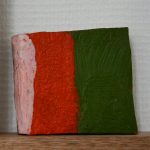
This is a line from a Shakespeare sonnet . Piet Dirkx finds his titles everywhere and notes them on cigarboxes and Moleskine note books and this is probably one of the most illustrous of all. The work of art is also exceptional. The first time i saw it was at the first Piet Dirkx exhibition in the Ravesteijnzaal at the Haags Gemeentemuseum and this was the second work i acquired for my collection and never regretted it. It is long work of art , measuring aprox. 200 cm and its height being ca. 15 cm. The lat is tiles and signed and dated by Piet Dirkx. The work consists of 14 small paintings on wood , placed on a special lat.