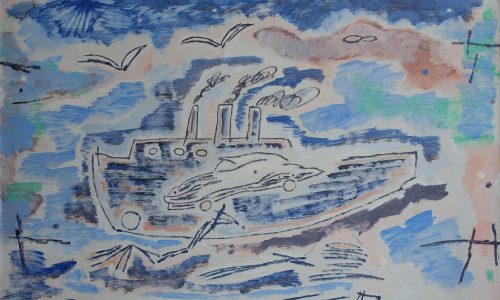
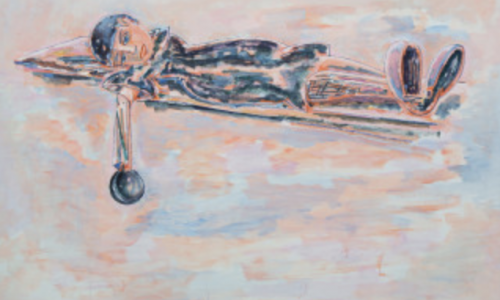
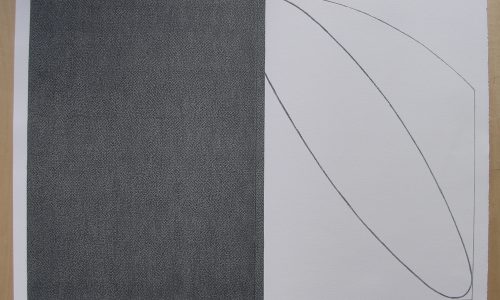
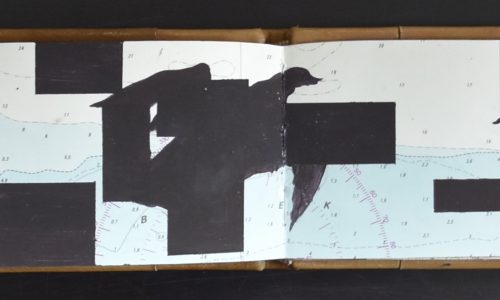
Last month i sold one of those special books from my inventory that i most probably will not be able to sell again.
It is the signed LOGOGRAMAS book by Pedor Xisto. It is because this is such a scarce item that i photographed all pages to share this wonderful publication with all……enjoy and for other Concrete Poetry publications please visit www.ftn-books.com
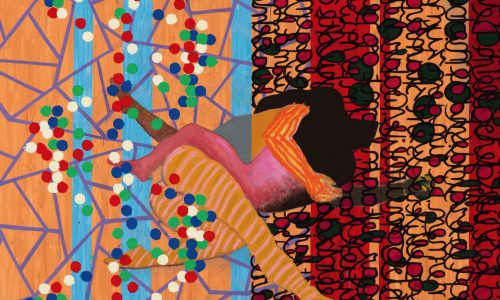
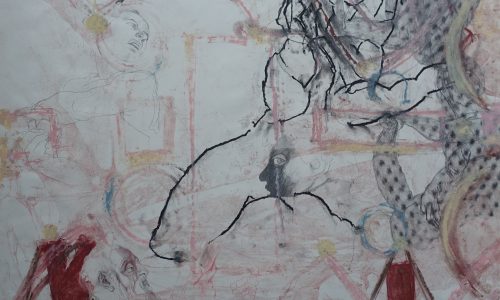
Roger-Edgar Gillet’s pictorial itinerary revolves around widely differing periods that often resulted in his voluntary isolation from the Paris art scene. Although, at the start of his career, he associated himself with the Art Informel movement alongside Michel Tapié and Charles Estienne, with whom he experienced the passionate controversies sparked by their exhibitions, he asserted his desire for expressive freedom at a very early stage and from then on consistently refused to attach himself to any sort of movement – witness his return to subjective figuration towards the 1960s, which placed him outside the trends then in fashion. Gillet went his own way, producing an oeuvre in which caustically traced, ardent forms that are expressionistic only in appearance are brought forth from highly-worked material. The subjects lend themselves to a ferocious style of painting rendered oblique by dreams, irony and humour.
Between 1939 and 1944, he studied at the École Boulle, where he acquired a thorough technical grounding and an appreciation of fine workmanship, and trained under Brianchon at the Arts décoratifs. After the dark years, life gradually resumed. Galleries opened, introducing painters such as Wols, Dubuffet, Fautrier, Poliakoff, Tobey and Michaux. Saint-Germain-des-Prés was already becoming the stamping-ground of the new generation of artists. Gillet shared a former tanning workshop in the leather market with friends (it was subsequently occupied by Corneille and Appel). He attended Antonin Artaud’s funeral (1948) and went to a lecture on Picasso by the Abbé Morel that degenerated into a riot, himself ending up at the police station. Presently he acquired the middle name “Edgar”, courtesy of Michel de Ré, who thought he looked like Edgar Allan Poe. In 1950, while taking part in a group exhibition at the Galerie Mai, he re-encountered his future wife Thérèse, whom he had first met two years earlier at a Wols exhibition at the Galerie Nina Dausset.
He had overseas solo exhibitions at the Galerie La Licorne, Brussels, in 1954; at the Palais des Beaux-Arts, Brussels, in 1957; at the Galleria Blu, Milan, in 1960; at the Galleria La Bussola, Turin, and the Galerie Lefebvre, New York, in 1961; at the Galerie Moos in Geneva and Galerie Birch in Copenhagen in 1962. In 1964, the Galerie Dina Vierny, in Paris, showed a set of his drawings and the Galerie Françoise Ledoux exhibited prints by him. Drawing and printmaking were techniques Gillet used regularly, alongside oil painting. He saw drawing as an exploratory medium and an aid to memory.
www.ftn-books.com has the Galerie de France catalogue from 1961 now available. It has an original lithograph used as cover.
Carlos Mérida is best known for his canvas and mural works, most of which was done in Mexico. However, he also did engraving, set design and mosaic work.
His artistic direction has been compared to that of Rufino Tamayo, generally rejecting large-scale narrative paintings, preferring canvas,]being more interested in becoming a painter than in politics (with an exception in the 1950s when he was horrified by nuclear testing). He experimented with color and form as well as techniques. Music and dance were lifelong interests and they influenced his paintings with rhythmic, poetic and lyrical pieces.[2]
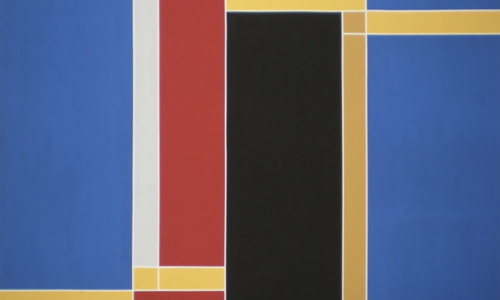
He had three major epochs, a figurative period from 1907 to 1926, a surrealism phase from the late 1920s to the mid-1940s and from 1950 until his death, geometric forms characterized his work. His early work is marked by experimentation.[16] He was in Europe when the avant garde was transitioning from Impressionism to Cubism and he was influenced by the works of Modigliani and Picasso His surrealist phase again came from time in Europe, meeting not only Paul Klee and Miró but also fellow Guatemalan Luis Cardoza y Aragón.] At this time, he abandoned his former figurative style and became one of Mexico´s first non-figurative artists, leaning to abstractionism and separating him from other Mexican artists.[2][12] This focus on the non-figurative continued into his later work, but with focus on geometric elements, especially those linked to New World indigenous cultures such as the Maya.[2][3] His work is considered highly intellectual, not representing things, but rather a concept of them. Salvador Novo wrote “The pre Hispanic world, in Carlos Mérida, attains a perfect synthesis, an ideal sublimation of numeric rhythm sprung from geometry. The debt owed by the abstract painting of our time to Carlos Mérida is thus as great as his work is perennially solid and relevant.
While heavily influenced by trends in Europe, especially his earlier work, Mérida felt it important to emphasize his American (New World) identity and culture. He fused European Modernism with forms and subjects specific to the Americas.[12] One reason for this was that in Europe he found that European artists were not interested in what was happening on the other side of the Atlantic.] He became convinced of the need to establish natively American art which would express the “original character which animates our nature and our race will inevitably engender a personal artistic expression.”[2] His work reflects on both the Mayan and Aztec civilizations along with the colonial period representing the indigenous as symbols of post Revolution Mexico.[He even integrated indigenous amate paper in to some of his works.[12] While part of Mexican muralism, he predated it slightly by promoting indigenous motifs seven years before Rivera led Mexican painting to fame.] Luis Cardoza y Aragon called him a pioneer of Latin American art, painting elements such as indigenous people, Mexican and Central American landscapes without oversentimenalizing which had not been done before.] This emphasis on the New World not only was expressed with folkloric images, especially in his early work, but also in his later work. The discovery of Bonampak motivated him deeply, taking new ideas from the ruins and eventually led to his interest in integrating painting and sculpture into architecture.
Antoine Poncet (b.1928) is a highly regarded exponent of post-war sculpture in Europe. He grew up in Switzerland he was surrounded by art from a young age. His father was a painter and his grandfather was the famous artist of the Nabis movement, Maurice Denis, whose theories contributed to the foundations of cubism, fauvism and abstract art. At the age of 14, Poncet studied under the sculptor Germain Richier in Zurich. From 1942 he attended the École des Beaux Arts in Lausanne, before moving to Pairs and it was at this point in his career that he turned towards abstraction.
The search of form was always his primary concern; ‘I have to create a sculpture that is able to live in a space with its equilibrium of volumes, its movement of and plenitude.’ Poncet was highly influenced by the work of Brancusi and Jean Arp, specifically their focus on shape, form and volume. Poncet creates bronzes that appear to be still taking shape in front of the viewer creating a sense of dynamism and transience. Surface texture is of real significance in his work; his sculptures are smoothly polished in order to enhance the play of light. From 1952 Poncet exhibited regularly at the major salons such as the Salon de la Jeune, the Salon des Réalités Nouvelles; and the 1953 a group show at the Musée National d’Art Moderne in Paris. In 1956 he participated in the international sculpture exhibition at the Musée Rodin in Paris, and was selected to represent Switzerland at the Venice Biennale. During his career he received several awards including the ‘Henry Moore Prize’ in Japan 1983.
www.ftn-books.com has the 1961 monograph by Les Rose des Vents available
In spite of what is believed a few pamphlets were published with the Fundamental exhibition from 1975. Rob van Koningsbruggen, had withdrawn himself from the FUNDAMENTELE SCHILDERKUNST exhibition and therefore was officially not included in the exhibition , but thanks to Christiaan Braun, who lent some Koningsbruggen works ( with permission of van Koningsbruggen ), his works were included and the Stedelijk Museum decided to publish this 4 page pamphlet. This was published in an extremely small edition, but this 4 pages proof its existence.
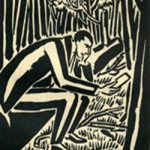
Flanders has a history filled with great woodblock printing artists. There is of course first of all Frans Masereel, further Jozef Cantré and some find the same qualities present in the works by Victor Stuyvaert. He foremost illustrated books by the classic writers like Cervantes and Edgar Allan Poe, but the majority of people know him from his ex libris prnts. It is a rare occasion that his prints are offered by me , but recently i discovered 2 small prints from a small portfolio which i bought. The reason i liked the prints and they show craftmanship. Both prints are now available at www.ftn-books.com
Some 2 years ago iw rote a b;log on one of my all time favorit dutch artists…. MAARTEN PLOEG….
I followed his career until his death in 2004 and because we have the Large OK HOOFD in our collection i bought over the years an extra copy of the Dienst Beeldende Kunst booklet ( text Gerrit Jan de Rook). Now that i am reorganising my bookcase i found this extra copy and realised that the cover is special!. Nowhere else is this to be found and my guess is that this was specially designed for this 1985 publication. In all my archives i did not find this print that was used for the cover of this scarce Maarten Ploeg collectible. The Dienst Beeldende Kunst publication is now available at www.ftn-books.com
I already wrote once on the Geert van Fastenhout painting we have in our collection, but now there is a reason to continue and write once again. We have acquired another painting by van Fastenhout at auction and because i checked my bookcase i found that i have a second copy of the 1996 book by van Fastenhout. I will keep my personal dedicated copy of course, but the nice ting is this is also signed and dedicated by Geert.
The book is filled with beautiful impressive paintings made over 3 decades and many of these landed in Japan (more than 250 paintings) . My guess is the Japanese like to study and meditate with their art and Geert van Fastenhout his works are very suitable to do so. Finally i will share the painting we recently bought for our collection. Colors are hardly to be discovered, blacks, blue sand browns are all present but because of their darkness it takes time to discover them, but they are there (the camera makes the darkness much lighter) . Another masterpiece by Geert van Fastenhout.
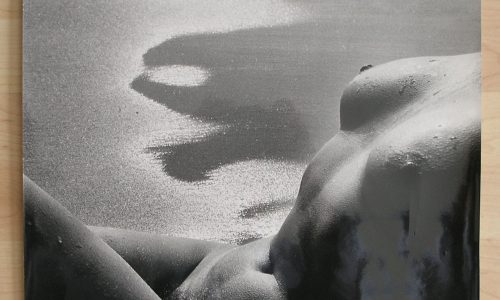
Jean-François Jonvelle, born on October 3, 1943, in Cavaillon was a French photographer of fashion, glamor and portraiture. Work on the release of 20 ans magazine and then work on Dim, Dam, Dom, Vogue, Stern, Gala, Elle. In the 1960s, Jonvelle was assistant to Richard Avedon. During his career, he made many portraits of women, often his friends: natural young people, often naked, unconcerned. Unlike other fashion and glamor photographers, who offer a provocative woman, Jean-François Jonvelle’s performance is much softer, more natural, more jovial but equally sensual. He died at the age of 58 years of terminal cancer, 15 days after it was detected on January 16, 2002, in Paris.
Jonvelle’s work is often described as being – in the time-honored formula – ‘sexy but not vulgar’. I prefer his own description of what he sought out: ‘la poésie du quotidien’, ‘the poetry of the everyday’. Photographs freeze moments of truth, all you have to do is choose the ones that do it best. “I tell myself that the present and the future don’t exist”, he also used to say. “Everyone, every day, creates their own past.”
The quality that makes his images more moving than the rest is their vulnerability. Jonvelle taught me one crucial lesson: in photography, as in literature, what counts is feeling. Eroticism and tenderness are not sworn enemies. A downy arm, the frail nape of a neck, an uptilted breast, the curve of a back beneath the sheets, damp hair, closed eyelids, the trace of a kiss on the neck all these can be arousing. Jonvelle’s women are fresh and natural because they are unaware of our gaze. Jonvelle makes adoring voyeurs of us all. He shows us why heterosexuality can be so painful: everywhere, in every house and every bathroom, paradise lurks. Paradise delicately removes her T-shirt, brushes her teeth, buttocks pert, the curve of her breasts taut, timeless. Suddenly paradise parts her legs in silence, biting her fingernails as she looks you straight in the eye, teasing you as she waits for you on the sheets. Jonvelle is in paradise now, but for him nothing has changed: he was already there in his lifetime. ( text Photo.com )
www.ftn-books.com has the 1994 Stemmle publication now available. Arguably this is considered as being the most important Jonvelle publication. Book is in MINT condition.
With his sculptures, usually carved out of one massive block of wood, Stephan Balkenhol was among the first artists of his generation to reintroduce the figure to contemporary sculpture. With a hammer and chisel, the artist gouges his figures out of the tree trunk. He takes no effort to hide the shavings and traces of the tools visible in the wood with its knots, grain and cracks. Rather this is part of the work – an inheritance that was perhaps passed on by his minimalist teacher Ulrich Rückriem. In most aspects, however, Balkenhol did not follow the Minimalist and Conceptual trends he was exposed to as a young sculptor. Inspired by the social and political changes of the 80’ s, the artist felt it was necessary to reinvent the figure “to resume an interrupted tradition”.
I have been following his vcareer for over 20 years now and to me Balkenhol is always a surprise. His technicque of woodsculpting it at his very best at this moment asnd his sculptures grow bigger and bigger and keep getting more important by the years. www.ftn-books.com has some nice Balkenhol titles available.
Artist/ Author: Oliver Boberg
Title : Memorial
Publisher: Oliver Boberg
Measurements: Frame measures 51 x 42 cm. original C print is 35 x 25 cm.
Condition: mint
signed by Oliver Boberg in pen and numbered 14/20 from an edition of 20