Posted on 4 Comments

Gerry Schum ( 1938 -1973)

Schermafbeelding 2018-12-17 om 17.05.06

Rightfully he may be called one of the true pioneers of Video art.

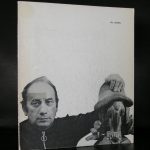
Because of his early contribtions to the collection of the Stedelijk Museum resulted in an exhibition ( which catalogue is available at www.ftn-books.com) and the hsitory and development of Video art during the last 50 years. Th Stedelijk has made a permanent presentation of his :

Schum made Land Art as part of his Fernseh-Galerie Gerry Schum. The German television station Sender Freies Berlin broadcasted this film on 15 April 1969. Schum was looking for a way to show modern visual art to a wide audience. He achieved this by broadcasting his film and video productions on television, bypassing the traditional institutions. The TV programme showed recordings of artistic interventions in the landscape by eight artists, including Jan Dibbets, Barry Flanagan and Richard Long. Schum’s own sober camera work is an essential element of the visual end result. Jan Dibbets’ contribution 12 Hours Tide Object with Correction of Perspective shows a tractor leaving behind a trapezium-shaped track on a beach. The position of the camera and the effect of the perspective mean that the viewer sees this shape as a rectangle. Dibbets was casting doubt on the reliability of representation via the camera and on the perception of the eye, as he had done previously in his ‘perspective corrections’.
It takes time to appreciate Video as an art form , but when you finally do so , there is an artist not te be missed and that is Gerry Schum.
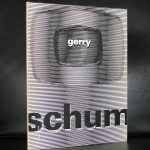
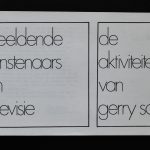
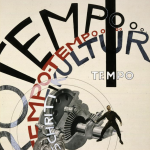
btw. The Gerry Schum catalogue was designed by Wim Crouwel.

Posted on Leave a comment

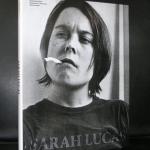
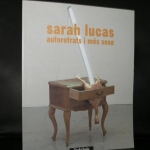
Sarah Lucas (1962)

Schermafbeelding 2018-09-17 om 12.22.01

Another young bBritish artist who emerged in the early Nineties in a wave of young British artists. Others from her generation rose to fame in the same years. Among them Gary Hume and Damien Hirst. They had one thing in common. All were added to the Tate collection at a very young age and collected by Saatchi. Personally i am not a great admirer of her works. For the same reasons  i am not a great admirer of Hirst his works, but sometimes you have to look twice and try to discover the meaning of her(in many cases) masculine constructions to confront and dissect their nature.

Schermafbeelding 2018-09-17 om 12.26.19

Her pieces represent a fantastical world and playfully employs unrealistic ideals to unearth obscene paradoxes created by those very constructions. These works are constructed and well thought over and perhaps that is the quality i do not like about them.

www.ftn-books.com has some Sarah Lucas titles available

Posted on Leave a comment

Michel Cardena a conceptual artist ( 1934-2015)


Schermafbeelding 2018-09-10 om 15.01.26

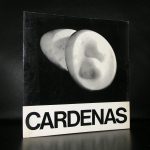
MIGUEL ÁNGEL CÁRDENAS was born in El Espinal, Colombia, in 1934 and died in Amsterdam, the Netherlands, in 2015. He studied architecture at the Universidad Nacional in Bogota (1952-1953) and visual arts at the Academia de Bellas Artes (1955-1957) and the Escuela de Artes Gráficas in Barcelona (1962), before moving to the Netherlands where he lived for the remainder of his life and adopted the artistname Michel Cardena. In 1964 Cardena was included in the seminal exhibition “New Realists and Pop Art,” which travelled from the Gemeentemuseum The Hague to Vienna and Brussels. In 1972 Cardena established an artist-run space called the In-Out Center along with a group of Amsterdam-based international artists. The In-Out Center hosted exhibitions of early video and performance art in addition to supporting conceptual and collaborative projects. Cardena’s work is in the collections of the Stedelijk Museum, Amsterdam, Netherlands; Moderna Museet, Sweden; Gemeentemuseum, The Hague, Netherlands; and Museum Boijmans Van Beuningen, Rotterdam, Netherlands, among others. His work was recently exhibited at the Instituto de Vision, Bogota, Colombia (2015) and at Andrea Rosen Gallery in New York (2017) and will be part of the exhibition ‘I am a native foreigner’ opened at the Stedelijk Museum Amsterdam in September 2017.

Cardena is becoming more and more known and gaining importance for the conceptual art of the Sixties and Seventies. www.ftn-books.com has two important publications on the artist.

Posted on 1 Comment

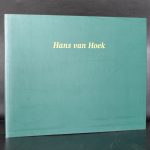
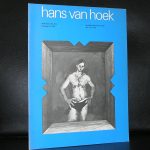
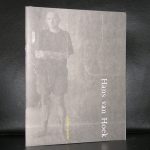
Hans van Hoek (1947)

Schermafbeelding 2018-09-10 om 15.19.06

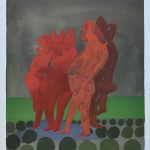
Hans van Hoek, a typical dutch artist who’s work is rooted in the classical approach to painting. You can recognize parts by Rubens and Cezanne in his painting but overall it is typical Hans Van Hoek. Look closely and you can distinguish figures…from a distance it is different and it is almost like looking at an abstract painting.

Schermafbeelding 2018-09-10 om 15.28.32

van Hoek was a very well known and appreciated painter in the Netherlands and he had his exhibitions in the large museums over here. Stedelijk Museum and van Abbemuseum had their exhibitions with this great artist, but people lost interest in his works when he decided to move to South Africa where he stayed in Barrydale for a period of 12 years. In 2008 he returned to the Netherlands and he had to build his reputation as an artist once again, but somehow he has lost momentum in the period he stayed in South AFrica because when he left he was a welll appreciated and colelcted artist and recently i encountered work by van Hoek at auction for prices as low as euro 600,–

Schermafbeelding 2018-09-10 om 15.36.34

Hans van Hoek will prove to be important in the near future so i can only recommend his works to be collected. www.ftn-books.com has some nice hans van Hoek publications available.

Posted on 3 Comments

Vic Gentils (1919-1997)

Schermafbeelding 2018-09-07 om 14.29.36

Another of those more obscure Belgian artists is definitely Vic Gentils. Studied in Antwerp and became known through participating in the Kassel and Venice Biennales in the mid Sixties, but soon after people lost interest in his art was only known in Belgium. Not many museums have work by Gentils, but if you encounter work in a museum it is probably a “painting” from the series of ANTI-PEINTURE. a series of non paintings which is pure abstract and can be categorized as Informal.
Schermafbeelding 2018-09-07 om 14.38.48

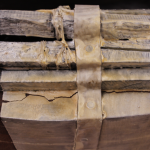
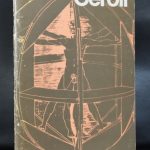
Following years of search and doubt during which Vic Gentils assimilates expressionism and the ubiquitous Picasso and Klee, in 1955 he turns to abstract painting. And when that too seems inadequate, Gentils starts making his famous assemblages. These are indeed abstract compositions, from wood scraps – usually frames from doors or windows – that he combines with appropriated picture frames, thus also referring to the painting as ‘window on the world’. In this sense *Anti-peinture I* (1960) is not really an adieu to painting but rather an evocation of painting’s own shortcomings. Gentils makes art-historical art. With cast-off decorations once sold to nostalgic parochial folk, he forges a new patrimony. In the white modern spaces so desirous of being timeless, his assemblages function like alienating interventions, objects that underscore the historical nature of each object, each space. And perhaps the opting for dark tones was his way to escape from the shadow of expressionism, by ironic reference to that somber style sometimes drown in asphalt.

 

Possibly there will be a time that the works by Gentils will be reevaluated and appreciated but for now the only thing to do is to study the older publications on Gentils of which some are available at www.ftn-books.com


Posted on 4 Comments

Marianne Brandt (1893-1983)

Schermafbeelding 2018-09-03 om 14.25.10

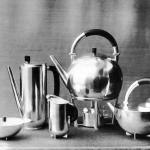
Marianne Brandt is one of the true fist multi disciplined female artists from last century. One of the front “(wo)men” for Bauhaus and what it stands for. She was responsible for some truly great designs for everyday objects.

Teapots, lamps, cupboards and plates, she has designed it.
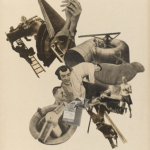
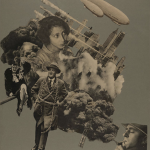
Lesser known is that she was one of the pioneers of Photomontage.

A discipline in which she excelled and on which subject a few years ago an exhibition was dedicated at the Bauhaus Museum in Berlin ( catalogue available at www.ftn-books.com)

OLYMPUS DIGITAL CAMERA

It is time that outside Germany Marianne Brandt becomes known for her excellent designs. At auctions her designs are very much sought after and reach record prices, so how is it possible that a great female artist like Marianne Brandt is hardly known?

Posted on 3 Comments

Arjanne van der Spek (1958)

Schermafbeelding 2018-11-18 om 15.08.54

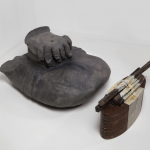
Is it luck or did it had to be this way?,….. because a few months ago if finally could purchase for the FTN collection an important and i think beautiful and intriguing sculpture by Arjanne van der Spek. It must have been some 25 years or more ago that i think Gerrit Jan de Rook introduced me to Arjanne van der Spek.  It was during the exhibition she had at the Gemeentemuseum and was joining Frank van Hemert in their joint presentation. A just starting, promising sculptor, who had finished her education and studies at the Ateliers 63 just half a decade earlier. She had her first solo exhibition at the Tanya Rumpff gallery who had started her gallery a few months earlier. I went to the gallery to see the other drawings and sculptures other than the ones i had seen and admired at the Gemeentemuseum and i really fell for her sculptures. As i explained to her a few weeks ago …they were intriguing and completely different than the sculptures i had seen before. The use of wood, steel, ceramic and tissues all in one sculpture were new to me. Unfortunately i could not afford a sculpture, but time changes everything  and a few weeks ago i was able to buy KNAP KNAP KNA from the former Klein Breteler collection, who had the work acquired from gallery de Vries in Haarlem. The work was not sold during auction, but i was able to buy it in the aftersale. I informed Arjanne that i had bought the KNAP KNAP KNAP and she was delighted to hear it found a new home. She thought it to be one of her best works and is still very fond of it so i offered it on loan when ever she wanted to use it in an exhibition:

‘Knap Knap Knap’ (2009)

a mixed media object (ceramic, wood, paint, brass) in two parts, 70x100x40 cm

Provenance: Acquired from Galerie Rob de Vries, Haarlem

It is a large work which makes it not that easy to place although outside placement under a roof is an option.

I added this work last week to the FTN art section and for those interested in buying please inquire at wvdelshout@ziggo.nl

Posted on 4 Comments

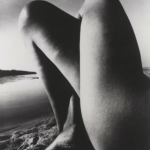
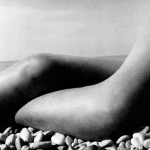
Bill Brandt (1904-1983)…body parts

Schermafbeelding 2018-09-03 om 14.52.46

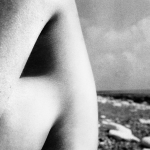
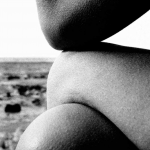
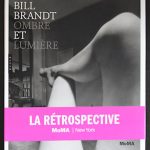
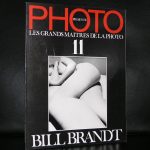
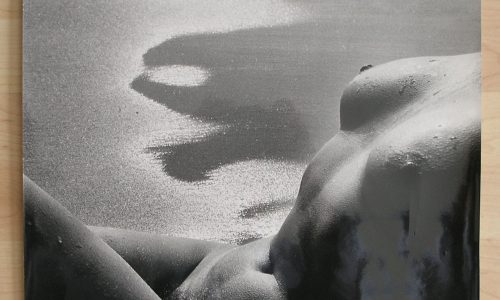
Yesterday….  a blog on Marianne Brandt, today the subject is Bill Brandt. Not related in anyway  and an age difference of some 50 years, but both working with photography. But where Marianne cut up photographs to make some excellent photomontages, Bill Brandt uses the angle of the lens to make some very impressive photographs. For me Brandt is together with Lucien Clergue one of the very best nude photographers from last century. He uses the angle of the lens to photograph parts of the body and with this technique his photos are like the sculptures of Maillol and Moore in which body parts are enhanced and polished into almost abstract sculptures.

Schermafbeelding 2018-09-03 om 14.50.44

This technique makes him quite unique among photographers and with this quality he stands out. Add the use of Black and White film and Bill Brandt becomes a very recognizable photographer. His nudes are among the very best photographs from the last century and it took me only a minute to find some of the examples that show in an excellent way that what i tried to explain in words. www.ftn-books.com has some Bill Brandt titles avaialble.

Posted on Leave a comment

Mario Ceroli (1938)

Schermafbeelding 2018-10-11 om 16.20.14

This is what his site says about the artist:

Mario Ceroli is one of the most important representatives of contemporary art in Italy.  As an eclectic artist, sculpture, designer, architect, painter and scenographer, he has been able to transform, during his long career, such powerful raw material as wood in breathtaking one of a kind art pieces. Born in 1938 in a small town of the province of Chieti, Italy, he moved for the first time to Rome in the early 60’s. This was the emerging period of the pop art in Italy; a motivating moment of the traditional contemporary art in which he distinguished himself with his capacity to combine tradition with modern. Mario’s creativity runs from reinterpreting famous art to creating new open spaces, furnishing theatrical plays to the realization of great sculptures en plein air including references to material reality and symbolic figures. Ceroli recognized, other than his masterpieces, as a pioneer in starting a wave of expression in art and demonstrating with a strong conviction that experimenting with new materials is the beginning of professional growth in a real artist.

His great artistic talent allows him to obtain from natural elements such as wood, glass, earth and ice, a blend of geometrical figures, inlaids, marvellous works that can be only created by a master mind.  When Ceroli talks about wood, he states, “It’s the only material that allows me to right away give form to my imagination and ideas; it’s from the material that the images jump out of me”.

Ceroli known in the world especially for his horses, sculpted in bronze and wood, symbolizing salvation and aspiration, the founder one is the bronze horse that we can find in the middle of the Rai Headquarters in Rome. Although he is at the top of contemporary art in Italy, his work also mirrors the research of “The Beautiful Ideal” from Winckelmann in the late XVIII century. With the unusual form that his sculpted furniture takes place, you can perceive the presence of the metaphysic paintings of Giorgio De Chirico in such way that it actually honors him.  Ceroli’s art offers a one of a kind esthetic experience; an encounter between past and present and a total immersion in beauty.

Please visit his site, because it is well worth your visit:

http://mobilinellavalle.it/en/artist-mario-ceroli/

www.ftn-books.com has two rare Ceroli titles available

:


Posted on Leave a comment

Chris Lanooy (1881-1941)

Schermafbeelding 2018-10-10 om 13.28.06

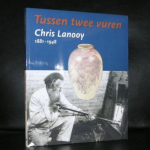
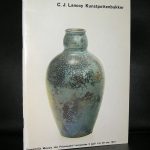
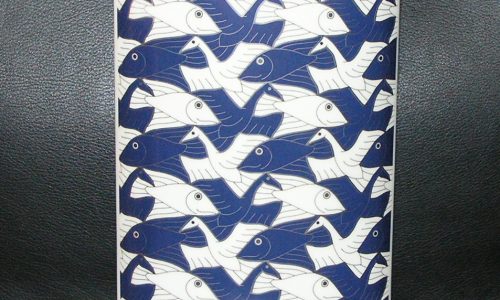
If ever there was one potter who was of great influence to the dutch potter generations to follow it must have been Chris Lanooy. He set a standard with forms and decorations for the decades to come and for instance the Rozenburg and Gouda potteries were all highly influenced by this master potter. It is of late that his works are recognized as highly influential and authentic and a recent monograph TUSSEN TWEE VUREN from some years ago proves it. ( available at www.ftn-books.com)

Chris Lanooy deserves to be recognized internationally as one of the great potters from last century since his pottery is now considered as true art.