Posted on Leave a comment

Lothar Baumgarten (1944-2018)

Schermafbeelding 2021-01-27 om 13.14.35

Lothar Baumgarten is one of those artists who’s fame never was never worldwide, but who rightfully deserves to be known and admired by many more. In recent years a new reveived interest grows in his works. Baumgarten, a conceptual artist< has had his exhibitions in the Netherlands at the Stedelijk Museum and Museum de PONT, but these have been some years ago, but lately i see a raised in interest and the works that appear at acution are sold at fair but rising prices. A good work from an edition is sttill to be acquired far below euro 250,–

Baumgarten is an artist to follow, and if you admire his works, like i do, focus on the editions. These are still to be bought at low prices.

www.ftn-books.combaumgarten bulletin has some nice Baumgarten publications available.


Posted on Leave a comment

Chris de Bueger (1948)

Schermafbeelding 2021-01-21 om 16.31.41

Try to find information and a portrait of Chris de Bueger and you will have a difficult time ahead. Because of a publication i bought some years ago ( piece of oil painting on the cover) i started to search fo the artist. No portraits , no text, just some abstract paintings and  apiec of canvas ( painting) on the cover of the blue book.

There is only way to find the maker of this book and paintings and that is study the pages and photographs. Paintings are nice abstract paintings and certainly worth viewing and possibly even collecting. and yes…..on one of the photographs there was the signature of the maker. First i read de Buger, but thanks to Google i found that it had te be Chris de Bueger and now the book is availabe at www.ftn-book.com.

Posted on Leave a comment

Chris Ware (1967)

Schermafbeelding 2021-01-21 om 16.13.22

Last week i have withdrawn all my Chris Ware items ( except for a Beau Hunks cd) from www.ftn-books.com.

beau hunks ware b

Not because of any controversial text or offending drawing , but because i had  so many beautiful publications collected over the years that it was time to start my own Chris Ware collection(again). My first encounter with Ware his drawings was at the galerie Lambiek in Amsterdam . At that occasion Ware was presented together with Henk Kuijpers. Of course no funds to buy, but from that moment i admired and started collecting Ware his publications. Some 15 years ago i decided to sell all, but now i have changed my mind and will start collecting again. Chris Ware is truly one of the greatest of them all.


Posted on Leave a comment

Keith Haring, Bulletin contribution, 1990

Schermafbeelding 2021-01-21 om 14.22.19

1986….Keith Haring had his retropective at the Stedelijk Museum and made the VELUM for the entrance at that time. Since, there has been a friendship between Wim Beeren and Keith Haring. The 1990 Bulletin published by the STEDELIJK MUSEUM, had a small contribution on the memorial held at the MAZZO discotheque in Amsterdam. With the article a note written by Keith Haring addressed to Wim (beeren) was published for the first time. Here is the letter.

haring brief

The Bulletin frm 1990 is now availabe at www.ftn-books.com

Posted on Leave a comment

Simon Benson represented by gallery Phoebus

benson a

The following text is written by Mirjam de Winter from gallery Phoebus, who represents Simon Benson.

Simon Benson is a draughtsman above all else. In pencil, on A4 and A3 size paper, you find almost everything: from almost invisible organic lines drawn in a searching automatic hand, to harder lines, drawn with the help of a ruler or a template; as well as areas of solid fill or cross-hatched and soft nebulous planes. Since the end of the 80’s nature and architecture have been his main subjects in which he can deploy his drawing skills. In the course of the 90’s, language and text make an appearance, along with the human form, sensory perception and feelings. In 1998, he makes the first self-portraits. In the meantime, new techniques are being used in the works on paper: photography and digital prints. Alongside all this, Benson has been making wall-paintings and three dimensional wall and floor objects made from mdf: he has also realised a number of public space commissions.

Schermafbeelding 2021-01-19 om 14.55.17

In 1997, Simon Benson, made a text-piece, ‘Universal Anatomy’, in the form of a digital and a silk-screen print. It consists of a list of about 300 Italian words. (Italy referring to the beginnings of art in the Renaissance). The scope of this theme becomes clear: from roof to foundation, mountain peak to valley floor, from human head to feet – the body expanded to include perception, feeling and thought – all this subject matter described in one descending movement. At the same time, with a fascination for crossovers, Simon Benson drew a house in the form of a head, or a tree that appeared to be speaking; and he also made an installation entitled ‘An Anthropomorphic Landscape’, with consisted of a series of mdf objects with an block-like architectural appearance, which contained textual references to certain facets of the human form.

benson b

Not just in this conceptual framework -that to this day continues to grow and is still a way to get to know Simon Benson’s work- but individual text works also play a role. For example, ‘Solutio’, ‘Heiliger Platz’, Senza Fiato’, ‘Fluchtpunkt’, ‘Seed’, ‘Cielo’ and others confront you with a greater or lesser degree of
ambiguity, of under- or overstatement – and creates a lot of space for association. Words or letters are sometimes, through a clear yet abstract arrangement, made unreadable. For example, the sixteen letters of the name of the gallery ‘ P H O E B U S R O T T E R D A M ‘ are placed in a grid of four by four letters on the facade of the building in which the gallery in housed. Text as starting point and secret language, a labyrinth to wander around in, a place where you can stand still, think and dream.

That Simon Benson is inspired, on various levels, by the traditions of western art and architecture is discernable in his work. Sometimes it is possible to point out variations on existing images, like in the references to Dürer’s drawings or Botticelli’s, or in the assimilation of architectural drawings of Gothic cathedrals or Le Corbusier’s buildings. As far as sources from literature are concerned, Simon Benson made, in 1999, a series of drawings based on Dante’s Divine Comedy and lately he has been inspired by James Joyce’s ‘Ulysses’, especially by the notion of a varyingly, inward and outward looking subjectivity. ‘Thought Through My Eyes’- eyes open and closed. His work is becoming more and more personal. Image and text, increasingly woven together – something like what you see in a present day source of his: television and computer culture.

The ‘ DO YOU STILL HEAR THE BIRDS SINGING” publication is available at www.ftn-books.com

Posted on Leave a comment

Geurt van Dijk (1941)

Schermafbeelding 2021-01-19 om 14.32.58

Maybe not as known as many of his contemporaries, but still known by those who specialize in small and scarce publications. I stumbled upon van Dijk and his publications some 10 years ago when i discovered 2 small publications published by the Brummelse Uitgeverij voort luxe werkjes. Both titled ” VARKENSLAPPEN ” but with a difference.

varkenslappen cards ba

One published as a small book. the other in an envelope containig the illustrations as postcards. I tried to find moer information on bot of these publications , but only found that the van Dijk publications are publisehd in very small editrions of around 30 copies.

Both are published by the BRUMMELSE UITGEVERIJ VOOR LUXE WERKJES in 1977 and both are now for sale at www.ftn-books.com

Posted on Leave a comment

Niek Kemps (1952)

Schermafbeelding 2020-09-25 om 15.34.25

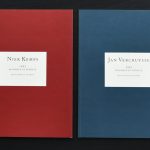
Niek Kemps has been a part of the international art scene since the eighties. The artist wants to stimulate the spectator with his conceptual work, to process images in a different way; a statement about the attention span of modern day society and the accompanying image culture. Kemps’ work is like a laboratory, wherein he does both substantial as visual research to the social and cultural context, and how this relates to image, space, contemporary art and the concept of ‘museum’.

Sculpture becomes space, space becomes museum. A museological space can take diverse appearances: whether it’s static, collapsed, moving, hidden or even virtual. In his work, the artist questions, among other things, the more traditional configuration of the museum. From the need for a funded complexity, he analyses the different connotations, and this from a philosophical and visual stand point. In doing so, Kemps researches the impact of a full virtualization of the museological existence, wherein a virtual (read: fictional) museum merely displays digital work.

Schermafbeelding 2020-09-25 om 15.34.58

Also in this imaginary constellation, the focus remains on the perception of context and space. An intertwining between fiction and reality is created. Virtual work is easily translated into a physical construction, a spaciousness, a sculpture, and vice versa. Kemps’ images never stand alone; they consistently show a sensitivity in relation to their surroundings, they interact so to speak with the space wherein they are located.

‘The narrow line between sight and seeing’, a work from 1986, is a speaking example of this. Until now, this illustrates the essence of his oeuvre. Originally it seems to be a sculpture. Yet the work is experienced as a space; a between area that questions all sorts of traditions and clichés. By continuously operating on this interface, the artist challenges the spectator to get out of their comfort zone, to explore the work, and to spend time with / in it. The artwork reveals itself only to the patient, attentive spectator. Every composition is formulated very precisely, like a poem. This form of complexity ensures that the work can never be apprehended at first glance. To fathom the different layers of meaning(s) takes time and effort. By defying fixed landmarks, meanings, perspective, and scale, every form of rational analysis is extracted or simply removed and it results in an astonishing artwork that invites to be lived and incites the spectator to reflect one self.

Posted on Leave a comment

Joost Swarte and THE ROUSERS, 1980


Schermafbeelding 2021-01-15 om 16.19.36

There has always been a warm relationship between Joost Swarte and music in general. The result album covers, cd covers and cd specials which were published over the last 40 years . One of the earliest albums  Swarte designed was the THE ROUSERS album from 1980. The band is forgotten, but the album has one of the strongest covers i remember from the Eighties. Both sides of the cover look the same but there are differences between them. The perspective and timeframe are different making this a look into a scene …just seconds apart. Everything was designed by Swarte. Cover, Lettering and album labels all Swarte design making this one of the scarcest and certainly most collectable Swarte items i remember. The album is available at www.ftn-books.com

rousers swarte a

rousers swarte b

Posted on Leave a comment

Burgoyne Diller (1906-1965)

Schermafbeelding 2020-09-22 om 09.24.27

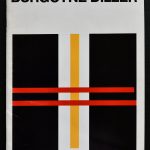
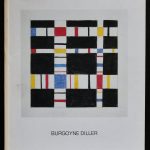
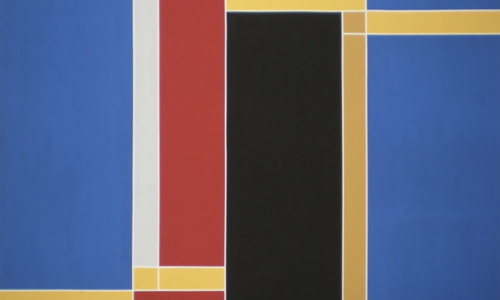
A pioneer of American modernism, Burgoyne Diller devoted his career to the exploration of geometric abstraction in paintings, drawings, collages, and sculptures.

For Diller, abstraction was the ideal realm of harmony, stability and order in which every form and spatial interval could be controlled and measured. His style began with forms of modernism, including cubism, Kandinsky’s abstraction, constructivism, and other European models.He simplified his palette to the bold colors and black and white of neoplasticism and reduced his visual vocabulary to squares and rectangles.” “Diller developed a highly personal language based on three major compositional themes. These themes, which he labeled “First,” “Second,” and “Third,” explored the picture plane in relation to forms in movement and forms in constant opposition. By 1934 Diller had likely become the earliest American exponent of Mondrian’s type of geometrical abstraction. In the early 1940s, he began creating wall-mounted wood constructions, and during the 1950s and 1960s his sculptures developed into the large-scale, free-standing, formica works for which he is well known.”

The Sullivan Goss Art Gallery notes the following about Diller’s style: “Composed predominantly of squares and rectangles and accented with primary colors against a solid white background, Diller’s mature abstract paintings are the result of his explorations of pure color and form. Diller’s austere work recalls the stinging isolation of the lives of all Americans of the Depression era, and possibly his own. However, the well-planned geometric nature of his paintings reveals his desire for a reconstructed world prevailing over the seemingly hopeless situation in the United States during the Depression

Above is the excellent text on Diller and his style of painting found on Wikipedia

www.ftn-books.com has some excellent and scarce Diller publications available

Posted on Leave a comment

VIII Bienal 65 at Sao Paulo by Jurriaan Schrofer

Schermafbeelding 2021-01-14 om 16.31.06

For many years this was the last time a dutch group of artists presented diutch art at the Sao Paulo Bienal exhibition. For several reasons the Bienal was boycotted and only in the late Eighties dutch art was presented once again at the Sao Paulo Bienal.

But the reason for this blog is not the presence of dutch art in SAo Paulo….no….. the reason is that this 1965 catalogue for the dutch pavillion was designed by Jurriaan Schrofer, who made this catalogue a very special one. The idea came from a leporello in which each fold contains a small catalogue. The artists present are for the official contribution: Co Westerik adnPeter Vos and for the special room: Melle, Carel Willink, Charles Roelofsz and Pyke Koch.

bienale schrofer a

Schrofer managed to include all these artist in a very special way in this catalogue in which all the artists received their own small book. Cover design is special too in which the title spirals away….I really am a great fan of this catalogie which is now available at www.ftn-books.com.

bienale schrofer b

bienale schrofer c


\