Posted on Leave a comment

Piet Dirkx, On four locations

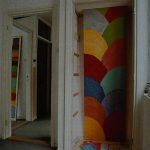
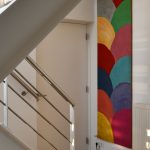
There is a work by Piet Dirkx that has been with me as long as i know it existed. I first have seen this long multi colored wax painting in Piet’s studio. Later i noticed the same work being a part of BIOTOOP and after our purchase it was one of our favorite works by Piet on our Sijzenlaan location and now, it is still “going strong” as our entrance work of art. The painting has been a part of our lives for nearly 30 years now. Long live ” MUSIQUE ORIGINALE ”

Posted on Leave a comment

Erwin Olaf (1959) exhibition at the Gemeentemuseum Den Haag

Schermafbeelding 2019-02-09 om 15.34.31

What I want to show most of all is a perfect world with a crack in it. I want to make the picture seductive enough to draw people into the narrative, and then deal the blow.

– Erwin Olaf
From the 16th of February until the 12th of May at the Gemeentemuseum Den Haag
Schermafbeelding 2019-02-09 om 15.28.48
Gemeentemuseum Den Haag and The Hague Museum of Photography are to honour one of the Netherlands’ most famous photographers, Erwin Olaf (b. 1959), with a double exhibition. Olaf, whose recent portraits of the royal family drew widespread admiration, will turn sixty this year – a good moment to stage a major retrospective. The Hague Museum of Photography will focus on Olaf’s love of his craft and his transition from analogue photojournalist to digital image-maker and storyteller. Olaf will himself bring together some twenty photographs by famous photographers of the past who have been a vital source of inspiration to him. Gemeentemuseum Den Haag will show non-commissioned work by Olaf from 2000 to his most recent series, including the work he produced in Shanghai and his most recent series Palm Springs, on display for the first time. Olaf will be showing his photography in the form of installations, in combination with film, sound and sculpture.

Posted on Leave a comment

Angelo Savelli (1911-1995)

Schermafbeelding 2018-10-10 om 12.01.51

Savelli is the Italian master of “WHITE”. Practically all works by Savelli from 1959 on are executed in White. The difference is their shape and the materials used. This makes this Italian artist almost on par with the dutch Jan Schoonhoven , who used “WHITE” too. The difference… Schoonhoven is rooted in the Zero mouvement whereas Savelli is more an abstract constructivist who uses different kind of materials and execute them in WHITE.

Savelli is not very known outside Italy, but in prepaartion of this blog i found that some of his paintings are in famous museum collections. Moma and White Chapel gallery have work in their collections and when you look into his oeuvre you notice that his art must be now in fashion. it tends to Zero and has some qualities of the arte Povera. Both mouvements in art that now are in “Fashion” and are collected worldwide.

Perhaps the next 2 decades Savelli will be discovered by many and become a household name like Jan Schoonhoven’s name has become nowadays. www.ftn-books.com has Savelli publications available.

OLYMPUS DIGITAL CAMERA


Posted on 1 Comment

Giovanni Nicolai (continued)


giovanni a

Not just an ordinary painting, but this time a very special painting by Giovanni Nicolai. Giovanni sent me this beautiful painting of an Italian gentleman. In bright greens and red colors . A classic composition , but when studied from up close there is an abstraction in the painting that is very appealing. Giovanni Nicolai is a typical italian artist with his roots in classic painting. It will be interesting to follow his career. If you are interested in his paintings and drawings , know that i have some drawing for sale at www.ftn-blog.com and that for other works you can approach him at : giovinicolai@hotmail.com

giovanni card

Posted on Leave a comment

Robert Ryman (1930-2019)

Schermafbeelding 2019-02-12 om 09.09.44

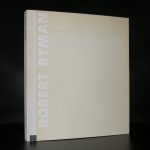
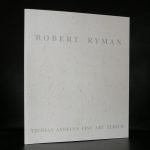
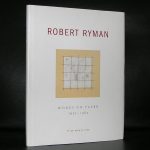
One of the greats in Abstract Modern Painting died at the age of 88 on the 8th of February 2019. White was his “color” and he painted on every material with his “white”. Impressed by the Rothko paintings at the Metropolitan Museum of Art where he was working as a museum guard, he started to paint himself and finding in the process the strength of “white” when used as the only color in his paintings. This approach made him famous within a period of 5 years. After these initial years he had had his first gallery exhibitions and soon after his his first major exhibition at the Guggenheim museum. Rymans paintings are highly recognizable abstract paintings and can be seen as the link between abstract expressionism and minimalism ( btw. Sol LeWitt also started his career as a museum guard). We are lucky to have al large collection of his paintings iin the Netherlands since the Stedelijk Museum started collecting his paintings from the very first years of his career. The result an impressive 11 paintings from all periods of his artistic life. Robert Ryman publications are available at www.ftn-books.com

Posted on Leave a comment

Ellsworth Kelly (1923-2015) and galerie Maeght

Schermafbeelding 2019-01-01 om 12.10.33

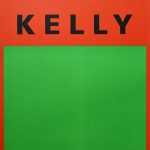
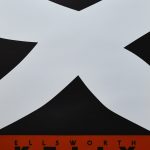
Two iconic names in Modern Art have a long time history together. galerie MAeght must have been among the first to show works by Kelly. This contact resulted innumeral exhibitions at the the galerie Maeght. Paintings , lithographs , etchings, drawings…..every aspect of Kelly his art life have been presented at the Maeght galleries.

Ellsworth Kelly has been a widely influential force in the post-war art world. He first rose to critical acclaim in the 1950s with his bright, multi-paneled and largely monochromatic canvases. Maintaining a persistent focus on the dynamic relationships between shape, form and color, Kelly was one of the first artists to create irregularly shaped canvases. His subsequent layered reliefs, flat sculptures, and line drawings further challenged viewers’ conceptions of space. While not adhering to any one artistic movement, Kelly vitally influenced the development of MinimalismHard-edge paintingColor Field, and Pop Art. The Maeght galleries have contributed to his fame with many breathtaken exhibitions. The best is they still publish the exhibition posters which were published for these exhibitions and these posters/lithographed prints are availabble at www.ftn-books.com. Printed by Arte Paris make these the best available Kelly objects possible

Posted on Leave a comment

Holland in Vorm 1987

I remember it well. It was the first time i met with Jan van Capellen, the responsible person who had the same  function at the Boymans van Beuningen Museum as i had with the Gemeentemuseum at that time and we carried box after box with one of the heaviest catalogues ever produced by the combined (important) dutch museums. Within the project the Stedelijk Museum, Haags Gemeentemuseum, Arnhem Gemeentemuseum, Museum Boymans van Beuningen and Centraal Museum Utrecht all participated and all had a different approach and subject on dutch design. The overall design of posters and catalogues was executed by Anthon Beeke and Swip Stolk. Unfortunately the catalogue was at that time not the success the museums had hoped it would be , but now…. over 30 years later, it is a sought after collectable catalogue. One that inspires and was at the start of the dutch design mouvement which is now collected all over the world. Catalogue and exhibition posters are available at www.ftn-books.com

Posted on Leave a comment

Isabella Rozendaal (1987)

Schermafbeelding 2019-02-08 om 13.02.51

A young dutch photographer, who deserves her exhibition at the Fotomuseum Den Haag is Isabella Rozendaal. She has gathered fame with her animal projects, but her other subjects result in excellent photographs too. The Fotomuseum Den Haag shows a selection of her best photographs from the 9th of feb 2019- 12th of May 2019

Schermafbeelding 2019-02-08 om 13.02.16

An important exhibition at the Fotomuseum which can be combined with the Erwin Olaf exhibition at the same location orgqanized by the Gemeentemuseum Den Haag.

www.ftn-books.com has the completely sold out publication “on loving animals” available.rozendaal


Posted on Leave a comment

Piet Dirkx…van Abbemuseum , 1985( continued)

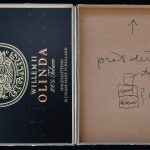
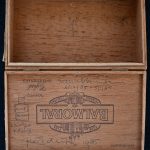
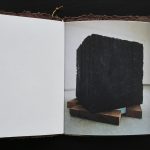
This week i am making up for an incomplete blog . I just noticed that to make the story on last weeks blog complete i had to add the photographs of the inner sides of both objects which were on show in the Piet Dirkx exhibition at the van Abbemuseum in 1985. Pier had indicated on the inside of both boxes in what way both had to be combined and showed. So to make the story complete here are both insides.

Posted on Leave a comment

Isamu Noguchi (1904-1988)

Schermafbeelding 2018-12-30 om 16.27.09

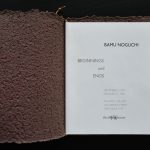
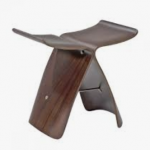
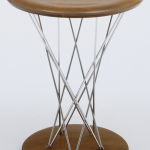
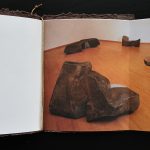
One of the greatest sculptors from last century for me is Isamu Noguchi. The reason is simple i have been living for half of my life with designs of Noguchi around me. I have sold lamps and stools by the artist and in our own home a stool is ever present in our interior. The sculptures are different . In many cases executed on a scale to large to place inside and nowadays far too expensive for almost all. But sometimes you can exprience the quality of Noguchi as a sculptor in a simple publication. This is the case with the Pace Wildenstein publications which has al the qualities you are looking for in a Noguchi work. enjoy the photo’s. Publication is available at www.ftn-books.com

noguchi pace a

Here is the text on the artist from THE ART STORY

Isamu Noguchi, a major American and Japanese sculptor and designer, spent over six decades creating abstract works – largely in stone – based on both organic and geometric forms. Greatly inspired by traditional Japanese art, as well as by the biomorphic style of some Surrealist art, Noguchi became internationally known both for his artwork and his publicly accessible furniture and architecture. His ultimate objective, to create and enhance public spaces through sculpture, provided his career with a distinct direction and established him as a critical figure in the worlds of post-war art, architecture and design.

The overarching concept informing Noguchi’s work was his passionate, career-long desire to create art the public could use in a social space. He realized this goal in myriad ways: mass produced furniture and lamps; theatrical set designs; public projects such as gardens, playgrounds and fountains; and sculptural manipulations of the natural landscape.
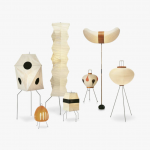
Noguchi wanted to call attention to the dichotomies inherent in much of his work: he merged geometric and organic forms, found value in both positive and negative space, and created works that challenged the boundaries of design and art. He also integrated the materials and art forms of both his Japanese and American heritages into his innovative creations.
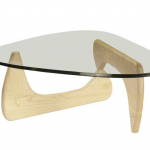
Noguchi was socially and artistically connected to Abstract Expressionism, as evident not only in his large-scale works evoking abstracted forms but also in his friendships with Arshile Gorky and Willem de Kooning. Yet, his sculpture retained a distinct sensibility in its use of natural materials and its distinct blend of Surrealist and Japanese influence.