„One would be tempted to believe that this structure used to have some convenient form, and now it was only broken. This does not seem to be the case; at least there is no indication; nowhere are approaches or fractures to be seen that would point to such a thing; The whole thing seems pointless, but completed in its kind. Incidentally, nothing more can be said about it, since Odradek is extremely flexible and can not be caught. „- From: Franz Kafka, The Care of the House Father
Extremely agile and unstoppable – that‘s also what Paul Schwer and his art say. The objects (an auxiliary term for quite different things) that Schwer produces do not move themselves, but almost systematically dispense with the usual names and categories with which works of art are classed in terms of genre, media or style.
How consistently Paul Schwer places his work between the chairs of conventional art forms, the various attempts make it clear that they capture it in an orderly manner. In the Wikipedia article he is called installation artist. On the website of the Goch Museum, he is considered one of the most famous German sculptors. And the radio contribution by Thomas Frank, which was broadcast to the exhibitions in Ratingen and Goch, sees the aspect of extended painting as central, thus ultimately following the artist himself. Somewhat surprisingly, he then places Paul Schwer in the art-historical tradition of stained glass. The fact that each interpreter sees a different artist, depending on the perspective, could be due to a very divergent design vocabulary within the work. Even well-known artistic oeuvres do not offer a uniform picture. Suppose someone is not familiar with Pablo Picasso‘s work and enters a solo exhibition of this painter who has become the cliché of the modern artist. If he then sees works from the blue and pink period, then the cubist, the classicist and the later phases, he is likely to expect to attend a group exhibition.
That would hardly be suspected in an exhibition by Paul Schwer despite the diversity of media and materials. Plexiglass and polyethylene terephthalate (PET9, wood or fluorescent tubes are repeatedly used materials that, in addition to a clear color, a game with transparency and semi-transparency and a play of surface shapes and complex volumes,a clear, consistent „handwriting“.
At the same time, however, seemingly contradictory things are always connected with each other. Both the individual object as well as an overall arrangement in an exhibition or in an outdoor space (often Paul Schwers works outdoors) often suggest a lability and fragility, a situation that would immediately get out of hand with a small change in the heavyweight.
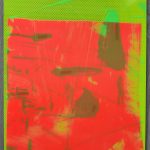
Not just a house is upside down, on the edge of the roof (which we will come to). The relationship between two- and three-dimensionality always stands in the balance. The „painterly“ application of color does not take place on a flat surface. The most common image carrier is a transparent, heated PET fluid (or Plexiglas) that has been thrown in a fluid state and re-hardened. Thus, the „image ground“ becomes a plastic, free-standing object or lying on the ground object. The latter is reminiscent of the irregular outline of a crumpled paper, as if a picture or a drawing were discarded and thrown away, which also applies to the various red forms in the exhibition in Goch.
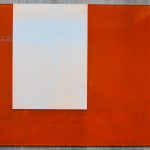
Thus, each image is simultaneously a sculpture, with sculptural elements, so to speak on the other side, also tending to be architectural elements in space. The prototype for this are the natural-brown or green lattices, which are made of roof battens and based on the outline of two pillars in the room, which reach below the ceiling in Goch and divide one of the two exhibition rooms, divided into different directions, into compartments. However, these rooms in the room are not completed; The grids are not fixed walls, but largely open to the view. The different sawed out sections correspond exactly to the dimensions of the door and window openings of the room. Other elements that also have an optical outline function are colored rectangular discs made of corrugated polyester, which hang pictures on the construction like single panels – not all at the usual eye level, but their size and position is also derived from the architectural conditions of the room.
The reference to the conditions of space based on strictly geometrical forms and dimensions could almost be read as a continuation of the tradition of Minimal Art. But one may also be reminded of the Cabinet of Abstracts, which El Lissitzky set up between 1926 and 1928 in the Sprengel Museum Hannover and which since 2017 has been accessible there as a reconstruction. Lissitzky designed a kind of Gesamtkunstwerk for the presentation of works by other artists as well, based on a clear constructivist vocabulary of forms. However, Paul Schwer also incorporates in his „Gesamtkunstwerk“ other elements that would be unthinkable to Lissitzky or strict minimalists. Thus, several red PET objects form a radical contrast to the geometric reduction. Complex wrinkled and folded forms can not be grasped at a glance, suggesting a baroque overabundance, an impression of the random and the chaotic. A staging of the exhibition space based on such strong formal counterparts may seem like an attempt to bring things right back to their original level after an explosion or other destruction.
The corrugated iron hut, which stands diagonally upside down in the other showroom, could also have been torn away by a flood. It does not seem habitable anymore, even when light is on. Inside, there is an accumulation of fluorescent tubes, the cables of which hang down at the bottom, reminiscent of a torrent of water.
„Model“ for this architectural sculpture is a corrugated iron hut that Paul Schwer has seen far away from human settlements in Iceland. Travel memories often form associative starting points for his spatial stagings. The second room was inspired by the facade of a vegetable shop in Istanbul, where the artist had a scholarship in 2015.
However, such references and narrative references never become clear; mental impressions, like physical materials, enter into the composition of an „installation“. After all, is Paul Schwer ultimately an „installation artist“ who combines various individual elements into a spatial entity? Or does he create three-dimensional images that extend concepts of painting into space? Even though Paul Schwer himself, as already mentioned, tends towards the latter „categorization“, in the end it is up to us how we classify our mode of experience conceptually. The emotional impact can also vary depending on the observer. Thus, the strong color and the physical force of the sculptural forms combined with the often surprising light effects of the fluorescent tubes can trigger a feeling of expressive affection. If you look more closely at the constructive components, you will discover in Paul Schwer‘s work a seemingly contradictory, almost hermetic feature, in which the elements, as on different levels of presentation, almost seem to interlock with one another like a Russian doll.
Furthermore, one could ask how Paul Schwer‘s art of spatial presentation could be classified in the context of contemporary installation art. If we follow Claire Bishop‘s 2005 installmentage „Criitical History“ in the Tate Modern Press, different forms of installation are distinguished not by their spatial presentation, but by the way they are viewed („viewer“) that are, are mentally and physically involved. Dream scene, heightened perception, Mimetic engulfment and Activated Spectatorship are the guidelines here, which are also based on different subject theories. The recipient subject is involved, but also decentred: psychoanalytically, phenomenologically, libidinally or in the sense of a post-structuralist political subject.
The receiving subject is called upon to actively explore the spatial staging. But this is no selfassured subject with a sovereign command of a unitary space as in Renaissance perspective but one that is decentred in the sense of poststructuralist theories. There is no sovereign viewer’s standpoint from where the entire spatial installation can be grasped in one sweep. This is a central characteristic of Paul Schwer’s spatial stagings, aligning them with the procedures of many wellknown installation artists like Allan Kapow, Lucas Samaras, Paul Thek, Ilya Kabakov, and Gregor Schneider.
However, the combination of different, seemingly incongruent things in stagelike spatial ensembles also calls to mind the psychoanalytically inspired combinatorics of the Surrealists. And perhaps the individual elements brought together by Paul Schwer take on a »sense« only if read as Freud read dreams: as picture puzzles whose deeper meaning does not lie in what is to be seen in the images.