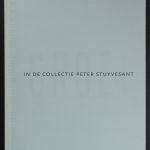
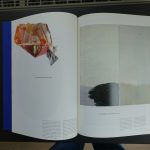
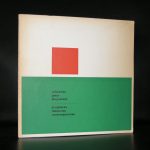
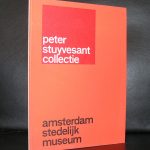
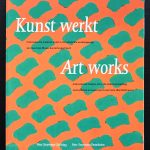
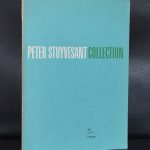
Readers of this blog know of my admiration for Gerard Verdijk and did not hesitate a single secoond when in 2011 a very large painting by Verdijk was put up for auction and did not receive its first bid. It appeared to be the winning bid and since the moment this painting entered our home it has been on display in our living room. The painting was part of the Peter Stuyvesant collection but a decade ago the staff of the Turmac Tobacco company and the founders of the Stuyvesant foundation decided to sell their collection. This collection is very well documented and from its earliest of beginnings the best dutch designers made the catalogues which documented their additions. I knew almost for certain that our paintings was in one of these publications but i never found the right one, but…..i now have it and i am very pleased that our painting is prominently present in a beautiful large catalogue, designed by Anton Beeke …and the title of it is “GROOT” in de collectie Peter Stuyvesant.
Published in 1997, the new additions were curated by the former director of the Stedelijk Museum, Wim Beeren.( see photo above this blog) An interesting final addition which almost completes all Peter Stuyvesant publications. This one is not for sale but there are others which are available at www.ftn-books.com.
It was a long time on my wish list and ia finally could fullfill this wish. Since i met Floor van Keulen at the Haags Gemeentemuseum where he painted the “Project room” at the Haags Gemeentemuseum in 1989.
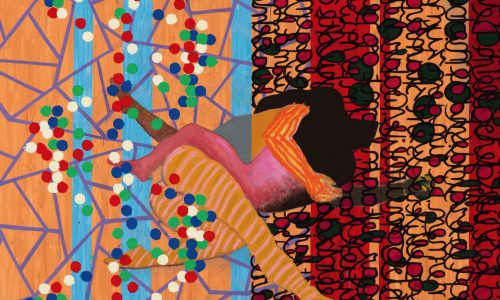
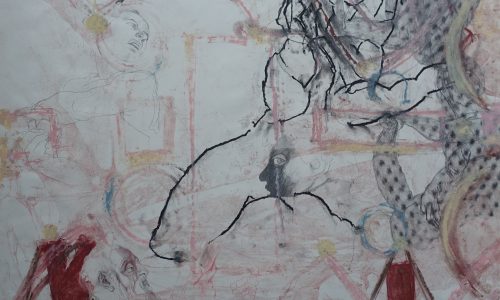
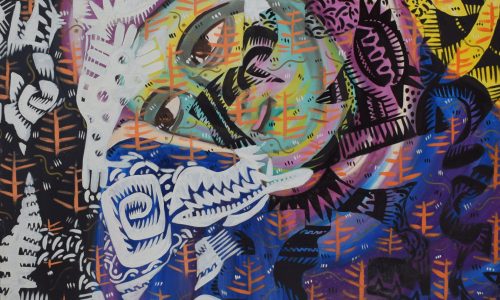
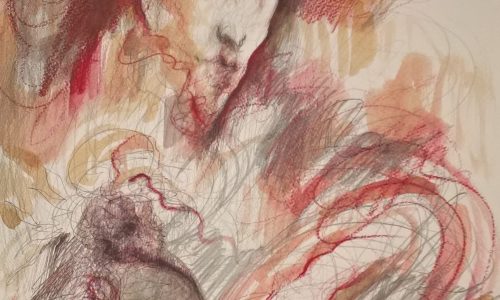
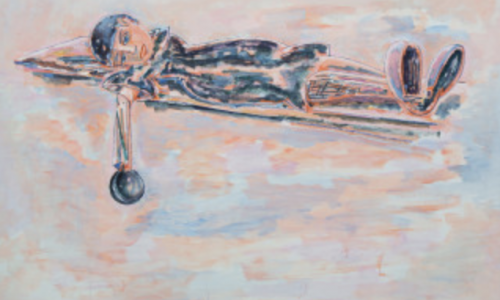
His wall drawings are extremely large narratives. You can discover human figuren, weapons, books and landscapes all within the same wall painting/drawing. Connected with eachother by more figures and objects, resulting in an almost abstract painting, but with so many details that are realistic. His stand alone paintings are scarce. Most of the time lare/extremely large and where his small drawings are just sketches and exercises for the large wall drawings. His paintings on paper are true paintings. Where his wall drawings are most of the time removed or painted over. His large “paintings” are permanent and one of these , from 1987 , i now have added to the FTN art collection.
The following text was found on the Piet Heen eek site and shows a different approach to his art.
Human figures and cartoons are the only motifs in the repertoire of drawings created by Floor van Keulen since 1980. They appear to be randomly spread across the surface, components of a well-balanced composition without any specific meaning. Shapes effortlessly melt into one another, debate with each other; emotions occasionally flare up, only to harmoniously merge together afterwards.
Floor van Keulen appears to shirk from the formal experiment, the abstract art experiment, in which realistic and figurative art that set the tone for hundreds of years is brushed aside as a truly relevant form. Van Keulen does not allow himself to be drawn into movements or trends within contemporary art. He has developed his own unique vision and confrontational visual language in which figurative depictions are interwoven with abstract shapes.
His art originates in his imagination and reality. He uses the ‘vocabulary’ he has put together through the years to formulate a vision of the world around him. The viewer encounters the virtuosity of the image and gets carried away in the painter’s exuberant gesture. On closer analysis of what it is exactly that affects the viewer so strongly, he or she first focuses on the pattern and motifs, attempting to decipher the artist’s story by interpreting the figurative elements. Only later does he or she discover that it is the work as a whole that is key here, the total emotion, not the details, form and contra-form. At first glance, the work appears to be expressive, but on closer inspection, clearly has a more subdued character and is carefully balanced and considered.
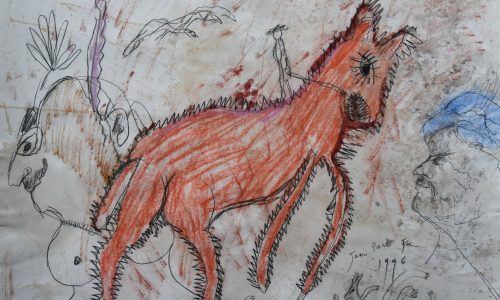
In 2004 the Gemeentemuseum Den Haag received a donation from Gerard Petrus Fieret, containing over 1000 photographs, drawings and other collectable items. This gift grew the collected Fieret works in the collection of the museum considerably making it the largest Fieret collection in the world. To remember the donation and to please the artist the artist was invited to make a live exhibition in which he made his drawings in one of the rooms of the museum and decorated the walls with these drawing. If i remember well , Fieret entered the museum for some five weeks, greeting the doorman in a very grumpy way ( yes he was a grumpy old man at that time~), walked the museum hall , entered the designated room and started to draw. Drawing after drawing came out of hands and the publicity department decided to use the event to anounce an exhibition of this huge gift by the artist. They selected 81 drawings from the already considerable pile of drawings and bundled these into a specially made poster and send these out to the press ( all in house made) to announce the Fieret exhibition. Only a few dozen of these press kits were made, making this one of the most desirable and collectable Fieret items. The press kit is now for sale at www.ftn-books.com
I understand completely that artist draw inspiration from other artists their works, but in the case of this “Fait d’hiver ” it is far too much a copy than an original work by Koons. I know of the spectacular Banality series sculpture from the Stedelijk Museum and i think it was a rightful choice to acquire this for a large sum., but i did not know the sculpture from the Centre Pompidou and its history. Here is the storuy which i found on “art-critique”
A Paris court of appeals has upheld a 2018 ruling regarding a 2015 copyright infringement lawsuit brought on by photographer Franck Davidovici. With the Tuesday decision, the Centre Pompidou and artist Jeff Koons have been found guilty of copyright infringement and now jointly owe Davidovici €190,000 (£163,900).
The lawsuit hinges on a 1988 sculpture by Koons called Fait d’hiver depicts the bust of a woman lying on the ground as a pig, wearing a flowered collar with a barrel, and two penguins look on. The amusing sculpture was part of “Banality,” a series by Koons that debuted in 1988. The series raised eyebrows at the time but many of its works would go on to be featured in a 2014 retrospective of Koons’ works that kicked off at the Whitney in New York before traveling to the Centre Pompidou and then the Guggenheim Bilbao.
“Fait d’Hiver” by US artist Jeff Koons at Christie’s auction house is seen before going on sale for an estimated 4-6 million USD in New York 12 November 2007. Christie’s will hold its bi-annual Post War and Contemporary Art Sale 13 November. AFP PHOTO/Emmanuel DUNAND / AFP PHOTO / EMMANUEL DUNAND
Meant to be commentary on the imagery of mass media, Fait d’hiver became the centre of the dispute after Davidovici saw Koons’ sculpture in a catalogue for the Centre Pompidou’s exhibition of the 2014 retrospective. The issue was that Davidovici found the sculpture to be incredibly similar to a photograph taken and published by the photographer in 1985.
Davidovici’s black and white photograph was created for the French brand Naf Naf and included a woman, wearing a jacket with fur accents, lying on the ground. A pig, wearing a collar with a barrel gazes at the woman with the words “FAIT D’HIVER” in the top left corner of the two-page spread.
“Fait d’hiver” (1985) by Franck Davidovici for Naf Naf.
While Koons made a few alterations, like the addition of two penguins and swapping the fur jacket for a mesh top, the sculpture does seem to mimic the photo taken by Davidovici just a few years earlier.
Davidovici first sued Koons and the Parisian museum in 2015 and in 2018, a judge ruled that the artist and museum violated copyright laws and owed Davidovici €135,000. However, the artist and museum appealed the ruling which has now been upheld and their monetary penalty was increased by €55,000. Additionally, if the museum or Koons continue to exhibit Fait d’hiver online, they will be fined €600 per day. Meanwhile, the publishers of the 2014 catalogue that accompanied the retrospective now owes Davidovici €14,000 as well.
In 2007, an artist’s proof of Koons’ Fait d’hiver sold at Christie’s for just under $4.3 million (£3 million).
Koons is no stranger for being taken to court for plagiarism. In 2019, a Paris court upheld a 2017 ruling that found the artist, and again the Centre Pompidou, guilty of copyright infringement. That case concerned Koons’ sculpture from the same series called Naked and a photograph titled Enfants by French photographer Jean-François Bauret. While the sculpture was not shown in the 2014 retrospective, images of it were used to advertise the show. The artist and museum were ordered to pay €20,000 to Bauret’s family. Koons also paid the family an addition €4,000 for use of the image.
I thoughtn I had lost the book….. but a few weeks ago it surfaced agian after rearranging all my titles and putting them back in order again…….and there it was, a small book i bought when we visited Mallorca and the Fundacio Joan Miro on the island.
I remember buying 2 of these books, because i was impressed by the works of this artist…James Lambourne. It has the quality of Richard Long his stone circles, but instead of a horizontal object these were vertical like paintings.
Observing nature is the basis of James Lambourne’s artistic creation, building an iconography and a personal language that connects us to the shapes, colours and elements of his surroundings. This is how the art critic lookos at his works, but what struck me personally was the bond i felt the artist had with nature, making for me personally these works being attractive. This smust have been teh reason to buy 2 copies of the book of whcih one is now available at www.ftn-books.com
Blog readers know of the large collection i have for sale on the Stedelijk Museum, its artists and its exhibitions ( www.ftn-books.com), but it is hard to grow this collection . No book markets, no museum visits and the only thing i could do is to photograph and describe my stock and add this to my inventory. It has now grown over by 1100 entries and i am convinced it is one of the largest collections for sale on the Stedelijk Museum and itss history. But to bridge the time between closure and reopening its collections to visitors, they made available some interesting virtual visits to the museum and its collections. Guided by curators and director Rein Wolfs , you can now make a virtual visit. One of the best i think is the one Rein Wolfs hosts. It shows the direction into which the Stedelijk is developing for the next decade or so. Interesting…. yes…., but i do hope they still will keep their focus on their history and great collection, they build over the years.
I was trying to find some information on the Belgian artist Dirk Vander Eecken when i stumbled upon a painting by this artist. The work was sold nearby at auction. SO there i was at the viewing day…..It was there high up in the shade and badly presented to the public, but i decided to take the gamble and made a bid and won.
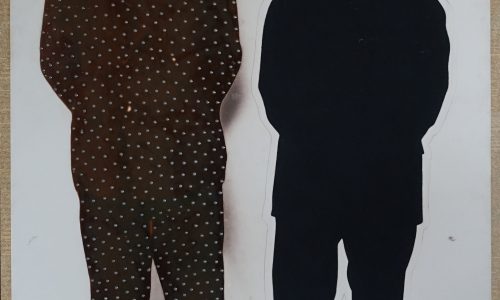
Now i have it in my sudy. It is there, proudly standing against one of my bookcases and i am getting more and more impressed by its qualities. It is a combinbation of painted papers, prints and tissues worked into two sides which appear to have no relation which each other accept……. study it closely and you will see that in the background of the right part a part of the composition of the left part is still visible. The right part has been overprinted/painted with some wooden/organic/vegetal parts making the painting much more complex and appealing. This painting is now for sale at www.ftn-blog.com ( ftn art).
It measuers 200 x 100 cm. signed by Vander Eecken and its condition is still excellent. For a viewing appointment please contatc me at ftnbooksandart@gmail.com. Vander Eecken has had exhibitions all over Europe and his works are present in the collection of the SMAK, Mhka and many more.
One of the most iconic sets is the catalogue and poster for the 1965 Raysse exhibition. Pure french Pop Art whith a poster that shows the neon elements for which aysse became famous. Both poster and book belong to the best Crouwel has designed in the Sixties for the Stedelijk …..
OLYMPUS DIGITAL CAMERA
and this time they have many design elements in common.
Most art lovers abroad do not know that within a distance of 10km of the Boymans van Beuningen Museum in Rotterdam, another great museum can be found. The museum itself much …much smaller…. but for its collection it deserves to be mentioned beside the Boymans. the STEDELIJK MUSEUM SCHIEDAM has had its collecting focus during the last 30 years on Cobra and The INFORMELEN and Zero art and build a collection which must be visited.
Situated in an old building in the center of Schiedam it is now being renovated to present its Cobra collection in the best way possible. So make a mental note when you are visiting Rotterdam. Take the tram to Schiedam and visit its collection when it opens again after the renovation. The following Stedelijk Museum Schiedam books are available at www.ftn-books.com
The first time i encountered works by Alain Clément was in Germany when i visited the Ludwig collection and never stopped loving his works since. Form, colors, shapes it all results for me in a state of happiness.
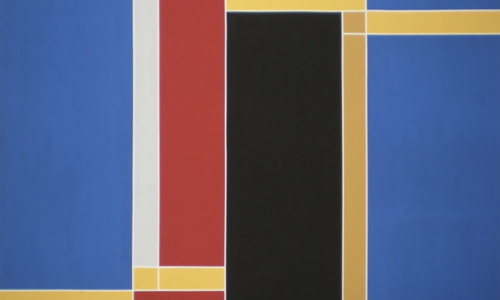
Alain Clément (74), a former professor and director of the École des Beaux Arts in Nîmes, seeks to unify light and color into an indissoluble entity in his paintings. The horizontal streams of color are often traversed by diagonal streams, and the vertically-running ones often collide with the culmination of the pictorial reality at the surface edges. No sooner do you comprehend one thread of the artistically interwoven color than does it withdraw and you begin to pursue the next.
Alain Clément described his art as follows: “My lines became more fluid, the forms more mobile; I was able to disengage the body from my painting and create a dance, a dance that no longer depicts the bodies of the dancers but the movement of the line, which I express in a constant back and forth between painting and sculpture.”
On occasion the forms are severe, at other times a labyrinthine entanglement of brushstrokes. Or they are of equally nimble and light cut and painted strips—of steel. The figurative may have defined the early work of the artist, but after five decades of seeing, learning and experience, he arrived at abstraction: a superb pas de deux of color and form. And everything that occurs to the radiance on and behind these pictorial spheres emerges from Alain Clément’s unbridled love of life, art, and the inexhaustible wealth of art history; in which, as he once said, Gauguin has influenced—”almost physically energized”—him.
www.ftn-books.com has two beautiful Clement publications available
Artist/ Author: Oliver Boberg
Title : Memorial
Publisher: Oliver Boberg
Measurements: Frame measures 51 x 42 cm. original C print is 35 x 25 cm.
Condition: mint
signed by Oliver Boberg in pen and numbered 14/20 from an edition of 20