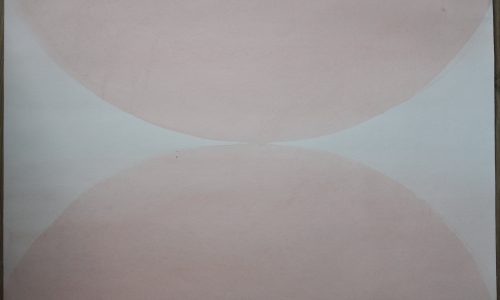
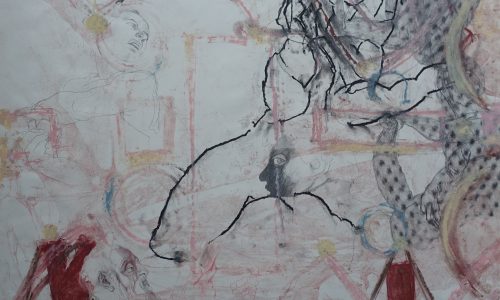
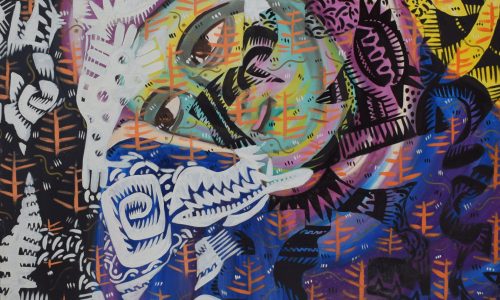
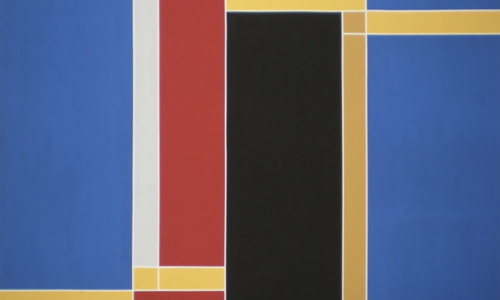
Roger Bissiere held an exhibition in 1958 at the Stedelijk Museum. Catalogue and poster were designed by Willem Sandberg. In 1966 it was again time for Bissiere to show his latest works. This time Wim Crouwel designed both catalogue and poster. With the poster he was inspired by the one Sandberg had designed before. The poster is almost classic Sandberg in its approach. Colors, graphic design. red lettering all strongly influenced by Sandberg. But the catalogue!…there it was ….a typical Crouwel design…., size, binding, colors every aspect oozes Crouwel. Here are both and both are available at www.ftn-books.com.
From the same source as the Crouwel posters of yesterdays blog comes this series of posters for the ZONNEHOF AMERSFOORT museum. Later this would become the Armando museum, but in the Sixties and Seventies they had their own small program of exhibitions. Well worth visiting and it is interesting to see that also a smaller dutch museum thought it important that design and typography of their publications was important. The main part of these series was designed by van den Brink. All are now available at www.ftn-books.com
Followers of the blog will know of my admiration for Wim Crouwel, but what most people do not know is that Crouwel designed in the late Sixties and early Seventies for two other Amsterdam museums. Beside the Stedelijk Museum he made poster and publication designs for the AMSTERDAMS HISTORISCH MUSEUM and MUSEUM WILLET-HOLTHUYSEN. As for the posters….. FTN-books acquired a smalll collection of these pposters which is now for sale at www.ftn-books. Here are some pictures of the 12 posters now available.
A few years ago i wrote a blog on Micha Klein. Klein is slightly younger than Erwin Olaf , but has a carrer which resembles the career of Erwin Olaf. Both are embraced by interior decorators all over the world for their large blown up photographs, but where Olaf creates an atmosphere of classic “SIXTIES” scenes and dark historic scenes, Klein is much more “light” in his compositions.
Futuristic, colorful and modern scenes are his trademark. A few months ago i found another copy of the Micha Klein / Groninger Museum catalogue and put it up for sale, but months later an even far more scarce item was added to the Micha Klein inventory. It is the Micha Klein exhibition poster. Design by Swip Stolk and of a rare quality. The poster is MINT and is perfect for framing. A glossy poster which resembles the original photograph and now available at www.ftn books.com.
Trained at the Accademia di Brera and as an architect, Turin-based Ezio Gribaudo brings to his visionary art a distinctive sense of chromatic precision and historical determination that derive from his work as a painter, sculptor, and graphic artist. His award-winning production has been recognized with various international prizes, among which the IX Rome Quadriennale in 1965, the XXXIII Venice Biennale Prize (for graphic arts) in 1966, and the São Paulo Biennale in 1967.
Gribaudo’s prolific production and diversified activities have given him a highly significant presence in contemporary Italian art. He worked with Francis Bacon, Giorgio de Chirico, Willem De Kooning, Marcel Duchamp, Peggy Guggenheim, Joan Miró, Henry Moore, the CoBrA Group with Pierre Alechinsky, Karel Appel, Jean-Michel Atlan, and Asger Jorn, to mention a few artists and personalities with whom he crossed paths. Through his committed activity as an art publisher, he mentored and promoted many of the most relevant figures in modern art since the 1950s.
His experimentations with materials and print bring to light archeological remnants in the context of intense chromatic studies. A specific line of his work is called logogrifi (a term of Greek origins evoking fishnets and objects that are caught in a specific moment in time). They can be understood as a verbal commentary that incorporates ancient texts, maps, and artifacts within the painting’s visual space. These works are based on the engraving of white surfaces, resulting in dazzling white on white compositions that frame memories of daily objects in visual renderings reminiscent of Duchamp’s readymades. Giorgio de Chirico pointed out that Gribaudo’s work has elevated the use of white to a whole new conceptual level.
Gribaudo has also perfected the use of paper as a philosophical concept whereby incisions and collages map the archeology of human and animal experience. His use of a manual press renews the function of an old and noble instrument, now incorporated with craft and ability in the artist’s daily practice.
While Ezio Gribaudo keeps an inspired routine as a working artist, his daughter Paola Gribaudo is an active player in managing his presence and visibility in the international art markets and museums.
Another galleria del Cavallino artist was Howard Wood. A lesser known name but a great expressionist for those looking for authentic work that is typical for the end Fifties. Wood worked a little like Jackson Pollock. The result……. dripping paint on canvasses in a spontanious way, but much more colorful.
This is agian another artist to follow in the coming decade. When paintings become for sale and you like what you seee of this artist? …. do not hesitate and buy this art of Howard Wood.
Another sculptor i had not heard of before is Carlo Ramous. Ramous has a Calder like quality and this shows the best in his steel sculptures.
Carlo Ramous was born in Milan in 1926. Sculptor and Painter, he studied at Accademia delle Belle Arti di Brera (Brera Academy of Fine Arts) with Marino Marini. In 1946 he exhibited his first works. In 1951 he won the Diomira Award, the Mattioli Award and the Oggioni Award of Brera Academy; in 1954 he was present at Triennale di Milano; in 1955 he was present at Quadriennale di Roma and he won the Brusadelli Award. In 1956 he worked on building the façade of Santa Marcellina Church in Milan. Since then, his name has been present at least 300 times worldwide in one man shows and in international exhibitions: in Biennale di Venezia in 1958, 1962, 1972; in Biennale of S. Paolo of Brazil in 1961; in Quadriennale di Roma in 1955, 1959, 1973; and then in Paris, Tokio, Rome, London, Oslo, Milan, New York, Antwerp, Alexandria, Teheran, Mexico City, Budapest, Aquila, Zurich, Colonia, Nuremberg, Berlin, Sidney, Den Haag, Copenhagen, Lisbon, Dusseldorf, Los Angeles, Lagos, etc… It is since the beginning of the 60’ that the most discerning Italian and International Critics recognize Ramous as one of the most original and coherent sculptors of the first generation succeeded after 1945. The willingness and the ability of the sculptor to confront shape and space make every sculpture, even if motionless, beating life in the imaginative dimension. After the early 60’, Ramous’ sculptures change: although remaining still “massive”, they acquire new style, sharp edges and a drive to verticality that can transmit tension and emotions. His work has been evaluated by the most attentive critics, Trier, Dorfles, Russoli, Gassiot-Talabot, Valsecchi, Elgar, Caramel, Ashbery, Ballo, Leveque, Carandente, Alvard, De Micheli, Welcher, Crispolti, Coulan, Natali, Guardoni, Bettolini are only few of them. Besides the countless collective and group expositions, he created numerous architectural works, among which: Santa Marcellina Church in Milan, Don Bosco Church in Milan, Cino Del Duca Imprimerie in Blois (France), the big sculpture in Conciliazione Plaza in Milan, the sculpture in front of the school in Viale Marche in Milan, the monument to the Patriots of the Island in Milan, many sculptures for the schools in Italy and for Hospitals in Pordenone and Como (Italy), the monument to the deceased for the freedom in Miani plaza in Milan, the big sculpture in Chuo Park Chiba City in Japan.
Carlo Ramous died on 16 november 2003, in Milan.
Since November 2, 2006 he’s been included among the meritorious to the memorial chapel at the Monumental Cemetery in Milan.
www.ftn-books.com has the galleria del Cavallino , 1961 pubication available.
Jürgen Klaukeis a German artist. Beginning in the 1960s, he used his own body as a subject of his photographs. He also experimented with minimalism and surrealism. The ZKM in Karlsruhe exhibits his work. Since 1968 he lives and works in Cologne.
Klauke was born in Kliding near Cochem, about 70 kilometers southwest of Koblenz, in what became the postwar West German state of Rhineland-Palatinate. He studied graphic arts at the Kölner Werkschulen from 1964 to 1970; toward the end of his studies he began focusing on photography as a medium of artistic expression.
From 1994 to 2008 Klauke was professor of photography at the Kunsthochschule für Medien (Academy of Media Arts), in Cologne.
In January–February 2016 Klauke had his first solo gallery exhibition in New York City; the show, Jürgen Klauke, Transformer: Photoworks from the 1970s, at Koenig & Clinton, included photographic series completed between 1970 and 1976, primarily featuring costumed and androgynous images of the artist.
It was hard for me to find some information, because i have some titles available by the artist, but i never have actually seen his works. In all those years of following art and artists , i could not remember to have seen anything by Klauke. This itself makes it special have found and selected the Klauke books for my inventory. I kept them and now i am offering these books on www.ftn-books.com
Another few weeks and the new depot for the Boymans van Beuningen collection will be open for the public. Now are the weeks of moving and placing the many objects from the collection of the Boymans van Beuningen museum and an openingof the new building is foreseen on the 25th of September next. This building promisses to be something very special and i predict it will have the same appeal as the Guggernheim Museum in Bilbao. Inside , outside and the direct surroundings are all functional for visitors and citizens of Rotterdam alike. It will be an iconic building for Rotterrdam and the Netherlands and i can not wait to visist the building and see its collections by myself. To follow the progress of the opening of the building follow this site; https://www.boijmans.nl/depot
and for all historical publications visit my site at www.ftn-books.com
Normally galerie Sothmann has the perfect “gallery eye” for new and upcoming artists. They were one of the first to recognize the importance of Jessurun de Mesquita, who taught Maurits Cornelis Escher the “trciks of the trade”.
With Sam Kaner they hit a miss. After raving reviews for the Kaner exhibition at the Guggenheim Palazza DEI LEONI in Venice they presented the works by Kaner in their Amsterdam gallery and sold, according to my information, none of the works within the exhibition from 1963.
What rests is this colorful exhibition poster they had made. Printed recto /verso with information on Kaner and his career and works. Kaner is well worth collecting nowadays and this scarce poster is no exception. ( poster available at www.ftn-books.com)
Artist/ Author: Oliver Boberg
Title : Memorial
Publisher: Oliver Boberg
Measurements: Frame measures 51 x 42 cm. original C print is 35 x 25 cm.
Condition: mint
signed by Oliver Boberg in pen and numbered 14/20 from an edition of 20