Piet Dirkx cigarbox 428

Piet Dirkx cigarbox 428

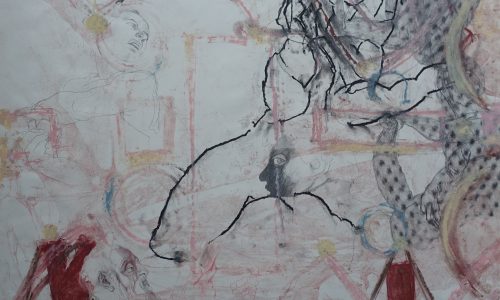
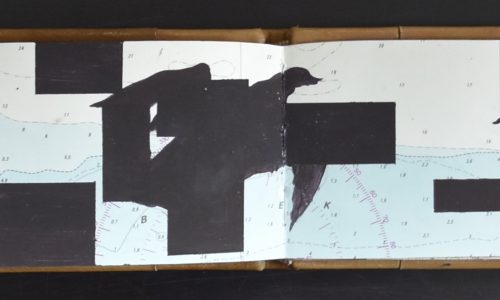
The coming blogs on Sunday are all devoted to SCHAAMSTREKEN . a series of artists books by Otto Egberts , all containing original drawings , executed on special papers and bound in goat leather
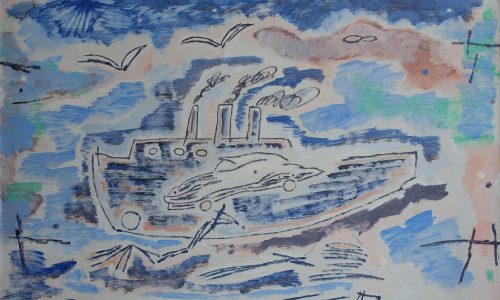
These Egberts books are very special and deserve to be known by a larger public and will be coming up for sale next year. It would be a pity that these great artist books are only known to a few persons. Therefore i decided to publish all pages of the 4 books in 4 separate blogs on consecutive Sundays starting from now and today is the first volume to be published within this blog series . The SCHAAMSTREKEN 1 book measures 39,3 x 10,9 cm. And contains 34 pages, 15 drawings spread over 2 pages and 2 one page drawings. The end paper has the signature and date on it in pencil. These original drawings were done in color on old Danish maps and nautical charts.
Here is the integral reproduction of volume 1


A truly magnificent artist book and one of the most spectacular books i have ever owned. For more information on Otto Egberts do not forget to visit his website www.ottoegberts.nl and other great artist books at www.ftn-books.com

Piet Dirkx cigarbox 427

Only 15 years the Hochschule für Gestaltung Ulm was active and it was one of the first institutions in the world where you could fhave an education and follow lectures in design. After the Bauhaus it was the leading centre in the world on design and responsible for many great “timeless” designs of which the Lufthansa corporate design is probably the most best known.
The importance of this educational centre which was co founded by Max Bill and had ao. Johannes Itten ( see blog from a few days ago) as a teacher was recognized by Willem Sandberg who organized an exhibition in 1965 on the “Hochschule für Gestaltung Ulm” and the catalogue which appeared together with this exhibition has become one of the rarest and most collectable Stedelijk Museum catalogues ever. Wim Crouwel designed this catalogue. Oblong format, grey cover, very nice typography ….the catalogue has become a statement for good and simple design, readability and beauty. The designs within the catalogues are beautiful, but the catalogue itself is arguably even better.
This catalogue is available at www.ftn-books.com
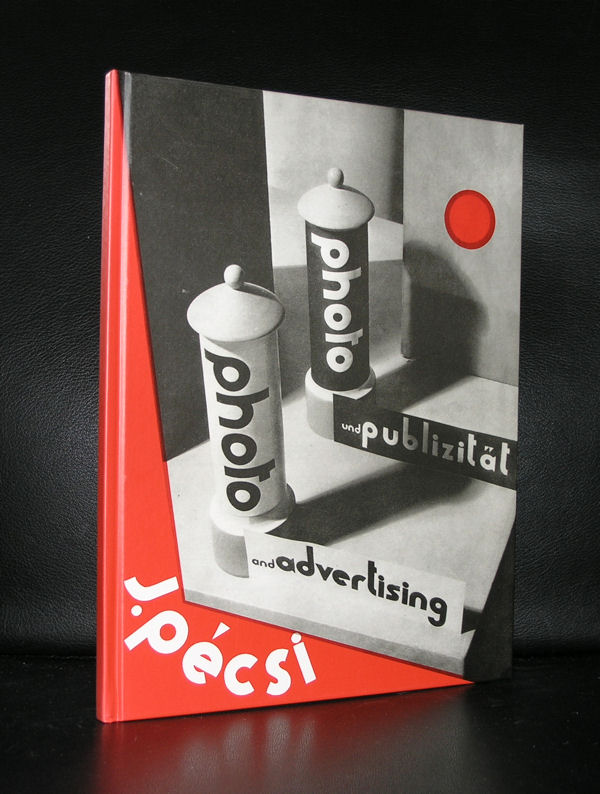
There is a great timeline to discover the Hochschule at :
http://www.hfg-archiv.ulm.de/english/the_hfg_ulm/timeline.html

Piet Dirkx cigarbox 426

Take one look at the (action) photographs and you will get immediately an idea of the works that Kudo made.
A little chaotic and compositions made of lost and found objects . Compositions in cages and cubes and a bit in the way like Joseph Beuys used showcases/vitrines . Kudo cages/ boxes/vitrines/cubes are absurd and contain colorful objects, but not without a meaning . They are arranged in a way that they have a meaning and make the viewer aware of the way the artist has visualized the title. Take for instance a look at: Bonheur… a cage where Happiness is far away. The title suggest Happiness, but the reality of the cage shows the grim reality

Tetsumi Kudo, Bonheur, painted cage, artificial soil, plastic flowers, cotton, plastic, polyester, resin, string, cigarettes, thermometer, Aspro tablets, circuit board, 21 x 11 x 14 inches, 1974
Ranging from plastic dolls to stuffed canaries Kudo arranged them and put them together to make a very recognizable work of art. For me Kudo is a cross between Pop Art and a Realistic sculpture.
Tetsumi Kudo was born in 1935 in Osaka, Japan, and spent a large portion of his youth in the town of Okayama, neighbour of Hiroshima. He graduated from the Tokyo National University of Fine Arts in 1958. In 1957, he began exhibiting his work at the Salon of Independents, Yomiuri and had his first solo exhibition at the Galerie Blanche, Tokyo. He was awarded the Grand Prize and a travel grant to Paris through his participation in the 1962 Second International Young Artists Exhibition in Tokyo. He subsequently spent 25 years in Paris from 1962 to 1987 before returning to Japan. He died in Tokyo in 1990.
Tetsumi Kudo is one of the artists that inspired contemporary artist like Paul McCarthy and Mike Kelly.
www.ftn-books.com has 2 collectible Kudo titles available.

Piet Dirkx cigarbox 425

I am not an admirer of Marc Chagall. I am even one of those art lovers that does not like Chagall at all. Except there were 2 occasions i was impressed with Chagall. I remember the first time i went to the Fondation Maeght where ” La Vie ” was on display.
This painting had everything in it. Color, abstraction, symbolism and its size made it an overwhelming experience. The second time was in France too. I visited the Reims cathedral where the glass stained windows were designed by Chagall. In this religious setting everything came together again. Like the experience in Vence i had the same experience in Rheims…an overwhelming sence of piece and joy and realisation that life is great and beautiful. On the Maeght site i found this story on Chagall and for any publications on Chagall visit www.ftn-books.com
Painter born, Moïche Zakharovitch Chagalov, 7 July, 1887 near Vitebsk, in Belarus (then part of the Russian Empire), acquired French nationality in 1937 and died 28 March, 1985 in St. Paul de Vence.
Aimé Maeght met Marc Chagall for the first time in October 1947 at the opening of his retrospective at the Museum of Modern Art of the City of Paris organized by Jean Cassou to promote and celebrate the return of the painter after years of exile in the United States.
“Ida Chagall took me to her father’s house, and in the studio I was amazed when I discovered the gouaches painted in the United States and Mexico, sixty superb works that I had the chance to bring to rue de Téhéran. We all stopped the project for the first exhibition at the gallery. This meeting marked the beginning of our close and confident collaboration and a loyal friendship.” explained Aimé Maeght. This exhibition was held in March 1950. It was also the year that Chagall came to live in Vence near Saint-Paul.
When Marguerite and Aimé Maeght created the Foundation, they asked Chagall for a large painting for the room to be dedicated to him. The artist created La Vie (1964, oil on canvas, 296 x 406 cm), a large swirling composition where real-life events and dreams that had always lived within the painter come together : the rabbi grandfather, the marriage to Bella, the birth of Ida, the two exiles, the one from Russia by horse and the one to America by boat, musicians, acrobats and dancers, Paris all in blue and at the end of the path, the painter with the palette that appears to contemplate this epic that is larger than the adventure of one man. Above him, embracing him in her arms, is Vava his companion, the beneficial ally, who seems to be born of his painting to soothe the anxiety and torment of the creator.

Piet Dirkx cigarbox 424

Johannes Itten. Not many know him, but through the years he has been acknowledged as being one of the teachers who developed the most important “color theory” in art.

Johannes Itten (11 November 1888 – 25 March 1967) was a Swiss expressionist painter, designer, teacher, writer and theorist associated with the Bauhaus (Staatliches Bauhaus) school. Together with German-American painter Lyonel Feininger and German sculptor Gerhard Marcks, under the direction of German architect Walter Gropius, Itten was part of the core of the Weimar Bauhaus.
But for me there is more about Itten. In 1957 the Stedelijk Museum devoted an exhibition to Itten. The catalogue of the exhibition was designed by Willem Sandberg , who made it one of the most iconic Stedelijk Museum catalogues from the 50’s. This catalogue is still available at www.ftn-books.com. But there si more on Itten and the Stedelijk Museum to be told, because Itten also designed one of the velums ( ceiling coverings) for the Stedelijk. It is rarely on show, but there is a nice publication on the project also available at www.ftn-books.com