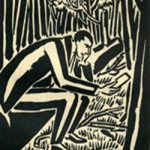
I wrote several blogs on Helena van der Kraan her photography, but never mentioned i had my first meeting with the both of them as artists. It was at the time they made huge wooden sculptures that did move. One of these, with a giant bass fiddle was acquired by the Haags Gemeentemuseum and one was placed for a very long time at an office building at the Kortenaerkade in The Hague. The last one was special and frightened many a passer by. Every quarter of an hour he turned his wrist and looked at his watch, scaring the people who happened to pass at just that moment, Now i ahve added to my inventory 2 books on Axel en Helena and….. i want to share a special movie in which Kees Broos (curartor at the Haags Gemeentemuseum) made a video on Axel and Helena, featuring….Gerard Verdijk.
Scott Kilgour (1960)

Why this blog on Scott Kilgour? Two reasons….1st i have added a brilliant ” (red) PUTTI” from 1990 by this artist to my art inventory and 2nd because i think he deserves to be mentioned and i am not alone . The famous Henry Geldzahler wrote the following in 1990
Scott Kilgour’s personality is cool, at a slight distance, but never cruel or ironic. The world he experiences and transmits is idealized without being dewey-eyed. Born and educated in Glasgow, he has known enough of sharp adversity to last him a lifetime. Twenty-three years old when he moved to New York in 1983, Scott found his balance rather quickly, voraciously swallowing museums and art galleries, surveying the scene and seeking his point of entry, his own stance. His bouquet of favorites included several surprises, Hans Hoffman and Willem De Kooning among them, artists whose excellence he recognized without needing their particular esthetics in his own work.

What Scott did discover and make use of immediately on his arrival was George Ballanchine’s great neoclassical institution the New York City Ballet, at its peak in the early and middle eighties, its repertoire as broad and sharply characterized as any performing arts company in this century. It was there, several nights a week, that he refined his sense of composition and his daughtsmanship, that absolute balance of ground and line that is Scott’s benefaction. And it is to Picasso’s transcendental neo-classical harlequins and dancers of 1922 and 1923 that Scott Kilgour’s sense of wholeness and absolute balance refers to memorably, so movingly.
Henry Geldzahler
May 1990, Southampton
the RED PUTTI from 1990 is now for sale at www.ftnbooks.com
please inquire at : wilfriedvandenelshout@gmail.com
Other works by Kilgour are on offer at :
and
http://www.michelemackfineart.com/kilgour.html
Leonardo da Vinci vs Johannes Vermeer

Since Linda had visited the Mauritshuis some 40+ years ago we finally had planned to visit the Mauritshuis. She told a story that one of her classmates had fainted after seeing ‘THE ANATOMIC LESSON” by Rembrandt, but the real reason to visit was not the story but the truly marvelous collection of 17th century art.
Most visitors interested in art who visi the Netharlnds go to visit the Rijksmuseum, but at a much smaller scale the Mauritshuis covers the same period and personally i think the collection is even better that that of the Rijksmuseum.
The Mauritshuis has in its collection THREE! iconic Vermeer paintings of the aprox. 35 known and dedicated to the artist, plus……these are among the highest rated of the artist including ” GEZICHT OP DELFT” and “GIRL WITH THE PEARL EARRING”. If you expect rows a viewers looking at this work of art…..you are wrong….my wife was the only one present in the room and admiring the painting from up close. This is the way a painting should be viewed and not the way the Mona Lisa is presented.
For me personally i prefer the Vermeer at anytime i hade to chose. Arguably a far more intriguing work of art and one i admire since the time i first saw it. My taste in art changed, but the admiration for Vermeer is still alive.
Beside many publications on Modern Art www.ftn-books.com also has a small collection on 17th century art.
Joke Robaard (1953)

An interesting artist. First time i encountered work was at a fashion centre and later i learned more on the artist. SHe is fascinating and there are not many publications on her. The best was published by VALIZ and is now available at www.ftn-books.com
The Dutch artist and photographer Joke Robaard originally trained in fashion, investigates the configuration of groups of people, for example in networks of friends, colleagues, companies and neighbours. She ‘directs’ individuals in certain positions and patterns in relation to one another, which are then photographed, and uses clothing to illustrate where the connections lie and how they are constantly shifting.
Her work is based on a huge collection of images and texts relating to people’s clothing behaviour patterns. Robaard does not categorise them as ‘fashion’, but wants to find out how clothing works. Her archive can be seen as a cartographic record of everyday clothing. Robaard moves simultaneously through the various zones of visual art, photography, video and fashion.
Moving through art, photography, video and fashion her beautifully designed book Folders, Suits, Pockets, Files, Stock includes texts by Gilles Deleuze, Roland Barthes, Robert Bresson, Jorinde Seijdel and the artist herself.

Mario Molinari (1930-2001)

Lifelike figures with abstract element. This is is how Mario Molinari presented his art at galerie d’Eendt in 1964. Later he became known for his colorful constructivist sculptures which can be seen at the Fondazione in Torino, but the start was more realistic. Clearly influenced by African art his sculptures do not look modern.

An in teresting period and a catalogue which is hard to find ( available at www.ftn-books.com). Next time when near Torino start looking for these colorful sculptures. They are not to be missed.

Leo Vroegindeweij (1955)

The first time i encountered the name of Vroegindeweij was at the time i started to take an interest in the students who visited the”Ateliers 63″ academy. Leo Vroegindewij was a student at Ateliers 63 in the years 1976-1978 and finshed his studies around the time i started my publishing years at the Gemeentemuseum Den Haag. It is also the years i took an interest in the Art & Project gallery which was one of the f
irst to show the works by Leo Vroegindeweij. I like his sculkptures however they are not very suited for the living room and really need space and only galleries and museum s can presdent them in a proper way and for me that is the reason i never considered buying a work by Vroegindeweij. They need “room to move” and it is hard to realize such space in a family home. Still, his works must be admired and whenever a small one comes to the market i promissed myself to reconsider buying one.
Jurriaan Schrofer ( continued )
Last month…. on the bookmarket…. i found a series of beautiful and typical late Sixties designs by Jurriaan Schrofer. Schrofer is together with Wim Crouwel the other favorit dutch designer from the Sixtie.
A Pop Art like style he developed over the decade and used this for his projects and the series he made for Museum Journaal is one of the most impressing from that decade. The series is now for sale in separate volumes at www.ftn-books.com, nbut for the collector that desires them all please contact me at wilfriedvandenelshout@gmail. com for a special offer of all volumes available.

Excellent piece on Schrofer written in French at this site:
Will Alsop (1947-2018)

Here is the text that can be found on the pages of the agency of the late Will Alsop. It is one of the architects from outside the Netherlands who designed several projects over the decades in the Netherlands. This is how i learned to appreciate the projects by Alsop.

The late Prof. Will Alsop OBE RA was a prominent architect, artist and educator who established aLL Design in 2011. He was awarded the RIBA Stirling Prize for Peckham Library, London and the first RIBA Worldwide Award for The Sharp Centre for Design (OCADU), Toronto, amongst numerous other prestigious accolades for a multitude of projects. His work encompassed all sectors of architecture including urban and landscape design and planning. His studio practice incorporated fine art painting, writing and modelmaking.
Will’s core values were innovation, expression and originality with an emphasis on enjoyment. He worked on a vast array of projects and in all scales; from a bandstand in London to the French Government HQ in Marseille ‘Le Grand Bleu’ via masterplanning, urban design, landscape architecture, interior and product design. He hosted numerous international workshops and lectures.

His interaction with and involvement of people both within and outside the arts led to design that challenges architectural norms. His practice, aLL Design, was founded principally to ‘make life better’ – the philosophy extends from the design of individual buildings to embrace broader principles of urbanism and city development and uses painting, writing, consultation and workshops to further understanding of design.
Will sat on the architectural advisory boards for Wandsworth and Kensington & Chelsea Councils. He was Professor of TU Vienna and Professor of Architecture at Canterbury School of Architecture, UCA.
His involvement with the Royal Academy of Arts included inclusive education programmes and his model of ‘Heliport Heights’ won the Turkish Ceramics Grand Award for Architecture in the RA Summer Exhibition, 2016 for the ‘most outstanding work of architecture.’ The judges were Ece Ceylan Baba; Kate Goodwin; Vicky Richardson and Ian Ritchie.
Will specialised in large-scale masterplans and regeneration projects for boroughs and districts in Almere, Rotterdam, Groningen, Berlin, Manchester, London, Middlesbrough, and Barnsley, for which he won the 2003 Architects’ Journal Award for Architecture. Latterly he designed part of the regeneration of Kew Gate district for the London Borough of Hounslow; developing schemes for Vauxhall’s regeneration and worked internationally in China, Canada and Europe.
Prior to his death in May 2018, Will was also designing a bandstand for a London Park and working with a Gloucestershire farmer to create an urban farm in South East London. Many of Alsop’s designs, such as the Glenwood Power Plant in Yonkers, New York; OCADU, Toronto, Gao Yang International Cruise Terminal, Shanghai and the HQ of the French government in Marseilles have become icons for their cities, encouraging and increasing tourism and establishing Will as a visionary in the field of architecture.
www.ftn-books.com has some publications on Alsop available at this moment

Another visit to the Stedelijk Museum
Readers know and read that i was not very enthousiastic about the presentations of the Stedelijk Museum during our last visits. Very little that was appealing and lacking all the quality the Stedelijk Museum is famous for.
Last week we visited the Stedelijk again and what a difference. This was an excellent presentation/exhibition with all the art the Stedelijk Museum is famous for and with some great additions. the Bruce Nauman exhibition itself was well worth visiting, but what pleased me the most was the way some of the highlights from the collection were put together on show in BASE 1 and BASE 2.
A true feast and the only part i thought was not there was some of the Minimal Art from the collection.
The first picture is the one on the Wim Crouwel publications the Stedelijk commissioned during the Sixties and Seventies. Recognized as top quality design and becominmg more and more important as part of the collection. many of these publications are also available at www.ftn-books.com.
Rating this presentation….B+.
scarce Stedelijk Museum item / 1960

I proud myself in having one of the largest Stedelijk Museum Amsterdam collections available for sale on the internte and i just added a extremely scarce item i want to share with you. I always was under the impression that from the mid Seventies the larger museums in the Netherlands started their educational programs to attract the young and school pupils to the museums.
I was wrong….
Recently i discovered in one of the 1960 catalogues a folder which was added which shows that the Stedelijk Musdeum had its own educational program in 1960. The 6 page folder, probably designed by Willem Sandberg shows an event specially organized for the very young to come to the museum and have fun. An “art” party for the young organized by the STEDELIJK in which childeren of all ages were entertained and encouraged to practisize their own art. A great and important collectable item available at www.ftn-books.com