Posted on Leave a comment

Joke Robaard (1953)

Schermafbeelding 2021-04-19 om 13.11.22

An interesting artist. First time i encountered work was at a fashion centre and later i learned more on the artist. SHe is fascinating and there are not many publications on her. The best was published by VALIZ and is now available at www.ftn-books.com

The Dutch artist and photographer Joke Robaard originally trained in fashion, investigates the configuration of groups of people, for example in networks of friends, colleagues, companies and neighbours. She ‘directs’ individuals in certain positions and patterns in relation to one another, which are then photographed, and uses clothing to illustrate where the connections lie and how they are constantly shifting.

Her work is based on a huge collection of images and texts relating to people’s clothing behaviour patterns. Robaard does not categorise them as ‘fashion’, but wants to find out how clothing works. Her archive can be seen as a cartographic record of everyday clothing. Robaard moves simultaneously through the various zones of visual art, photography, video and fashion.
Moving through art, photography, video and fashion her beautifully designed book Folders, Suits, Pockets, Files, Stock includes texts by Gilles Deleuze, Roland Barthes, Robert Bresson, Jorinde Seijdel and the artist herself.

robaard folders a


Posted on Leave a comment

Mario Molinari (1930-2001)

Schermafbeelding 2021-04-18 om 12.05.27

Lifelike figures with abstract element. This is is how Mario Molinari presented his art at galerie d’Eendt in 1964. Later he became known for his colorful constructivist sculptures which can be seen at the Fondazione in Torino, but the start was more realistic. Clearly influenced by African art his sculptures do not look modern.

Schermafbeelding 2021-04-18 om 12.10.20

An in teresting period and a catalogue which is hard to find ( available at www.ftn-books.com). Next time when near Torino start looking for these colorful sculptures. They are not to be missed.

molinari d'eendt

Posted on Leave a comment

Leo Vroegindeweij (1955)

Schermafbeelding 2021-04-16 om 15.09.15

The first time i encountered the name of Vroegindeweij was at the time i started to take an interest in the students who visited the”Ateliers 63″ academy. Leo Vroegindewij was a student at Ateliers 63 in the years 1976-1978 and finshed his studies around the time i started my publishing years at the Gemeentemuseum Den Haag. It is also the years i took an interest in the Art & Project gallery which was one of the f

irst to show the works by Leo Vroegindeweij. I like his sculkptures however they are not very suited for the living room and really need space and only galleries and museum s can presdent them in a proper way and for me that is the reason i never considered buying a work by Vroegindeweij. They need “room to move” and it is hard to realize such space in a family home. Still, his works must be admired and whenever a small one comes to the market i promissed myself to reconsider buying one.

Posted on Leave a comment

Jurriaan Schrofer ( continued )


Last month…. on the bookmarket…. i found a series of beautiful and typical late Sixties designs by Jurriaan Schrofer. Schrofer is together with Wim Crouwel the other favorit dutch designer from the Sixtie.

A Pop Art like style he developed over the decade and used this for his projects and the series he made for Museum Journaal is one of the most impressing from that decade. The series is now for sale in separate volumes at www.ftn-books.com, nbut for the collector that desires them all please contact me at wilfriedvandenelshout@gmail. com for a special offer of all volumes available.

schrofer MJ b


Excellent piece on Schrofer written in French at this site:

Jurriaan Schrofer

Posted on Leave a comment

scarce Stedelijk Museum item / 1960

stedelijk doe feest b

I proud myself in having one of the largest Stedelijk Museum Amsterdam collections available for sale on the internte and i just added a extremely scarce item i want to share with you. I always was under the impression that from the mid Seventies the larger museums in the Netherlands started their educational programs to attract the young and school pupils to the museums.

I was wrong….

Recently i discovered in one of the 1960 catalogues a folder which was added which shows that the Stedelijk Musdeum had its own educational program in 1960.  The 6 page folder, probably designed by Willem Sandberg shows an event specially organized for the very young to come to the museum and have fun. An “art” party for the young organized by the STEDELIJK in which childeren of all ages were entertained and encouraged to practisize their own art. A great and important collectable item available at www.ftn-books.com

stedelijk doe feest a

Posted on Leave a comment

Jan Meijer / Jurriaan Schrofer/ Ed van der Elsken

Schermafbeelding 2021-03-25 om 14.19.12

Another artist i had no memory of. I had heard the name before, but coould not place his works in any context. I must have seen his work at some time, but no recollection at all.

So why this blog on Jan Meijer. The artist is perhaps the least interesting in this blog. Still Meijer’s lyrical abstract works are well worth looking at and deserve much more recognition.

Schermafbeelding 2021-03-25 om 14.25.54

But…..the true reason i write this blog is the Jan Meijer catalogue which was published in 1957 for the Galerie Dina Vierny exhibition. A typical 50’s publication with a colored cover, BUT, what makes it stand out ……..it is designed by Jurriaan Schrofer and photographs by Ed van der Elsken. It is one of those rare occasions that these great Fifties artists come together. Perhaps they needed to make some money, perhaps they were friends and have known each other from their Paris time. I do not know, but ik know that this is an extremely scarce publication, well worth collecting and to dream away and try imagining how life must have been in Paris in the mid Fifties.

the catalogue is available at www.ftn-books.com

Posted on Leave a comment

Martin Gerwers (1963)

Schermafbeelding 2021-03-25 om 14.05.14

I know the works by Martin Gerwers for some 10 years now. The first time i encountered them was at an exhibition at galerie de Rijk and since i have been following with great interest this German artist. His abstraction leans towards the de Stijl movement , but is so much more fragile and delicate. Thin lines and much “space” make his paintings more like minimal art paintings than DE STIJL. One thing they have in common. It is use of bright colors  for the compositions. Gerwers his works are now financially out of reach for me , but i still admire his works and hopefully one day i encounter a nice small painting at auction. If the price is right i do not hesitate and buy it for my personal collection.

Schermafbeelding 2021-03-25 om 14.04.14

Martin Gerwers, emerged with monumental geometric abstract paintings. He has recently extended his dicipline with 3-dimensional painted objects. Made out of triangular forms from wood they take the shape of dynamic pyramids, which define the surrounding space. His work is in the tradition of Mondrian and the American colourfield painting. Gerwers’ paintings and objects evoke space through big contrasts in light and dark, thin lines and broad planes of color and subtle differences in tone.

Martin Gerwers is born in 1963 in Velen (DE). He lives and works in Düsseldorf. After the Kunstakademie Düsseldorf, where he studied with Jan Dibbets, he exhibited regularly at Konrad Fischer Galerie in Düsseldorf and Galerie Tschudi in Glarus in Switserland. Since 1999 he has been exhibiting at Slewe Gallery. His work has been collected by several private and public institutions such as the Stedelijk Museum Amsterdam.

gerwers


Posted on Leave a comment

Mirjam Hagoort (1961)

Schermafbeelding 2021-03-23 om 16.41.12

I have in my FTN-books collection an CBK Rotterdam catalogue on Mirjam Hagoort, published in the early Nineties it shows the works by Hagoort as a young artist . Big almost geometrical paintings with words and sayings, a bit like Ed Ruscha, but while preparing this blog on Hagoort i noticed a change in her work. Nowadays her drawings are much like Marcel van Eeden his daily drawings. They have the same look and feel.

Schermafbeelding 2021-03-23 om 16.30.11

The paintings however are different. Here she shines with a kind of abstraction that make her early paintings from the Nineties such appealing works of art. With the recent paintings she combines abstraction and architecture into great works of art.

hagoort a

Posted on 10 Comments

Alva (Solomon Siegfried Allweiss) (1901–1973)

ALVA C

Here is an artist i recently discovered. HIs work has the abstract qualities of the best artists from the Fifties and here and there you will find Comic like characters in his drawings and paintings.

Presumably because of the different environments in which Alva lived—Galicia, Berlin, Paris, the Middle East, and eventually London—he was familiar with a wide range of artistic influences and moved easily between different styles. His works include an illustrated and decorated version of the first chapter of Genesis, a series of studies of the Prophets in lithograph, and oil paintings on several subjects from Jewish life in Eastern Europe. Some of his paintings, like the one displayed here, are Symbolist. Characteristic of his style is the use of distinctive brush strokes and an aerial perspective.
Solomon Siegfried Allweiss was born in Berlin in 1901 but grew up until age 10 in Galicia, where he received a strict Jewish education. He studied music in Berlin before switching to art and adopting the pseudonym Alva in 1925. He traveled extensively in the Middle East and spent five years studying art and painting in Paris before he emigrated in 1938 to England, where he spent the remainder of his life. Alva was an occasional contributor of illustrations to Yiddish books published in London, most notably the cover for Y.A. Liski’s volume of proletarian stories, Produktivizatsie (Productivisation), published by Naroditski in 1937.

Posted on 36 Comments

Herzl Emanuel (1914-2002)

Schermafbeelding 2021-03-23 om 15.56.51As a teenager, Herzl Emanuel studied art at the Rochester Memorial Art Gallery in Rochester, New York. Emanuel quithigh school in 1931, and, with the assistance of several patrons who recognized his talent, went to Paris, hoping to study with Emile-Antoine Bourdelle. Although the French master died with Charles Despiau and Fernand Léger and attended lectures given by André Lhote. He was soon joined by Hananiah Harari, then a student at Syracuse University, with whom he shared a studio and later accompanied to Palestine. In Paris, the two young men were intrigued by contemporary art. They felt its validity and power without fully understanding why Picasso, Matisse, and others could so successfully do such violence to the figure.(1) Believing the answer to their questions lay deep in the history of art, Emanuel and Harari spent a year drawing from the collections at the Louvre. Beginning with Hittite and Egyptian art, they worked their way chronologically to the nineteenth century, seeking to understand the structure and logic of the art of the past. In the Louvre, Emanuel says, we learned the grammar of art. We learned its syntax, its alphabet, until contemporary art represented no mystery. We learned its rationale, where it came from, the basic language. We saw its connection with the art of the past.”(2) Although in Paris whenAbstraction-Création wasbeing formed, Emanuel and Harari saw such publications but paid little attention to the theories or the movements germinating around them.

emanuel x


As fascism threatened Europe, Emanuel and Harari left for Palestine where they worked on a kibbutz for over a year. Although the kibbutz regimen left little time for art, the experience enriched them philosophically. After a brief stay in Jerusalem, Emanuel returned to the United States and in 1936 joined the sculpture division of the New York Federal Art Project.(3) During the mid 1930s, Emanuel was sympathetic with leftist political causes. By participating in the WPA, he said, ​we felt we were working directly for society.”
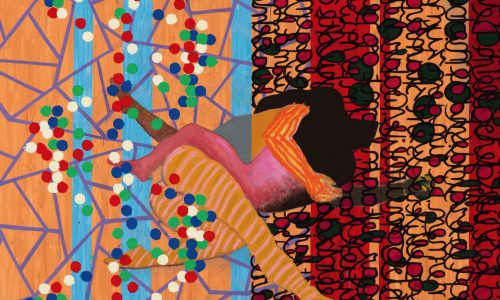
When war came, Emanuel went to work for a shipyard, and afterwards made his living doing display work. Later he worked as an illustrator. During the mid 1950s he taught illustration, sculpture, and a foundation course at the School of Visual Arts in New York. After six years, he gave up his teaching position to return to Europe. In Rome, he set up a studio that he still maintains.

Throughout his career, Emanuel’s art has been centered in a deeply felt humanism. Art for him offers a way to come to terms with the human condition. Though he still finds inspiration in Romanesque and Italian Renaissance art, it was Picasso’s Guernica that had the most dramatic impact in his life. Calling it the most significant work of art of the twentieth century, Emanuel has sought to achieve in his own work a fusion of abstracted form with tragic content that parallels Picasso’s powerful statement. Since the 1930s, his sculpture has evolved from an Analytical Cubist format to an Expressionism in which the human form is distorted to convey the human condition. Yet by intertwining limbs and connecting gazes in multifiguralcompositions, he offers up human relationships as notes of hope that temper the effects of a tragic existence. www.ftn-books.com has the Kuhlik 1972 catalogue now available