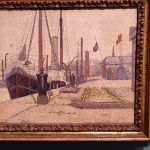
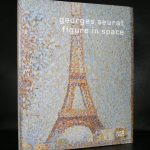
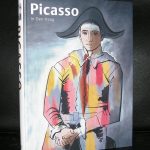
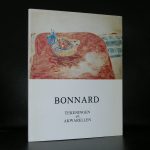
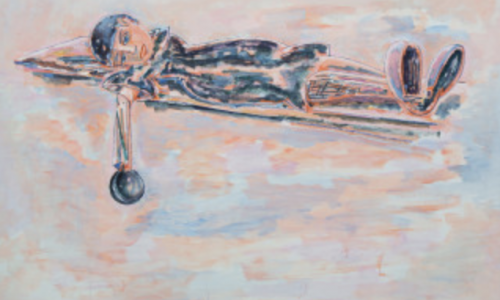
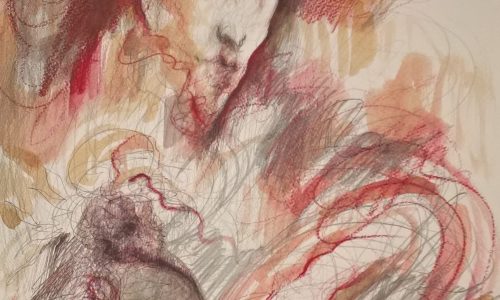
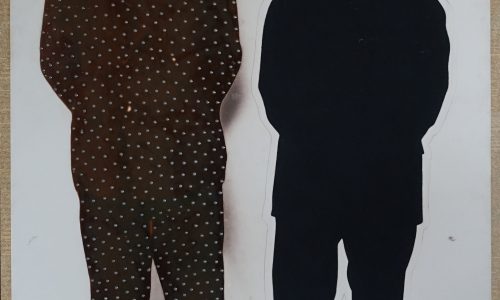
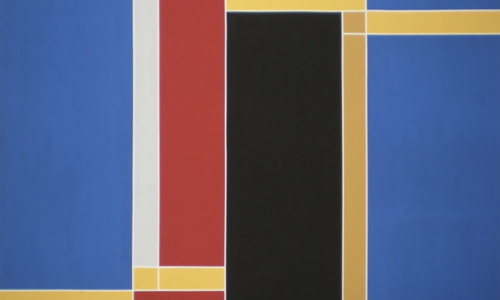
We went for a short visit to Prague last weekend and walked over 30 miles within 3 days to explore the city. One of our first destinations was the Narodni Muzeum at the Trade Fair Location. It is at least a little confusing, but spread over Prague there are about six Narodni museums on all kinds of subjects. This Trade Fair Palace was the one i had on my list for a long time and been wanting to visit for some decades now, but never had a chance to, because Prague was out of the way for us but this weekend we finally went and were not disappointed. At the time of its construction (completed in 1928), this was the largest building of its kind in the world and the first Functionalist building in Prague. Today it serves the needs of the National Gallery. Knowing its age you must admire its architecture….a true avant-garde building which is unique, but because of its functionality hard to admire. It looks old and worn but the light within the buildling is unique.
It houses one of the best International collections i have ever seen and its historic value is beyond any doubt. One of the first rooms you enter consists of a mini exhibition which , organized elsewhere would draw hundreds of thousands of visitors. The quality of the paintings and sculptures is superb and deserves to be visited and admired by many more than the handful of visitors we encountered during our visit.
The small room houses a Picasso, Matisse, Bonnard, Seurat, Monet, Renoir, Degas statue, Maillol and ( personally i am not a great van Gogh fan) a spectacular and beautiful van Gogh.
We were so surprised to find so many of these beautiful paintings and to discover some great Czech art. It was a very nice visit and made us even more like the collection, because we specially came to visit the Giacometti exhibition, but in it’s wake we were treated on some of the most beautiful and surprising art i have seen lately.
Of course www.ftn-books.com has on all these artists some nice publications.
I remember a magnificent Masson exhibition at the old venue of the Musee de l’art Moderne / avenue Wilson in Paris. It was at the time i was living for 9 months in Paris and visited that museum frequently. They had the Brancusi Studio , which is now opposite the Centre Pompidou. I remember the Masson exhibition being different . I expected a kind of surrealism like the paintings by Dali and Magritte, instead i found paintings which were far more abstract and reminded me more like the ones i had seen by Miro. Here follows a short biography i copied from Wikipedia.
His early works display an interest in cubism. He later became associated with surrealism, and he was one of the most enthusiastic employers of automatic drawing, making a number of automatic works in pen and ink. Masson experimented with altered states of consciousness with artists such as Antonin Artaud, Michel Leiris, Joan Miró, Georges Bataille, Jean Dubuffet and Georges Malkine, who were neighbors of his studio in Paris.
From around 1926 he experimented by throwing sand and glue onto canvas and making oil paintings based around the shapes that formed. By the end of the 1920s, however, he was finding automatic drawing rather restricting, and he left the surrealist movement and turned instead to a more structured style, often producing works with a violent or erotic theme, and making a number of paintings in reaction to the Spanish Civil War (he associated once more with the surrealists at the end of the 1930s).
Under the German occupation of France during World War II, his work was condemned by the Nazis as degenerate. With the assistance of Varian Fry in Marseille, Masson escaped the Nazi regime on a ship to the French island of Martinique from where he went on to the United States. Upon arrival in New York City customs officials inspecting Masson’s luggage found a cache of his erotic drawings. Living in New Preston, Connecticut his work became an important influence on American abstract expressionists, such as Jackson Pollock. Following the war, he returned to France and settled in Aix-en-Provence where he painted a number of landscapes.
Masson drew the cover of the first issue of Georges Bataille’s review, Acéphale, in 1936, and participated in all its issues until 1939. His brother-in-law, the psychoanalyst Jacques Lacan, was the last private owner of Gustave Courbet’s provocative painting L’Origine du monde (The Origin of the World); Lacan asked Masson to paint a surrealist variant.
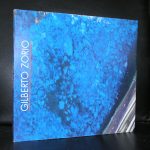
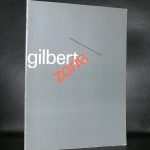
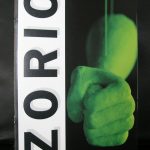
It was in the mid eighties that i first heard of Gilberto Zorio. An Italian artist rooted in the Arte Povera mouvement. At that time we had a book distributor at the Gemeentemuseum who had this impressive catalogue on Zorio. I bought it for the bookshop, but i must have been the only one who admired it, because years later we still had the book andeventually it was sold with a huge discount. Times have changed, Zorio has now become one of the great names in the Arte Povera and his works fetch high prices at auction. It is not the easiest from of art Zorio makes, but his often huge installations always fascinate me.
Zorio’s artwork shows his fascination with natural processes, alchemical transformation, and the release of energy. His sculptures, paintings, and performances are often read as metaphors for revolutionary human action, transformation, and creativity. He is known for his use of materials including: incandescent electric light tubes, steel, pitch, motifs, and processes through the use of evaporation and oxidation.
OLYMPUS DIGITAL CAMERA
OLYMPUS DIGITAL CAMERA
OLYMPUS DIGITAL CAMERA
OLYMPUS DIGITAL CAMERA
btw. It was the silver one with the red lettering we were stuck with, but i have it now once again available at www.ft-books.com
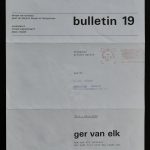
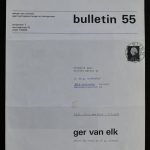
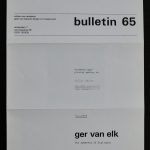
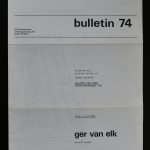
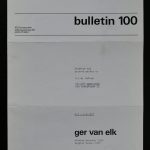
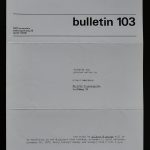
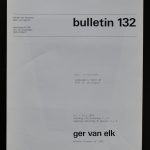
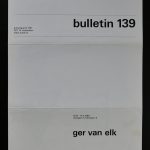
Followers of this blog must know by now that i have acquired a large collection of Art & Project Bulletins, publications and invitations. Among these invitations , many are considered to be true Mail Art and Art & project was one of the first galleries to communicate with its subscribers in this way. From the first 100 of exhibitions held at the gallery many are considered to be iconic, but some stood out. One of these exhibitions is still a classic in the history of the gallery. It is the 1970 Gilbert & George exhibition. First there was the bulletin send from Japan. with drawings of Gilbert by George and of George by Gilbert and secondly i must mention the invitation by van Beijeren and Ravesteijn. Handwriting in print to made it as personal as possible. Here is the example i have currently in my inventory which is addressed to Kees Schippers, the dutch conceptual artist.
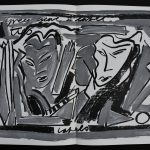
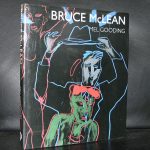
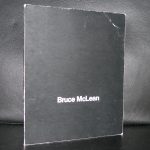
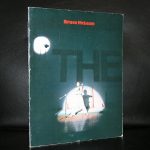
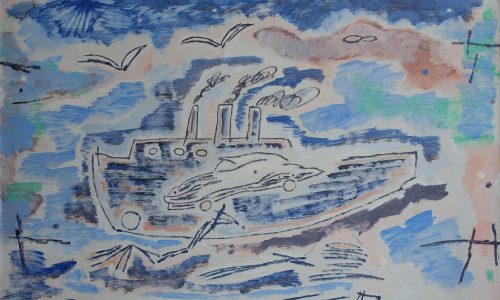
This makes it easy. I like Mclean and his works resembel the ones i admire so much from the Italian 80’s painters. Cucchi, Chia and Clemente are all contemporaries of McLean and where their touch is light, Mclean paintinsg are more “heavy” still very accessible but unfortunately they have become far to expensive for a humble collector as i am. Hre is the Tate biography on Mclean.
Bruce McLean (born 1944) is a Scottish sculptor, performance artist and painter.
McLean was born in Glasgow and studied at Glasgow School of Art from 1961 to 1963, and at Saint Martin’s School of Art, London, from 1963 to 1966. At Saint Martin’s, McLean studied with Anthony Caro and Phillip King. In reaction to what he regarded as the academicism of his teachers he began making sculpture from rubbish.
McLean has produced paintings, ceramics, prints, work with film, theatre and books. McLean was Head of Graduate Painting at The Slade School of Fine Art London He has had one man exhibitions including Tate Gallery in London, The Modern Art Gallery in Vienna and Museum of Modern Art, Oxford.
In 1985, he won the John Moores Painting Prize.
Mclean lives and works in London. His son is the architect Will McLean.
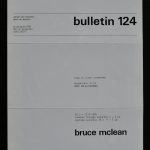
www.ftn-books.com has added a nice special edition by Art & Project from 1981, The Bulletin 124 is beautiful with a special off set print on the inside
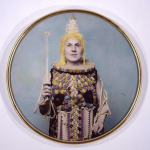
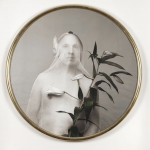
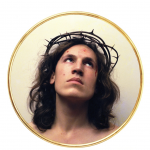
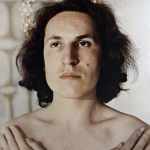
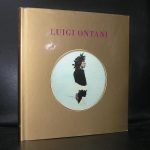
Like Cindy Sherman, Ontani makes his own image subject in his his works and therefore it is not by coincidence that the Groninger Museum has made n exhibition with Ontani some 20 years ago. Ontani has a natural place in the colection of this Museum, Italian art and a focus on photography are two pillars that made the collection of the Groninger Museum well known all over the world.
After studying at the Academy of Fine Arts of Bologna Ontani began his artistic career in the 1970s when he became known for his tableau vivants: photographed and videotaped performances in which he presented himself in different ways: from Pinocchio to Dante, Saint Sebastian to Bacchus. These displays of “actionism” (different from Viennese Actionism, to which Hermann Nitsch is associated) verge on kitsch and raise personal narcissism to a higher level.
Throughout his long career Ontani has expressed his creativity and poetics through the use of many different techniques: from his “oggetti pleonastici” (1965–1969), made in plaster, to the “stanza delle similitudini,” made with objects cut in corrugated fiberboard. He has often anticipated the use of techniques subsequently adopted by other artists: his first Super 8 films were made between 1969 and 1972. With his work “Ange Infidele” (1968) Ontani begins to experiment with photography. From the beginning his photography has been characterized by some particular elements: the subject is always the artist himself, who uses his own body and face to personify historic, mythological, literary and popular themes; the chosen formats are usually miniature and gigantography, and each work is considered unique. From the late 1960s on are “Teofania” (1969), “San Sebastiano nel bosco di Calvenzano, d’apres Guido Reni” Tentazione,” “Meditazione, d’apres de la Tour,” “Bacchino” (1970), “Tell il Giovane,” “Raffaello,” “Dante,” ” Pinocchio” (1972), “Lapsus Lupus,” the diptych “EvAdamo” (1973), “Leda e il Cigno” (1974), “I grilli e i tappeti volanti” that will be followed by other “d’apres,” and the first Indian cycle “En route vers l’Inde, d’apres Pierre Lotti.” His first artistic photography has a historic importance because it anticipates a phenomenon that will be widespread and popular from the 1980s.
While working on his photographs Ontani began to make his first tableaux vivants. From 1969 to 1989 the artist made around 30 of these exhibitions, again foreshadowing the so-called interactive installations, which are based on the mixture of various technologies. With this same attitude he has created works in papier-mâché, glass, wood (he has made numerous masks, especially on Bali, with Pule wood) and, more rarely, in bronze, marble, and fabric. He has also made notorious works in ceramic, thanks to the cooperation with Bottega Gatti of Faenza, Venera Finocchiaro in Rome, and the Terraviva laboratory of Vietri: some of them are his “pineal” masks, the “Ermestetiche,” and the last great works such as “GaneshaMusa” and “NapoleonCentaurOntano.”
Ontani has not used all these different techniques as ends in themselves but as occasions to experiment new possibilities and formulate new variations of the themes and subjects that interest him the most: his own “transhistoric” travel through myth, the mask, the symbol and iconographic representation. He has exhibited his works in some of the most important museums and galleries of the world, from the Solomon R. Guggenheim Museum to the Pompidou Centre, the Museo Reina Sofía to the Frankfurter Kunstverein. He has also participated in several editions of the Venice, Sydney, and Lyon biennales. Recently he has had four important retrospectives at the MoMA (2001), the SMAK in Ghent (2003–2004), the MAMbo in Bologna (2008), and the Accademia di San Luca, also called the Accademia Nazionale di San Luca, in Rome (2017). The retrospective in Rome marks his receiving the Premio Presidente della Repubblica award in 2015.
Part from thnis blog comes from the WIKIPEDIA page on Ontani
www.ftn-books.com has the most important Ontani publication on stock.
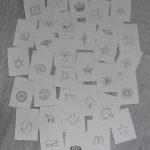
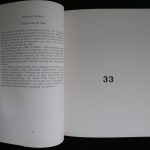
The Jochem Hendricks book that www.ftn-books.com has for sale is something special. Some reasons. First it feels and looks like an artist book, secondly it is in pristine condition and third….it contains the 33 raisor sharp LOGOS and WOLRD IMAGES Hendricks designed in 1985. The exhibition with these designs was held in 1992 in Frankfurt and curated by Jean-Christophe Ammann, making this an important exhibition. I personally did not visit this one , but seeing and leafing the book i wish i had.
It was about 3 months ago that we visited DE PONT in Tilburg. Our friends from the US wanted to visit the Bauhaus Textile exhibition and Linda and I decided to make the visit to DE PONT. An important museum and it struck us both that their collection is of the greatest quality. This is quite an accomplishment for such a small museum. So the Pont is worth visiting and what strikes you immediately at the entrance is a bend mirror like sculpture that reflects the sky. It is majestic in its appearance and of course the reflection is alway different so the sculpture present itself in a different way constantly.
[wpvideo DWIVniUJ]
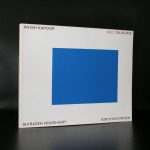
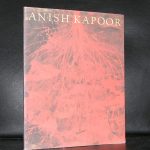
A visit to remember since this is an excellent museum with ao. this Anish Kapoor, who is one of the most influential sculptors of his generation. Perhaps most famous for public sculptures that are both adventures in form and feats of engineering, Kapoor manoeuvres between vastly different scales, across numerous series of work. Immense PVC skins, stretched or deflated; concave or convex mirrors whose reflections attract and swallow the viewer; recesses carved in stone and pigmented so as to disappear: these voids and protrusions summon up deep-felt metaphysical polarities of presence and absence, concealment and revelation. Forms turn themselves inside out, womb-like, and materials are not painted but impregnated with colour, as if to negate the idea of an outer surface, inviting the viewer to the inner reaches of the imagination. Kapoor’s geometric forms from the early 1980s, for example, rise up from the floor and appear to be made of pure pigment, while the viscous, blood-red wax sculptures from the last ten years – kinetic and self-generating – ravage their own surfaces and explode the quiet of the gallery environment. There are resonances with mythologies of the ancient world – Indian, Egyptian, Greek and Roman – and with modern times. www.ftn-books.com has some nice Kapoor titles available
Artist/ Author: Oliver Boberg
Title : Memorial
Publisher: Oliver Boberg
Measurements: Frame measures 51 x 42 cm. original C print is 35 x 25 cm.
Condition: mint
signed by Oliver Boberg in pen and numbered 14/20 from an edition of 20