Halcyon Days: Childhood in a Petit Bourgeois World
During Willem Diepraam’s youth there was little that pointed to his later career as a photographer. There was no artistic or intellectual milieu to stimulate his talents. In her own youth, his mother had toiled in the laundry run by her parents in the working-class Pijp neighbourhood in Amsterdam. His father came from a lower middleclass family who led such a frugal existence that they continually lived in fear of being swallowed up in the proletariat. ‘My parents,’ Willem Diepraam explains, ‘were brought up with the threat of poverty breathing heavily down their necks.’1 The couple married during the war, and Willem, their first son, was born in April 1944 in Amsterdam. Their second son, Jan, was born two years later.
Willem’s father decided to guard against the threat of poverty by resolving to establish a socially successful career, a view that was in perfect keeping with the spirit of the early postwar years: work hard and roll up your sleeves to reconstruct a prosperous and decent nation. Diepraam senior was the textbook example of the new Dutch citizen that then prime minister Willem Drees must have had in mind: thrifty, furthering oneself by study ing at evening classes having entered work after three years at grammar school, day-to-day activities centred around the kitchen table, and a ‘best room’ in the house reserved for special visits.
The evening classes that Diepraam followed bore fruit: starting on the bottom rung as a bank clerk, in 1946 he got a job with the Nederlandsche Handel Maatschappij, the forerunner of the ABN-AMRO Bank, in Arnhem, and the family moved there. His desire to climb the social ladder and thus fulfil his heartfelt desire to become a respected citizen inevitably led to conformism and an obliging demeanour to his superiors, in order to safe – guard his position in an expanding hierarchical organization. Ultimately, Diepraam proved too mild-mannered to maintain his position in the hierarchy, and he took early retirement. His two adolescent sons thus saw him as the personification of a lack of freedom, living in a strait – jacket of rules and conventions, a textbook example of how you should not live your life. Willem Diepraam: ‘We saw my father being crushed by that hierarchy and, with out exaggerating, you might say that from the moment we were sufficiently aware to understand this we were preoccupied by the notion of independence.’ Thus, without knowing it or wanting it, their father had laid an important foundation for the creative careers chosen by both his sons later on.
The moral and social values of their upbringing were as tried and tested as the Netherlands itself and as modern as the decent demeanour of the modern citizen in the period after the Second World War: a foundation of Christian, Calvinist values, which also saw the parents going to church on religious holidays. This was complemented by the essential, centuries-old Dutch maxims: ‘Behave normally; that’s quite crazy enough’, ‘Don’t lie’, ‘Don’t simply do what you want’, and ‘Bear other people in mind.’ However, these norms were not bolstered up with a religious sense of guilt. Exercising a great deal of creativity, Mrs Diepraam managed to make ends meet on the meagre wages that her husband initially brought home; a trait that their son Willem, it proved later, had acquired and used to good effect at times when his costs were greater than his income. Her attitude to life was somewhat less moralistic than her husband’s, and she more readily permitted herself moments of pleasure.
No matter how ideal that petit bourgeois worldview may have been for the Diepraam boys to rebel against later, it was but one aspect of their upbringing. Another aspect was of a completely different and considerably more emotional order, and would have an enduring lifelong impact. Willem Diepraam: ‘They gave us a tremendous emotional security, because we really were terribly wanted and loved. With hindsight it is clear that we were able to develop very well from within that safe nest of the family and the home. That has marked me for the whole of my life, emotionally as well as in important aspects of my character. That sense of love, that feeling that we were perfectly adequate, gave us a sense of self-respect as well as blown-up egos. We emerged from our adolescence with the feeling that there was nothing that could happen to us, excepting sickness, death and the loss of love – a sense that there were no limitations and an absence of fear. I was able to deal with all the later crises in my life thanks to that fearless – ness. That’s why there are still extremely deep emotional channels that bind me to my youth and to my parents.’ Willem’s brother, Jan Diepraam: ‘Our childhood was simply fantastic. There was really the kind of security that you only appreciate for what it was later on. At that particular moment you of course don’ t know any better. It meant that we also believed that we were perfectly good fellows, and we did not have much of a problem with false modesty.’2
Upwards
Something that had a profound affect on Willem and Jan them in their childhood was the Diepraam family holidays to the Wadden Island of Ameland, off the northwest coast of the Netherlands, in the early 1950s. They would alight from a postwar bus with copper rails and red plush upholstery at the local vicarage where they let out rooms. Willem Diepraam: ‘When I go to the beach now, I still get flashbacks of how the sea was then, how it smelt and how the two of us, shrimp nets in hand, ran down to the surf as fast as we could in our yellow bath ing trunks with a brown stripe, a big haze of peace and happiness. That is the happiness that I have been trying to rediscover for the whole of my life, that kind of equi librium. That is also why I have this bond with my brother. The feeling that the world will be a good place forever, even though you later discover that it is a shambles.’ Perhaps it was this contradiction between the stability of his youth and the turmoil of the real world that later formed an underlying motive for his work as a photographer. In 1953, when Willem was nine years old, the family moved to IJmuiden, because Mr. Diepraam had secured a position as the manager of a small branch of a bank. The young Willem underwent a metamorphosis thanks to that move: ‘At school in Arnhem I was a mediocre student, neither fish nor fowl. In IJmuiden I went into a class with a teacher who started to take an interest in me and took me in hand. She sensed how to get me down to work. All of a sudden there seemed to be something to be gained in coming top of the class. Because of this I started to work like heck, and within no time, along with my friend Jaap Zwart, I was best in the class.’ Along with a couple of other classmates, in the final years of junior school he was groomed for grammar school. He was urged on enthusiastically by his parents, who saw grammar school as the path to the Olympus of social prestige and worldly success. Willem Diepraam: ‘Climbing the social ladder, working your way up, doing your best, and financial security. My goodness! My father bored us to tears with those mantras!’ Brought up on the wave of postwar reconstruction and all the creature comforts which that eventually brought with it, the Diepraam boys were never confronted with the worries that their parents had endured. At grammar school Willem continued the triumphal march that he had commenced in his last years at junior school. He was one of those exceptional types who are able to study solidly without wearing jam-jar spectacles and coming last in every sport. Tall and athletically built, he won just about every sports competition, and within four years he was chair of the school society, the sports committee, and the drama club. He would have been a model child for any parent. Willem Diepraam: ‘I was a perfect fit for their projection of successful upbringing and a socially successful future.’ Jan Diepraam: ‘ Willem always very much wanted to be a highly sociable boy, he was almost frenetic about it, and he also wanted other people to see him as sociable. He was a youngster who was able to study well and who was highly respected in the school society. He wanted nothing more than to live up to that image. I never had such a problem with that.The expectations for me were not so high, and that was actually quite agreeable.’ The young Jan did not fit that particular picture. He did not go to grammar school, was much more recalcitrant, wilful and adventurous. Willem Diepraam: ‘Jan shook himself free of the family norms and regulations sooner than I did. That immediately caused friction with my parents. As the second child, he was also less dominated in his early youth than I was. In the last three years of grammar school I slowly grew away from home, so I didn’t have to dramatically bring the matter to a head. In my final year my mind was al – ready somewhere else, and then I left as soon as I could.’
The First Photos
Willem headed for Amsterdam, not to lead an uncertain existence as a photographer, but to study medicine, as was proper. His fascination for the human body had al – ready developed much earlier. He had hung pictures by Donatello and Michelangelo in his room in IJmuiden, and he had already decided to become a doctor in his early days at grammar school. Coincidence or not, his fascination with the human body was apparent in his first photographs, which he submitted for the schools prize of the municipality of Velsen, and which immedi – ately saw him winning second prize. The subject of one of the photos was the slaughter of a horse: ‘There was a butcher just around the corner from us, and I asked him if I could go and watch the slaughter of the animals, and whether I could take photos. I saw what those looked like, the way they were opened up. It was infinitely absorbing. Another photo was of a post on the beach at IJmuiden with a setting sun, youthful romanticism you might say.’ He was introduced to the first principles of photography by the stepfather of his first girlfriend, Ilja Veldman: ‘Ilja’ s father sent his wife and daughters to bed and then he taught me how to print photos in the hushed house. That old-fashioned toil in the dark bathroom of yesteryear is essentially the same joy and pain that I experience in the darkroom today.’3 Those photos and the prize did not indicate that the young Diepraam at all had a calling to be a photographer: ‘The real incentive was certainly not a fascination with art, it was not because I wanted to be an artist.’ The motives to give it a try would later prove much more prosaic. The grammar-school education and the prominent pos – ition that Willem occupied at school left a much deeper imprint on him than his time at university. As chairman of the school society he learnt how to deal with power early on. Willem Diepraam: ‘I still remember exactly how that felt. It was enjoyable and I also immediately thought: “You mustn’t do this.” But at that time I really wanted to experience it. I remember, for example, that I was in competition with a couple of people and I beat them, as it were. I didn’t like myself for doing that. It wasn’t a fear of getting my hands dirty. It was some kind of intuition, about what suited me and what didn’ t. I really bid fare- well to that kind of ambition at grammar school, because it wasn’t in me and I didn’t find it important enough. I test ed that out then, and ascertained that it was not something for me.’ Jan Diepraam: ‘Both of us wanted to be good at some – thing, and being good at something also gives you a certain power. I think that the both of us think that’ s very pleasant. Not power in the sense of public power, but in the sense that you have a measure of respect among people who have an understanding of what you do. In fact we find that very satisfying, I’d say.’ Willem Diepraam: ‘Most people go through all of that later, but I put it behind me while still at school. That experience, and of course my upbringing, contributed to my leaving grammar school with a certain awareness of myself: “ I can do anything, but I don’t in fact have such great ambitions.” A very solid awareness that you are worth something. And absolutely no idea of where in particular it should lead. The decision to study medicine was also much more a case of a personal choice, part of my character, rather than my already having a specific career in mind. I already had the sense that my future life would gravitate towards my personal life. ‘In addition, at grammar school I had become accustom – ed to the notion that the body and the spirit have to be nourished equally and in balance with each other. Not forgetting the notion of honour. Not in the sense of the honour of being meritorious, but the honour of living up to your own standards as far as possible; a certain integ – rity, the honour of being yourself, not allowing yourself to be led astray into doing things that you don’t want, or things that don’t suit your character, and not saying what you don’ t want to say. That is not just a notion, some – thing learnt, but has an essential meaning for me: honour and independence. And ultimately, the lessons from Greek history, the Greek tragedies, the power of fate, the realization that there are things that just have to be accepted.’ With the disaster that would strike his family in 1977, the grammar-school understanding of fate so powerful that even the Greek gods were subject to it would become a grim reality. On finishing grammar school, Willem immediately fell victim to a bout of wanderlust, in search of the concrete traces of classical culture. So he went to Italy for two months in order to visit as many museums as possible, returning to the Uffizi in Florence four times in order to pore over the Portinari altar by Hugo van der Goes. A year later he travelled all round Greece. Willem Diepraam: ‘It was a journey of discovery pur sang, in search of wonderful, thrilling experiences and, even then, an ardent search for love, women, and beauty. The world opened up. It was hugely influential in the development of my thinking, in a way that is now hard to comprehend. Though it’s rather speculative, I have sometimes wondered whether the fact that I saw so much classical art at that time, and was so impressed by it, is the reason why I wasn’t very well equipped to work in an avant-garde style. I was profoundly impressed by two millennia of culture, and I sensed that the epoch in which I was living was not necessarily the most import – ant. But it is also a question of character: I am no lover of antagonism or aggression. Needs be, then I am pre – pared to put up a fight, even literally, but I won’t get into one lightly. I have absolutely no desire to set myself apart from any generation whatsoever. I wasn’t made for that. Perhaps that is why I have never felt that I had to free myself from photographic tradition. On the contrary, I found it very satisfying to be accepted within that trad – ition, even though some people would now regard that as a rather old-fashioned attitude.’
Amsterdam
At that time, Diepraam’s photography played nothing more than a marginal role. After winning a photography competition at school, he did not take photos again for the next five years. In Italy he soon lost the camera he had just bought for his travels through the Classical world, and he did not replace it with a new one. It was time to leave behind small-town IJmuiden behind and exchange it for big-city Amsterdam. The way it started came as a bit of a surprise. Willem’s proud father refused to pay his study costs. The only thing to do was find paid work and earn as much as possible in the shortest possible time, because it was not only his studies that demanded a lot of time, but he also had to take additional science exams because he had opted to study for the diploma in the humanities at grammar school. He ended up working night shifts during the weekends at the Hoogovens steel works in IJmuiden. He also soon had to face another setback from an unexpected corner: he failed at medical school. The image of the young man who enjoyed success in almost every aspect of his life started to show cracks. Willem Diepraam: ‘The world came crashing in! I wasn’ t smart enough to study medicine. I failed the pre-med twice. What was going on? It was simply impossible! But it happened nevertheless. Then you walk around gritting your teeth with the idea that you’re good for nothing, and its healthy to dispel that thought as soon as you can.’4 He took a two-year break from his studies ‘during which he was busy with all kinds of things’,5 a series of little adventures in the big wide world. With the skills learnt from his mother he survived on little, the minimal amount of money that he earned himself, making ends meet as creatively as possible. Jan Diepraam: ‘We are both practical. If we needed to then we could get water out of stone, you know. That’s no big deal. There may well be a knack to it, but if we have to do it then we can.’ When the relieved young Diepraam moved to the big city in 1962, the distance between IJmuiden and Amsterdam seemed more like light years than a short train journey. The naivety of a decent, provincial upbringing clashed acutely with the metropolitan reality. He later described his first encounter with Freek de Jonge, having lived in Amsterdam for two years, as follows: ‘He had absolutely no self-assurance; he had no status. He just dwelled on the notion that he really had to do something. I understood this very well, because I’d just been through this phase myself. But when I had just arrived in Amsterdam, I had experienced that frustration of not being understood acutely. ‘I came to Amsterdam with a similarly naive, affable mentality. That played tricks on me in my relationships with the women I was interested in. Something like, if you fall in love with someone now, and if you say that out loud, then everything will work out fine. But at a certain point you realize that you have to construct an act and that you have to parade your ego, but not without applying a bit of smart street-sense. And that works! Even with really nice people who you thought would see through it. And when you realize that it is already un – necessary after the shortest time… that kind of ridi – culous, awful thing. […] We had some very comical discussions about that.’6
Billy Holiday
In addition to this there was the fact that the new zeitgeist, which by then had started to blow through Amsterdam, and would enter the annals of history as ‘The Sixties’, did not instantly fire Willem Diepraam’s imagination. ‘In 1963 a completely new tendency in music burst on the scene, labelled ‘pop music’. Led by groups such as The Beatles and The Rolling Stones, the sedate music of the older generation was thrown overboard by inflammatory rhythms, and The Rolling Stones in particular sang the praises of the happy revolt against parental authority and society, and about the pleasures of the extramarital sexual act.’7 The pop music didn’t catch Willem Diepraam’ s eye. His passion for jazz and classical music was sufficient for him. He did not be – come an activist on the formation of the students union in June 1963, nor because of the happenings organized by the Provo movement against ‘the bourgeoisie’, ‘dic – tator mentality’ and ‘the establishment’ in the summer of 1964. in Amsterdam. Jan Diepraam: ‘I think that I was, and I still am, much more a child of the Sixties than Willem. I have the feeling that I was growing up at pre – cisely the right moment.’ Willem would embrace the Sixties in a different fashion. A fanatical oarsman, after his first year in Amsterdam he became a member of the student rowing club Nereus. Through his interest in rowing he met Henk van Nieuwenhuyzen in 1962, one of his best friends to this day. Van Nieuwenhuyzen sketches Diepraam as he knew him in his first year as a student: ‘ It clicked between us straight away. So three months later, when Willem found a basement flat on the Weesperzijde, we both moved in there. At that time, our lives were all about coming to Amsterdam from outside the city, and sharing the new discoveries you made here, as a young adult. We spent a great deal of time with each other at that time; it was one big, fantastic voyage of discovery. And at that time there were only a couple of people who you could share your experiences with. And then they be come friends for life. Willem was a real inspiration for me. ‘He had, and still has, a quality that I found very unusual at that time; something that I still find very special about him almost forty years later. That is his engagement with people, which means he really wants to know what makes you tick and has no hesitation about stating what makes him the way he is, or how the world works and what he thinks of it. He encourages you to say what you think about life and lays himself bare with all his personal weaknesses, doubts and beliefs. For me that was a change of gear, an acceleration in my learning how to communicate with people, and for me this is still more intense with Willem than with others. He was so fascin – ated with what he wanted and his interests were so broad. You could say that he hadn’ t even thought about being a photographer. That took him by surprise as well.’8 Van Nieuwenhuyzen explains why Diepraam was not caught up in the Provo movement or pop music: ‘We arrived in Amsterdam during the transition from the 1950s to the ’60s. We were so early that it was just be – fore the Provo movement had dawned. So our social scene was very much centred around the progressive circles of the 1950s; what was happening around the Leidseplein, a sphere that revolved around people like the writer Harry Mulisch, café Reinders and the Sheherazade jazz café. We scoured the Waterlooplein flea market for records by Willem’s great love, Billy Holiday. In short, it was the progressive cultural mood in Amsterdam as defined by the leading figures of the 1950s. And for us, youngsters from outside Amsterdam, that was a big enough experience.’ In order to become members of the Nereus rowing club, Henk and Willem were obliged to join the Amsterdam Students Union and a debating society. That had unexpected consequences. In the students union they met Freek de Jonge and Bram Vermeulen. They became friends and Diepraam photographed De Jonge’s and Vermeulen’s experimental and ground-breaking cabaret work before becoming court photographer of ‘Neerlands Hoop in Bange Dagen’ (‘Dutch Hope in Times of Angst’), the cabaret act that De Jonge and Vermeulen formed in 1968. Henk van Nieuwenhuyzen: ‘There were all kinds of characters, from the student union movement as well as from within Provo, who were simultan – eously members of the student corps. It was one big steaming cauldron. It was a very open time then, and within the student body an awful lot was accepted.’ Willem Diepraam: ‘At that time everyone was nondescript. Bram already counted, he was someone al – ready, because he was a brilliant volleyball player. The struggle, of course, was to be someone. At that time that was a very strong motivation for me, too.’9 But for the moment, his ‘being’ someone was not at all realized through his photography.
Fulfilment with a Borrowed Camera
Willem Diepraam: ‘Until 1966 I had barely touched a camera. It was not a heartfelt desire. I had absolutely no sense of an artistic calling. Not in the least!’10 The reason why he deliberately set out to earn a living with photog – raphy a few years later was much more prosaic: his relationship with Ria Bosma resulted in their having a daughter, Karolien, who was born in February 1969. So there was a family to be supported. Diepraam does not have any regard for the sacredness of the creative duty. In his view, the investiture of creativity in the artist is a gross misconception: ‘In our society there is an almost religious reverence for creativity, creativity which is then projected onto the soul of the artist. This feeds all kinds of strange myths about the artistic calling. Society seems to project all manner of things that are not so easy to define onto the artist. It is simply the notion of the old magus in primitive society. But creativity is some – thing universal; bookkeepers are extraordinarily creative too.’
But before Diepraam picked up a camera again, and a borrowed one at that, the period in which he ‘was busy with all kinds of things’ came to an end, and he decided to study sociology. It was in part thanks to that course of study – which he cut short after three years – that the initially somewhat apolitical, soul-searching student became more involved with the social happenings of that era. It was now almost impossible to avoid, because the Provo protesters blanketed Amsterdam in smoke during the wedding of then princess Beatrix and Claus von Amsberg, the builders marched on the offices of De Telegraaf newspaper on the Nieuwe Zijds Voorburgwal, and the students railed that then U.S. president Johnson was a murderer for his actions in Vietnam and demonstrated against the imperious structures of a mouldering university. Diepraam followed the demonstrations with his borrowed camera and took photos as an interested spectator. It was in that period that he met his later friend Gerard van Westerloo. Van Westerloo was one of the editorial team for the magazine Student [p. 178], which had also been gripped by the ‘new mood’, and he would later become its chief editor. Van Westerloo: ‘At that time I had fallen in love with Lieneke Frerichs, who had been in the same class as Willem at grammar school. ‘On a Saturday morning in 1967 or so we were sitting in a bus on the way to Germany to join a demonstration against the Notstandsgesetze, which aimed to prevent the German left-wing getting into government. I was going to write a piece about it for Student. During the bus journey a tall, skinny man came up to me. He walked up to Lieneke and said: “Nice to see you again.” And then he spoke what I now consider the historical words: “This must be your sweetheart?” I instantly knew that I didn’t want to be around someone who said things like that. He continued: “So you’ re from Student. Then I’ll take photos for Student.” I still remember that I had the presence of mind to ask: “Are they expensive?” No, they were free. “Oh, then that’s fine,” I replied. They turned out to be really wonderful photos, photos that you didn’t see in newspapers. I noticed an engagement and at the same time a detachment and professionalism, which I thought was masterly. So I thought: “I’ ll just have to get over that ‘loveheart’ thing.” And he wanted to have fur – ther contact, it seemed, because he was terribly ambitious at that time. I didn’t understand one word of what he said; he didn’ t look at the world in the same way as other people. If I said: “Notstandsgesetze are pretty in – timidating,” then he would say something like: “But the sky was very beautiful.”’11 After two failed studies a new ambition was born, which would later prove to be one of life’s fulfilments. The first photos appeared in Student and Diepraam was soon tackling the design of the publication too. He designed photocollages for the cover of Student with police officers setting into demonstrators, bloodied heads of Vietnam demonstrators and black activists in handcuffs. The student movement had not yet forced itself into its later straitjacket when it allied its supposed lot with that of the working class. Student still exuded the aura of jovial opposition and the new freedoms of the late 1960s. The age of the deeply serious, rigid student frameworks advancing side by side with the workers towards the glowing dawn of Socialism had not yet arrived. And Willem Diepraam, now art director of Student, worked on happily. In the April/May 1970 edition there was a cartoon by the regular Student illustrator, Jan Willem van Vugt, in which a priggish student joins a group of work – ers drinking beer and eating hamburgers: ‘You, the revolutionary class, are the objective ones.’12 Three years later, a cartoon like this would have been abso – lutely ‘not done’. Gerard van Westerloo: ‘Willem was also involved with those illustrations. Once a month we went to visit Jan Willem van Vugt and then we devised the cartoons. Willem came up with the idea for the cartoon and I came up with the caption. Jan Willem made the wonderful drawings, but politics didn’t interest him. ‘During my time as editor-in-chief, I was sometimes loudly accused of being with the Girondins, while the time was ripe for the Jacobins. Willem and I were Girondins. We kept that up for two years, and we laughed our heads off.’
Photographic Times
In the October 1969 edition of Student there was an art – icle by Van Westerloo on the DDR dissident, Professor Robert Havemann, with photos by Diepraam, while on the back page there was another Diepraam photo with two naked girls for an article announcing the founding of the Erotisch Syndicaat (Erotic Syndicate) in Amsterdam. The syndicate adopted the slogan: ‘A happy fucker is no agitator.’ The syndicate’s manifesto explained that it was founded ‘ on the conviction that the erotic proclivities and needs are still neglected and oppressed in our society, while expressions of aggression, militarism, cutthroat competitiveness, censorious and oppressive au – thority, etc. can count on much more tolerance.’13 Photographic times had arrived, the change and modernization of society and the protests were literally spilling out into the streets, or in teach-ins and occupations. It was the intriguing watershed of two eras: one the one hand, in 1969 H. Bonset was sacked from his post at the Nieuwe Lyceum high school because he had read from a book by Remco Campert and NATO aeroplanes based in Portugal bombed villages in the Portuguese colony of Mozambique; on the other hand, the prim and proper University of Utrecht fraternities, UVSV and Veritas, organized a congress about democracy under the title ‘Democrazy’. The invited speaker Jan Pronk (currently Minister of Housing, Spatial Planning and the Environ – ment), who spoke about the theme ‘conflict situation’ , stole the show, according to reports. Meanwhile, Willem Diepraam had returned the borrowed camera – a Minolta with just one 50mm lens – to its proper owner, and he had bought a camera himself. Willem Diepraam: ‘The way that I took photos then was not professional in the least. It was motivated by an interest in what was happening […]. There were more and more reasons to go out and take photos, it became more enjoyable and I was learning how to do it better. The simplicity and straightforwardness of the way I took photographs, as well as the intense concentration on what I wanted to capture from a scene, what I cropped and what I added – I’m sure that it was all very clumsy, but it still had some kind of directness which was absent in other photos nevertheless; something that was perhaps a little more personal. I think that was the distinctive factor.’14 His friend Gerard van Westerloo warns in advance about the interpretation of Diepraam’s photographs from those early years: ‘Don’ t think that Willem had any socialist or communist affiliation for a second of his life. From the start, his worldview was directed against the pillarization, the establishment and the authorities, which you knew were empty from the very beginning, and had collaborated with the Nazis. That was what had to be brought down, so it was much more libertarian than it was left wing. Don’t go too far with the notion that the early work is politically tinted.’ In 1968, Diepraam began to sell his photos. On July 28 the news weekly Vrij Nederland (VN) published his work for the first time, a photo of students throwing a smoke bomb at the then minister of education, Dr. G.H. Veringa. Willem Diepraam: ‘The photos were a by-product of my life […]. I quickly realized that if I had shot something I could also sell it. You jumped on your bike and went round all the editorial offices, put something in the letterbox, bought the next edition – checked whether the photo was in, presented an invoice, collected the cash. Compared with working shifts at Hoogovens it was a nice way to earn money. I got a reaction from De Groene [p. 178] sooner than from VN. It was indeed a small circle of publications that had any interest in what I was incidentally producing. You went by de Volkskrant, but not to De Telegraaf – that was the enemy. Elsevier was also not done, and NRC Handelsblad was borderline.’ 15 Willem Diepraam today: ‘I didn’t need to do any – thing out of the ordinary. It wasn’t work, because I was there anyway. Besides, there was also the kick of making something with your own hands, something that you considered beautiful. It is a process that is your own work from start to finish. A laborious but satisfying process to select something that you think is best. And it was also pro b ably the fact that it means that your work appears in the newspaper and lots of people see it. These elements combine into something that you really want to keep on doing. After all, and this is fundamental, I didn’t start doing it in order to earn money, but as a hobby, because I enjoyed it so much. It became like a habit that I still don’t want to kick. Pleasure is the motiv – ation. Con vers e ly, if the primary motivation is to make money, then it costs you your independence.’ The motto of the new movement, ‘Power to the imagin – ation’, would later transpire to mean something different to what people then imagined, but at that point in time the literal meaning of the term ‘imagination’ as an expression of the stirrings in society was visible as almost never before: street theatre, marines who swept away the people sleeping on the Dam, pop festivals, hippies in the Vondelpark, street scenes filled with Afghan jackets and posters; wherever you looked, the Netherlands of the 1950s seemed almost as far off as the Pleistocene age. In a book about the photography published in Vrij Nederland, former editor, Ursula den Tex, wrote: ‘When the spirit of the times is not merely palpable but also visible to the eye, those are the ideal and happy years for photojournalism.’16 How far and how profoundly the new zeitgeist was manifested displayed itself in the most diverse places in society was demonstrated by three very different publications that Diepraam was involved with in 1970 and 1971.
‘Petty Bourgeoisie’
In the 1971 booklet Kunstonderwijs op losse schroeven (‘Art Education in a Mess’) by Jan Juffermans, for which Diepraam took most of the photos, the author discusses the influence of the traditional art academies on the development of art, concluding: ‘The technical accent of the art academies has created the situation where those who are incapable of mastering the “rules of art” at an academy are completely cast out by the established art world. This means that the practice of art has become exclusive to a small, often intellectual, elite layer of our society […]. This is how the term “Academism” has become such a loaded concept: a scholastic art prac – tice that builds on tradition and will thus never be revolutionary, turning traditions such as “work expressively from nature” and “ restraint in the use of material” into IDEOLOGY.’ Further on, he talks about ‘raising awareness of the social order that is a recurring theme through out the new syllabus. Perhaps art training will then more closely resemble a social academy rather than an art academy.’17 The second booklet was the 1970 yearbook of the Amsterdam Student Corps. In the introduction to the almanac – with a layout in psychedelic style – there is a word of thanks: ‘ With thanks to Ed van der Elsken and Willem Diepraam, who permitted the use of their photos of the Maagdenhuis for a minimal fee.’ The photos capture baton-waving police officers and resolute occupiers. Seven years earlier the Corps had made the news because of extreme freshman rituals that were called ‘Playing Dachau’; now the noviciates spent their freshman week in part doing ‘ work in the factories that was considered rather dull and not very instructive’. There were information evenings about ‘university, study, sex and Amsterdam’. And under the header ‘Studying in Amsterdam’ a senior member of the fraternity gave a commentary on the events around the Maagdenhuis occupation: ‘We decide to lend support to the liberators and set off for the Spui, but we were already thwarted at the Rokin, but turned the flank and arrived at the Heren – gracht, on the corner with Leidsestraat, where the po – lice met the crowd with sticks and helmets awaited us, motorbikes with sidecars racing past (later we read to our pleasure that at least one of them was hit over the head). There was a charge outside the university library, we determine the tactics of the enemy: dogs, horses and long truncheons. We see a young man being set on by two dogs and beaten up by three police officers. Our comrades at the N.Z. Voorburgwal start to chant “Sieg Heil!” We take up “This is the beginning […] we will continue the struggle.” The result is a police charge on horseback in the glare of floodlights. ‘We regroup, this time singing “In Holland Stands a House”. When we start singing “And They Won’t Get In” we set off on foot again. The red flag was raised at home, there was much discussion, someone had been injured, and was declared the hero of the debating society.’18 The third book was called Roodkapje in het Vondelpark, De Geschiedenis van Roodkapje en de Boze Wolf, Een Proeve van Menselijkheid, Het Vondelparkprojekt 1971 (‘Little Red Riding Hood in the Vondelpark, The History of Little Red Riding Hood and the Angry Wolf, A Test of Humanity, The Vondelpark Project 1971’). Photography by Willem Diepraam [p. 178]. The photos by Diepraam primarily portrayed hippies in the Vondelpark, ‘the bourgeois’ who came to look at the hippies, and hippies alongside the park’s traditional visitors. The booklet’s author mused about the fate of an imprisoned hare, intended for consumption: ‘For that is the less amenable possibility: that it would be skinned, having already been removed from its habitat, rendered for consumption, cut “to size” , turned into a commodity, in a world where everything is for sale and all values are set by people with a market value. And, once made into a “commod – ity” it can be traded! In other words, everything is always and forever manipulable. The divide and conquer outlook, the cultured view of the landscape.’19
Willem’s Skies
The artists, the students and the hippies as the messengers of new times and the foundation of the new future. The new era also meant big changes for the Dutch weeklies, not just as regards the content of the articles but also for the design, and for the role of photography within the design in particular. The weeklies had previously been dominated by pages full of black and white print – since the time of Calvin, the Netherlands had been a country of the word, after all – with a small photo here and there as illustration. Den Tex explains this as follows: ‘So long as the Netherlands went to the polling booths according to their sectarian allegiances, the religious pillars, there was little reason to give more detailed personal attention to individual politicians. In the 1960s the daily newspapers paid little visual attention to parliament and there was little enjoyment in it for photographers. Taking photos was governed by strict regulations, the parliamentary chambers were off-bounds, the use of a telephoto lens was an unwelcome intrusion of privacy.’20 And it was not only the Tweede Kamer, the Lower House of Parliament, that went unphotographed, but also the factories, hospitals, deprived neighbourhoods, schools and housing. In 1966 the sectarian ‘pillarization’ was dealt a tremendous blow with the political success of D’66, a party which used polished television commercials – copied from the United States – to present the young, goodlooking Hans van Mierlo. The television, as the personification of the image, had just started its advance towards becoming a mass medium. The gradual increase in prosperity also provided the newspaper editors with more generous budgets, so there was also more money for photos. Diepraam believes that he made his first real entrance at Vrij Nederland thanks to a telephone call from Rinus Ferdinandusse, then editor-in-chief, who asked him whether he would photograph the people sleeping on Amsterdam’s Dam square. ‘The editor-in-chief himself had phoned up to ask for a photo!’ Diepraam thought.21 ‘ I didn’ t know what I was hearing! There was nothing to see on Dam Square, nothing whatsoever, and he wanted to have the picture the very next morning – that’ s typical too. Working against the clock was also a constraint. It was only later on that I had any leeway, or had the space to take more time over my pictures.’ And Rinus had the perfect sense to realize that it had to be that way. Gerard van Westerloo, who wrote the ‘Universitas’ column for Vrij Nederland from 1969, and joined the fulltime editorial staff in 1972: ‘I don’ t know whether or not Ferdinandusse had especially good taste in photog – raphy, but that was not what mattered. He was the first journalist at VN who understood that a publication like this wasn’ t read because it published the self-important opinions of clergymen, PvdA (Labour Party) politicians or important economists. It was read because it was a lively, bold publication, a weekly that also dared to show its teeth. That is why Ferdinandusse brought in photog – raphy. He gave photography space, which is all an editor-in-chief has to do.’ ‘Photography won a place in Vrij Nederland thanks to Willem Diepraam and the layout,’ Ferdinandusse rem – inisces in the book Vijfentwintig Jaar Fotojournalistiek in Vrij Nederland (‘Twenty-five Years of Photojournalism in Vrij Nederland’).22 ‘[Ferdinandusse] clearly remembers the moment that the attack was launched. It was on the fourth floor of the “Rode Burcht” (“Red Stronghold”) on the Hekelveld, where Vrij Nederland and the trade union publications were designed and typeset, one floor above the editorial offices of Het Vrije Volk (The Free People). Willem Diepraam, “a man with unusually long legs in tight trousers”, strode in. Diepraam delivered a whole monologue at Ferdinandusse: there have to be more photos in Vrij Nederland, and they must say more. Ferdinandusse: “For me it was the first time that some – one had explained how photos could be more than just an illustration.”’23 The photo of the protestors sleeping on the Dam dated from 1971 and from that point forward, the photog – raphers Dolf Toussaint, covering the political world in The Hague, and Willem Diepraam covering the rest of the Netherlands worked regularly for Vrij Nederland 20. ‘His photos won a place amidst the bold typography of VN and made a big impression. “The skies of Diepraam”, or among his confreres, “Willem’s skies”, became a household word,’ Den Tex wrote. ‘Photos with stark contrasts, a coarse grain and heavily burnt in, life carrying on under skies even more sombre than those we are already accustomed to in the Netherlands. Others have interpreted his style as something ideological; according to the photographer himself it is circumstantial.’ Diepraam: ‘I used the effect very consciously, very practically, due to the use within the page. They had to be able to see my photo; it couldn’t disappear in the grey mass of text. You couldn’ t use any subtle greys, because the print quality of the magazines was not very good. ‘In itself it was nothing new; there was already a tradition. Ed van der Elsken, Johan van der Keuken, Eddy Posthuma de Boer and Koen Wessing worked like this. William Klein, too. It is a technique that was necessary at the time, and I tried it out myself and it worked well. It wasn’t possible to plan much of the work for the weekly. You couldn’ t come back without something. That was not done. So I always worked to a disaster scenario, the technique safe but very primitive, so that even in the worst lighting conditions it was still possible to extract later something from the negative. It was about seeking out situations that give a photo substance, always being quick, in the knowledge that it is now or never, knowing that that moment will never return, so long as you cap – ture it. Next you had to be able to produce something that was beautiful in the darkroom, from negatives captured in impossible situations. A struggle, terror. In those days I learnt to print so well that providing the negative contained at least something essential I knew that I could succeed in bringing that out in the darkroom. Whether the shot was three stops over- or under – exposed, so long as there was something there. That was the feverish way I worked.’24
Fame
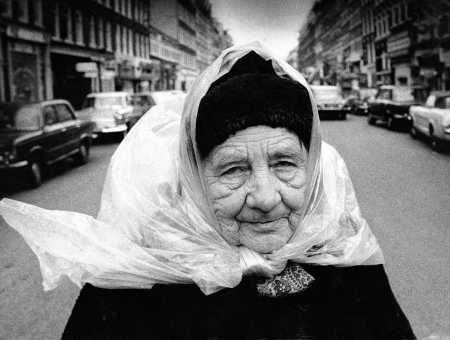
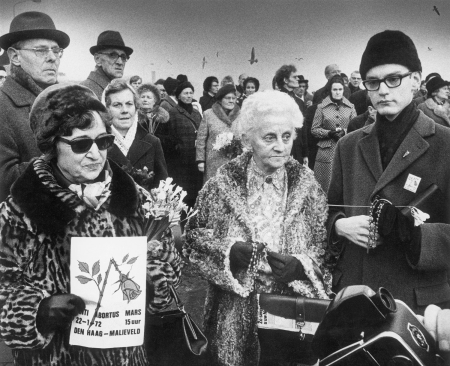
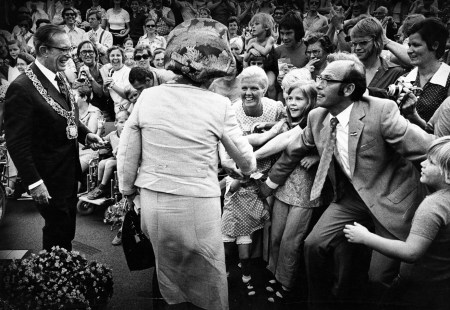
From 1971, the Netherlands as seen by Diepraam gra d – ually took shape in Vrij Nederland: cheerless railway yards in Utrecht, Spanish migrant workers at Hoogovens steel works, children playing with a wrecked car in the Dapper neighbourhood in Amsterdam, a picture of Queen Juliana taken from behind and showing her crumpled suit while an adoring crowd in Tilburg cheers [p. 52–53 and 178], women with plastic rain hoods demon – strating for equal pay [p. 50–51], trailer park residents in Osdorp [p. 60–61 and 178], a class-con scious couple at a festival organized by the communist newspaper De Waarheid (The Truth). It would prove to be the ‘finest hour’ of postwar social photography. Individuals and groups who had previously bided their time un noticed in the shadow of society were portrayed in resignation, protesting, assertive, crushed or militant. From that point, Diepraam’ s work met with almost immediate success, and it was considerable. Between 1971 and 1973 he became ‘world-famous in the Netherlands’. In his thesis about Diepraam’s work, Van den Bosch wrote: ‘The demand for his work between ’71 and ’73 was so enormous that his memory of that period is like a flash of light.’25 Diepraam worked for Vrij Nederland, De Groene Amsterdammer, was on the edi t orial team of the critical periodical20 Wonen – TA/BK (Tijdschrift voor Architectuur en Beeldende Kunsten, or Journal for Architecture and Visual Arts), made books such as the abovementioned Roodkapje in het Vondelpark andKunstonderwijs op losse schroeven, took photographs for a multitude of socio-political newspapers and magazines, was award – ed the Experimental Prize by Amsterdam City Council in 1971, and won a commission to document ‘a year in Amsterdam’ along with other photographers. In 1972 he documented the celebrated occupation of the Enka factories, which was published in the book Enka dossier, Handboek voor Bezetters (The Enka Dossier, A Guide for Occupiers).26 His fame went before him. By 1973, when aspirant photography students applying to study photography at the Rietveld Academy were asked who they saw as a role model, almost all of them answered: Diepraam. ‘Diepraam was not the only example, but he was indeed the most attractive because he was so young. He was the great god, the hero. Thanks to his position in Vrij Nederland […] it was clear that photography brought recognition and status, and that you could show your work to a large public in relative freedom […]. VN was like an academy. You read it, you talked about it: the subject matter was most important, followed by the aesthetics. You had to be concerned with the right things; mutual censure was strict. If you took a photo that was simply beautiful it was met with: ‘What is this about? It’s purely for effect.’27 In those days the editors of Vrij Nederland well-nigh considered themselves a self-appointed judge and jury, pointing out the vacuity of the powers that be with pen and camera in order to expose the governance based on arrogance and the absurdity of its influence. With that same pen and camera they thought that they could demolish the rotten pillars of that establishment and thus establish a society with an important place for previously gagged workers, women, youngsters, students, intellectuals and the unemployed. Gerard van Westerloo: ‘ Willem, like a great many photographers at that time, behaved as if they could influence politics, that they could change the world with a photo. Dolf Toussaint, who was to a certain extent Diepraam’ s example in this sense, made a real case for this. He could literally hold forth for a whole evening about the fact that his photos were the reason for the national insurance contributions increasing by 0.2% less than originally planned. He came up with the most amazing things. Willem was not so idiotic, nowhere near, but photographers thrived on the notion that what they made really mattered in political terms. If your photos could really sufficiently convince people about the real state of affairs, then society would certainly change in the long run. At that time the photographic journalists talked about it more than the writers. Their efforts to emphasize the importance of photog -raphy for the Big Revolution were inexhaustible. And Willem believed in that as well, not for such a long time, but he certainly used to believe in it. Yet at the same time he was one of the few who had in the meantime realized that essentially the one thing that mattered was making beautiful photos, and nothing else.’
Archetypes
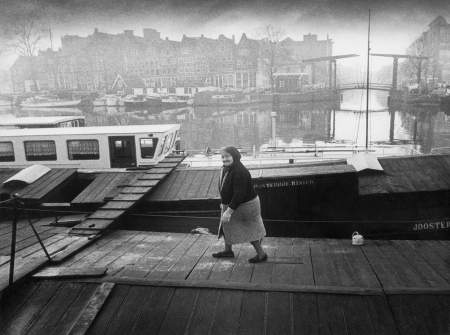
The documentary photography of the 1970s strove to capture an everyday reality in which the socially disadvantaged took centre stage and the content of the photo was subsidiary to a greater whole. The photographer made and selected his or her photos on the basis of a left-wing analysis of politics and society. They thus attempted to capture or illustrate abstract notions such as power structures and political processes. The aim was to influence public opinion and thus further stimu – late political activism. People worked with black-andwhite film. Photos had a hard contrast, a rough grain, and often a slapdash character. The darkroom tech – nique of burning-in (at the corners and around the edges) was applied liberally, in order to focus attention on the main subject. The photo was subordinate to the message and was not permitted to attract too much attention.28 Most photographers worked with a 35mm camera and a wide-angle lens, so that they could get close to the subject. Willem Diepraam: ‘Naturally, the intention with those photos, still using the graphic techniques that I employed when making and printing photos, was to ruthlessly force the gaze of the viewer in one single direction: where I wanted it go.’ The artistic photographer that he already was by this point – perhaps secretly – was set aside, and found expression in his efforts to achieve that one special image: ‘That something extra that you can put into a photo. That tension, that enigma, which means that you can look at it again and again. I knew when I had achieved that. You’ve worked like heck, you arrive back home, you select the very negative where you’ve caught ‘it’ just right. Then you get down to work: cutting, cropping, burning in, shading. Squeezing the lemon dry; that was the process of the early years with Vrij Neder – land.’29 In part thanks to Diepraam’s efforts, the actual space that photos came to occupy in Vrij Nederland increased. Not infrequently there would be a large-format photo with only a short caption by aVN journalist. One exam p – le was a Diepraam photo of the beach at Zandvoort with a little group of despondent people in bathing suits behind barbed wire that was published in July 1973. The sky is burnt in to a pitch black. Beneath it stood the text: ‘ City residents escaping the strictures of their living environment encounter each other again in a holiday resort of equally oppressive uniformity. The proximity of the sea is the only relief. This is how Willem Diepraam photographed a concentration of people at Zandvoort.’30 From 1974, Vrij Nederland introduced colour supplements: the cover story in the first colour edition of March 1974 contained a reportage by Diepraam about the Emma Children’s Hospital in Amsterdam loosely linked with a review of a book about sick children. More follow – ed. The colour supplement ‘De fabriek’ (‘The fac tory’) [p.179] was published in September 1974, with photos by Willem Diepraam and text by Gerard van Westerloo. Van Westerloo talked with factory workers and Diepraam took the photos. Diepraam: ‘It was wonderful to cast off that absolute compulsion of “the photo must be ready this week, it is a case of now or never” ; I knew that I could find similar situations again. Not that I suffered from that pressure; for four or five years I had been able to work in unison with the weekly and there was nothing wrong with that. I only understood that pressure when I discovered that it wasn’t a necessity.’31 With respect to the factory photos, Van den Bosch later wrote: ‘ They are portraits that exude something iconographic: the archetypical factory worker as victim. Some photos from this reportage displayed a studied composition, an elem – ent that becomes ever more emphatic in Diepraam’s work over the years.’32
The First Photographic Exhibition
Diepraam spent these years repeating his fervent pleas to the editors of Vrij Nederland to appoint a photo editor. Nothing came of it. Diepraam: ‘Looking back, I believe that there was a great need for what is now called an ‘art director’ within a publication where there were no visual specialists among the employees. It was taboo, until the moment that it was no longer needed, because Vrij Nederland was already past its peak.’ Later on he did succeed in getting his own photo column in the weekly: a photo over a two-page spread with only a mention of the place and date: ‘That was a very good presentation, except for the fact that I grievously over – estimated what I could present to the readers of Vrij Nederland.’ But that was much later, long after the photojournalist had become an art photographer. In the course of 1973, Diepraam was honoured with a request to compile a retrospective of his own work for the Van Abbe Museum in Eindhoven [p.178]. Politics, the elixir of life in those days, had also reached the museum. That meant that the museum’ s then director, Jean Leering, sought to establish a connection with the everyday real ity of the era, i.e. the reality captured by Diepraam: an already cheerless Bijlmermeer under construction, depressing deprived neighbourhoods in big cities, strawboard workers at the gates of hell: an indescrib ably dirty factory space with monstrous, old and dangerous machines that seemed to spring from the darkest dawn of 19th-century capitalism, riot police towing away four trailer homes and campers belonging to caravan-park residents in Osdorp, Vietnam demonstrations in Amsterdam and Utrecht, and striking workers in Antwerp, Belgium. For Leering, the museum needed to ‘connect with a broader public’, as it was then termed, and avoid shying away in ‘an avant-gardist corner’.33 Displayed alongside Diepraam’ s work were photos by August Sander (1876– 1964), the great German photographer whose goal was to make a survey of the German populace at the time of the Weimar Republic. Sander and Diepraam were described in the catalogue text as follows: ‘Sander’s photographs show types: the doctor, the farmer, the artist, the soldier, also often identifiable thanks to an attribute, an instrument or tool specific to their profession, or from their clothing. Willem Diepraam’s starting point is comparable with that of Sander – he also photographs people, usually anonymous – and the juxtapos – ition of their works demonstrates the similarity of their approaches. However, because they were active in different eras, there work had a completely different effect. While with Sander the classes are distinguish – able, in 1973 it was about the groupings rather than social classes, groups whose “props” are their everyday ]environment: their factory, their neighbourhood, their street or their action group. Diepraam is not so much concerned with the specific individual traits of his characters, since they can be interchanged for others; they represent a GROUP.’34 Diepraam asked Gerard van Westerloo to write some – thing about his work for the catalogue. In his discussion of the differences between journalism (at that time, Diepraam described himself as a photojournalist) and art, Van Westerloo wrote: ‘Jour nalism is distinct from art in its objectivity and lack of ambiguity, among other things. A poem or a story can be interpreted in myriad different ways: the personal interpretation and the timeless schemes which can be applied to many possible situations in the present are perhaps a precondition for great art. But journalism must place the facts right in front of the reader’s or the viewer’s nose, and as soon as there is any chance of them wandering, the journalist must set the reader or viewer back on the right track, with a hammer-blow to the head. Willem Diepraam is fairly heavy-handed in this respect. Even if you just brief – ly start to wander you bang straight into the black wall that Diepraam is so fond of erecting at the corners and edges of his photos; he blanks out all the distracting and potentially unnecessary background details, and calculatedly throws you back into the slightly glaring light that points to what really matters in that picture. Some people, including photographers, argue that Diepraam tamp ers too much with his prints; you might also say that journalism demands obvious rather than vague forms.’35 The primacy of political values had been the measure of all things throughout the ages. The revered icons of yesteryear end up on the rubbish tip of history. After all, there has to be space for one’s own view of the world, one’s own work. Diepraam explicitly distanced himself from the photographic exhibition that he had previously praised so highly, ‘The Family of Man’,36 in his text for the exhibition catalogue: ‘ Though I would rather not use such gran – diose terms, that timeless stirring of emotions is simply something I do not pretend to. “The Family of Man” brought together everything that humankind can ex – perience, and if well done, that can be deeply affective, but at one and the same time it present the possibility of a high degree of interchangeability. It is no longer so important whether you photograph swollen bellies in Ceylon or Surinam, the images are profoundly stirring, but they are of little consequence. You could keep taking photos like that for a thousand years, and perhaps you have then made fantastic things, but it would never make me feel that I had done the right thing. In the end they are still just clichés, as stereotyped as the highlights of the life cycle that we all undergo: birth, love, children, death. And it is self-evident that photographers have been concerned with these things since the in – vent ion of photography, but those highlights, no matter how superbly they are photographed, still have no polit – ical significance in their own right.’37 Diepraam told Van Westerloo that he was fairly unconvinced of the influential power of his own photos. This comment gives the impression that Diepraam himself thought that he had not fully succeeded in grasping the spirit of the times: ‘My photos, and I don’t like this in the least, are rather stylized and rather static, they are photos that have little that is raw, little action, though some thing does happen in my photos, but then it is usually in a roundabout way, and what does happen is so minimal, you know. It is not very often that I come across a photo where the subjects jump out at you. I would quite like to take photos like that, emotionally, not rationally but emotionally, great stories like “Pearl Fishers in the Red Sea Butcher a Shark” , tales of love and hate, peril and fear. I often feel that I am such an awfully Dutch photographer who captures Dutch scenes from such a terribly oblique angle. I think it shows a lack of guts to make photos that are really stark and direct.’38 In his text Van Westerloo had already noted that political correctness and Diepraam did not dovetail perfectly. Almost apologetically, he wrote: ‘Yet that does not mean that Willem Diepraam’ s photographs do not have an emotional impact. But that is not what matters, or rather that is not the primary concern.’39 After all, personal emotions still made ‘no political sense in and of themselves’ and ‘always turn out to be clichés’ . Personal emotions were not appropriate for capturing images of abstract notions such as oppression, protest, inequality and struggle. However, as the quote above indicates, it was impossible to gloss over that politically somewhat incorrect emotional element in Diepraam’s work. The confrontation between Diepraam and the work of Sander was such as shock that with hindsight it would prove to be a turning point. Being ‘world-famous in the Netherlands’ may well have been very flattering, but it was still no guarantee that his work would survive the test of time. And just as he had after grammar school, he went in search of the source: ‘When I saw the works hanging alongside each other I was really taken aback. I had to take stock: what does what I have made actually represent? For the first time it was a question of coming to my senses. Until then I had worked in a frenzy, with an enormous vitality; I had to prove myself and I had a young family to support. We got by with very little money. It was only then that I stepped back: what is my work in relation to the rest? I also realized that I had to look abroad in order to be able to compare myself with others. Over the next few years I carted hundreds of photographic books and tens of thousands of photos back to my house in order to catch up on my lack of knowledge. This had two effects that hit me right between the eyes: I saw that I could never be as good as Fox Talbot, as Emerson, Fenton or Kertész. At the same time it was relaxing to see everything within an inter – national overview, to see that the Dutch labels did not matter so much. From then on I knew: I am not that good, but I am pretty damn good. I was humbled by the absurdly high quality of what I saw, and at the same time I gained an idea of what I could realistically achieve.’40 Diepraam started by collecting photos at flea markets. Soon after, he entered the circles of professional collectors. It was to form the basis of an impressive and valuable collection. At the same time, he launched into an indepth study of literature on the history of photography. Not long after, some of this history would leave its mark.
Surinam 1975: Turning-Point
In 1975, Diepraam and Van Westerloo started work on a unique project that would mark an apex in both their careers: for the one, a new plateau in documentary photography, for the other, in social journalism. They had come up with the idea of moving to Surinam with their families for three months. Their goal was to use pen and camera to make a comprehensive portrait of Surinam, just prior to the country gaining its independence from its Dutch colonizers. The reportages by Van Westerloo and the photos by Diepraam, which linked with each other perfectly, were sold to Vrij Nederland. They would later appear in the book Frimangron, Suriname, repor – tages uit een Zuidamerikaanse republiek, (‘Frimangron, Surinam: Reportages from a South-American Republic’). [p. 74–79 and 180] ‘Frimagron’ means ‘land of free people’. Why, Diepraam and Van Westerloo ask themselves at the start of this book, are the people of Surinam fleeing their country en masse, in search of the social security that the Netherlands has to offer? What kind of country is it? What kinds of communities, classes, leaders, the poor, priests, jungle dwellers and colonials actually live there? How do they survive? What do they fight about and what have they resigned themselves to? Willem, his wife Ria and their two children, Karolien (6) and Michael (4), set out with Gerard, his wife and their small child for Paramaribo, where they rented a house. Their search for the life and struggle of the people of Surinam would result in a book of 225 pages.41 It turned into a tale of a forsaken country in a state of collapse. The titles of most of the chapters speak for themselves: ‘Those who don’t work won’t eat’, ‘Ten houses per year for the people’ and ‘ Three centuries of Dutch participation in slave trade and coolie transports’. Van Westerloo described the fate of the old people, talked with Hindus, the offspring of slaves, Indians, Javanese and Creoles, and interviewed the bosses, the politicians and the religious leaders. This quote is about a visit to the Wel – dadig heidsgesticht, an old people’s home: ‘ Barracks fill – ed with beds, nothing but beds, only half a metre from each other lengthwise and crosswise, and on those beds lie human bodies that can barely still function, old people grown lonely, who look at us blankly, not all of them, but certainly for the most part. Forty, fifty people per hut, here tactfully referred to as a ‘block’. Block 1 for the Javanese, the men segregated from the women, and then through a block for the psychiatric cases, for the former leprosy sufferers, and open sewers running between the blocks where the vultures shrug their shoulders as they walk through, in numbers that we have encountered nowhere else in Paramaribo, and rats dash back and forth beneath the barracks. It is Friday afternoon, 4 p.m., visiting time, but there are no visitors, apart from the white father and the preacher, who visit their flock.’42 Diepraam usually photographed this desperation using rough-grained film and burnt-in borders: a fingerless, begging leper, a demagogic rice merchant, the family of a tenant farmer with five children in front of their rough wooden hut. The corners of their mouths are usually downturned, the faces exhibit a resigned desperation, and here and there a playing child laughs. The dark photos gave the impression that the sun hardly ever shone in Surinam and many of the book’s readers‘ wondered whether it is always raining in Surinam’.43 The book was very well received in the Netherlands: ‘ A rare example of a book in which text and image stand on equal footing.’44 Gerard van Westerloo commented: ‘In Frimangron, the combination of photographic and written journalism has succeeded in a way that “has never been equalled”, according to other journalists.’ Later, in 1995, Diepraam explained the way in which he had made the photos inFrimangron, a method he had also used for the greater part of his photos before then. It is a useful intellectual key to understanding Diepraam’s development before and after 1975: ‘ Until 1975 I worked in one single manner: you knew who would look at your photos and you made some kind of interpretation according to a third voice in your head. You yourself are the first voice; the second exists in the world that you photograph; the third is the public. Is it something between you and the world, or between you, the world and the third voice? That is a completely dif – ferent story.’45 With the rhetorical tone of the question, Diepraam indicated that he had in fact already answered the question himself: he wanted to be free of the third voice. And thus the photographer became the artist. Diepraam: ‘Working for the left-wing Vrij Nederland, you were not only working for an organization, but it was also something that entailed obligations, logical responsibilities. The idea that you owed some – thing to your public, the idea that you had to be subservient to something that was greater than you. The third voice was fairly essential in this, namely in order to inform the Dutch about what kind of people were arriv – ing from Surinam. That was a clear-cut objective, and therefore entailed a responsibility. But I saw that there was something to be gained there in Surinam that made taking photographs inherently more exciting. And that brought me into conflict with the idea that you had to make yourself subordinate to something that is greater than you as an individual. I only saw this in part, because I was also intensely preoccupied with the story that we went there to get in order to bring it here. That was still the intention, there was absolutely no misunderstanding about that, but you have to realize that Surinam was a process that took months. Those other elements, which fell outside the task of serving the public and the obligations to Vrij Nederland, were so overwhelming and made an especially forceful impression because they were so unusual. I was of course nowhere near as prepared for that experience as I was ready to deal with a Dutch polder landscape. Those impressions were ex – tremely powerful.’ For Diepraam the reality of Surinam was richer, more profound than just a story of exploit – ation, a complete lack of prospects, poverty, and a oneway ticket to Amsterdam’s Schiphol Airport. While still in Surinam this was offloaded in a serious clash with Van Westerloo. The crisis came to a head towards the end of their stay. In the car, somewhere on a dirt track, Diepraam realized that this was not what he wanted. ‘You lent your mind to a public that expected something of you, but I started to understand that you could also do something simply because you want to do it for yourself. I was ashamed of myself for this; you weren’ t supposed to feel this. And I vented all my irritation on Gerard as the Stellvertreter of my social conscience.’46 Diepraam was no longer able to squeeze the reality of Surinam into his ideologized photos. This ideological volte-face profoundly shocked Van Westerloo. Diepraam: ‘At that point in time, my dear friend Gerard had a vision that was completely different to mine. For him it was incredibly shocking. Surinam did not have the same impact on him as it did on me either. But if you see it in a much larger context, in hindsight he has under – gone the same development. Many people underwent that process in the second half of the 1970s. There are many people who then understood that you could better examine your ideals realistically. I saw it somewhat earlier than others, and made it more explicit in my work. That was a slap in the face for them. What matters is that you can free your mind, so that at certain moments, alone with yourself, you can express precisely what you want. That you switch off the third voice for work that comes purely from your inner self. I had that mental agility.’ Gerard van Westerloo remembers a slightly different version of the incident in the car: ‘It had already started earlier. Willem was, to put it very simply, becoming a bit of an artist. And I thought: “Yes, damn it, that’s something you’ll do in your own time! Right now we are making a book.” And Willem thought, and he was much more in the right than I, that I was spending too much time looking over his shoulders through his lens. Not in order to correct him politically, but we had an agreement that we would make a book with photos and text on equal footing. So I was trying to look with Willem’s eyes, and I thought: “I don’t need to describe that in words, the photo already says it all. That’s easy.” But Willem started to see that as: “What’s that jerk doing busybodying about?” And I gradually came to see it as: “Damn it! We are here to make a book, not for Foto magazine or something.” We weren’t quite that rude, but something of that friction was starting to show itself. The quarrel that preceded this was that I complained that we were working too simplistically, and that we should in fact work more artistically. Willem retorted scornfully: “You sound like an artist!” To which I replied: “You more like!” The scene in the car was more like a reconciliation.’
Disenchantment
Whatever the case, Willem Diepraam had passed the point of no return while in Surinam: no more ties to the left-wing public and its attempts to validate its own precepts; no more looking at the world through the pre – scribed grid that one was supposed to adopt. The role of the photos by August Sander was not insignificant. Diepraam: ‘For a time I was terribly influenced by his work. It was almost the antithesis of my own way of working. I was occupied with that incredibly overwrought journalism, where producing something was what counted. And that was what I wanted; I wanted to show that I could do it. Whereas Sander hardly did any – thing: complete calm, something that seemed like absolute mastery. The stylistic simplicity of those portraits made a very profound impression on me. The excitement of being in a situation that didn’t have a patently obvious significance, making something from nothing and thus giving it a particular meaning.’ Inevitably, the differences of opinion that had arisen caused problems with the compilation of the book back home in the Netherlands. Diepraam insisted on the inclusion of a photo of a little boat on the Marowijne river with a little dog in the corner, for example: ‘It perfectly captured what it was like there: a paradise of peace and serenity.’ It was as if he had rediscovered the immeasurable, youthful happiness of the childhood vacations on the Wadden Islands there on the banks of the Marowijne. Van Westerloo and the book’s designer, Jan van Toorn, protested against the inclusion of this photo. Each picture had to have a meaning, after all. In the end the photo was included. Diepraam had broken out of the ideological straitjacket. Gerard van Westerloo: ‘Within written journalism those openings were barri – caded for much longer. At that time you could not in – dulge them. A reporter has no other choice than to con – tinue balancing on that fence. If the writer steps beyond these bounds then he is no longer a journalist, he won’t be published any more, and then he won’t have a readership. That also created a certain strain for Willem. But it is the fate as much as it is the glory of the writer as journal ist not to stray too far from this, because then the writer becomes a poet or novelist. Willem was more aware than others of the notion that some photos could indeed have a value that extended beyond the week in which they are published, and the photographer also already enjoyed more freedom in overstepping the journalistic boundaries.’ That may well be the case, but it did not change the fact that Diepraam still had to find a way to sell his photos. At that point this was not his main concern: ‘It was a gentle escape from the overseer, it didn’t involve the murder of the guard, but he was slowly pushed aside. In the first place, it had something to do with a characteristic that is highly typical for my brother and I: the unbelievably strong compulsion to be ‘free’. Or perhaps put more realistically: a great aversion for bondage that you have not chosen yourself.’ At that time, the ideological edifices started to develop serious cracks. The armoury that had previously been so effective in the political struggle, such as ‘right and wrong’, gradually became too crass. The zeitgeist, always capricious, made a somewhat embarrassed shift sideways and was replaced by a fondness for previously banished notions, notably ‘beauty’ and ‘aesthetics’ . The left-wing intellectual discovered that the worker, one of his playthings, did not do as he expected and was not as he had imagined. Instead of freeing himself of his chains, he went out and bought a Ford Cortina. Weary and disappointed, the intellectual put it in the big chest full of other old playthings, never to dig it out again. The worker had proven to be no more than a shop-window mannequin. Looking back many years later there is surprise, almost disbelief. In 1995, Ursula den Tex, who was editor of Vrij Nederland at that time, observed with surprise: ‘When I read the publications of that time with the awareness that we have today […] I’ m often shocked. To think that we could write like that! We were so emphatic, so convinced that we were absolutely right; for a modern reader it must seem like pure ideology, when that was not in fact the case. Simply the way that the phrases that are really important are hammered home, and then set in italics too. The reader shall not think any differently about this than us. Thus is it written. […] A photo by Diepraam (28-7-1973) of the beach at Zandvoort shows a little group of dejected people in bathing suits behind barbed wire. The sky is terribly ideologically burnt-in to pitch black. The text accompanying the photo: “City residents escaping the strictures of their living environment encounter each other again in a holiday resort of equally oppressive uniformity. The proximity of the sea is the only relief. This is how Willem Diepraam photographed a group of people at Zandvoort.” The photo stands on the front page alongside the list of contents. The text continues, as if it isn’t terrible enough already: “ Tessel Pollmann writes about another sombre aspect of the summer-time freedom – the efforts to introduce even longer school holidays, which will avail neither parents nor education.” And people still liked to read Vrij Neder – land!’47 Willem Diepraam: ‘Perhaps I have forgotten or repressed any memory of that text for the campsite photo in Zandvoort, but if you read it now then you blush to your roots. At that time the way I photographed people was based on the notion that they were victims. Victims of life, society, contradictions and inequality. But that text is frightening: you can’t put it like that. For me, it was a perspective that started to reveal its unbelievably dema – gogic elements. That was one of the reasons why I start – ed to regard my work with a mild form of self-disgust. It was not exact enough, it was all too coarse, and it was too simplistic. And it would be terribly dishonest to blame that on Vrij Neder land. It was a personal development that I underwent myself. Within the world of Vrij Nederland I wanted to stand out, and I wanted to play as important a role as possible. And that group wanted to change the world and also believed it could. In that sense it was the third voice for me. There was no question of a classic self-castigation that goes hand-inhand with a political ideal, but the exact opposite. In that respect, people led unbelievably schizophrenic lives during the 1970s: everyone was getting wealthier, every – thing was looking up, and everyone within that social environment was enjoying life. Me too. It was one big party. But at the same time there was also a very strict regimen that suppressed ideas, even self-generated ones: censorship and self-censorship.’ Even though it naturally had nothing to do with some immense pressure or tyrannical social control, it was a definite presence all the same. There was a very strict control of beauty. That was related to the revival of old modernist principles, in which aesthetics had no place and the subordination of the message to political ideas counted for everything. There was a self-assurance and a wonderful sense of ‘us’, for as long as it lasted. I sometimes photographed people as wretched, pathetic victims, in a way that I now, with hindsight, find ridiculously paternalistic. It stemmed from the surprise of someone who had experi – enced an extremely sheltered bourgeois upbringing, someone whose reaction was sometimes extremely sentimental but at other times sincerely angry. In the period that followed, there were colleagues at Vrij Nederland who no longer thought that my politics were acceptable.’ In 1883, the year that Karl Marx died, Friedrich Nietzsche wrote: ‘Ye crowd around your neighbour, and have fine words for it. But I say unto you: your neighbour-love is your bad love of yourselves. Ye flee unto your neighbour from yourselves, and would fain make a virtue thereof: but I fathom your “unselfishness”[…]. Ye call in a witness when ye want to speak well of yourselves; and when ye have misled him to think well of you, ye also think well of yourselves.’48 In 1977, Willem Diepraam stated: ‘I no longer have any faith whatsoever in a […]. People are bad and terrible for each other; there is no escaping that. That is some – thing that you cannot possibly deny, unless you clamp your eyes shut. You cannot even pronounce it an histor – ical process: it clearly unfolds in your own life. Viewing the whole of history is devastating; surveying the last 35 years leads to utter despair. It is almost crushing for your will to keep on trying to change something in the world. But I find it difficult to live without the feeling that what you do is part of something that could be meaningful.’49 However, the demystification of the world, the disillusionment after losing faith in the ideal, did not spell the end of Diepraam the photographer: ‘ The idea that you can still do something with your own wherewithal, that you have some influence, is washed away in that groundswell of circumstances. But my powerlessness to really mean something for others, except in my own circles, has protected me against excessive ideological escapades. The disenchantment was therefore not a block for anything.’ The shattering of the optimistic, combative worldview into thousands of splinters made Diepraam’s work from that point more colourful (sometimes literally). The shards mirrored a much richer reality and dared to reflect doubts, beauty and abstraction. In short, they were splinters that signalled greater freedom in a great er number of dimensions.
Catastrophe
In 1976, Diepraam won a commission from circles completely outside those he generally associated with in Amsterdam. He was asked to make photos for the second and completely revised edition of Het Neder – lands Landschap (The Dutch Landscape) [p. 88–95], a book in which the engineer J. Bijhouwer describes the genesis and development of the Dutch landscape and exam – ines its various types of landscape. Initially Diepraam saw this as a routine task. However, as he busied himself with the project, he noticed that despite the stipulation that he should illustrate the text he could put a lot of himself into it, and he started to really enjoy it. At that time Diepraam was about to change course, and the genre relieved him of his journalistic duty to imbue the photo with a message. Using predominantly romantic – ized landscape and nature shots, the book rolls out a land scape in which humankind is largely absent but has indubitably left its footprint. Relieved of his journalistic responsibilities, Diepraam displayed a preference for atmospheric and carefully considered compositions. His visual vocabulary included heavily overcast skies, rhythm, and the interaction between horizontal and ver – t ical lines. With but a few exceptions, the content of the photos had little to do with the concept of documentary or social photography, but the stylistic devices so typical for this genre were still evident: a rough grain and heav – ily burnt-in skies.’50 While he was working on this book he was struck by a tragedy of horrific proportions. On March 27, 1977, a Boeing 747 of the Dutch national carrier KLM was attempting to take off from Tenerife airport with 248 Dutch holidaymakers on board, including Diepraam’ s wife, Ria, and their sons, five-year-old Michael and newly-born Jan. Their daughter Karolien (8), who was already at junior school had remained at home with her father in the Netherlands. Taking off too early, due to a human error, the KLM aircraft smashed into a PanAm Boeing 747 that had just landed and was taxiing towards the terminal along the same runway as the KLM jet. It was the biggest disaster in the history of civil aviation: all 248 people on board the KLM Boeing lost their lives, along with 335 of the 396 passengers and crew of the American plane – a total of 583 people. Willem Diepraam: ‘Freek de Jonge, who I still saw often at that time, and who I had just spoken to at the literary ball, so he was aware of Ria’s holiday, called me early in the evening. Karolien was already sleeping. ‘ Did you hear the news about that KLM airplane?’ he asked. I hadn’t heard a thing. What he knew was vague, but it immediately sounded menacing. He told me very calmly, which was very wise. “I would call if I were you,” he said, “I’m on my way over.” I called immediately, and by the time Freek arrived I knew that something terrible had happened. I didn’t know exactly what, because the first news flashes reported that all the people in the American plane had died, while in the Dutch plane there were apparently only a large number of people injured. We drove to the KLM office at Schiphol but did not learn anything more from them. The information was unreli – able and contradictory. By the time we got back home, many of my good friends had slowly gathered at my house. In the interim, from Freek’s phone call to the definitive radio announcement, I saw all the possibilities before me as clear as day, in the absurd knowledge that it had already happened long ago. If they had escaped with their lives, what would be left of their bodies? I sat waiting in the midst of my friends until the blow came. And I can still visualize the scene at that moment: to the left of me there was a voice coming from the radio, and while I am realizing how Ria and the children have been torn from me in one fell swoop we are all sitting in my living room, on the floor, with our backs to the wall. I’m sitting on one side; my friends are on the other. They don’t say anything, as it had to be. Gerard stayed the night. I slept. At six in the morning he woke me. I woke Karolien and told her, but it hardly seemed to sink in. ‘A few days later, when I dared to look out above the edges of the pit and clambered out of it, I was quite sure of something: “For the time being I will sit quietly and I won’t do a thing.” Without knowing it then, I was once again carried forward on the vast store of emotional reserves that I had built up during my early years. It was the result of my happy childhood, the ultimate gift from my parents. With all their middle-class sensibilities and limitations, the way they reacted to that crisis and later, to the unconventional way I had to behave in order to make sense of my life again, was perfect. As a matter of fact, it was the same with most of my close friends. ‘Sometimes, if I look back, I’m surprised that I actually fairly quickly wanted to live on and that it worked. But I see the logic of that. I have not really changed. Some of my character traits are more marked. I was already no stranger to “die Unzulänglichkeit des menschlichen Strebens”, but I have become a little more modest and I am not so quick to think that I have something valuable to say. Just like my brother, I could never deal with bull – shit very well, which meant that both of us sometimes came across as rather arrogant. After the accident I tried to have as little to do with nonsense as possible, sometimes exaggerating. I have managed that, but it also meant that I lived a bit like a recluse until the late 1980s, with very few people around me. When Shamanee, whom I started to live with soon after the accident, and I returned from Paris in 1988, having lived there for more than half a year, I consciously broke through this. ‘When I was only fifteen, when the combination of love and sex first made its mark, I had already fully realized that I would die one day. That is actually the only personal streak in which I have felt different to other people since. Perhaps it means I have used my time with a greater awareness, or frittered it away more consciously. After that accident, that sense of my mortality did in – deed become more profound. In my constant pursuit of happiness, and I know exactly what that entails for me personally, the management of my time plays an important role. That will never change.’ Diepraam tried to deal with the consequences of the catastrophe with the help of his bosom friends. Henk van Nieuwenhuyzen: ‘From the moment it happened, he didn’ t give it a chance to bury itself too deep in his subconscious, ready to resurface twenty years later like an abscess. He made it something that could be talked about right from the start.’
The Dutch Caribbean Still and Simple
Willem Diepraam met Shamanee Kempadoo on one of his photo trips. He shares his life with her to this day, along with their sons Maris (9) and Orfeo, born on March 31st, 2000. Diepraam’s The Dutch Caribbean [p. 98–105 and 183] was published in 1978, with a selection from the photos he had taken between 1973 and 1978 on his numerous trips to Surinam and the Dutch Antilles. The English title and the introduction in Dutch and English by Gerard van Westerloo indicate that Diepraam wanted his work to reach the international market. While in Frimangron the photography was still second – ary to the text, in this book it was the exact opposite. Diepraam carefully described the volte-face that he had experienced since Frimangron in the text for the book’s jacket. He has eradicated the hopeless misery tailored for a guilt-ridden western public: ‘They are the specific memories of one person for whom the split second of every photograph was a subjective and often extremely intense experience. This book is not an attempt at a definitive or complete documentation of the Dutch Caribbean. It is only a collection of images that I have chosen because I wanted to see them again. Ultimately, photography does not prove anything. In looking at photo graphs and in trying to determine their veracity one can only say that through the existence of certain circumstances the creation of a certain photograph was made possible. Photography, then, only gives circumstantial evidence and the photographer must learn to live with this. He should not regret this. Thrown back on purely photographical means of expression he speaks, with his images, a language that can be recognized and understood everywhere.’51 According to Van den Bosch, Diepraam was the first Dutch documentary photographer who carried through the emancipation of the single photo. In The Dutch Caribbean the vision of the photographer takes centre stage rather than the subject for the first time.52 The book is composed of two sections. The first section is primar – ily made up of photos from Frimangron. This makes it seem that Diepraam now wanted to give his social photo graphy an artistic dimension. The new photos from 1977 and 1978, shot on the Dutch Antilles, are so different that it is difficult to see a connection between the two sections. In the second section the formal aspect of the photographs prevails, with carefully composed sea – scapes, cityscapes and landscapes, practically devoid of people. The rough grain and the heavily burnt-in borders are also less prominent. According to Van Bosch, they were ‘apparently incidental images, which on closer inspection prove to be carefully composed.’53 Diepraam had achieved the desired stillness and simplicity, and at that time this stirred up angry reviews of his work. After all, one couldn’t jump ship without punishment. In the Haagse Post Martin Schouten wrote: ‘It is calm in his photos. People have become a rarity, as well as the indications of human presence. There is a photo of a salt-water lake on Bonaire: a horizontal strip of land divides the identical grey of water and sky. It would be well nigh impossible to photograph anything less. Is this still reportage? Is a photographer of landscapes and seascapes still a journalist? Not in my view. A journalist is someone who captures what is going on with people and things, situations and events that will quickly be over and done with. He reports on this in a manner that conforms to certain conventions. Diepraam’s writing partner, Van Westerloo, makes reports that have the force of literature. But he doesn’ t write poems; he remains with the tradition – though he walks a tightrope at the bounds of those conventions, which makes his work engrossing. A photograph such as that of the saltwater lake sets Diepraam outside the journalistic trad – ition and in that of art photography: eternal things and the like – it was like this fifty years and fifty years from now it will still be like this. That’s not why I read a newspaper.’ 54 The reviewer was wide of the mark, since the work was a book. However, Schouten very clearly sensed that Diepraam had stepped over the fence into the world of artistic photography. Diepraam did not contradict this: the official presentation of the book was held at the Fiolet Gallery in Amsterdam and was couple with a small overview exhibition. The prints were for sale. The gallery published a deluxe edition of fifty copies, accompanied by a print that was signed and numbered by Diepraam. Diepraam’s stepping foot in the art world did not mean that he automatically adopted the norms of its prevailing members. In an interview with Anna Tilroe for the December 1978 edition of Avenue magazine, he poured out his heart about what offended him in that new world. These were unmistakably the words of a man who understood the photographic profession thanks to years of assiduous work, collection and study, someone who had no intention of passively leaving his insights, opin – ions and judgements behind on entering the temple of Holy Art.55
Longing for Beauty
In 1978, Diepraam said: ‘For someone who looks at art with an informed eye it is so patently obvious that photog raphy is art that it is actually a moot point. On the other hand, the fact that photography is art is, in prin – ciple, irrelevant. In theory it doesn’t make something any more or less important and it doesn’t add anything to it. ‘Photography is evolving more and more from an applied art into art pur sang. That is an unfortunate development, because I think that one of the meaningful things in art is that it serves some purpose. Art with a capital ‘A’ doesn’t make society any better; it is a wholly isolated activity, which means the social function is reduced to zero. It is like keeping something alive in a sterile laboratory envir – onment instead of making art into a dynamic, functional discipline. The importance of art should not be over – estimated. What’ s more, if art it becomes so extremely professionalized, it also often tends to become narrowminded. It must retain something of that amateurism, relaxed and informal. In photography the connection with amateurism must always remain open. There must be at least 5 million cameras in the Netherlands. A new folk art has developed. That is incredible: there has never been anything like this. After all, there are very few people who can sketch a horse, but there are a great many people who can take a good photo. A cul – tural custodian must realize that there is treasure here. Just like Wim Schippers, I believe that everyone is an artist by nature. To argue otherwise is short-sighted. And at the same time it puts paid to all that mystical humbug about the artistic calling. I cannot stomach that mystical nonsense.’ Diepraam’s analysis of images, his appraisal of other people’s photos as well as his own, his personal style, the longing for beauty, the need for tension and enigmas in a photo, leads to surprising statements. The social photography of the 1970s turns out to have been motivated by another, albeit secret, intent. Diepraam: ‘In that period I limited myself, in a certain sense, by taking many other people into account. That sacrifice of part of myself to a public was a self-selected process, I was aware of that. I wanted to be of service and, of course, still make beautiful photos. That process has not completely vanished, but it is no longer essential for my way of working.’ ‘I have always had that craving for beauty. It is a mantra for my faith in life, for the fact that life is good, that the world can also be beautiful. I have always worn that on my sleeve, though now I am more honest about that world being all that I have, and if it is beautiful then I can feast on beauty to my heart’s content. No matter how you dealt with this in the Seventies, then, just like the present, there was no way to avoid dealing with beauty, in the world and in composition. People who maintain that they don’ t deliberately compose anything are talk – ing nonsense; they do indeed compose things. The mistake is in the way things are labelled. In the Seven – ties, and later too, the term ‘aesthetic’ , for example, gave rise to outrageous misunderstandings. There was nothing to explain or clarify either, because if someone used the words ‘beautiful’ or ‘aesthetic’ then the discussion was over. At that time, aesthetics were not asso – ciated with composition, but with beautifying. You can’t do anything with that, but it is still used in that sense. What you have to talk about is composition. By composing, by arranging the elements in an image, a photo is perceived as beautiful or less beautiful, stunningly beautiful or cryptically beautiful. You have to see it in those terms. In their layers my own photos have indeed become more complex, but not in my approach. This is linked to my intrinsic desire for simplicity and restraint, which also mark me in other ways. Simple and sober, but at the same time it can be stunningly beautiful, more or less strikingly, as the mood takes me. Beauty, that is personal, allied with the relationship between an individual and the world. Beauty is what reflects back to an individual from another person or that world. ‘A good photo must have various layers. If it is not sufficiently complex and there is nothing beyond the first layer that you see immediately, then it is worthless. You need those additional layers in order to be able to con – tinue looking. Whatever is going on in the various layers of an image must therefore be communicable as well. Consciously or unconsciously. That is essential. Photos that only awaken a surface interest only take an instant, so there has to be something going on in the second instance. That is the excitement and the puzzle: what do you want to know, why you want to keep on looking. As a photographer you are constantly playing with the way to present the deeper layers. In this lurks the danger of getting stuck in a philosophical mud bath or conceptual nonsense, because photography can be enchantingly obscure but has no point and doesn’t achieve anything either. So it is important to add something to that deeper layer of the image, which is closely linked with your own mind, something that is ‘readable’ by someone who looks beyond the first layer. If after a time you know for sure that there are readable meanings there, somehow or other, then you can throw such a picture out into the public domain.’
Sahel: Beyond Morality
In 1979 the Comité Kinderpostzegels (committee for post age stamps sold to support children’s charities) commissioned Diepraam to document development projects in the Sahel region in western Africa, and to take photos there for a series of stamps [p. 184]. The Sahel was a well-known disaster area. In 1972–1973 it was struck by a terrible famine due to protracted drought, and in 1979 there were again the first indications of a looming human disaster because of a shortage of food. The first results of a trip to the Sahel undertaken by the reporter Katherina Keyl and Diepraam appeared in July 1979 in the colour section of Vrij Nederland. After a second trip, a photo reportage about Mali [p.185] with an introduction by journalist Kees Schaepman was published in the colour section of Vrij Nederland in November 1980. After five different trips to the region, Diepraam eventually published the book Sahel [p. 118–130 and 186] with 95 pages of photos in 1982.56 It was what one might call a hybrid book. With the financial support of Novib (the Netherlands Organization for International Development Cooperation), among others, the subject matter was ideally suited to tapping into feel – ings of guilt in the Netherlands and convincing the Dutch to open their purses for the disaster area using confron – t ational photos of famine. However, the book did not only include these photos of starvation and other catastro ph – ic conditions so typical of ‘Third World’ countries, but also much more. To be specific, Diepraam decided not to hide his ideological Werdegang. The result was far from the standard, pity-seeking account of misery in the developing world, instead presenting a view of a society that stepped off the well-trodden path of social photog – raphy because Diepraam, as in Surinam, had encount er – ed a reality that could not be squeezed into the trust ed blueprints of the 1970s. Not even in a region such as the Sahel, which was in a much worse state than was Surinam in 1975. The cover photo offers the first exam – ple: instead of an emaciated figure in an empty desert landscape there was a photo of a well-nourished, stunning young lady with a smile on her face. [p.119] The majority of the photos that follow do not report hunger, thirst and wastelands, but showed a farmer filling his granary, a baker’s assistant dusted in flour [p. 187], por traits of Tuareg and Tamachek women, shots of the Niger river, the beautiful medieval city of Djenné and Moorish women bringing in the harvest. It was impos – sible to avoid seeing the ‘stunningly beautiful’. Despite the enormous problems there, the Sahel region was evidently a society full of life where people also laughed, herded their livestock and made journeys, rather than a place where apathetic Africans resignedly awaited a food-drop from the United Nations, and one which probably never arrived at that. Diepraam: ‘It was patently obvious that this enormous group of people who live differently to us, with completely different pro – s pects, could find a great deal of pleasure and contentment within their respective frameworks. People all around the globe are at heart exactly the same, and in general in the way they act too, providing you can look beyond the cultural differences. You can see that expressed in the Sahel book. I contrasted that with the stereotypical image that was then a recurring phenom – enon: that society was so mono-dimensional that it was impossible that anyone could exist there. In order to contrast his position even more starkly, Diepraam started the book with a quote from Sigmund Freud’s Das Unbehagen in der Kultur, first published in 1930. Here there is no militant protest, nor a worldview riddled with guilt, but rather an inescapable acceptance. This is underscored by the two people to whom Diepraam dedicated the book: Michael and Jan, his two deceased sons. ‘Our enquiry concerning happiness,’ he quotes Freud, ‘has not so far taught us much that is not already general knowledge.’ Freud places the possibil – ities for transforming the ‘social source of suffering’ in perspective, because ‘a suspicion dawns on us that here, too, a piece of unconquerable nature may lie behind – this time a piece of our own psychical constitu-tion.’57 Diepraam explains: ‘Citing Freud was an attempt to declare myself free of morality, because it doesn’t help you to understand the world. At that point it was more interesting to explain human behaviour on the basis of primal impulses and desires; not from a notion of what is moral as dictated by culture.’ Freud set little store by new answers to the problem of ‘why it is so hard for men to be happy’. An implicit judgement is inherent in Freud pointing ‘to the three sources from which our sufferings come: the superior power of nature, the feebleness of our own bodies, and the inadequacy of the regulations that which adjust the mutual relationships of human beings in the family, the state and society.’58 The introduction to Sahel by Kees Schaepman highlight – ed the book’s hybrid nature. To quote: ‘Colonialism cannot simply be regarded as a succession of crimes against humanity committed by white European overlords. If one does this, then one risks ignoring the most destructive aspects of the system. For even without cruelty and barbarity, colonial rule has always resulted in the destruction of certain social forms, and thus – in the most extreme cases – to the annihilation of entire societies. The countries of the Sahel region present myriad examples of this.’ The Sahel book prompted the same criticism as the earl – ier The Dutch Caribbean. During a forum discussion in Museum Fodor, the photographer Han Singels accused Diepraam of ‘aestheticizing’ his Sahel reportage, and argued that the photos could therefore only be discussed in terms of their formalistic quality. Diepraam rebutted this criticism by stating that though he had indeed concentrated on the composition, so that people would look at his photographs the way he wanted, this was not necessarily to the detriment of the content. In order to clarify his standpoint, he cited these words of Brecht: ‘Es geht auch anders, aber so geht es auch.’ When Diepraam was confronted with certain people’s dismissal of his Sahel photographs as ‘art’ during an interview, he did not seem at all pleased: ‘ They cannot be dismissed as art whatsoever. There are only a few people who have said that, and that is up to them. The material is not specially used as artistic material in the least. It is a book. I have had five exhibitions, which with the exception of one were not at all artistic, but practical and business-like. There are more in the offing. Of course people notice that formal aspects also play a role in my photography. You can classify my photos as art if you wish, but that doesn’t mean that it says any – thing pertinent about their use.’59
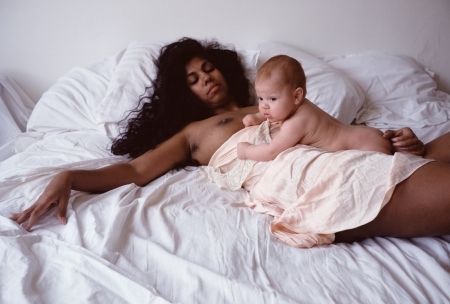
Photos (1985): Universal Themes
Sahel presented the last images by Diepraam as photojournalist; they would not return in his later work. Diepraam the Genauigkeitsfanatiker reached an impor t – ant turning point, and from 1985 he shut himself away from the media interest. He had also had enough of that kind of journalism; he decided to give no more interviews, and he turned down radio and television shows. He was seeking anonymity, and eventually found it. Diepraam: ‘I had very little interest in anything at that time, except for staring at my own navel. I was pre – occupied with my private life and the question of what my life was actually about. At that point I didn’t have any – thing useful to say about it. The pointlessness of the social pretensions of my work had proven ineluctable, so I didn’t have a message there. Besides, speaking in public via the media was not only unexciting, but the effect was always so imprecise as well. You could almost never tell your own story; there was almost no one who really wanted to know something. They all made their own story, and the stories never ever had anything that I was happy with afterwards. In addition, my work and my life were so subject to devel opments in my private life that even if I was discussing my work, private elements crept in again on the slightest excuse. And all that created was confusion and hogwash. With hindsight, I am glad that I escaped the public eye. It is one instance where I listened to myself properly. Since then I have only talked about things that concern me indirectly, for example about the work of other photographers if I curated an exhibition of their work, as was the case in the 1990s with Cas Oorthuys, Carel Blazer and Eva Besnyö. That suits me better. Then I can talk in a relaxed manner, and that is more pleasant for everyone.’ Diepraam was the curator of a series of exhibitions with accompanying catalogues about the three most import – ant founding fathers of reportage photography in the Netherlands for the Amsterdam Historical Museum. This was the logical outcome of his activities as a collector and his continuing journey of discovery in Dutch and international photography. ‘Intuitive processes play a big role in various creative aspects of photography and in collecting. These processes have proven to be to my advantage, but I rarely analyse them. That might lead to treacherous pitfalls. For example, if I were to mentally construct the notion that Robert Mapplethorpe is an over-rated photographer. Over the years I internalize this so that it becomes an idea that I live with comfortably. But then the cruel mirror suddenly confronts me with the question “Why?” Or I think, “What are all those people doing going on about the difference between documentary photography and art photography?” when I think I have known for many years that both forms are the result of essentially similar methods. I know that already, but in order to be able to explain it I may have to go and read up on neurology. ‘If you have seen as many images as I have, and find it easy to form these more or less casual ideas, then it is engaging to research, explain or demonstrate some – thing with precision from time to time. Primarily for yourself. You can do that by making exhibitions or by writing. Making exhibitions is closer to photography, more expressive, but it also has a concentrated intellectual component, which suits me. I have often made exhib – it ions about work of other photographers from various periods. I don’t have so much experience with writing and I have to put in far too much effort to compensate for the lack of quality, so it costs me a lot of pain but gives me a special satisfaction. Besides, it exercises the part of the brain that doesn’t get much chance with photog – raphy.’60 The profundity of the link between Diepraam’s private life and his work was demonstrated in 1985 when Diepraam published the album Willem Diepraam Foto’s Photographs.61 [p. 191] It was dedicated to his daughter Karolien, and not only included a selection from all his work since 1970, but also included portraits of his de – ceased wife Ria and two sons Michael and Jan, and por traits of his daughter Karolien, his wife Shamanee and his friend Henk van Nieuwenhuyzen. For those who were familiar with Diepraam’s personal life it was probab ly the most personal expression of the most pri – v ate emotions. Diepraam: ‘I didn’t compile that book in a balanced fashion. It had to reconcile all kinds of different interests. It was very much based on the idea that it would deal with all my negatives up to that point, and I had decided that it could also include extremely personal photos. That had a slightly stifling effect, because I was also privately compiling that book for the one hun – dred people who had known Ria and the children. So I was mixing up two different things that you shouldn’t mix. You can see that from the book.’ The book targeted the international art market even more emphatically than The Dutch Caribbean. It had a luxurious hard cover, a large format, and an introduction by Gerard van Westerloo in English as well as Dutch. For the reproduction of the photographs, Diepraam consistently employed what is known as a ‘museum approach’ in technical jargon: isolation and material – ization of the image, a single photo on each page, sur – round ed by generous white margins. This gave the caravan dwellers in Osdorp, the Hoogoven workers in IJmuiden, the Creoles in Suriname and the baker’ s assistant in Mali a charisma that they had previously lacked, or had only to a limited degree: not only were they suddenly the leading actors in a beautiful scene, but they had also become real people, no longer mere outcasts, the exploited, the oppressed or victims. The book included landscapes, Fatima pilgrims, critically ill patients in Amsterdam’s Binnengasthuis hospital and Emma Children’s Hospital, a series of photographs of a funeral on Aruba, a women in the throes of childbirth, a child’s corpse in a white coffin on the Cape Verde Islands and seductive cows’ eyes in Friesland. It was the road back to ‘The Family of Man’. Despite the uneven way it was compiled, there was an unmistakable leit – motif running through the book: human life and struggle in a beautiful yet terrible world. Van den Bosch com – mented that ‘tackling universal human themes such as birth, life, eroticism, work, religion, maternal bonding and death, Diepraam follows the road from the cradle to the grave. In doing this, he uses pictures from his private life as well as a great diversity of pictures of other people: from black to white and from poor to rich. In both its organization and its approach, this has strong echoes of ‘The Family of Man’, which was also a case of an infor – m al selection of documentary photographs founded on a universal human message.’62 From 1985 his working relationship with Vrij Nederland gradually changed. In the end the publication wanted to stay as it was; a primarily text-focused weekly. The edi – t ors had not appointed an art director. From 1985 to 1987 Diepraam still made reportages for the colour section of the weekly, where the space for text and photography meant they were mutually balanced. His contributions included reports about the Carré theatre [p. 190], ‘Living with Life Imprisonment’, and ‘Prognosis Zero. Diary from an AIDS Clinic’. The cover of this section usually had a colour photo, and there was another colour photo inside. The rest was black-and-white prints. The aim and the achieved result of the photographs was a careful composition combined with ideal content. In 1988, the last year that Diepraam worked for Vrij Nederland, the format changed. For a whole year he kept a Dagboek (Diary) [p. 134–147 and 192–193] every week in the form of a double-spread colour photograph, only mentioning the place and date. He not only experimented with motion blur, but also included photos of his private life, as in the 1985 book. Diepraam published portraits of his wife Shamanee, his daughter Karolien, his grandmother, a critically ill Ed van der Elsken, Johan van der Keuken with his wife, and Chet Baker, the jazz trumpeter Diepraam loved so dearly. There were many landscape photos and allusions to the art history, for example a ‘Renoir Photo’ of the Cabaret Paradis Latin in Paris, abstract images of weathered pavements in Amsterdam and two ‘enigmatic’ shots of cloudy skies, which a layman could not distinguish from kitsch. Diepraam: ‘When photography becomes such an intrinsic part of the way you express yourself, then some very idiosyncratic images arise in your own head. That can reach strata where I am almost certain that they will not be “read” in the same way by someone else. As with those clouds, the meaning is merely something highly atmospheric. It is risky to do that, because you can count on perhaps only 500 Vrij Nederland readers having a particular knowledge of the history of visual art, and aanrealizing that that photo fits in that continuum. It is extremely personal too. An image like that is about a desire to escape the world. It is like an exercise in dying: you are not there but you are still alive, something like that. That was the most extreme example of the way I experiment – ed with things in that column.’ The people who straddled the fence between art and journalism were, and still are, unpopular. The editors of Vrij Neder land felt that the diary was not informative enough, and the art world then still upheld a protectionist stance to wards ‘ foreign’ elements, Diepraam asserts.63 In Decem ber 1988 the photographer and the weekly parted ways. After the airline disaster on Tenerife in 1977, Diepraam used the insurance payment to purchase a large number of photos. But in the early 1980s he realized that it would be impossible for him to complete his own collection, even in his wildest dreams, because of the sharp price increases in the photo market. The comfort that he had initially gained from viewing and collecting beautiful pictures after 1977 had also worn off. From the early 1980s he collected photos much less voraciously. Around that time, the government bought the Hartkamp photo collection for an unprecedented sum. The govern – ment asked Diepraam to give his advice about the quality and value of the Hartkamp collection. After presenting his conclusions, Diepraam realized that his own collection would represent an excellent acquisition for the state and would yield a substantial amount of money for him. Shortly after, the Rijksdienst Beeldende Kunst (Netherlands Office for Fine Art; now integrated in the Instituut Collectie Nederland, the Netherlands Institute for Cultural Heritage) purchased the Diepraam collection for 1.69 million guilders. The photographs from the nineteenth century went to the Rijksmuseum, those from the twentieth century to the Stedelijk Museum. Provided for with this healthy financial buffer Diepraam not only decided to make further inroads into the art world, but also offered his time and services pro deo, i.e. for expens es only, to organizations such as Médécins sans Frontières and Novib. He did this until the birth of his son Maris in 1992, when starting a second family tied him more closely to home.
Lima: A Happy Sisyphus
In 1988, Novib set up a project called ‘Homeless in the World’. Diepraam and the designer Jurriaan Schrofer were asked to put together an exhibition on this theme to tour throughout the Netherlands. They decided to focus on the homeless of Lima. The resulting book, Lima [p. 150– 163 and 194], which Diepraam regards as one of his most successful publications, appeared in 1991, a co-production of Fragment Publishers and Novib supported by a subsidy from the then Ministry of Welfare, Health and Culture.64 The first three photos of Lima already show that Diepraam was pursuing a different objective with this book. No beautifully composed but still harrowing im – ages of suffering in the developing world, but something completely different. The first and only colour photo shows a girl dressed in cheery red against the almost colourless background of Villa El Salvador [p. 146–147] , the biggest slum in Lima. She is leaning relaxed against a line on which well-worn clothes have been hung out to dry and affectionately stretches out her hand towards a dog that is scratching its ear. Her almost unconscious gesture transcends all the misery of the slum. In the second photo a man is running across an unending plain of sand towards a destination that perhaps even he doesn’t know, chased by a pack of three black dogs that trails far behind [p. 150–151]. In the third photo, ‘Maria’s bow’, we see the immaculate white bow on the back of the girl’s head [p.152–153]. The back of her head is just visible through a hole in her slum, a motley construction of cardboard boxes, plastic bags and torn sheets of corrugated iron. The bow effortlessly holds its own against the desolate frame that surrounds it. We see the poorest of the poor parading their children with pride. A series of pictures about Maria’s family shows mother Carmen and father Ramón with their five children in their slum with its sagging bed, a wall of plastic sheeting, and other nondescript jumble that belongs with hardship and poverty. With loving attention, Ramón and son Marco look on as Carmen breastfeeds baby Ivon. These domestic scenes are set in a shelter that is a far cry from anything that might be termed a house [p.154–157 and p. 194]. Death features in a photo of a young family who have just buried their little child Nelida at the Nueva Esperanza cemetery. In other pictures there are building sites, traders, and a flower-seller who walks past Maria. On the page opposite the photograph of a scrubbed-out, almost obliterated daub on a wall, ‘The Symbol of the United Left’, Diepraam places a picture of a group of men, serious and devout as they carry a precious statue in procession and captioned ‘Procession in Holy Week’. The ‘other’ resonates in all of this: the message that life overcomes all misery, no matter how great, no matter where in the world. In the end, the love, the solidarity, the family and the joy of childhood are stronger than the dull poverty, the militant ideology, and the contempt and indifference of politics. Here is a photographer making a completely personal statement, transcending politics, transcending stock ideology, and transcending the third voice. Just like the fleeing man in the vast plain, on his way to unfamiliar remoteness, and then finding himself in the world of the slum, which essentially seems no different to the rest of the world. The text that Diepraam chose to open the book formu – lates what matters for him and the crux of his photographs in twelve succinct phrases. It is a quotation from The Myth of Sisyphus by Albert Camus. Sisyphus managed to foil death twice, and thus perhaps represents Diepraam’s main theme: death. Sisyphus was condemned by the gods to roll a boulder up a mountain for eternity. And even in this endlessly tormenting fate it is possible to find sense and life. ‘Each atom of that stone, each mineral flake of that night-filled mountain, in itself forms a world,’ Camus wrote. ‘the struggle itself towards the heights is enough to fill a man’s heart. One must imagine Sisyphus happy.’65 In other words, there is hope beyond the deepest despair, even in one atom of an immeasurably heavy boulder. Diepraam: ‘It is a matter of humility, the realization that what you have left is all there is. If life is nothing more than what it is, then that is what you have. That one thing then becomes an heroic luxury. That is what matters. It is about the overwhelming sense that you have that life and want to keep it. It is life or death. There is no compromise. This quote from Camus is quite literally about me personally. It is something that I have project – ed onto Lima, my view of human toil and drudgery. Sisyphus knows that all he has left is the path of futility. In that sense there is no more hope. But personally I am incapable of living without hope, and nor can most people. I can’t stop hoping and yearning, for others and myself. I am addicted to happiness. I know and feel to the core when I am happy and when not, whether I am experiencing happiness or whether it simply not there. In that respect, I am never uncertain.’
Landscape by the Sea
For his most recent photo book, Landschap aan Zee (‘Landscape by the Sea’)[p. 166–175 and 195], Diepraam went back to the grounds of the Hoogovens steel works in IJmuiden.66 He was given an atelier there, and for a couple of years he also lived there part of the time. The book then took shape in the same way as Lima. But while with Lima he had the feeling that he was projecting an idea, with Landschap aan Zee he projected himself. Diepraam: ‘The way the book was created was completely intuitive, without the slightest interference from the outside world. There was also no intention of making Landschap aan Zee as it eventually turned out. It grew from a constant production of photographs that eventually formed a whole. I don’t know how those images in came about. I wanted to make them. And I don’t know to what extent other people can understand them. All I know is that I made the book without any guiding outline. Remco Campert wrote two poems for me. I walked the steel works grounds with him, and told him something about my mood. The book is about impotence, about the fact that things in life don’t go as you want, about the inability to control the big things in my life. At that time it became clear to me that I have no more certainty in those big things. My fear of that impotence is gone. I have now become used to that feeling of insecurity, which extends to all the relationships that matter. In Lima there is almost no blackness; it is a very pale greyness, greys that fade to whites. They are extremely soft, white and fragile, but not sombre greys. Landschap aan Zee was made in dark greys, which darken to black. That encapsulated the difference in colour. The colour that hangs like a veil over the periods when I made those books.’ Landschap aan Zee is also, perhaps primarily, a book of a loner, an Einzelgänger, who does not merely photograph the landscape of his soul without embarrassment, but also publishes it. Willem Diepraam: ‘The job of photog rapher is that of a loner. That is exactly the same for my brother’s profession. What our parents gave us has equipped us perfectly to be self-sufficient. We are both dependent on love and on our sexual partners. That means we live in a small world with people who really matter.’ The position of loner also provides the so deeply desired freedom, without which an artist cannot be – come what he wants. And it affords him distance from the time in which he lives: ‘Of course I am indebted to these times, even if only because I have to raise my own children. But in other respects there is nobody obliging me to adopt any of the traits of the zeitgeist. It is non – sense to think that all the important things happen in your day. It is a serious error to take your own times more seriously than they are. In that respect I live out – side these times.’ This is why the best photos by Willem Diepraam will endure for longer than the split second they were shot.


 You probably did not know, but Salvador Dali was one of Gaudi’s greatest fans……The year 1976. Salvador Dali was commissioned a cover for the edition on the Gaudi project for the COLONIA GUELL. He made the cover and it was used for the edition of 100 copies on the project. A scarce publiction and numbered beside the blind stamp of the Catedra Gaudi institute ( High School of Archtecture). This numbered publication is now available at