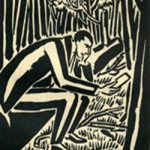
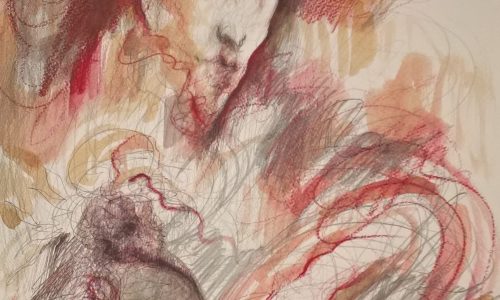
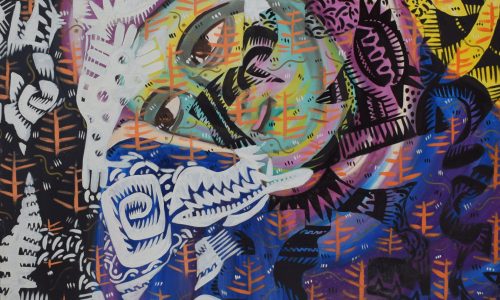
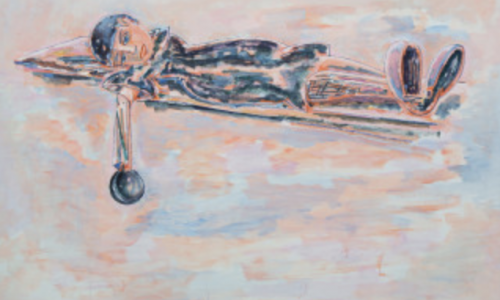
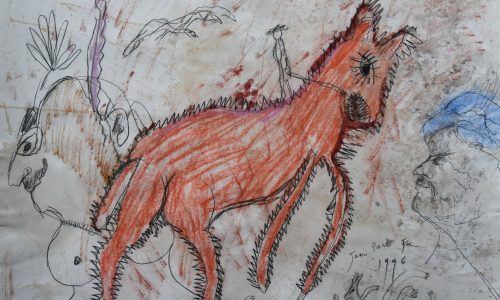
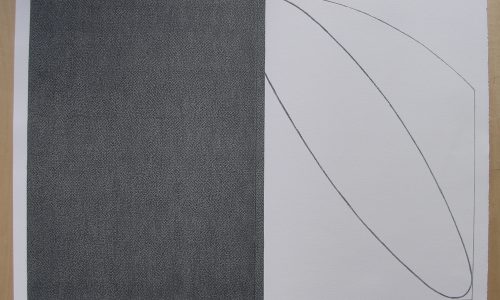
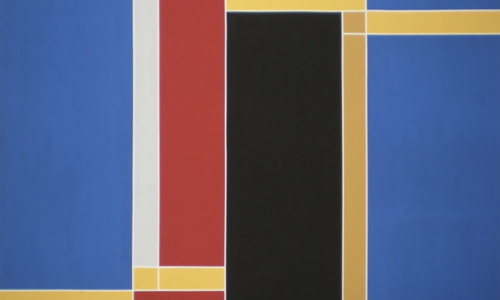
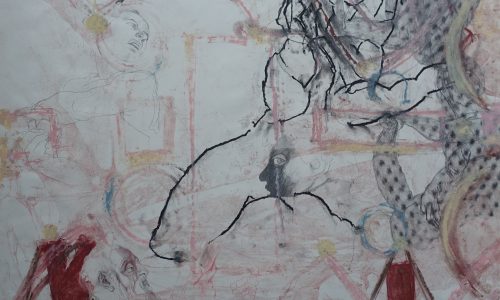
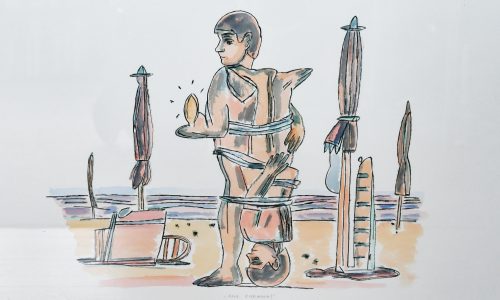
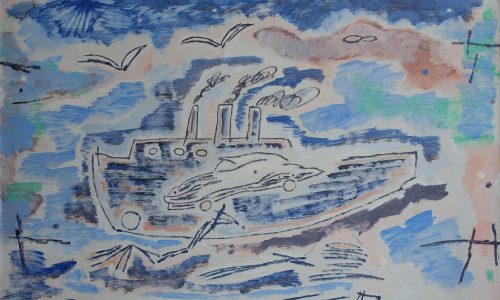
Stephen Gilbert (15 January 1910 – 12 January 2007) was a painter and sculptor from Scotland. He was one of the few British artists fully to embrace the avant garde movement in Paris in the 1950s.
At one time he even was considered to be one of the members of the COBRA mouvement, but now, some 60 years after COBRA most critics think Gilbert knew the Cobra artists but do not consider him to be one them. Still his paintings and drawings deserve to be appreciated. His almost child like works are close to Cobra, but some of his more abstract works are typical for the end of the Fifties. It really depends upon the work. Some are great art and others are far from that qualification. The galerie 1900-2000 tried to push his works into the art market in 1987 with a special Stephen Gilbert exhibition ( catalogue avaiable at www.ftn-books.com), but was not successfull. If you like his works, the works by Stephen Gilbert cab be found at smaller auction houses for still reasonable prices than the great CObra names fetch for thier art.
This blog is devoted to the “golden” paintings by Remo Bianco. The studio Delise catalogue , which contains many examples of these golden paintings, is now available at www.ftn-books.com. The reason is that the paintings remind my of the golden minimal painting by Tomas Rajlich. Different but somehow they have a same approach to the canvas. They devide the canvas into equal parts and the golden layer is vissible in each adn every square.
The Tableaux Dorés series was executed by Bianco from 1957 as a development from his Collages. They represent one the most well-known cycles of the artist, and also the one that lasted the longest amount of time.
Bianco observed: “In 1957, in Milan, I applied some small sheets of gold leaf to a collage surface, after having painted it as a monochrome. The result was a two colour artwork, like a herald. This experience was probably the most ongoing of my researches. I continued this research for years, sometimes alongside other new Collages and other research”.
The two-colour backgrounds, oil or enamel paint, to which the gold leaf is subsequently applied, often have a white part alongside a red, blue or green surface, as well as other coloured surfaces. There are also some Tableaux Dorés with a monochromatic background or made with straw or fabric. These works stand out because of the light that radiates from the golden “tessera” (squares) the surfaces of which, irregular and frequently appearing veiled by shadows, create a counterpoint to the preciousness and fragility of the material. As expressions of a “contemplative maturity”, the Tableaux Dorés can be interpreted as “a sort of curtain that the artist brings down so that the viewer’s eyes can investigate the surface and beyond it but, at the same time, they shun theatricalism, instead proposing absolute silence” (P. Biscottini 2005).
Tnere are several Bianco publications available at www.ftn-books.com
Meitner operates on the crossroads of scienceand art and is inspired by scientific glass objects.
The intellectual, poetic, and always changing work of the American artist Richard Craig Meitner reflects a variety of influences and ideas, from Japanese textiles and Italian painting and applied arts to science and the natural world. The colorless glass surfaces of his quixotic objects often incorporate assorted materials such as rust, enamel, bronze, tile, paint, and print. Meitner revels in unusual juxtapositions of forms and ideas, in unanswered questions, and in the intersections between art and science.
“Perhaps we can say that art and science are attempts, by very different methods, to get at the same truths. Both are directed at finding out more about ourselves, and the universe we inhabit, by studying and recording. Science attempts to explain the universe by assuming causality, linear time, and the existence of hidden rules or patterns which, if diligent enough, we can discover and understand. Art attempts to explain the universe more intuitively, emotionally, and even magically. Science depends largely on the genius of the intellect, and art on the genius of the spirit.”
Blog readers know of the importance of Benno Wissing for dutch typography and design and today i present one of the really scarce publications by Wissing he made for the Museum Boymans van Beuningen in 1951. A smaller sized catalogue which has the typical Wissing qualities of transparent , but personal design by Wissing. It is on the exhibition ” 19e EEUWSE EN MODERNE SCHILDERKUNST UIT HET MUSEUM VAN SCHONE KUNSTEN TE LUIK “. A catlogue which i did not know existed but what appears to appear one of earliest of designs Wissing made for the Museum Boymans van Beuningen in 1951. The condition is still excellent and looking and searching for this publication on the inytern et i did not find another copy for sale….so scarce andf now available at www.ftn-books-com.
Painter, printmaker. Took up painting as a teenager while convalescing from an infection that ultimately cost him a leg. Began formal studies in Weimar in 1870. Initially painted large-scale landscapes, working successively through academic, naturalist, Impressionist, and Neo-Impressionist styles. In 1901 left Weimar for Hagen at urging of collector Karl Ernst Osthaus, who offered him a studio in the modern art museum he was establishing there. Through this exposure to the avant-garde, including meeting Edvard Munch in 1904 and Emil Nolde a year later, and seeing Van Gogh’s choppy brushstrokes and vibrant coloring, his work moved into its final, Expressionist phase.
Made first of 185 prints at age sixty, in 1908, after seeing an exhibition of Brücke prints. Aside from two lithographs, worked exclusively in woodcut and linoleum cut. Rarely editioned his work, preferring to create unique or variant impressions by hand-printing his own blocks, which he inked with a brush and then printed through rubbing or by applying pressure from a weighted cigar box. Concentrated mostly on figurative subjects, as well as biblical themes in response to World War I. Stopped making new motifs in 1926, but continued printing new impressions from old blocks.
In 1937 Nazis expelled him from the Prussian Academy of Arts, condemned him as degenerate, and removed 412 of his works from public collections.
In the late Fifties and Sixtie there was a raised interest in Rohlfs and as a result some exhibitions were organized with his works. www.ftn-books.com has some of these publications available.
Last Saturday dutch photographer Paul Blaca died. His body was worn out after years of drug and alcohol abuse. Without Blanca dutch photography would have been half as interesting as it is now. He was self taught and discovered and explored portrait photography in a very special and own way, transforming it and perfecting it into his preferred form of photography.
the following text comes from the Paul Blanca site:
Paul Blanca (1958) is a Dutch self-taught photographer who started with a Canon F1 and later switched to a 6×6 cm Haselblad camera. In the 80s he created a series of violent self-portraits inspired by Robert Mapplethorpe (1946 – 1989) and Andres Serrano. Mapplethorpe introduced Blanca into the art world to artists like Grace Jones and Keith Haring stating “Paul Blanca is my only competitor”. Mapplethorpe’s favourite was Blanca’s self-portrait ‘Mother and Son’.
Hans van Maanen and Erwin Olaf call Paul Blanca the photographer of emotion. That ties in with his work. His self-portraits run like a thread through his overall work. For some things you can’t ask a model. For example, to hit a nail through someone’s hand. And like the self-portrait Mickey Mouse. In which a smiling Mickey Mouse is carved into his back with a thumb up.
For his series ‘Par la Pluie des Femmes’ women were captured in tears by thinking of their most traumatic experience. When he lived in Spain for 2 years, he stood with his camera at the front of the Spanish bullfighting arena. This resulted in the portfolio Sangre de Toro (Blood of the Bull): silk-screen prints with Bull’s blood.
In the beginning of the 90s he photographed the facial expression of speedball hookers for the series ‘Wit en Bruin’. Speedball is a very dangerous mixture of cocaine with heroin or morphine and has a substantial risk of overdose.
In the series ‘Deformation’ he was inspired by Rob Leer‘s SM scene. Models mutulated by fishline and hanging in the air, supported by the same fishline. This series was made for Amsterdam International Fashion Week (AIFW), in collaboration with fashion designer Hester Slaman, and exposed in Apart Gallery Amsterdam.
With the series ‘Kristal’ and ‘Mi Matties’ he had a double exhibition at Witzenhausen Gallery in 2008. Kristal is a series about the sweet and the bitter in relation with women. Presented in Witzenhausen Gallery Amsterdam in 2008. Mi Matties (my friends) is a series made in one of the neighborhoods of old Amsterdam. The portraits show young men who are presenting themselves as a group, sort of a gang.
In 2014 he created a self-portrait ‘Mother and Son’, 32 years after the first self-portrait, where he carries his mother, just like he carried her to bed for 4 years because she couldn‘t walk.
I know of many artist who at one time in their lives were invited to decorate a church or execute stained windows. In the Netherlands it is Marc Mulders who is the best example. Acroos the border many other names like Matisse, Rothko, Foujita and Chagall and recently i discovered that Robert Combas made his own contribution to this kind of art. The exhibition was held at the Vieille Église Saint-Vincet in Merigmac / France.
Impressive paintings of arguably the best of all Figuration artists. Catalogue is available at www.ftn-books.com.
The French artist Robert Combas has become known as one of the protagonists of “Figuration Libre”, the French form of new figuration in the 1980s. Robert Combas was born at Lyon in 1957, he grew up in Sète, where he also began to study at the “École des Beaux-Arts” in 1974. Between 1975 and 1980 he completed his studies at the DNSAP in Montpellier. In those years the Punkrock movement had decisive influence on Robert Combas. In 1978 he even founded a band, together with Hervé di Rosa and Richard di Rosa. In 1979 Robert Combas, Hervé di Rosa and Ketty Brindel published the art magazine “Bato”. From those days on, Robert Combas was able to establish himself as painter and graphic artist in the style of “Figuration Libre”. Along with Rémi Blanchard, François Boisrond and Hervé di Rosa, Robert Combas was a founding father of the artist group of the same name. Comics and graffiti inspired his works, Pop Art and Arabian art can be named as additional sources of influences. Strong and striking colors with black contour lines increase the effect of his images. As of the late 1980s an increasingly mystical tendency can be observed, Robert Combas’ works are darker and gloomier. In the 1990s Combas expanded his field of artistic activity: He writes poetry and works photographs over with felt tip pen, assemblages are also part of his oeuvre. After the turn of the millennium music became a great source of inspiration for Robert Combas once again, and he made large paintings in cooperation with rock bands. “Ma peinture c’est du rock”, my painting is rock music, said the artist about his work.
Most people do not know it and personally i did not realise the relationship between Drachten/ Dr8888 and the Dada and Merz mouvements until recently.
But it appears that some of the artists from Friesland had strong relationships with Dada artists and even were influenced by them . In the same way Dada artists freed themselves from the bourgeois morality, Werkman tried to do the same, although freedom in morality was less important than having a free spirit, searching freedom in his art. The Museum in Drachten finally realized some decade ago that their true importance was this heritage. Dada in the Netherlands is nothing else than Dada in Friesland and Drachten. They made a choice and exploited this heritage since and with one of these exhibition a magnificent catalogue was published, which is now available at www.ftn-books.com
The reason for this blog is that i lately found sand deiscovered some interesting Pop Art artists in Germany and Switzerland and Peter Stämpfli is one of them.
Born July 3, 1937 in Deisswil, Switzerland Stämpfli is a Swiss painter of the Pop Art movement. A major figure in 20th century painting, Peter Stämpfli has always scrutinized everyday life: our environment, our objects, our gestures. However, far from being satisfied with the simple appearance, his work has endeavored to reveal the depth and the strength that it contains. From 1963, the artist devotes himself to a work of inventory of all the repetitive details of everyday life, which he methodically fixes on a white background. The artist isolates, from 1969 until today, the pattern of the tire, emblematic of our industrial society; it quickly becomes his favorite theme and offers countless variations. Interview with an artist who appropriates his entourage in amazing simplicity to invent his own icons… an absolutely Pop art.
www, ftn.books.com has added a Centre Georges Pompidou title recently. It is the book published on the occasion of the 1981 Paris exhibition in the Pompidou museum.
Two names triggered me to look a little closer at the works of Pieter Stoop. The fact that the book now available at www.ftn-books.com comes from the personal colelction of Henk Peeters and….. Rudi Fuchs, who was responsible for showing Stoop his works at the van Abbemuseum. Stoop was influenced by Soutine,de Kooning and van Velde and it shows, but what becomes clear after studying more works from him is that he deswtilled a style of his own from these influences.
Artist/ Author: Oliver Boberg
Title : Memorial
Publisher: Oliver Boberg
Measurements: Frame measures 51 x 42 cm. original C print is 35 x 25 cm.
Condition: mint
signed by Oliver Boberg in pen and numbered 14/20 from an edition of 20