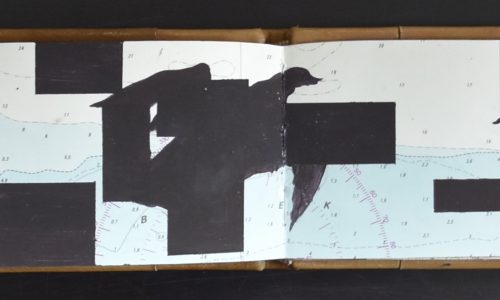
Piet Dirkx cigarbox 776

Piet Dirkx cigarbox 776

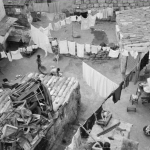
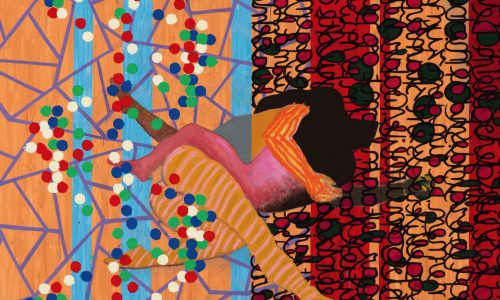
It took me a very long to finally acquire a Ronald de Bloeme painting for our collection , but finally we found one and added it on the 2nd of October 2018. It is one from the series “Oil On Postal bags” and comes from the former Hans Sonnenberg collection.

This collection was split up and auctioned some months ago and this work found in the end its way to our collection. It is an impressive painting and shows exactly why de Bloeme becomes more and more important in modern art. The series of postal bag paintings was partially painted at the time he was in residence at the Kunstlerhaus Bethanien where he made several of these large paintings. Postal bags stitched to each other and with their original postal prints still on them, de Bloeme made a composition on them in which points, arrows, dots, numbers and stripes are attached to each other, making a composition in which you can see that the subject is COMMUNICATION in all its appearances and the essence of this series of paintings. The feel of the canvas is totally different than expected. You expect a coarse surface, but this is not the case. The surface feels like nylon and it looks and feels more like a sail or a tent canvas.
The painting that we now hold in our collection has all these symbols included. Planes, dots, postal bags from czechoslovakia, Turkey and India symbolize the routing of the planes and the dots could stand for all the places that are reached in these countries. Of course this is my personal interpretation, but it is for certain a very impressive and important painting.
The painting is depicted in the Ronald de Bloeme Bethanien catalogue on page 33 and it is available at www.ftn-books.com

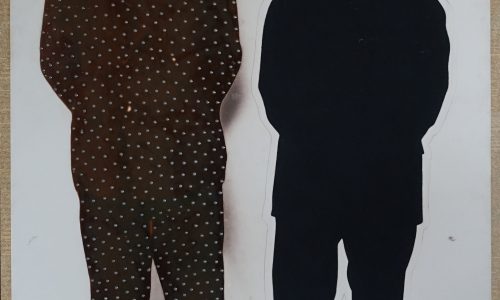
Piet Dirkx cigarbox 775

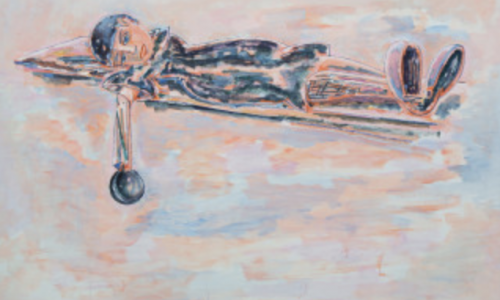
Just take a look and see that i added this beautiful hypnotizing Ossip to FTN collection about 2 months ago at www.ftn-blog.com. It comes from the the Vescom collection . A collection which was created over the last 3 decades and was sold at auction in Amsterdam. I was lucky to buy this “JONGEN” by Ossip together with 2 works by Joris Geurts ( in another blog later). This “Jongen” is one of the more “static” works . It has the same qualities as the works he presented in his exhibition at the Gemeentemuseum Den Haag . Most of the works i know of have moving parts but this late Nineties /early 2000 work was made when composition and image were the typical Ossip elements within a work of art. I know that there exists also a larger version of ” JONGEN” which is depicted in the Ossip monograph , but this version measures 112 x 89 cm. and is signed and dated Ossip, 23-11-2003 and now available at www.ftn.blog.com

Piet Dirkx cigarbox 774

Andre Emmerich was an exceptional art dealer. Robert Motherwell introduced Emmerich to “the small group of eccentric painters we now know as the New York Abstract Expressionist School”. During the second half of the 20th century the Emmerich Gallery was located in New York City and since 1959 in the Fuller Building at 41 East 57th Street and in the 1970s also at 420 West Broadway in Manhattan and in Zürich, Switzerland.
The gallery displayed leading artists working in a wide variety of styles including Abstract Expressionism, Op Art, Color field painting, Hard-edge painting, Lyrical Abstraction, Minimal Art, Pop Art and Realism, among other movements. He organized important exhibitions of pre-Columbian art and wrote two acclaimed books, “Art Before Columbus” (1963) and “Sweat of the Sun and Tears of the Moon: Gold and Silver in Pre-Columbian Art” (1965), on the subject.
In addition to David Hockney, and John D. Graham the gallery represented many internationally known artists and estates including: Hans Hofmann, Morris Louis, Helen Frankenthaler, Kenneth Noland, Sam Francis, Sir Anthony Caro, Jules Olitski, Jack Bush, John Hoyland, Alexander Liberman, Al Held, Anne Ryan, Miriam Schapiro, Paul Brach, Herbert Ferber, Esteban Vicente, Friedel Dzubas, Neil Williams, Theodoros Stamos, Anne Truitt, Karel Appel, Pierre Alechinsky, Larry Poons, Larry Zox, Dan Christensen, Ronnie Landfield, Stanley Boxer, Pat Lipsky, Robert Natkin, Judy Pfaff, John Harrison Levee, William H. Bailey, Dorothea Rockburne, Nancy Graves, John McLaughlin, Ed Moses, Beverly Pepper, Piero Dorazio, among others.
Between 1982-96, Emmerich ran a 150-acre sculpture park called Top Gallant in Pawling, New York, on his country estate that once was a Quaker farm. There he displayed large-scale works by, among others, Alexander Calder, Beverly Pepper, Bernar Venet, Tony Rosenthal, Isaac Witkin, Mark di Suvero and George Rickey, as well as the work of younger artists like Keith Haring. Many of the above mentioned artists are available with different publications at www.ftn-books.com
, but FTN books also has some specific Emmerich publications available.
In 1996, Sotheby’s bought the Andre Emmerich Gallery, with the aim of handling artists’ estates. One year later the Josef and Anni Albers Foundation, the main beneficiary of the Albers’ estates, did not renew its three-year contract.The gallery was eventually closed by Sotheby’s in 1998.

Piet Dirkx cigarbox 773

For Paul Cuvelier comics were a necessary way to earn money. His true heart lay in painting and sculpting, especially nudes which showcased his passion for the beauty and anatomy of the human body. Cuvelier’s fine art was characterized by a sensuality which has been described as “slumbering eroticism”. The same can be said about some of his comics. Even the juvenile heroes in his ‘Corentin’ stories are scantily clothed most of the time. The friendship between Corentin and Kim can be interpreted in the same homo-erotic subtext as the companionship between Jacques Martin’s Alix and Enak. His final ‘Line’ story also featured a more sexy presentation of the heroine. The 1973 ‘Corentin’ story ‘Le Royaume des Eaux Noires’ featured much nudity and hinted at a sexual relationship between the protagonist and Zaïla. By then, Cuvelier and Van Hamme had already created their groundbreaking erotic graphic novel ‘Epoxy’ (1968).
‘Epoxy’ was created in the wave of adult-oriented comics, which found its breeding ground in the American underground comix movement. The first generation that grew up with the post-war comics continued to embrace the medium, which opened up new possibilities for creators. Free from the restrictions of working for the children’s press, authors could now aim their work at a mature audience. In Europe, magazines like Pilote and Hara-Kiri were at the vanguard of this new movement. Frenchman Jean-Claude Forest‘s sci-fi heroine ‘Barbarella’ (1962) was the first character that embodied the sexual revolution of the 1960s.
In Belgium, Guy Peellaert had pioneered the comics eroticism with his stories ‘Les Aventures de Jodelle’ (1966) and ‘Pravda, la survireuse’ (1967), while Guido Crepax heralded in the “sexties” in Italy with his ‘Valentina’ (1965). Dutch authors Thé Tjong-Khing and Lo Hartog van Banda released their pop-art inspired graphic novel with the sexy ‘Iris’ in 1968. Cuvelier and Van Hamme’s ‘Epoxy’ fully presented the artist’s qualities for sensual artwork, against a story inspired by Greek mythology. Created in 1967, the album was released by the Paris-based Belgian publisher Eric Losfeld in the revolutionary month of May 1968. It initially didn’t catch much attention, but in later years its historical importance was recognized for being one of the first independent and fully erotic Belgian comics. It has been re-issued in later years by Horus (1977), Marcus (1981), Clue Circle (1985), Éditions Lefrancq (1997) and Le Lombard (2003). German and Scandinavian translations of ‘Epoxy’ were however published without the knowledge and consent of the authors, who consequently never received royalties from these editions.
Paul Cuvelier spent the final years of his life in poverty, and in a constant search of artistic fulfillment. A final attempt to pick up ‘Corentin’ was made in cooperation with Jacques Martin, who wrote the script for ‘Corentin et l’Ogre Rouge’ (1973). Cuvelier abandoned the project after the first pages, which were published posthumously in the monography ‘Paul Cuvelier: Corentin et les chemins du merveilleux’ by Philippe Goddin in 1984. Martin later used the plot for the ‘Alix’ story ‘Les Proies du Volcan’ (1978). Jacques Martin also picked Cuvelier as his first choice to draw his historical comics series about French serial killer Gilles de Rais. Cuvelier was however not interested, and was revived by Martin and Jean Pleyers for the series ‘Xan’ (1978, later renamed to ‘Jhen’). Pleyers was Cuvelier’s pupil during his final years. In an interview in L’Est Républicain in 1993, Pleyers recalled squatting with Paul Cuvelier during most of the 1970s, living in “old embassies, surrounded by homosexual drug addicts”. Another assistant of Cuvelier was the Spanish artist Juan Lopez de Uralde, who helped him with the last pages of ‘Corentin et le Prince des Sables’ in the late 1960s. Paul Cuvelier’s final work included some erotic illustrations for Privé magazine in 1975, and the preparations of an exposition with the theme “Fillettes” (“little girls”). The artist however passed away in 1978 in Charleroi at the age of 54 after years of declining health.The extremely large folio edition by Blue Circle is available at www.ftn-books.com

Piet Dirkx cigarbox 772

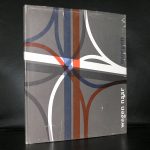
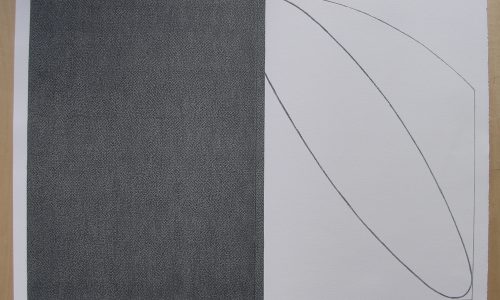
Last week i found at the local bookmarket a special artist book by Hendri van der Putten. The book was made for the exhibition of Hendri in the Apollohuis in 1988.The artist book consists of 16 pages of which 5 are silkscreened with lines across the pages and on the edges…. a very delicate yellow. an exquisite book which is now available at www.ftn-books.com