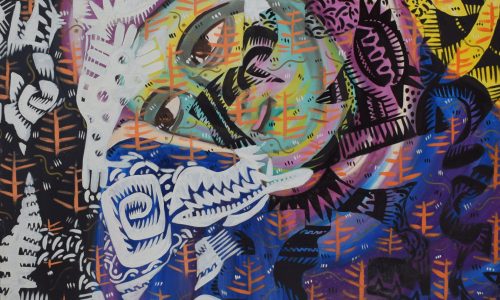
Hollandse Specerijen/ 10 grote Dromen has also a Piet Dirkx contribution.

Hollandse Specerijen/ 10 grote Dromen has also a Piet Dirkx contribution.

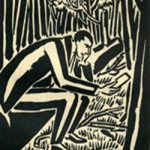
Claus was a very gifted Flemmish artist who had one specialty… he made almost exclusivily drawings and within these drawings he rarely used color. This made his work highly recognizable and because of the size of the drawings , some very nice publications were published. These artist books have now become very desirable and highly collectable books and www.ftn-books.com is lucky to have several titles available.
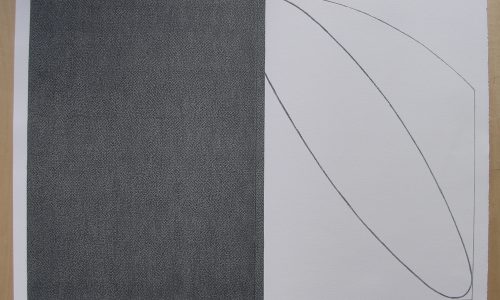
Claus was a master in creating an empty space with just a single form within. One of his favourites was a head on a rectangular plinth. With this drawing he creates an image of a sculpture but which was `ctually just a 2d drawing. Claus left about 30 sketchbooks in which it is made clear how he searched for abstraction.
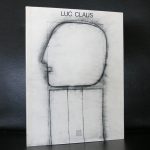

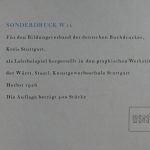
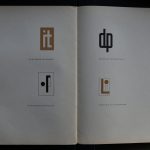
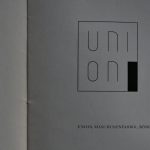
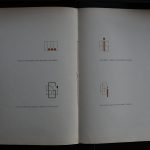
I am proud to have finally found one of these iconic publications by the Staatliche Kunstgewerbeschule Stuttgart. It was a lucky find, but still one i have been looking for for for many many years in the past. The location was secret for many years because it was protected by another book which i recently had bought and which is roughly from the same date. It must have been the former owner who knew its value and wanted to protect the precious publication. These Stuttgarter Hefte were published in only 400 copies in the mid Twenties and printed in the printing rooms of the Kunstgewerbeschule. Everything is special about these publications. Sizes are far larger than usual. The lay out is impressive and the designs are true avant-garde for those years. This one was printed in 1926 and as said in an edition of only 400 copies. I am sure that only a few have survived over the years and most of these have found new owners or are in important libraries. I found the set being a part of the MOMA collection and when i tried to find other copies on the internet….. i found as expected…. ZERO of them. Now this excellent copy is for sale. On a scale of 1 to 10 i would rate this one at 8+ points
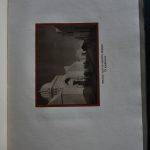
Pictures tell a better story so here are some of the pages an designs of this truly remarkable publication.

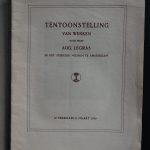
To be honest … i had never heard of Legras before, but the catalogue is impkrtant enough to add it to my inventory. Since this is rare. Published in a time that the world was at war and the Netherlands was neutral. What struck me, is that like many of his fellow artists Legras was charmed by North Africa. he visited countries and villages and translated his observations into drawings and paintings. This catalogue is special and a very welcome addition to all who collect the Stedelijk Museum catalogues.


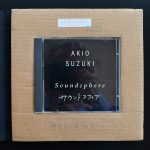
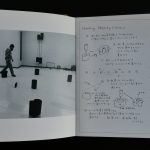
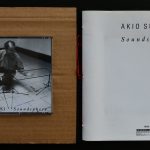
It was the Apollohuis who introduced Akio Suzuki to a dutch audience and since i have been following Suzuki. Finally i have found another copy of the Akio Suzuki Soundphere cd package that was published in 1990 by HET APOLLOHUIS. The package contains a booklet and a cd and is one of the hardest to find of all Suzuki publications.
| De Koolmees: Suzuki Type – Glass Harmonica | 23:37 |
| Analapos A: Voice | 14:41 |
| Analapos B: Multiple Stand | 22:43 |
| Analapos C: Object For A Single Person | 9:13 |


The following article can be found at the Mutual Art site:
https://www.mutualart.com/Article/Grave-Architecture–How-Leon-Kossoff-Bui/451BDAE66E6E3100?source_page=Magazine&utm_source=MutualArt+Subscribers&utm_campaign=587eaad649-nl_20_07_19&utm_medium=email&utm_term=0_0a9ce6ca24-587eaad649-445942749&ct=t(EMAIL_CAMPAIGN_10_5_2018_13_56_COPY_01)&mc_cid=587eaad649&mc_eid=129d9ef3a9
Earlier in July, British painter Leon Kossoff passed away. Sometime between 1939 and 1943, he entered the local museums at King’s Lynn, the Norfolk town in which the painter spent three years as a wartime evacuee. Here he saw paintings by local brothers, Thomas and Henry Baines, depicting the town’s famous-ish architecture (Daniel Defoe described the place as “well built” in the early 1700s).
This was Kossoff’s first experience of the productive tension between two-dimensional painting and three-dimensional structure; his first intimation of how the flat, framed surface could hold interior space and exterior space at once. It was the experience of leaving London, the buildings which had surrounded him in his native Islington falling away as he left for more rural surroundings, which piqued his interest in architectural painting. A sketch done during this time of the local King’s Lynn Customs House is Kossoff’s first architectural study. Later, he made pictures with oil paint so thick it was more like a built environment than a painted one, allowing the material to fall away from the surface and be rebuilt in waves.
The Baines brothers made technically neat, emotionally sentimental studies of the town’s North Gate, the Kettle Mill, the squat, brick-worked, 15th Century Red Mount chapel. Thomas Baines and others also painted several views of the Greyfriars Tower in Norfolk. The tower stands firm and alone, the only surviving fragment of the Franciscan monastery which was demolished after Henry VIII’s dissolution. Today, it is recognised as the finest among the three surviving Fransiscan monastery towers in England.
Thomas Baines depicts the tower standing proud in the far right of the frame, facing down a blazing wave of nimbus cloud at sunset. The shorter buildings around it are as subservient as the cows in the foreground, lying at the feet of two upright humans. The dominion of man over animal is clear in the painting’s composition, but the tower itself seems to suggest a structural means by which man can reach towards the divine.
To Kossoff’s young mind, the painting would’ve echoed the newspaper images showing blitzed London burning behind St Paul’s cathedral. Much less a case of man challenging the divine, great architecture came to symbolise, for Kossoff and the artists of post-war Europe, the rebuilding of the human soul after the inimitable evils of the holocaust, the blitz and the “moral bombing” of Germany by the victorious allies.
After returning to a bombed-out London, Kossoff began a career of architectural painting, which in turn informed his intimate brand of formal portraiture. The house he had grown up in had been razed to the ground by German bombs, and much of the London landscape underwent significant change in the rebuilding process.
St Paul’s Cathedral became a symbol of London’s resistance, of home-front stoicism, as it withstood the blitz. Kossoff complicates this line of thought with his painting, Small Landscape With St Paul’s (1960), a thick, swathy abstract in monochrome, diminutive in size. It has none of the upright architectural theism of the Baines monastery tower. Through the viscous, massy material of his own grave architecture, Kossoff communicates the difficulty of wading through post-war fallout.
A portrait from the same year, simply entitled Head (1960) has a similar vibe, the low-drooping of the sitter’s forehead seeming troubled, disgruntled, the currents of thick paint dissolving their form into the abstract
By the 1980s and 1990s, Kossoff built up the layers of his paint to a more firmly structural, figurative end. One of his self portraits from 1972 shows the angle of the head inclining slightly in comparison to earlier portraits. Later still, his celebrated portrait of his brother, Chaim, shows a proud and firm sitter, chin raised, hands locked like buttresses, looking down at the viewer. Maybe even a little haughty. It’s not dissimilar, in manner and attitude, from the dramatic perspective of his famous views of Christ Church, Spitalfields.
Even as he builds form throughout the decades, Kossoff’s paintings still always reverberate with some sonorous and unsettling boom, still rush and flow with the headlong motion of time. The sheer drama of a 1990 preparatory sketch for one of his Christ Church paintings is sufficient to show this.
Some of what moves Kossoff’s best paintings, however, is a certain warmth, a faith in the human animal, and an embodied, tangible sensation of London community. Perhaps this is best communicated by his series of swimming pool paintings. Like Kossoff’s paint dripping off the canvas and being reapplied, the water drips from the skins of the bathers. (The heavily-applied oils of many Kossoff or Aeurbach paintings are so thick that they hover between matter-states, half solid half liquid, never truly dry [like an ancient stained-glass window bulging at the bottom]). Similarly, the people captured merge and mingle with the water. Osmosis occurs between their bodies, between the waters, the different kinds of interiority going on here, all suffused with a natural sunlight which glints artificially off the poolwater. There’s a sense of true community, a dialogue between water and structure which includes the human.
Sometimes, things need to fall away to find their form. Kossoff, who built paintings, knew the differences and the non-differences between structure and fluidity, whose fluxes might be the roots of the human soul.
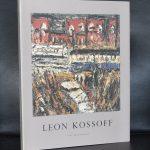
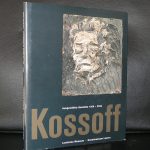
www.ftn-books.com has some nice Kossoff titles available

Emmy Andriesse was married to another famous dutch graphic designer. Dick Elffers was her husband and together they formed a formidable and important artistic couple. Where Elffers excelled in design and typography,
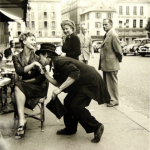
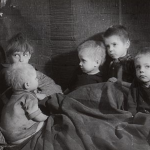
Emmy Andriesse found her artistic goal in photography. Het photographs belong to the best dutch photography has produced in the 20th century. People were her main subjects, but beside her portraits and scene photographs she proved to be an excellent landscape photographer too. At one time she travelled to Arles to photograph what van Gogh must have seen in his days and these photographs belong to the best ones she ever has made.
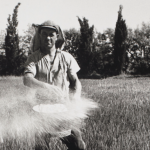
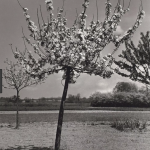
Book available at www.ftn-books.com. Het photographs have a social element which was rare and give an extra depth to the scenes she photgraphs.

Another rare exhibition catalogue is the one Piet did for his Sao Paulo Bienal exhibition in 1987,


A blog on an artist , who is foremost an illustrator, but of whom i discovered recently that she had made a series of intrigueing paintings which were on exhibition in 1988 at the Dordrechts Museum. The series of VIJVERSCHILDERIJEN are highly typical for the works that were made at the end of the Eighties.

They remind me a little of the works by Gerard Verdijk . Ik feels like Verdijk meets Marc Mulders in his studio and they decied to make a large sized painting together . These ara truly large sized painting of 400 x 260 cm. and perhaps that is the reason why i was so surprised to find these large paintings since i only know the small illustrations by ten Bosch.


His first exhibtion was held in 1966 at galerie 20 and since Walter Nobbe has had a loyal following of admirers. He was a master in drawing and painting the male figure and since his early days as an artist he belonged to the ABN group. Together with Pat Andrea and Peter Blokhuis he formed this group of young painters who were considered as the “creme de la Creme’ of dutch new realistic painters. Nobbe deserves a reappreciation of his art.
It has beside a high level of Craftmanship some great artistic components that make these work stand out from other from this era. Nobbe has had a loyal following. Specially in Den Haag and surroundings his works are well known. Pulchri and Gemeentmuseum have had his works frequently on show during exhibitions. Still, ask about Nobbe outside the region and his name becomes less familiar and that is a pity.
www.ftn-books.com has some nice Nobbe publications including a limited signed edition