Posted on Leave a comment

Louis C. Kalff (1897-1976)

Louis C. Kalff (1897-1976) was a designer and art director at Philips for advertising, products, exhibitions, and stands, as well as being an architect. Growing up in a prosperous environment in Amsterdam, his father was a lawyer who later became a journalist and the art and editor-in-chief for the Algemeen Handelsblad. Kalff attended HBS and the Quellinusschool for a year before studying architecture in Delft in 1916. During his studies, he designed posters, banners, and costumes for student celebrations. In 1923, he completed an internship with architect D.F. Slothouwer.

Kalff applied to work at Philips through a letter, stating that the company’s advertising was not modern enough and lacked “standing.” In 1925, he was put in charge of the commercial and artistic propaganda departments. In articles and memoirs, Kalff claimed that he wanted to standardize the Philips brand and emphasized the unity and international aspect of the company’s image. He also designed products, stands, exhibitions, and light shows for Philips. In 1929, he became the head of the so-called Light Advisory Bureau, and in 1946, he was appointed as the art director. In that same year, he advocated for a central design department that would also conduct research. However, it was not until 1954 that such a department was established under his successor R. Veersema.

In 1958, Kalff worked with Le Corbusier and composer Edgar Varèse on the Philipspaviljoen for the World Fair in Brussels, where their Poème Électronique was performed. In 1966, he designed the Evoluon, a technology center in Eindhoven. Kalff also built several villas, gave lectures, and was involved with the KIO and the Eindhoven Academy for Industrial Design. In 1941, he wrote the book Kunstlicht en architectuur (Artificial Light and Architecture).

www.ftn-books.com has the book on Kalff by van Dam now available.

Posted on Leave a comment

Carl Andre , one of the last true original minimal artists .(1935- 2024)

The year 1988, the Haags Gemerentemuseum organized , together with the van Abbermuseum , the largest of Carl Andre exhibitions. It included sculptures, drawings , multiples and Andre was set to open the exhibition , but he could not…. he was accusedf fort murder on his wife and could therefore not travel. So i missed to meet one of the artists i truly admired and still admire. Carl Andre will prove to be one of the most influential of all 20th century artists and will be missed.

Carl George Andre was welcomed into the world on September 16, 1935, in Quincy, Massachusetts, as the youngest of three siblings. His father, George, an immigrant from Sweden, taught himself English and pursued a career as a naval draftsman, focusing on creating freshwater plumbing systems for ships. In addition, he was an avid amateur woodworker, and his basement workshop became a favorite place for young Carl to explore his creativity. His mother, Margaret (Johnson) Andre, was an office manager but later dedicated her time to managing the family’s household.

Carl attended the prestigious Phillips Academy in Andover, Massachusetts, and briefly studied poetry under John Crowe Ransom at Kenyon College in Ohio.

His surviving family members include his fourth wife, Melissa Kretschmer, and his sister, Carol. He spent most of his life in Lower Manhattan.

www.ftn-books.com has some of the most im,portant Carl Andre publicvsations still available.

Posted on Leave a comment

Roger Vivier (1907-1998)

Roger Vivier, also known as the Fabergé of footwear, was born in 1907. He was a true master in his craft, creating shoes that were a fusion of function and artistry. His unrivaled talent led him to begin his sculpture studies in 1924 at the Paris School of Fine Arts. However, he soon abandoned this path to pursue shoemaking and start an apprenticeship.

With a deep-rooted fascination for the world of theatre and music halls, Vivier also dabbled in stage design. It was during one such occasion backstage that he had the pleasure of meeting renowned performers Josephine Baker and Mistinguett. Intrigued by their individual styles and needs, Vivier began creating custom-made shoes for them.

In 1937, following the overwhelming success of his footwear creations, Vivier opened his first boutique on the fashionable rue Royale in Paris. He quickly became renowned for his expertise in heels – the Aiguille stiletto, first launched in 1954, and the sinuous Virgule heel, considered the manifesto of his eponymous label since 1963. Vivier’s passion for feminine elegance and his innate ability to transform shoes into works of art earned him a well-deserved place as a master artisan, collaborating with celebrated French embroidery houses.

His designs caught the attention of exceptional women, with Queen Elizabeth II donning a pair of his shoes on her coronation day in 1953. Vivier’s acclaimed creations were sought after by the most prominent personalities of his time: the Duchess of Windsor, Princess Soraya of Iran, Hollywood icons Marlene Dietrich and Elizabeth Taylor, and French star Brigitte Bardot. One of his most iconic designs, featuring a silver buckle, made its first appearance in the film “Belle de Jour” on actress Catherine Deneuve.

Roger Vivier’s legacy lives on, with his masterpieces continuing to inspire and adorn the feet of women across the globe. His name will forever be associated with impeccable craftsmanship, unparalleled elegance, and timeless sophistication.

www.ftn-books.com has now 2 titles on Vivier available.

Posted on Leave a comment

Liesbeth Bijkerk (1957)

This is what Liesbert Bijkerk says on her work:

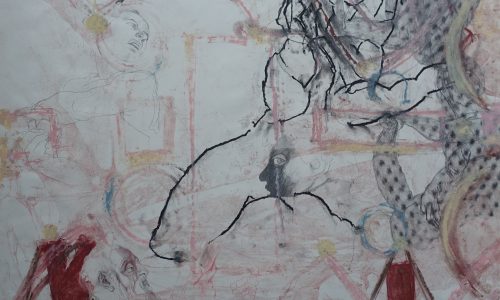
My starting point is not the visual reality, I do not depict anything. You could see my work as traces of memories. The inspiration can be something I have seen, or read, or heard. They can be personal experiences but also works of others: paintings, frescoes, drawings, texts, and musical pieces. After these things have occupied me directly for a while, they become mental impressions without tangible form. They detach from the sensory experience. With these kinds of impressions, I want to compose independent images, detached from everything that surrounds us daily.

Painting, for me, is creating: making something out of nothing. In the initial layers, I work with pigment, rabbit glue, and thin acrylic paint. I do not use photos or sketches. What happens on the canvas or paper is created in the moment when I work on it. In this process, I want to give randomness the maximum chance. Much of it happens associatively. One image almost directly follows from the other. This way of working gives me the greatest freedom. The painting does not always fit within the frame of the paper or canvas. Sometimes, I cut out the interesting pieces. When working on paper, they usually become collages. When working on canvas, I stretch the cut-out pieces on a smaller frame. After that, I add the final layers with oil paint. Here, I strive for maximum control. With oil paint, I can mix the exact colors I need to finish the canvas, and sometimes I use scraps of paper to find the right form. In an intuitive way, I search for the essence of the image. Each painting is like a puzzle without a reference picture. Gradually, it becomes clear how all the pieces should fit together. The final result is always more intense and powerful than the image I started with.

www.ftn-books.com has the 2007 WERK OP PAPIER catalog now available.

Posted on Leave a comment

Anselm Kiefer at Museum Voorlinden

Is Kiefer one of the great artists of our time…..certainly YES!

Is the Kiefer exhibition at Museum Voorlinden worth visiting? My personal answer is no. Far too crowded,. too many objects in one and the same room and expensive at euro 22 ,00 per person. Because of the many people present you can not take a distance from the large objects, showcases and paintings. It felt so crowded that it was unpleasant and after half an hour we decided to leave the museum. One of my personal observations was the analogy i felt with the 90’s and 00’s paintaings by Frank van Hemert.

Left and right are van Hemert paintings from the late 90’s and 00’s in the middle there is a work by Kiefer ca. 1996/97

I really love these sunflower paintings . whoever the artist, both convince me being great art. The large Kiefer paintings are very worth visiting at Voorlinden however , the bicycle objects and large showcases can not convince me and because they are over half the exhibition i thought it a disappointing visit.

All paintings , objects and cases deserve space and because this is limited at Voorlinden and the spaces were shared with far too many people the overall experience was disappointing.

The exhibition can be visited until the 25th of February and for those seeking catalogs on this artist please visit www.ftn-books.com

Here are some photographs i took at the exhibition:

Posted on Leave a comment

Pinterest pages by FTN books & Art

I have been filling some Pinterest pages with items i have in my inventory and which i think are nice tos hare with other collectors. It contains some great and important poster and book designs from the last 70 years. Please share these and hopefully you will enjoy these Pinterest boards too.

I have created four boards which are filled regularly with all original photo’s by FTN . Feel free to join the boards and use the photographs for noncommercial usage. I expect to post over 15.000 items on Pinterest in the coming year.

There now are boards on the inventory of FTN books & Art, Stedelijk MUseum Amsterdam, Wim Crouwel, Willem Sandberg

https://nl.pinterest.com/ftnbooksandart/wim-crouwel/ https://nl.pinterest.com/ftnbooksandart/stedelijk-museum-amsterdam/ https://nl.pinterest.com/ftnbooksandart/ftn-books-and-art/ https://nl.pinterest.com/ftnbooksandart/willem-sandberg/
Posted on Leave a comment

Julio Herrera Zapata (1932-2001)

  In 1965, he traveled to France with his second Cuban wife as an invitee to the Paris Biennale that year, and they decided to stay, residing in the Casa de Cuba at the Cité Internationale. His works were exhibited at the Salon de la Jeune Peinture in Paris in 1967 and 1968. In his final year, he received the First Prize at the I Lignano Biennale (Italy) for his work “Science au service de l’Homme.”

After exhibiting several pieces at the Sorbonne during the events of May ’68, a few months later the couple managed to obtain permission from Cuban authorities to allow their young daughters Magda and Siena to leave the country, and they settled on Boulevard Saint-Jacques, where they fixed up the studio that he would work in until the end.

Following his early Parisian works, French art critic Alain Jouffroy described him in Opus International issue n.18 (June 1970) as:

“creator of a highly powerful work, which allows us to admire its irresistible ascent. His latest works, depicting movement as the theme and eroticism as the subject, bring us into a raw intimacy where the clumsiness of bodies in love is only topped by their frenzy, their dominant violence.”

www.ftn-books.com has now the Galerie Tallien catalog from 1973 available.

Posted on Leave a comment

Alfonso Albacete (1950)

Once introduced to the art of painting at the studio of Juan Bonafé (1901-1969) in La Alberca, Albacete went on to further hone his craft by studying Fine Arts and Architecture in Valencia and Madrid.

His early creations flirted with the intellectual pursuit of Conceptual Art and the bold and vibrant expression of Pop Art, ultimately culminating in a deliberate return to painting in the late 1970s. Embracing a distinct and definitive style heavily influenced by an exacting use of color and a systematic approach to brushwork, he held his premier solo exhibition at Galería Chys in Murcia in 1972.

One of Albacete’s distinct approaches to his art is his fondness for working in themed series, each of which he methodically explores. Notable among these series are those centered on bathers, the painter himself, the city of Vienna, and the mythological figure of Narcissus. In the mid-1980s, his utilization of structured geometric patterns gave way to a heightened emphasis on light and shadow, as well as an increased incorporation of symbolic motifs. While consistently drawing on figurative elements, the early 1990s saw a shift in Albacete’s focus as he delved into a more experimental and introspective exploration of the space within his paintings and the concepts that surround it.

In 1988, the Museo Español de Arte Contemporáneo hosted the first retrospective of Albacete’s work, which in subsequent years has become prized and preserved in esteemed collections and museums both in Spain and abroad.

www.ftn-books.com has the Barcelona Maeght exhibition catalog from 1993 now available.

Posted on Leave a comment

Marcel Vertès (1895-1961)

Marcel Vertes was a Hungarian/French artist born in 1895 and passed away in 1961. He was an exceptional painter, printmaker, and illustrator of the 20th century. Vertes relocated from his birthplace of Hungary to Paris during World War I. He resided and worked in the famous Quartier Latin, alongside prominent artists such as Boutin, Forain, and Toulouse-Lautrec. The art of Marcel Vertes reached its pinnacle in the 20th century, focusing on scenes of street life in Paris, portraits of women, and depictions of circus and cabaret acts. Vertes left behind a legacy of original lithographs and drawings that excellently captured the spirit of 1920s Paris.

An enigmatic aura surrounds the oeuvre of acclaimed artist Marcel Vertes, a Hungarian-French mastermind born in 1895 and departing this world in 1961. A versatile virtuoso of the twentieth century, Vertes dabbled in painting, printmaking, and illustrating with unparalleled skill. Amid the tumultuous years of the Great War, Vertes left his homeland of Hungary to seek solace in the vibrant streets of Paris. Settling in the illustrious Quartier Latin, he immersed himself in the company of renowned artists such as Boutin, Forain, and Toulouse-Lautrec. However, it was in the roaring twenties that Vertes’ art reached its zenith. His focus lay in capturing the essence of Parisian street life, portraying the beauty of women, and illustrating the mesmerizing world of circus and cabaret. The legacy of Marcel Vertes continues to thrive through his collection of original lithographs and drawings, perfectly encapsulating the spirit of the dazzling city of Paris.

www.ftn-books.com has the 1956 DOCUMENTS publication now available.

Posted on Leave a comment

Musée Würth in Erstein

For me, when we finally had discovered it, it is now an absolute must visit in the Alsace region. Combine this with the Beyeler, Kunstmuseum Basel and the Modern art museum in Strasbourg and you will have seen 3 of the most importan modern art collections in the world.

Musée Würth

Reinhold Würth’s passion for art collecting, spanning almost six decades, encompasses an impressive 500-year scope of art history, encompassing works from the late Middle Ages to the present day. Delve into this remarkable collection, and you will discover Southern German Renaissance portraits alongside examples of courtly grandeur and exquisite craftsmanship. Admire the collection of hand-painted posters promoting a traditional Italian puppet theater, known as the “Opera dei Pupi,” along with international Christmas nativity scenes. Additionally, marvel at the captivating arrangements of works by renowned artists such as Anselm Kiefer, Max Ernst, and the iconic duo Christo and Jeanne-Claude.

The late Impressionist and Expressionist movements first ignited Reinhold Würth’s passion for art collecting. From there, he expanded his collection to include classic abstract art, particularly from the École de Paris, and figurative works from the 1960s and 1970s. Exhibitions also play a vital role in inspiring and enriching his collection, providing an opportunity to explore new artistic expressions from various nations, such as Austria, Mexico, and Poland.

The collection also proudly boasts works by exceptional artistic personalities, including Georg Baselitz, Fernando Botero, David Hockney, and Alex Katz. Sculptures of the highest caliber can also be found, represented by artists such as Horst Antes, Hans Arp, Max Bill, Anthony Caro, Eduardo Chillida, Tony Cragg, Richard Deacon, Antony Gormley, Alfred Hrdlicka, and Marc Quinn, among many others.

At this moment the Wurth museum is closed but will be open again soon.