Posted on 2 Comments

Kurt Kocherscheidt (1943-1992)

Schermafbeelding 2021-09-08 om 14.54.13

Kurt Kocherscheidt was born on the 6th of July 1943 in Klagenfurt, Austria to Friedrich and Elisabeth Mayer. After the divorce of his parents in 1946 and the move of his father back to Germany, the most formative person in his youth became his grandfather August Mayer (1885–1958) whose deep friendship with Hugo Adolf Bernatzik, a famous ethnographer and explorer, awakened Kocherscheidt’s interest in geography, zoology and art in general.

In 1961, after completion of his school years in Klagenfurt and Friesach (his mother’s hometown), Kocherscheidt moved to Vienna to study painting at the Academy of Fine Arts under Professor Sergius Pauser. As a way of supplementing his income, during the summers he would restore gothic frescos, in his words: “the thought of financial stability” led him to move to Zagreb (then Yugoslavia, now Croatia) for two years (1963–1964) to study mural painting under professor Ivo Rezek at the Akademija Likovnih Umjetnosti, before returning to Vienna and completing his academic studies in 1965.  In 1967 he married and divorced his long-time partner Andjelka Feuer.

In 1968 Kocherscheidt became a founding member of the artist group “Wirklichkeiten” (Realities). At a moment when the prevailing trend in art leaned towards conceptual art, these artists were bound by their interest in traditional modes of production, such as painting and drawing, and the representational qualities they favored. During this period, Kocherscheidt was predominantly painting highly saturated imagined landscapes that included both homages to real horticulture and surreal futuristic elements rendered in a palette that recalled the Fauves. The group included several painters who were of his generation and active in Vienna at the time, including: Wolfgang Herzig, Franz Ringel, Robert Zeppel-Sperl, Martha Jungwirth (who joined in 1969), and Peter Pongratz. The Kocherscheidt exhibition pposter for the JOsef Albersmuseum is now available at www.ftn-books.com

kocherscheidt bottrop a

Posted on 3 Comments

10 great and Iconic buildings, no. 9

This list is invented to make some quick and easy blogs for this month filled with festivities. I chose the buildings because i think they belong to the most important from all buildings realized in the last 100 years.

So here is no. 9. the Cité Radieuse by Le Corbusier

This big appartments building in Marseille was a source of Inspiration voor many apartment buildings that were realized after this was finished. The outside colors are inspired by BAUHAUS and executed in a special concrete paint in primary colors. The buidling is build from 100% armored concrete and includes 337 separate apartments. A community palyground was specially made for the occupants of these apartments. Since 2016 it belongs to the World Heritage list of Unesco

www.ftn-books.com has some nice publications on Le Corbusier

Posted on 3 Comments

10 great and iconic buildings. no. 10

This list is invented to make some quick and easy blogs for this month filled with festivities. I chose the buildings because i think they belong to the most important from all buildings realized in the last 100 years.

So here is no. 10 by Mies van der Rohe. It is the National Museum in Berlin. Not only a very nice building but also one of the most important collections in the world. The Kandinsky’s and the Kirchner paintings are one of a kind and i always will remember them.

Just look at this building for more than a few seconds and be amzed by its beauty. Even teh Calder in front is impressive.

www.ftn-books.com has some nice publication from the Nationalgalerie and on Mies von der Rohe

Mies von der Rohe publication
Posted on Leave a comment

Keith Haring (continued)

Keith HAring from the CAPC catalogue

This is a rare occxasion that i can offer two of the most iconic and early Keith Haring catalogues ever published. I have bought recently these two catalogue from a duthc collector and now i am offering these at www.ftn-books.com.

The CAPC catalogue is even more exceptional than the Stedelijk Museum catalogue . The CAPC has a silkscreened baby on the dustcover. These are highly collectable  books and the true Haring collector will know that this is a a rare opportunity to acquire these for his or her collection.

Posted on 29 Comments

Maja van Hall (1937)

Maja van Hall

In the late fifties of the past century Maja van Hall studied classical sculpture at the Rijksakademie van beeldende kunsten (State Academy of Fine Arts) in Amsterdam, a solid basis for which she remains grateful to this day. For the content of her work she has developed  a  vocabulary of her own, which she feeds with her own experience of life. She uses the expressive potential of stone, clay, bronze and sometimes wood to give form to her own state of mind. Slowly but surely, she is gaining more and more freedom for herself and for her  sculptures.

In the sixties she opted for a more informal, abstract expression in material and gesture. She never entirely foreswore figuration, though, preferring the form to emerge from her subjects. Take the small bronze of a vacuum-cleaning female she made in 1967 with the  derogatory title of ‘Sloof’ (‘Drudge’). As a feminist, Maja van Hall had created a little monument to the housewife. Three decades later this small sculpture will appear as a huge blue monument (‘Filosloof‘) during the international exhibition ‘Role Models’, The Hague  Sculpture 2003.
A polyester version was acquired in 2009 by the Museum of Modern Art in Arnhem in the aftermath of the international exhibition ‘REBELLEArt and Feminism 1969 – 2009.

In 1968, in an abstract-expressive vein, she represented the concept of ‘Battle’ in an eponymous bronze as the aggressive confrontation of two ‘parties’ in form and counterform, light and dark, line and  plane, open and closed. While she is working on a piece it  takes on   colour for her, sometimes quite literally when she treats it with pigments and the colour actually defines the sculpture. Such is the case with ‘Blue Dog’ (1988). Aggressive, as if it had escaped from a  myth, there it stands, as large as life. In her recent  installations she may   also add planes of colour – pure pigment on paper – to emphasize the theatrical character of the spot and the spatial unity of the whole piece.

‘Thoughts’ (1992), which she modelled in plaster but  also had cast in bronze, seems to have been worked on  for so long that the   form is worn away and the surface weathered, as if from centuries of use or misuse. The form of a human head can be discerned. It rests on a satin pillow. This is Maja van Hall’s comment on the aesthetic perfection of Brancusi’s work, except that in  spite of – or thanks to –   the destructive erosion, she has rendered visible and tangible the victory of human strength. Using her personal experience as a source of creativity, she has built up a consistent oeuvre that pays scant heed to trends. She has given her personal  emotions, emotions we all   feel, a place and look of their own in Dutch sculpture.

www.ftn-books.com has several van Hall publications availabel

Posted on 2 Comments

Peter van den Akker (1949)

Peter van den Akker

Relations between people, shifts in world cultures and changes in the technological, architectural, natural and human domain are sources inspiration for me. They are all images and spheres that exist, both dependent and independent from each other.

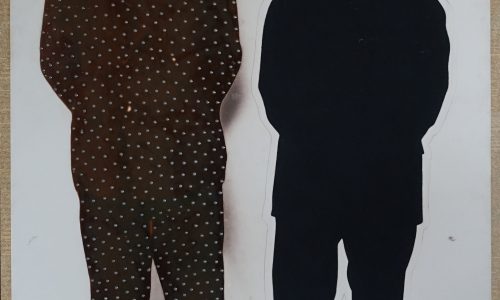
Central in my sculptures is the human image: the human not as an individual, but as an universal figure. In my work I represent the time relatedness and the different levels of human behavior by using transparency. For instance in the sculptures ‘Silhouetten’ and ’52 Dialogen’ the corten steel is  cut through with human figures. This produces special views, with many perspectives and represents vulnerability, captured in the hardness of steel.

As a painter I express this complexity, these different levels, by working  with transparent layers and sometimes mixing them. The colors and the forms that I use in my works have a special meaning, a symbolic value and are a determining factoring in the composition. The titles that I give to my works are connected with this inspiration or with a recognition of my emotional or other experiences.
These layered compositions, connected to different elements of the image, give rise to multiple meanings and interpretations of my themes. They symbolize a fracture of time: for me time is an unending chain of events, without beginning or end, a cycle.

I have always been inspired by music, dance and literature. Travelling is another important  starting point for my work. When I am in another county I am interested in the local cultures and in what motivates human behavior. When I was in New York I made a lot of paintings on the theme human-city. My stay gave me also a lot inspiration for new work that I completed in my studio in Holland. My journeys to South-America and Egypt provided me with completely different images, new impressions and new visions that I explored further in my studio. In 2010 I got the opportunity to work in Italy, in a guest studio as ‘artist in residence’. In Italy paintings on the theme human-nature came into being: a number of them you can see in this catalogue.

biografie

My working method  comprises many techniques in different materials: paintings, mixed techniques on paper/collages, silk screen printings, sculptures in corten steal, ceramic objects.

www.ftn-books.com has one Peter van den Akker publication available


Posted on 1 Comment

Martijn Sandberg (1967)

Schermafbeelding 2021-07-11 om 09.36.03

Just a simple blog on a great artist and his ideas . I admire Martijn Sandberg for his art. Every few month i look at his site and find some new works that fascinate me . Just take a dive into Martijn’s ideas and visit the link below. An internet related project by Martijn Sandberg. An art work he exclusively made available on the internet

http://www.msandberg.nl/noimageavailable/

Martijn Sandberg ‘Image Messages’The work of Amsterdam based visual artist Martijn Sandberg (1967) constantly explores border areas, such as the tension between text and image, illegible into legible, the private and the public domain. ”I make Image Messages, image is message is image.” The image hides the message.
In the cut paintings, such as ‘Sorry No Image Yet’ and ‘Im Westen Nichts Neues’, there is a subtle play between the language of the image and the significance of the image, and this gives rise to questions. Here, even the lack of image seems to be elevated to an image by the artist.


The direct relationship between the image, the material bearing the image and the environment is also expressed in his site-specific works in public space and architecture. As in the ‘De Oude Weg Naar De Nieuwe Tijd’ artwork, integrated as a brick relief in the walls of the gates and the pavement of the Spaarndammerhart building, Amsterdam. Or in the sculpture ‘I Will Survive’ located at the border of a burial ground in Hardenberg, The Netherlands.

BTW. For those interested in the editions by Martijn Sandberg please visit his shop at :

http://www.msandberg.nl/shop.php?shop=yes

Posted on 2 Comments

Joost Swarte (continued)

A very nice addition to my inventory. I will add some 35  “new” Joost Swarte collectable titles in the next few weeks. Here you can see which titles you may expect. 


new addition to my Joost Swearte inventory
Posted on Leave a comment

Hilla Rebay (1890-1967)

Hilla (von) Rebay

THis blog is on Hilla Rebay, born in Germany but living part of her life in the US. 

The inmportance of this artist is growing by the year and since i have acquired the extremely scarce original 1948 New York catalogue in which she explains what makes her paint in the way she does. The best i can do now is quote the German text which i found on Rebay. Catalogue available at www.ftn-books.com

1948 schreibt Hilla von Rebay im Katalog zur Ausstellung Gegenstandslose Malerei in Amerika in der Städtischen Kunsthalle Mannheim und zahlreichen anderen Städten in Deutschland Folgendes:

„Gegenstandslose Malerei bildet keines der uns auf dieser Welt geläufigen Dinge oder Lebewesen ab. Sie will nichts anderes sein als ein schönes, rhythmisch gegliedertes Gebilde aus Farben und Formen, das durch seine Schönheit allein erfreuen soll. Die Proportionen der Leinwand oder des Blattes selbst bestimmen diese Gliederung, die wie ein musikalisches Kunstwerk kontraproduktiven Gesetzen gehorcht. Das Grundmotiv eines Bildes gibt den Ausschlag für seinen Aufbau, der dann dem Gesetz eines eigenen Rhythmus folgt. Ein solcher Kunst noch ungewohnter Betrachter wird diese Gesetzlichkeit nicht von vornherein erkennen; erst nach längerem Umgang mit diesem Werk wird er im Unterbewussten die Wirkung seiner Schönheit und Vollendung an sich erfahren und seine im Geistigen begründete lebendige Gesetzlichkeit zu verstehen beginnen.
Die gegenstandslose Malerei spricht zu denen, die für reine Schönheit empfänglich sind. Selbst wenn Formen wie Kreis, Viereck oder Dreieck Verwendung finden, Formen, die man in solchen Zusammenhang fälschlich als geometrische bezeichnet, so sind sie hier doch rein künstlerischer Natur. An und für sich betrachtet bestand die reine Form ja schon lange, bevor man etwas von Geometrie wusste, und Geometrie von sich aus war niemals imstande, diese Formen in Kunst zu verwandeln: das ist allein Aufgabe des Künstlers. …

Sicherlich ist es leicht, aus Farben und Formen ein Ornament oder einfaches Muster zu entwerfen; aber wie sich in der Musik eine Sonate durch Melodie, Rhythmus und Kontrapunkt vom einfachen Ton unterscheidet, den jeder anzuschlagen vermag, so ist es auch in der gegenstandslosen Malerei. Nur dass bei ihr, im Gegensatz zur Musik, das Auge als aufnehmendes Organ angesprochen wird. Mag der Betrachter zunächst einfach sein Gefallen am Spiel der Formen empfinden, so wird er allmählich doch dahin gelangen, auch die läuternden und entspannenden Kräfte eines Bildes zu erfahren, dessen Schönheit im Geistigen, nicht im Sinnlichen beruht. …

Vor Tausenden von Jahren gebot uns die Bibel, kein irdisch geschaffenes Bild zu verstehen. Heute endlich besitzen wir die Voraussetzungen, dies Gebot zu erfüllen. Religiös gesinnte Künstler empfanden die innere Verpflichtung als erste; sie verzichteten auf bloße Nachbildung der Natur und suchten dafür nach jener tiefen Konzentration und Selbstdisziplin, die zum Wesen des eigentlich Schöpferischen gehört.“


Posted on 2 Comments

Tobias Pils (1971)

Schermafbeelding 2021-09-08 om 14.05.04

I entered the Josef Albers Museum 3 months ago, crossed the treshold and there it was ….on the left at 20 meters, large and totally in black and white…..one of the most impressive paintings i had seen in years. This is how i learned about Tobias Pils. I dit not know of the artist before, but his works have an abstract and graphic quality i had not seen before.

Schermafbeelding 2021-09-08 om 14.13.15

Working within a palette of blacks and whites and the range of grays that can be made from them, he creates mixed media paintings full of abstract and representational elements. These elements are often arranged so that they flow from one to the next seemingly of their own accord, obeying the dictates of a painterly logic that generates meaning through the accumulation of many small moments. As such, Pils’s works are endlessly captivating as arrangements of textures, flows, and material invention—in a sense, as symphonic, non-objective compositions, even when their mythological content and primal imagery tempt narrative readings. This syncretic approach reflects a mind that revels in contradictions, even as it seeks to suture together contrasting passages with a subtle and virtuosic array of mark-making strategies that are alternately bold, incisive, impressionistic, and completely open to the innate properties of paint medium and support. Pils works at a variety of scales and in different contexts, responding to the urgency of his own intuition and the external constraints of architectural and institutional settings with equal fluency. In each of these forums, he locates the places where the vast and the intimate meet, both in the physical world and the human psyche alike. The Tobias Pils poster for his Josef Albers MUseum exhibition is available at www.ftn-books.com

tobias pils a