Posted on Leave a comment

Francis Picabia is “PAPA DADA”

It took a long time for me to finally appreciate the works by Picabia. Once known as “Papa Dada,” Francis Picabia was one of the principle figures of the Dadamovement both in Paris and New York. A friend and associate of Marcel Duchamp, he became known for a rich variety of work ranging from strange, comic-erotic images of machine parts to text-based paintings that foreshadow aspects of Conceptual art. Even after Dada had been supplanted by other styles, the French painter and writer went on to explore a diverse and almost incoherent mix of styles. He shifted easily between abstraction and figuration at a time when artists clung steadfastly to one approach, and his gleeful disregard for the conventions of modern art encouraged some remarkable innovations even later in his career, from the layered Transparency series of the 1920s to the kitsch, erotic nudes of the early 1940s. Picabia remains revered by contemporary painters as one of the century’s most intriguing and inscrutable artists.

on the excellent site THE ART STORY i found this text on the ideas of Picabia

In the 1910s, Picabia shared the interests of a number of artists who emerged in the wake of Cubism, and who were inspired less by the movement’s preoccupation with problems of representation than by the way the style could evoke qualities of the modern, urban, and mechanistic world. Initially, these interests informed his abstract painting, but his attraction to machines would also shape his early Dada work, in particular his Mechanomorphs – images of invented machines and machine parts that were intended as parodies of portraiture. For Picabia, humans were nothing but machines, ruled not by their rational minds, but by a range of compulsive hungers.
Picabia was central to the Dada movement when it began to emerge in Paris in the early 1920s, and his work quickly abandoned many of the technical concerns that had animated his previous work. He began to use text in his pictures and collages and to create more explicitly scandalous images attacking conventional notions of morality, religion, and law. While the work was animated by the Dada movement’s rage against the European culture that had led to the carnage of World War I, Picabia’s attacks often have the sprightly, coarse comedy of the court jester. They reflect an artist with no respect for any conventions, not even art, since art was just another facet of the wider culture he rejected.
Figurative imagery was central to Picabia’s work from the mid-1920s to the mid-1940s, when he was inspired by Spanish subjects, Romanesque and Renaissance sources, images of monsters, and, later, nudes found in soft porn magazines. Initially he united many of these disparate motifs in the Transparency pictures, complexly layering them and piling them on top of each other to provoke confusion and strange associations. Some critics have described the Transparencies as occult visions, or Surrealist dream images, and although Picabia rejected any association with the Surrealists, he steadfastly refused to explain their content. Picabia always handled these motifs with the same playful and anarchic spirit that had animated his Dada work.
Picabia learned early on that abstraction could be used to evoke not only qualities of machines, but also to evoke mystery and eroticism. This ensured that abstract painting would be one of the mainstays of his career. He returned to it even in his last years, during which he attributed his inspiration to the obscure recesses of his mind, as he had always done.
Schermafbeelding 2018-08-09 om 12.17.07
www.ftn-books.com has some excellent publications on Picabia including the very special Ronny van de Velde publication PICABIA ( price upon request)
Posted on Leave a comment

Bruce McLean (1944)

Schermafbeelding 2018-08-08 om 16.17.20

It took me decades to discover the art of Bruce McLean. A typical Sixties artist who started with performances and now ends his career with HUGE paintings. In between …… an abundance of works of which the large canvasses i appreciate most.

An original and personal style of painting . …the result…. recognizable paintings. I looked up the artist Bruce McLean and found that his paintings are still on the verge of affordable to wealthy private collectors and maybe now is the time to start looking and finding a beautiful McLean painting for your collection?

Schermafbeelding 2018-08-08 om 16.17.01

www.ftn-books.com has a few bruce McLean publications available


Bruce McLean is a Scottish sculptor, performance artist, filmmaker and painter. He studied at the Glasgow School of Art from 1961 to 1963, and from 1963 to 1966 at St. Martin’s School of Art, London, where he and others rebelled against what appeared to be the formalist academicism of his teachers, including Anthony Caro and Phillip King. In 1965 he abandoned conventional studio production in favour of impermanent sculptures using materials such as water, along with performances of a generally satirical nature directed against the art world. When in 1972 he was offered an exhibition at the Tate Gallery, he opted for a ‘retrospective’ he titled “King for a Day” which lasted only one day. From the mid 1970s, while continuing to mount occasional performances, McLean has turned increasingly to painting/sculpture and film work. In 1985, McLean won the John Moores Painting Prize. Since retiring from his professorship of painting at the Slade School of Art, he has taken on a large studio in west London where he has been making increasingly large paintings and sculptural film works.


Posted on Leave a comment

Aziz Bekkaoui (1969)

Schermafbeelding 2018-08-08 om 15.39.42

One of the dutch fashion designers i truly enjoyed working with was AZIZ (Bekkaoui). I met a few of the great fashion designers in my time at the Gemeentemuseum. Frank Govers i found authentic but not that sympathetic, the same with Frans Molenaar …at a distance a likable personality, but as soon as you had met he was not the friendliest one. Max Heymans….. a rude person that thought of himself to be the king among dutch fashion designers, but for me he never reinvented himself, but his importance was based on a very loyal clientele who thought his designs were ina class of their own. Mart Visser a found sympathetic and one of the last i worked with was AZIZ Bekkaoui. A Moroccan born fashion designer of who i personally think is one of the most original ones to have appeared on the dutch fashion scene in the last few decades.  No gimmicks like Viktor & Rolf, but true and original fashion His fashion designs are inventive and highly original and…..he is certainly one of the friendliest designers i have met.

At the time of his Gemeentemuseum show he was hardly known, but the catalogue we made for the show was one of the most original ones at the time i was working at the Gemeentemuseum. Designed by Gracia Lebbink, we chose for a felt like white cover and the best printing possible…the result a highly collectable fashion exhibition catalogue which is still available at www.ftn-books.com

Schermafbeelding 2018-08-08 om 16.08.07

Posted on Leave a comment

Herbert Bayer (1900-1985)

Schermafbeelding 2018-08-08 om 15.23.10

Herbert Bayer is forgotten by many, but he definitely is one of the most important designers/artists from last century. He studied at the Bauhaus and was at one time educated by Kandinsky and Klee.

In the spirit of reductive minimalism, Bayer developed a crisp visual style and adopted use of all-lowercase, sans serif typefaces for most Bauhaus publications.[3] Bayer is one of several typographers of the period including Kurt Schwitters and Jan Tschichold who experimented with the creation of a simplified more phonetic-based alphabet. From 1925 to 1930 Bayer designed a geometric sans-serif Proposal for a Universal Typeface[1] that existed only as a design and was never actually cast into real type.[4] These designs are now issued in digital form as Bayer Universal.[2] The design also inspired ITC Bauhaus and Architype Bayer, which bears comparison with the stylistically related typeface Architype Schwitters.

Then his life changed drastically. In 1944 Bayer married Joella Syrara Haweis, the daughter of poet and Dada artist Mina Loy. The same year, he became a U.S. citizen. The result….Many lost interest in the works by Bayer, he did some typography and made some fonts, but gained again some importance in collecting over 30.000 works of art for the ARCO company. Still Herbert Bayer is recognized again as one of the more important artists from the Bauhaus era and this means his works start to grow in importance again.

www.ftn-books.com has some Bayer titles available.

Posted on Leave a comment

Barrie Cooke (1931-2014)

Schermafbeelding 2018-08-06 om 15.32.10

For me Barrie Cooke stands for the excellent taste Rudi Fuchs has in art and the beautiful designed catalogue Gracia Lebbink made for the Cooke exhibition in the Gemeentemuseum Den Haag in 1992. I can not remember if Cooke was present at the opening, but i still remember the first impression his paintings made on me when i first saw them in the exhibition rooms in the Gemeentemuseun. These paintings were personal and overwhelming and reminded me of the ones Francis Bacon made.
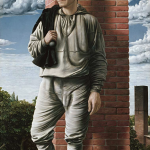
left Cooke and right Bacon

At that time Fuchs had become very interested in Irish art and presented Cooke shortly after he had had an exhibition with works by Jack B. Yeats

An artists’ artist, he won enormous respect from his peers over several generations for his utter commitment and the integrity of his vision. He was a passionate fisherman and the natural world was always at the heart of his work. His figure paintings and portraits are also exceptional.

His paintings are cherished for their dynamic, immediate, visceral connection with their subject matter. Early training at Skowhegan in the US and at Oskar Kokoschka’s School of Vision in Salzburg helped to shape the urgent vitality of his pictorial approach – a vitality reflected in the artist’s personality.

Having grown up in Bermuda and studied in the US, he went to England in 1954 to revisit his roots but found little to engage him. So he took a ferry to Ireland and, he said, felt at home even as he walked down the gangplank.

Irish life
He settled in rural Co Clare where he and his first wife, Harriet Cooke, lived in some poverty. Later he moved to Thomastown, Co Kilkenny, with ceramic artist Sonja Landweer, who introduced him to Rudolf Steiner’s ideas on natural processes. His next move was to a remote house overlooking Lough Arrow in Co Sligo.

The Barrie Cooke Gemeentemuseum catalogue designed by Gracia Lebbink is available at www.ftn-books.com
cooke a