Posted on 2 Comments

Joachim Brohm (1955)

Schermafbeelding 2021-09-08 om 12.25.02

I never had seen his photographs. The first time was when i encountered work by Brohm at the Josef Albers Museum in Bottrop ( poster available at www,ftn-books.com). I was impressed mand saw similarities with dutch 17th century painter Hendrik Avercamp.

Joachim Brohm was one of the first photographers in Germany to take pictures exclusively in color starting in the late 1970s. “Color lent my pictures credibility in the documentary sense,” he explains, defining at the same time his artistic credo. His approach went against the trend at the time in that it did not exhaust all of the possibilities of color photography: Joachim Brohm challenged omnipresent advertising aesthetics with his photographic naturalism, staged productions with documentation, picture effects with austerity, vibrant, high-contrast colors with his muted tones. As a student, he met with incomprehension from his professors, but photographic role models such as Stephen Shore and Lewis Baltz, who would go on to enjoy world fame, encouraged him to continue on his chosen path. “The Americans presented seemingly trivial scenes, content and context appeared to be missing – many people were unable to make any sense of it.”

Schermafbeelding 2021-09-08 om 12.28.23

Joachim Brohm brought this approach to a higher level: He combined mostly deserted landscape scenes with his interest in social interaction, turning his photographs into small-scale studies of society. They show how people change the landscape – and how the landscape changes people. He took his photographs of the Ruhr region at a time when theme parks and artificial lakes were being built to help cast off the image of a desolate mining region. Joachim Brohm shows this transition from work to leisure which accompanies the transformation from rural to urban from the perspective of a neutral observer. He sends the viewer on a mystery tour: “I wanted to show people in an environment undergoing change: What do they look like, what are they doing, what activities stand out?”

Joachim Brohm reveals structures in the landscape that would otherwise remain hidden. The camera’s elevated position, which is characteristic of many of his photographs, reinforces the impression of photographic surveillance which he himself describes as “all over”. The absence of a clear focus, and a depth of field that covers the entire image, mean that the individual scenes merge to form a situational snapshot. “The whole picture is the motif – the viewer can choose his or her focal point.” In this way, Joachim Brohm draws our attention to the big picture – with an excellent eye for detail.

brohm a


Posted on Leave a comment

Frank van Hemert…Zeven (continued)

zeven hemert

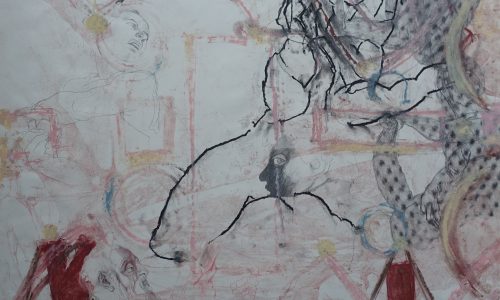
The day before yesterday i wrote a blog on the ZEVEN series by Frank van Hemert. But it was far from complete. On another bookshelf i found the book Reconstructie , published by the Haags Gemeentemuseum and written by Franz Kaiser . This contains several more paintings from the ZEVEN series. The reason why i had missed this is that i put the book apart from the rest of the Frank van Hemert publications, since most of the paintings it contains have been painted with the Red/Pink color that has caused so much trouble for Frank. Most of these paintings are considered to be lost, since the paint drips literally on the floor and unfortunately there is at this moment no solution to preserve them. I am a collector and i have been warned to be careful with these paintings and therefore i had placed the catalogue at hand….just to remember to be careful, but here are the paintings still in their prime condition, but after 30 years it is highly probable that most of these have been damaged beyond repair and must be considered lost.

(except for the painting above the text, the condition is excellent of this superb painting)

Posted on 7 Comments

Visible Language

Because of a recent addition to my inventory here is the information on the VISIBLE LANGUAGE magazine. It is one of the leading publications in the world of graphic design and i have added some important volumes from the 70’s and 80’s to my inventory.

Visible Language is an American journal presenting visual communication research. Founded in 1967 as The Journal of Typographical Research by Merald Wrolstad, occasional Visible Language issues are co-edited with a guest editor-author.

The journal was founded with the primary tenet of the journal being that reading and writing together form a new, separate, and autonomous language system. The journal has evolved to focus on research in visual communication. The journal has covered the subject of concrete poetry, the Fluxus art movement, painted text, textual criticism, the abstraction of symbols, articulatory synthesis and text, and the evolution of the page from print to on-screen display. Guest editor-authors have included Colin Banks, John Cage, Adrian Frutiger, Dick Higgins, Richard Kostelanetz, Craig Saper, and George Steiner.

The journal was edited for 26 years (1987–2012) by Sharon Poggenpohl of the Illinois Institute of Technology’s Institute of Design, with administrative offices at the Rhode Island School of Design. It is currently edited by Mike Zender of the University of Cincinnati, which publishes and provides administrative offices for the journal.

Below a first selection of the volumes available:


Posted on 6 Comments

Frank van Hemert (continued)…..ZEVEN

zeven cc

Frank van Hemert works in series. Paintings and drawings can have the same title and be totally different from each other in size and composition. However there is one element which is fixed. In the  ZEVEN ( Seven) series its is the sequential numbering of 1,2,3,4,5,6

The Seven is not used, but the ZEVEN title completes this series of numbers. To van Hemert, the number seven is a symbol for the person who has “fulfilled” himself, become a whole person. The fact that the number itself is not included in the image indicated that this stage has not yet been attained; This “not yet” is suggested by the incomplete number sequence.

Because many of these paintings have been painted with the pink/red that has to been proven instable. Many of these paintings have been damaged or at least can not been shown  and stored properly.

This SEVEN series has become of the most iconic and important series by Frank van Hemert and fact is that from these series part of the paintings can be considered to be lost because of the paint van Hemert used. Still some are in excellent condition and  i have been fortunate to buy one of these large paintings which is in excellent condition. It comes the former Buhrmann Ubbens collection and has been preserved in an excellent way and has become now one of the highlights from our collection.

I have tried to find some from examples from the series of ZEVEN paintings and of course i will start with the one from our collection…our own ….ZEVEN

and in the end there are some publications on Frank van Hemert that www.ftn-books.com has available.

zeven hemert


Posted on 21 Comments

Fred Sandback (1943-2003)

Schermafbeelding 2021-09-07 om 16.56.56

A very special Minimal artist definitely is Fred Sandback.

Fred Sandback would stretch lengths of colored yarn taut in a space to make people experience it differently, uniquely, unexpectedly. His ingeniously simple sculptures had no weight or mass, no inside or out.

He described is work eloquently in his booklet A Children’s Guide to Seeing made to accompany his 1989 exhibition of yarn sculptures at the Houston Contemporary Arts Museum. His words for kids provide illumination for adults:
We all need a place for play, whether it’s jump rope, baseball, or making a sculpture. I’m lucky enough to have the whole Contemporary Arts Museum in which to build my sculptures that are made out of knitting yarn.

I need a big space like this because I mean my sculptures to take space and make it into a place—a place that people will move around in and be in.

Knitting yarn is great for making the proportions, intervals, and shapes that build the places I want to see and to be in. It’s like a box of colored pencils, only I can use it to make a three-dimensional sculpture instead of making a drawing on paper.

My knitting-yarn sculpture is a somewhat distant cousin to some other string games. Maybe the one that uses the most space is kite flying. But the one that is the oldest, and the most universal, is cat’s cradle. Indians, Eskimos, Bushmen, and many other cultures around the world have had games like cat’s cradle since before anyone can remember.

Often cat’s cradle is about making a little place—just for yourself, or to share with someone. If you don’t know any of the moves, you can probably learn some from a friend, a relative, or from your mom or dad, if they remember them.

If you ask the attendant here in the Museum now, he or she will give you some yarn to use while you are here and to take home. Your fingers might do some thinking while you wander around and look at my sculptures.

And here are a few cat’s cradle ideas.

Cat’s cradle is nice because you can put it in your pocket when you’re busy with something else, and take it out again when you’re not. Although, as you can see, it’s not so hard to build big things like my sculpture. All it takes is a ball of string. If you were feeling a little adventurous, you could even wrap up your whole house.

www.ftn-books is fortunate to have some nice Sandback items available

sandback bottrop a

Posted on Leave a comment

Enzo Maiolino (1926-2016)

Schermafbeelding 2021-09-07 om 17.10.36

Not much information to be found on this artist. Still he is an established artist influenced by Hard Edge painting but with a much softer , subdued choice of colors he makes compositions that are typical for the Italian Sixties. These paintings are great and timeless and that is the reason why the Josef Albers Museum recognized the qualities of this lesser known artist. His works were presented in combination with the “square” paintinsg by Albers. The result /…… a feast in abstract ( minimal) art.

The Maiolino poster is availabel at www.ftn-books.com

maiolino aa

Posted on 1 Comment

Marcello Morandini (1940)

Schermafbeelding 2021-09-07 om 16.48.55

The first time i encountered work by Morandini was at the occasion of his special exhibition at the Josef Albers Museum in Bottrop in 2001.

Marcello Morandini was born in Mantova in 1940, but in 1947 he moved to Varese. He attended the school of Arts in Milano, where he works as an assistant designer. He is one of the most important exponents of the “Arte Costruttiva” in Europe.  He started his artistic career in 1963 and since then has been holding many personal exhibitions in Europe, USA and Japan. He was invited to historical expositions and to International Biennials, among which the ones in Sao Paulo, Brazil in 1967 and in Venice in 1968. He has always been professionally interested in design and architecture collaborations, but for me the quality that impressed me most was the OP ART . Most of his works being executed in Black/White and greys. Making these for me like a bridege between the multi colorod POP ART from the sixties and the ZERO art from some years later.

OLYMPUS DIGITAL CAMERA

www.ftn-books.com has some Morandini items available among them the Bottrop poster which is an original silkscreen print.


Posted on 3 Comments

Willem Witjens (1884-1962)

This is at true “Petit Maitre”. Possibly only known in the region in which he painted . The Bommelerwaard was one of his favorit spots to paint so many landscape where made in that surroundings. This is a painter who knows his techniques and materials but the result nothing special, but pleasing to the eye.. Witsen made many of this pleasing paintings which now appear at auctions and in the “classic” art galleries. They find their way to those who like art, but can not afford to buy the best from the 19th and early 20th century. Possibly there will be a time that his paintings are valued as great art from the 20th century but personally i doubt this,

www.ftn-books.com has a small Witsen publication available

witjens

Posted on Leave a comment

Paul César Helleu (1859-1927)

Schermafbeelding 2021-08-29 om 11.33.31

Paul César Helleu was a close and life-long friend of Sargent. According to Stanley Olson, John Singer Sargent bought a pastel from Helleu. “They were constant companions, going everywhere together, having their meals together, seeing each other every day. . .” In a letter to his daughter, Paulette, in December 1922 Helleu wrote, “J’ai voulu faire photographier Sargent qui à été pour moi, tout au long de ma vie, plus qu’un père.”

During the summer of 1889, Sargent had a number of guests to stay at his house at Fladbury near Pershore, including Vernon Lee, Ansttruther Thomson, Flora Priestly, and Paul and Alice Helleu. Helleu’s intimate portrait of his wife at Fladbury was painted in that summer when both he and especially Sargent, were experimenting in Impressionism. Sargent completed among others, Two Girls with Parasols at Fladbury, Fishing, Two Girls in a Punt, A Boating Party, and probably the best know of the Fladbury pictures, Paul Helleu Sketching with His Wife (now in the Brooklyn Museum, New York).

In Patricia Hill’s book John Singer Sargent (New York, 1987), William H. Gerdts writes in his essay entitled “The Arch Apostle of the Dab-and-spot School, John Singer Sargent as an Impressionist”, p. 131: “Finally, Paul Helleu Sketching must be seen as a further step in Sargent’s development of the theme of out-door- painting. Helleu’s canvas is turned away from the spectator, just as it had been in Dennis Bunker Painting.  But whereas Bunker was shown ruminating, away from his easel, Paul César Helleu is busily at work, and presumably confidently so. The subject he paints is of no concern nor does the spectator have a view of the scene which might be serving Helleu for his subject. What is certain is that it is an outdoor view, immediately recorded. Moreover, Helleu, like Sargent, was first and foremost a portrait painter, and by definition a portraitist of studio conceptions. Thus, Sargent presents Helleu as a convert to the new method, exploring new thematic interests. And it must be noted that Helleu is depicted doing exactly what Sargent was doing in his picture – painting out-of-doors. Helleu therefore becomes, in a sense, a surrogate Sargent himself, both men established artists in one tradition, sailing off into what was for them relatively uncharted waters.”

www.ftn-books.com has the 1974 Knoedler /New York catalogue available.

helleu


Posted on Leave a comment

Roelof Mulder (1962)

Schermafbeelding 2021-08-27 om 15.54.15

Roelof Mulder is a multidisciplinary artist, operating in the field of graphic design, type design, interior and exhibition design. He studied fine art at the Academy in Arnhem and he attended the Jan van Eyck Academy in Maastricht for a year in order to underline his love for the graphic arts. Mulder’s departure from the academy was quickly followed by the announcement that he was to be the first winner of the Rotterdam Design Prize.
His graphic and editorial work includes books for Droog, MVRDV architects, Marcel Wanders, Stedelijk Museum Amsterdam, E&Y, and artists Yasumasa Yonehara, Marijke van Warmerdam and Marlene Dumas. He was member of the editorial staff and designer of Forum magazine and he has been art director of Frame magazine twice. Mulder also did campaign work for fashion brands such as Takeo Kikuchi and Diesel, various exhibition and communication work for incubator Platform21, and stamps for the Royal Dutch Post.

From his early years www.ftn-books.com has a nice book in its inventory