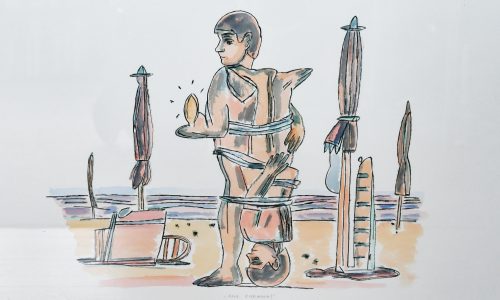
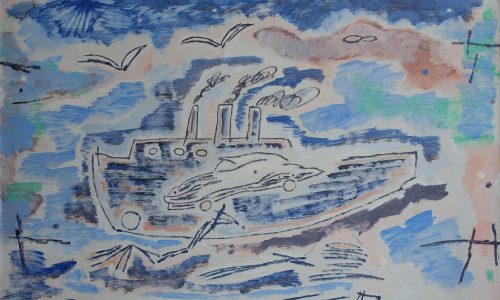
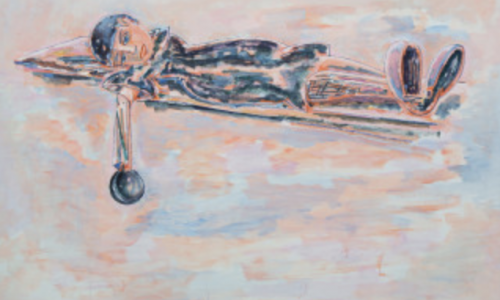
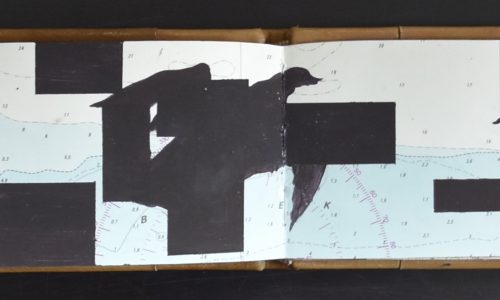
Adela Rodix is an artist, thinker, writer. She exhibits her works of art in leading galleries in Europe and America, such as Galerie Maeght. In her artistic career she is also known as Adela, R.D. Adela and Adela R. Duflos. She has a degree in History. Adela has also been a fashion and advertising model. From a Spanish-French family, she has been living in different countries, feeling herself as a pilgrim, a traveler. She lived for many years in Barcelona, Spain, and now she lives between Warsaw, Buenos Aires, Madrid and New York. She is also author of Light of Cultronia. Her new book The Weary Angel. will come in september 2022.
Antoni Clavé was born in Barcelona in 1913 and lived with his mother until 1934. In 1918 he entered elementary school, after which he entered the Hispanic American Quorum. Since 1926, he has been forced into forced labor from the age of 13, working first as a clerk in a textile store for cases. At the same time, he enrolled in the night class of a part-time art school. There he modeled in Angel Ferran’s class and painted with José Mongrel. Along the way, he meets Eduardo Serra, Jordi Casals, Ramon Martim, Grau Sala and Hermann Pico.
José Mongrel finds a job as a facade painting apprentice in Tolosa. By mastering crafts and techniques such as making plaster, plaster, and glue, and then mixing paints, young clave learn techniques such as fresco painting, lettering, and fantasy painting. In 1928, one of his first works was a portrait of his maternal grandmother. He remained employed in Tolosa well into the 1930s to support himself and his mother, who was now paralyzed and wholly dependent on him. In addition, he continues to take evening courses at an art school, of which he is now in the regular course. There, he meets Salvador Ortiga, with whom he develops a deep friendship. Ortiga advised and influenced his disciples over the course of three years. In 1932 Clave left art school. When he won second place in a poster competition organized by Sparkasse Barcelona, he felt encouraged to quit his painting job. In 1934, Clave was already using new materials in its advertising and stage design work that were first used by the avant-garde artists of the time: collages of various materials, ropes, printed fabrics, cardboard, newspapers, etc. I was. Together with his friend Salvador Ortiga he searched for other new material and created it in Paris a few years later.
www.ftn-books.com has some interesting Clave titles now available.
Why a blog on David Urban. The reason is simple. Urban exhibited at Barbara Farber in 1996. Unknown and available at that time at reasonable prices. Now almost 30 years later, paintings from that gallerist and its artists from that decade come again to the market. One of these artists is David Urban. Well known in Canada and the US and lesser known in Europe, but still there are some paintings to be found in European private collections and museums. One of the last auctions from last auctioning season had such a painting by David Urban. THE GOLDEN NUMBER from 1996. I was able to buy this painting for the FTN collection and it will be for sale in a few weeks. If you are interested , please contact me at wilfriedvandenelshout@gmail.com
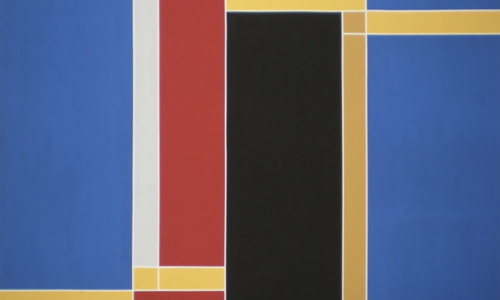
The work of David Urban is defined by bold collisions of line and shape, clashing tones and kinetic brushstrokes. Urban builds his dynamic paintings, layer upon layer, incorporating the traditions of still life and landscape, abstraction and realism. Rhythmic geometries conjure up networks of boards, beams and girders. His work explores the physical presence of sound, with a strong sense of connectivity and rhythmical structure. Urban produces forms that engage the viewer, pursuing an endless investigation into how and why we perceive images. Urban focuses on the history and methodology of color and painting itself, embedding powerful brushstrokes and charcoal drawings in thick layers of paint. His work explores the interplay of representation and abstraction while presenting his two distinct streams of contemporary painting. Urban is a true Renaissance man and scholar of art history, literature and music. He has a master’s degree in English Literature and is trained in several instruments. He studied the work of early Modernist painters such as Piet Mondrian and Henri Matisse. His artwork is the culmination of this creative effort and research. Urban graduated from York University in 1989 with both BA and BA.
Elly Strick lives and works in Brussels and started teaching at the age of 25. She herself studied at the Academy in Groningen and at the Academy in Minerva and Jan van Eyck in Maastricht. She specializes in working on paper and uses mainly materials such as graphite, pigments and oil paints, but she also uses wood stove ash and silver and gold leaf to achieve proper alchemy. increase. For them, the potential for transformation underlies our existence. Her exploration of human nature combines a visual language that is both poetic and radical. Ellie Strick held a solo exhibition at MHKA in Antwerp (B, 1999). De Pont, Tilburg (Netherlands, 2006). Van Abbe Museum, Eindhoven (Netherlands, 2006). Mainz Museum (Germany, 2012). Reina Sofia National Museum in Madrid (Spain, 2014) and 1700 La Poste, Montreal (California, 2018). Her work has won the Philip Her Morris Award, the Charlotte Koehler Award and the Jeanne Austing Award.
www.ftn-books.com has some very interesting Elly Strik titles available.
If i must choose one of the best illustrators working from the Netherlands in the last century it would be Kurt Löb.
Born in Germany he fled to the Netherlands and build a career in illustrating books, magazine and at the same time produced many great paintings and drawings. The style “fin du siecle” with loose abstract elements. He must have been influenced by Austrian Art from the 1900’s , but in his career he definitely created a style of his own. These drawings belong to the very best dutch/ german illustrators.
www.ftn-books.com has a nice signed copy of the Löb / Bild + Buch publication available.
Born in Kyoto in 1944, Akihiko Kuroda had a lifelong interest in art and painted his first work at the age of four. His family had a great influence on Kuroda as a boy. His father brought magazines like Le Minotaur from Paris. Through these magazines, Kuroda discovered the work of painters such as Picasso and Dali, inspiring him during the early stages of his artistic career. These resources were invaluable to the self-taught. In the 1960s, Kuroda traveled around Europe, finally deciding to settle in Paris in 1970. Kuroda struggled during his early years in Paris, until chance encounters with French-American writer and filmmaker Marguerite Duras, Spanish artist Joan Miru00f3, and gallery owner Adrian Margut decided his fate. Until I changed it, I was going to give up and go back to Japan. Aki Kuroda’s famous participation in the 11th Paris Biennale in 1980 signaled the beginning of his career. Kuroda flouted traditional hierarchies and in 1993 became the youngest artist to have a solo exhibition at the National Museum of Modern Art, Tokyo. Prominent artists Yoshitomo Nara and Takashi Murakami acknowledged Kuroda’s influence on their careers in their memoirs. In 2007, Kuroda became the first Japanese artist to be exhibited at the Beijing Imperial Museum and TS1 Museum in China. In Japan, Aki Kuroda’s work is in several public collections around the world, including the National Museum of Modern Art, Tokyo and the National Museum of Art, Osaka. In France, it is housed in the collections of the Marguerite Aime Mag Foundation in Saint-Paul-de-Vence, Paris, and the Museum of Modern and Contemporary Art, Strasbourg. In Ireland, Hugh Lane City Museum of Contemporary Art, Dublin. And in Holland at the Peter Steibson Foundation in Amsterdam.
www.ftn-books.com has the Maeght publication from 1986 now available
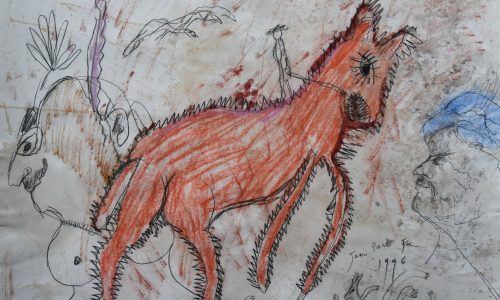
Joan Marti was a Spanish-Belgian artist born in Reus (Spain) in 1922 and died in Sint-Gillis/Brussels in 2002. He was also a painter and graphic artist. His parents fled Spain because of the civil war and settled in Belgium with his then 13-year-old son around 1936. During her four years she attended evening courses at the Academy in Sint Gillis, Brussels. A mechanic and tailor by trade, his work often includes elements of mechanics. His references to machines show a very poignant sense of humor, but also a certain pity for those who are unknowingly at the mercy of industrial technology. His work exudes fantasy and symbolism, but is often poetic. First exhibited around 1950, from 1970 he exhibited regularly at the Galerie Isy Brachot. Was a member of the circle Jecta in Brussels. Signed by the Belgian artist of BAS II and Two Centuries.
www.ftn-books.com has now the ISY BARCHOT /1987 catalog available.
Armodio (real name Vilmore Cernardi) was born in Piacenza in 1938. His training was based not on attending the “Gazzola” art school in his city, but on meeting the painter Luciano Spazzari. His studio was a convenient place to experiment and get to know each other. Here he met his first teacher and later traveling companion, the painter Gustavo Foppiani. The two worked together, later joined by painter Carlo Berte, and shared a studio until 1980. Thus, a free grouping was born. This grouping is inspired by a curiosity about the most diverse manifestations of culture, a desire to interpret reality based on sarcasm, and a penchant for playful transgressions. His first solo exhibition in Piacenza was in 1963 at Genocchi his gallery in Piacenza, and in 1964 the Roman Obelisk appeared in the gallery thanks to Foppiani. In the 1960s, the painter spent a short time in London, collaborating with the American Lily Shepley, and later with Galeria Forni in Bologna. In 1972 he met Philippe Guimeot, opened his own gallery for artists in Brussels and a fruitful collaboration began. From that moment on, most of his paintings were in important private collections in Europe and the United States. Galleria Jean in Milan After his stint at Ferrari, Armodio comes to Piacenza’s Galleria Braga. After this experience, he worked first in Arezzo’s Galleria Lin Margin only, then in Bologna’s Galleria He Marescalchi. His work is now exhibited in major galleries in Italy and abroad.
Otto Muehl (16 June 1925 u2013 26 May 2013) was an Austrian artist, best known as a co-founder and one of the principal figures of Viennese Actionism and founder of the Friedrichshof Commune. It is In 1943 Muehl had to serve in the Wehrmacht. There he enrolled in officer training. He was promoted to first lieutenant and took part in infantry combat during the Battle of the Bulge in 1944. After the war, he studied German and history at the Vienna Academy of Fine Arts, as well as art education. In 1972 he founded the Commune Friedrichshof, considered by some to be an authoritarian offshoot, which existed for several years before falling apart in the 1990s. In 1991, Muehl was sentenced to seven years in prison for sex and drug offenses against minors. He was released in 1997 after six and a half years in prison and founded a small commune in Portugal. After his release, he also published his memoir from prison (Out of Prison).
www.ftn-books.com has the 2008 Sammlung Friedrichshof book now available.
Bernard Schultze was a German artist, considered part of the informal movement, a group of artists who placed great importance on intuition and the subconscious in the creation of art. In 1952 Karl He founded the artist collective Quadriga together with Otto Goetz and others, making informal art famous in Germany. Schultz’s work is associative, expressive, and colorful, and poses strange questions to me as a viewer. Flipping through his monograph, Bright Breath, Sparkling Wind, we discover wonderful paintings, watercolours, and drawings, but also incredibly ugly paintings that leave an impression because they are completely formless. The photo was taken by a mentally handicapped person during a writing class, while the image on the other side is clearly of the same man. Schulze lived from 1915 to 2005. Since Schulze was born in 2015, 100 years before him, a major retrospective exhibition has been held in Cologne, and several excellent books have been published, including this fascinating book which gives an excellent overview of his work. Published. Many of his paintings are truly breathtaking, his drawings are sophisticated and beautiful, but his papier-mache images continue to amaze me with their fantastical forms. Even if the same whimsical figures appear in the painting, it is still strange that they do not mind being there. This keeps the piece attractive.
Artist/ Author: Oliver Boberg
Title : Memorial
Publisher: Oliver Boberg
Measurements: Frame measures 51 x 42 cm. original C print is 35 x 25 cm.
Condition: mint
signed by Oliver Boberg in pen and numbered 14/20 from an edition of 20