Posted on 2 Comments

Robert Combas (1957) (continued)

Schermafbeelding 2021-08-14 om 11.02.57

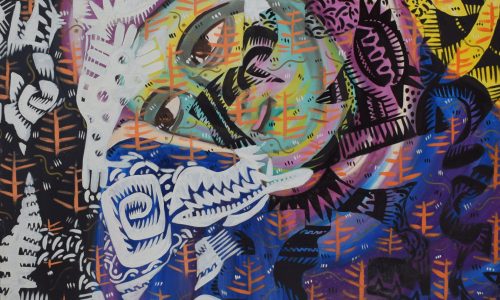
I know of many artist who at one time in their lives were invited to decorate a church or execute stained windows. In the Netherlands it is Marc Mulders who is the best example. Acroos the border many other names like Matisse, Rothko, Foujita and Chagall and recently i discovered that Robert Combas made his own contribution to this kind of art. The exhibition was held at the Vieille Église Saint-Vincet in Merigmac / France.

Impressive paintings of arguably the best of all Figuration artists. Catalogue is available at www.ftn-books.com.

combas eglise

The French artist Robert Combas has become known as one of the protagonists of “Figuration Libre”, the French form of new figuration in the 1980s. Robert Combas was born at Lyon in 1957, he grew up in Sète, where he also began to study at the “École des Beaux-Arts” in 1974. Between 1975 and 1980 he completed his studies at the DNSAP in Montpellier. In those years the Punkrock movement had decisive influence on Robert Combas. In 1978 he even founded a band, together with Hervé di Rosa and Richard di Rosa. In 1979 Robert Combas, Hervé di Rosa and Ketty Brindel published the art magazine “Bato”. From those days on, Robert Combas was able to establish himself as painter and graphic artist in the style of “Figuration Libre”. Along with Rémi Blanchard, François Boisrond and Hervé di Rosa, Robert Combas was a founding father of the artist group of the same name. Comics and graffiti inspired his works, Pop Art and Arabian art can be named as additional sources of influences. Strong and striking colors with black contour lines increase the effect of his images. As of the late 1980s an increasingly mystical tendency can be observed, Robert Combas’ works are darker and gloomier. In the 1990s Combas expanded his field of artistic activity: He writes poetry and works photographs over with felt tip pen, assemblages are also part of his oeuvre. After the turn of the millennium music became a great source of inspiration for Robert Combas once again, and he made large paintings in cooperation with rock bands. “Ma peinture c’est du rock”, my painting is rock music, said the artist about his work.

combas eglise a

Posted on 1 Comment

DADA en Drachten ( Dr8888 )

Most people do not know it and personally i did not realise the relationship between Drachten/ Dr8888 and the Dada and Merz mouvements until recently.

But it appears that some of the artists from Friesland had strong relationships with Dada artists and even were influenced by them . In the same way Dada artists freed themselves from the bourgeois morality, Werkman tried to do the same, although freedom in morality was less important than having a free spirit, searching freedom in his art. The Museum in Drachten finally realized some decade ago that their true importance was this heritage. Dada in the Netherlands is nothing else than Dada in Friesland and Drachten. They made a choice and exploited this heritage since and with one of these exhibition a magnificent catalogue was published, which is now available at www.ftn-books.com

holland dada aa


Posted on 2 Comments

Peter Stämpfli (1937)

Schermafbeelding 2021-08-13 om 13.49.05

The reason for this blog is that i lately found sand deiscovered some interesting Pop Art artists in Germany and Switzerland and Peter Stämpfli is one of them.

Schermafbeelding 2021-08-13 om 13.55.03

Born July 3, 1937 in Deisswil, Switzerland Stämpfli is a Swiss painter of the Pop Art movement. A major figure in 20th century painting, Peter Stämpfli has always scrutinized everyday life: our environment, our objects, our gestures. However, far from being satisfied with the simple appearance, his work has endeavored to reveal the depth and the strength that it contains. From 1963, the artist devotes himself to a work of inventory of all the repetitive details of everyday life, which he methodically fixes on a white background. The artist isolates, from 1969 until today, the pattern of the tire, emblematic of our industrial society; it quickly becomes his favorite theme and offers countless variations. Interview with an artist who appropriates his entourage in amazing simplicity to invent his own icons… an absolutely Pop art.

www, ftn.books.com has added a Centre Georges Pompidou title recently. It is the book published on the occasion of the 1981 Paris exhibition in the Pompidou museum.

stampfli a

Posted on Leave a comment

Pieter Stoop (1946)

Schermafbeelding 2021-08-11 om 14.36.48

Two names triggered me to look a little closer at the works of Pieter Stoop. The fact that the book now available at www.ftn-books.com comes from the personal colelction of Henk Peeters and….. Rudi Fuchs, who was responsible for showing Stoop his works at the van Abbemuseum. Stoop was influenced by Soutine,de Kooning and van Velde and it shows, but what becomes clear after studying more works from him is that he deswtilled a style of his own from these influences.

the book below is now available at www.ftn-books.com

pieter stoop

Posted on Leave a comment

Nijmegen…NYMEGEN…1930…help needed

nymegen

Recently i found a small book on the cultural festivities of the city of Nijmegen in 1930. “700 jaar stad” and “Kunst tentoonstelling” including works by Ansingh, Mastenbroek and Jessurun de Mesquita. The design of the cover is the problem…i can not figure out who made this… who can help?

Please respond to ftnbooksandart@gmail.com.

Posted on 1 Comment

Harry Ruhé (1947)


Here he is …..one of the leading experts on Multiples in the world and a gifted galery owner with his galerie A in Amsterdam. I met Ruhe at one time , some 30 years ago when i bought  a small multiple by Robert Barry and Ruhe has since become one of the leading experts on everything MULTIPLE and built one of the greatest collections on Fluxus in the world.

This is the reason he deserves a blog, since there is probably no one who is more knowledgable on Fluxus in the world. And there is more….what about his knowledge on Fontana! The result the most important book on the Fontana multiplpes on the world. Compiled, edited and written by Ruhé ( available at www.ftn-books.com)

For those visiting Amsterdam. Here is the address of the Galerie A:

Galerie A
Johannes Verhulststraat 53-hs
1071MS Amsterdam
Nederland

+31 206714087


Fontana multiples

all the above books are still available

Posted on 1 Comment

Henk Peeters and Paul Signac

Schermafbeelding 2021-08-05 om 15.30.56

On first observation there is no relationship between Paul Signac and Henk Peeters, but after i had included a book on Paul Signac from the library of Henk Peeters to my inventory it was clear to me that Peeters must have had a great admiration for Signac and his Neo Impressionist friends.. The placing of the dots i compare to the placing of the cotton pads or feathers by Peeters on the Canvas.

I can be sure that this book comes from the library of Peeters , since it is signed in ink on the title page and has 2 stamps. The oldest being with his address Fahrenheitstraat 671 in Den Haag, the second his Arnhem address at the Hoogstedelaan 12. Just to illustrate:

Schermafbeelding 2021-08-05 om 15.32.37

On the left signac’s enlarge part of the sky above Rotterdam and on the right a canvas by Peeters. The Signac book is now available at www.ftn-books.com

Posted on 3 Comments

Vincenc Kramar (1877-1960)

Schermafbeelding 2021-08-03 om 15.42.53

Vincenc Kramar (1877–1960) was one of the first collectors worldwide to recognise the importance of Picasso and Braque’s Cubism. Without a doubt, his collection, a substantial portion of which is now held in the National Gallery of Prague, had a profound influence on the development of several decades of Czech Modern art, but most of all the importance of the collection is that Kramar was one of the first to focus on Modern Art , this way buildinh a collection of unprecedented quality. Since his death there were several occasion where his scollection was shown to the public. One of the occsions was at the Museum Boymans van Beuningen in 1968, where the Kramar collection was shown, The beautiful ( typical Sixties ) catalogue is now available at www.ftn-books.com.

kramar

Posted on Leave a comment

Klaus Staeck (1938)


I always thought that Klaus Staeck was just a publisher, but now i have learned him not only being an art publisher but also a graphic artist and lawyer. His bond with Joseph Beuys and a political engagemnet is well know, but him being an artist by himself not. It is always nice to encounter a Staeck publiction. Always on the border of being an artist multiple. www.ftn-books.com has several Klaus Staeck publications available

Klaus Staeck grew up in the East German city of Bitterfeld. After passing the abitur in 1956 he moved to the West German city of Heidelberg where he lives down to the present day.

From 1957 until 1962 Mr Staeck studied law at Heidelberg, Hamburg, and Berlin before taking both state exams. He was admitted to the German bar in 1969.

Klaus Staeck is probably best known for his political poster art. He began to teach himself how to work as a graphic designer while pursuing his legal studies, creating posters, postcards, and flyers. In 1960, Mr Staeck became a member of Social Democratic Party of Germany (SPD). In the late 1960s he took part in local politics in Heidelberg. Over the years he created three hundred different motifs, drawing from current political discussions. He took sides for the poor, the environment, and for peace, urging his countrymen to join him and to interfere in political affairs. In his campaigns he employed claims such as, e.g., Deutsche Arbeiter – die SPD will euch eure Villen im Tessin wegnehmen (“German workers: the SPD seeks to take away your villas in Tessin from you”), or Die Reichen müssen noch reicher werden – deshalb CDU (“The rich must become richer yet, therefore vote CDU”).

First he made woodcut prints, while from 1967 onward he changed to screen printing. Mr Staeck managed to finance his political actions by selling his artwork in Edition Tangente publishing house which later came to be known as Edition Staeck. He worked together with other political artists and writers, most notably Joseph Beuys, Panamarenko, Dieter Roth, Nam June Paik, Wolf Vostell, Daniel Spoerri, Günter Grass, Walter Jens, and Heinrich Böll who publicly spoke out in his favour. At the beginning of the 1970´s Staeck began his long time collaboration with Gerhard Steidl. So far, Klaus Staeck was sued in 41 cases for his artwork to be banned from public, to no avail.[2]

Since 1986 Mr Staeck has been visiting professor at Kunstakademie Düsseldorf. In April 2006 he was elected president of Berlin Akademie der Künste, succeeding to Adolf Muschg who had stepped down from this position late in 2005.

Klaus Staeck was awarded the first Zille prize for political graphic design in 1970, and the Großes Bundesverdienstkreuz in 2007.

Posted on 2 Comments

Eugene de Kermadec (1899-1976)

Schermafbeelding 2021-05-17 om 11.42.09

There is not much information to be found on this french artist, but he was part of the younger generation supported by D.H. Kahnweiler / the Galerie Louise Leiris.

Eugène de Kermadec was born in Paris in 1899. His father, a teacher, was from Guadeloupe, and Eugène spent his childhood there. Returning to Paris in 1915, he trained in sculpture at the Artc Décoratifs, and in drawing at the Beaux-Arts. In 1920, Kermadec became a friend of Soutine’s who gave him several pictures, Modigliani and Desnos were also among his friends. He showed at the Paris Salon des Indépendants in 1920, and in 1927 became one of the Kahnweiller’s regular artists.
The Simon Gallery in Paris showed his work in 1929, but he mainly showed at the Leiris gallery, with exhibits in 1946, 1957, 1973, 1977. Many shows of his work were held abroad as well : Berlin 1929, Tokyo 1933, Toronto 1949, Stuttgart 1960. He was also well known as a tennisman, later becoming an international Tennis umpire. Another of his friend was Francis Ponge whose book “le verre d’eau” he illustrated with lithographs in 1949, of the 110 copies printed, not a single one is to be found today. Eugène de Kermadec died in 1976

I like his art…. it is playfull, filles with color and the abstraction feels far more contemporary than the late Fifties in which his art became well known through the presentations at the galerie Leiris. www.ftn-books.com has a galerie Louise Leiris catalogue from 1957 available.

kermadec a