Posted on 1 Comment

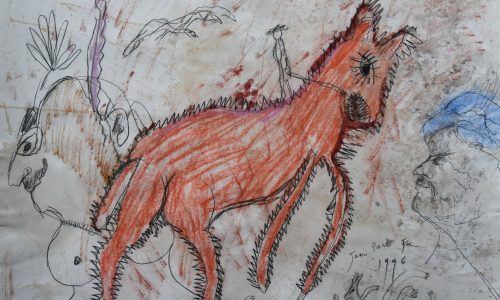
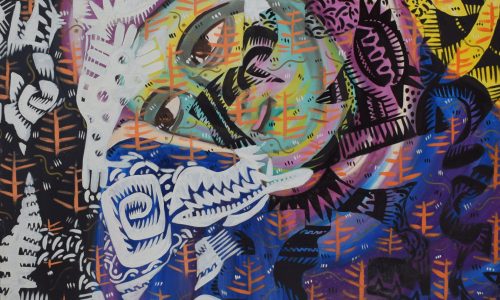
Marian Plug (1937)

My mother had aspired to become a painter, though it never quite materialized. Yet her originality and intense gaze were evident. On Sundays, she would assist my brother and me with painting, each of us on opposite sides of the table.

The training for art teachers, located in the gardens of the Rijksmuseum, was timeless. It was the second half of the 1950s, as if nothing was happening at all. It exuded contentment. We studied Dufy, memorized the floor plans of cathedrals, and took trips to Paris. In our art appreciation class, Mark Kolthoff taught us to observe the classics. After school, we would paint each other or hire a model. It was a thorough education, emanating a sense of calm. In the world of visual arts, it seemed as though nothing was happening. No Documenta or major American artists were making waves here. At the Stedelijk Museum, there was Tinguely, another example of complacency. Art had yet to become a mass-produced commodity. Of course, this peace and solidity were a strong foundation for the profession, but it took a long time to break free from them. For years, I continued to make beautiful etchings – on a shoemaker’s press from the Waterlooplein – with the feeling that I had all the time in the world.

My first exhibition was in 1963 at the Anne Frank House, organized by friends as encouragement after a long illness. The opening speech by Dick Hillenius was about dowsers, who reminded him of artists, myself included. What is made visible is different from what is seen. The artist sees more than others – ultraviolet, infrared, or inaudible knocking signals. At the end of the speech, there were sounds of whales in the sea.

Fortunately, the romantic image back then – that the artist sees more than others, pleasing as it may be for everyone – is now a thing of the past.

From an autobiographical note (1989).

www.ftn-books.com has several Marian Plug titles now available.

Posted on 1 Comment

Marten Toonder (1912-2005)

Marten Toonder (1912-2005) was first introduced to comics at the young age of six, when his father, a sea captain, brought back some American newspapers. After graduating in 1931, Toonder traveled by boat to South America. In Buenos Aires, he discovered the work of cartoonist Dante Quinterno. This former employee of Walt Disney published a written drawing course; it was from him that Toonder learned the foundations of animation and comic anatomy, inspiring him to become a comic artist.

Upon his return to the Netherlands, Toonder became an illustrator for a printing and publishing company in Leiden. After several attempts at creating comics for newspapers, he got his first break in 1941 when he was asked to supply a daily comic to De Telegraaf. The editor at the time wanted captions with the drawings (instead of balloons, which would encourage laziness in reading), and Toonder provided illustrations and texts for his new comic, Tom Poes. Toonder stopped in 1944 but continued the story in the Volkskrant and later NRC Handelsblad. He continued to create new episodes until 1986, with a total of 177 stories covering 11,768 daily installments. The comic became one of the longest-running comics by a single author.

The success of Tom Poes paved the way for various other productions, including plays, ballets, compositions, films, and a wide range of commercial articles. To bring these to fruition, Toonder continued to run the studio he established during the war. In the post-war years, this studio grew to become one of Europe’s largest drawing studios. However, with increasing business activities encroaching upon his creative work, Toonder made the decision to move to Ireland in 1965 to devote himself to his comic strip. In addition to Tom Poes, he also designed other comic strips, wrote poetry, autobiographies, and created illustrations for various purposes. He even produced short experimental films using different techniques.

www.ftn-books.com has several Toonder titles available. among them the much acclaimed biography on Toonder.

Posted on Leave a comment

Edwin Zwakman (1969)

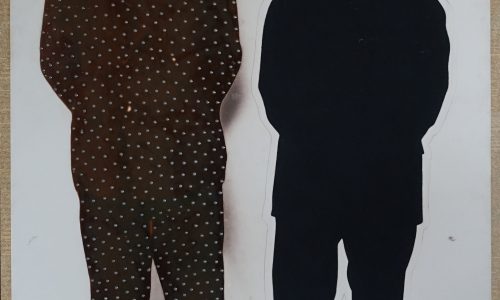
In his response to the excessive proliferation of images that bombard us daily and fabricate a simulated reality (as seen in the CNN coverage of the Gulf War), Edwin Zwakman crafts a carefully constructed, fictional scenario that nonetheless appears undeniably real. He employs clever tricks and fabricates falsehoods to reveal uncomfortable truths, in sharp contrast to the overt lies perpetuated by those in positions of power. Though power and authority are hinted at rather than explicitly portrayed, their stereotypical presence adds a potent impact. These pervasive stereotypes have been ingrained in our collective consciousness, which Zwakman masterfully juxtaposes to create contradictory scenes that stir up previously undefined but vaguely familiar anxieties. Through this dissonance between images, he unveils the true depth and magnitude of the abyss that lies just beneath the surface.

www.ftn-books.com has the van Abbemuseum catalog Façades now available.
Posted on 14 Comments

JP Kloos (1905-2001)

The birthplace of Jan Piet Kloos was Schiedam. He pursued studies in civil engineering at MTS in Utrecht, later continuing his education in Amsterdam during evening hours. At his day job, he worked under the direction of architect G.J. Langhout. Around 1927, he was involved with the construction of the Zonnestraal sanatorium in Hilversum; a Modernist masterpiece by Jan Duiker, where he served as an overseer and draftsman. Kloos himself also embraced the principles of functionalism.

In 1932, he established his own architectural firm. During this time, he occasionally collaborated with colleague Holt. Especially after the war, Kloos received numerous commissions for schools, hospitals, nursing homes, and residential buildings. One of his noteworthy projects in Amsterdam was the Kabouterhuis (1952) on Amsteldijk, a daycare center for young children.

He combined the functionalist approach of the Nieuwe Bouwen movement with mass-production techniques, yet managed to avoid creating monotonous structures. In literature, his housing project on Dijkgraafplein in Amsterdam, featuring suspension bridges, is often cited as an example of this.

www.ftn-books.com has the most important book on Kloos now available.
Posted on Leave a comment

Job Koelewijn (1962)

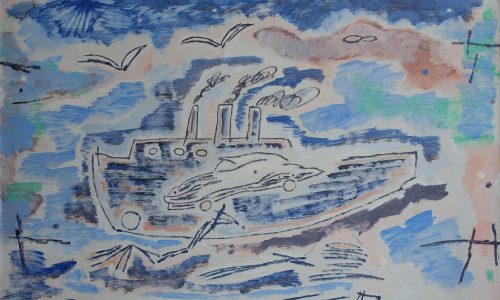
Job Koelewijn is an abstract artisan, whose creations often evoke intense sensations. Though his art takes on various forms – spanning from dominating installations and site-specific installations to videos, photography, and sculptures – they all share the purpose of altering reality to enhance a sense of place and time, heightening consciousness and sharpening the mind. To achieve this, Koelewijn’s pieces appeal to multiple senses simultaneously, making the observer cognizant of the influence of their senses.

In addition to visual elements, language is also a critical component of Koelewijn’s creative repertoire, manifesting in the forms of poetry, literature, and philosophy. Since 2006, Koelewijn has dedicated 45 minutes a day to reading aloud as part of his Ongoing Reading Project (since February 1st, 2006), viewing reading as a mental exercise.

www.ftn-books.com has several titles available on Job Koelewijn.

Posted on 1 Comment

René Jolink (1958)

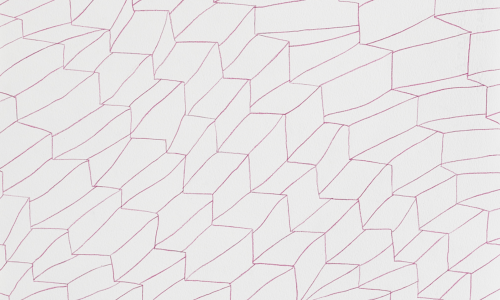
In response to the increasing transience or devaluation of images in our current media culture, René Jolink (1958) offers an answer through his paintings. Tineke Reijnders writes in the catalogue about his secondary way of painting the following: “By creating distance, he paradoxically enables himself to choose motifs that are close to him. Sometimes they are 16th century paintings that mean a lot to him, other times they are images related to his childhood in Spain, sometimes they are things that are literally close by, like the floor of his studio. The outer layer, that of the disintegrating image, is also that of the seeping image, which is nothing less than the promise of the restored image in all its glory.” Mark Kremer’s statement from 1993 still holds true: “The motifs in these paintings are painted in such a way that they shift and almost merge into a haze that lies on the surface of the painting. The appearance of the motifs is ambiguous: one moment they emerge from a misty distance, the next they are absorbed into the flat plane. These paintings seem to hesitate between evoking and suspending images.”

www.ftn-books.com has the van Abbe publication from 1996 now available.
Posted on 1 Comment

Hans Klein Hofmeijer (1957)

Upon entering the living room, sipping coffee in the kitchen, and wandering through the studio, I am aware of what is to come. It all halts at the defiant table. I peruse books on Thierry De Cordier, Berlinde De Bruyckere, Arnulf Rainer, and immerse myself in the seventeenth-century Chinese landscape painter Wang Hui. I extend the moment, avoiding looking just yet. I feel reluctance to turn around and face the new canvases. I have seen a few before, in an earlier phase, almost two years ago. I have an inkling of what to expect.

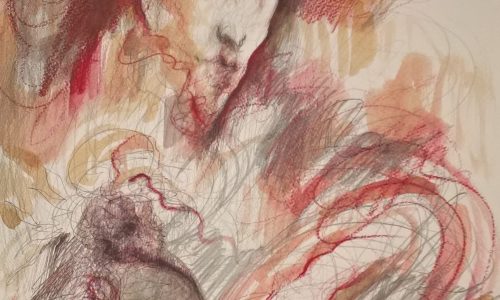
It feels like entering a mortuary: You want to go inside, but you also know it will be confronting. So you delay as long as possible. Seeing is knowing. And the mind still says ‘no’. No, to the overly explicit wound that strikes at womanhood. No, to the pain and sadness that speaks through these paintings. I recall the irritation I felt last time at the physical embodiment of soft red, the hairy skin, blue-veined. But wasn’t it the Jan Hoet we both admired who suggested that doubt and resistance are the best guides when it comes to art? ii If I am to be honest, that is probably the main reason why I am back in the studio.

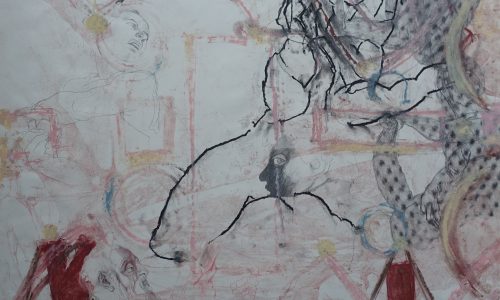
Hans himself calls the paintings Mental Landscapes. “Nothing mental,” I initially think, as once again I see mainly skin, blood red, soft pink, blue-purple veined. A pattern of ribs, and that confronting wound, which also explicitly represents a vagina. While we talk and gaze at the first canvas, I no longer only see skin and genitals in the red, gradually I also discern a massive curtain: a murky veil or dark celestial vault that tears apart. The whole thing drips with paint, floating above a tranquil landscape, a tiny world. But at the bottom of the canvas, in soft white and Prussian blue, light shines, there lies hope. www.ftn-books.com has the OCHTENDLICHT publication now for sale.

Posted on 2 Comments

David Rabinowitch (1943)

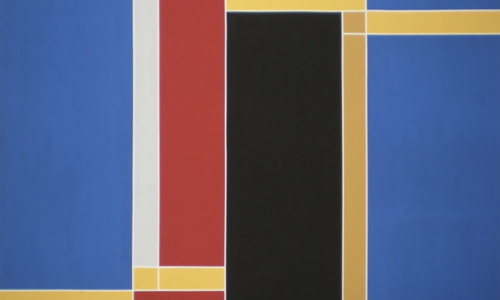
Born in 1943 in Toronto, Canada, David Rabinowitch passed away in 2023. Throughout his career, he has been featured in numerous solo museum exhibitions, including renowned institutions such as Museum Wiesbaden in Germany, Museum Kunstpalast in Düsseldorf, and Haus der Kunst St. Josef in Solothurn, Switzerland. He has also displayed his work at esteemed venues like the Museum Pfalzgalerie Kaiserslautern in Germany, The Chinati Foundation in Marfa, Texas, and the Kunstmuseum Winterthur in Switzerland. In 2004, his art was showcased at both the National Gallery of Canada in Ottawa and the Musée d’art Contemporain de Montréal in Quebec, which held a major retrospective of his pieces.

www.ftn-books.com has the Chemnitz book now available.

Posted on Leave a comment

Rudy Lanjouw (1954)

The artist resides and works on the northern outskirts of Assen, in a rich archaeological area of old cart tracks, remnants of prehistoric dwellings, imprints of vanished farms, and a valley stream. His fascination for soil stratification in time was sparked by an unearthed Roman treasure in his hometown of Beilen. For instance, a map of the Balloërveld hangs in his studio. This displays all the zones, speckles, lines, former watercourses, and even a tank trench. By examining this, one can immediately grasp the subject matter of his work, and where the title of his latest exhibition, ‘Traces of Traces,’ comes from. True to form, his abstract paintings do indeed tell a story. They are not mere illustrations for an archaeological narrative; they are the story itself, not as a collection of anecdotes, but as the universal tale of the stratification of things. Translated into his own unique idiom.
www.ftn-books.com has the TRACES book by Lanjouw now available.