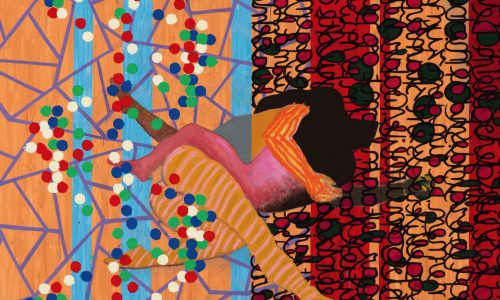
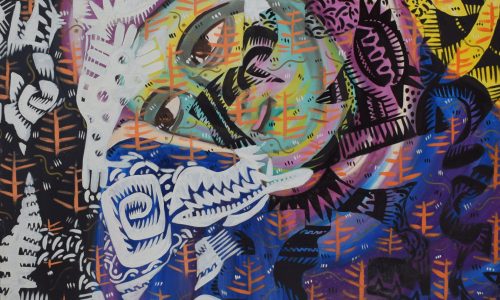
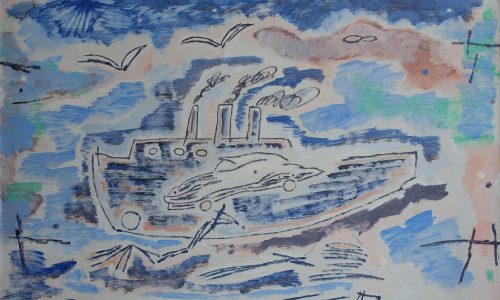
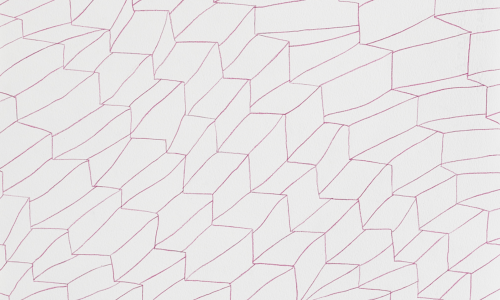
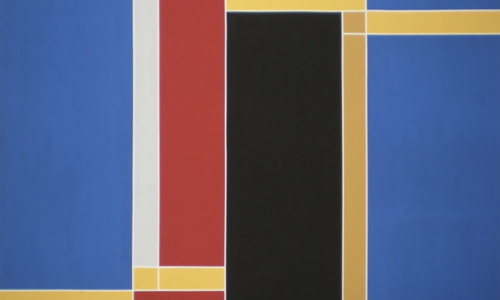
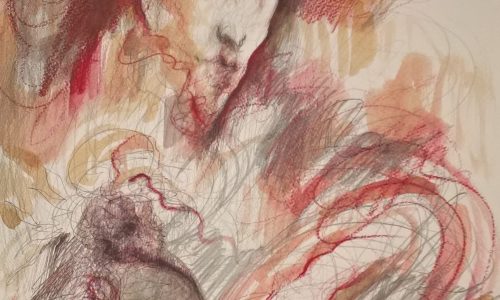
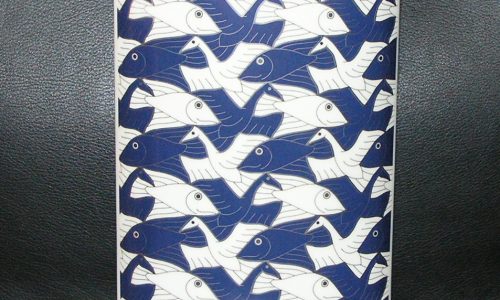
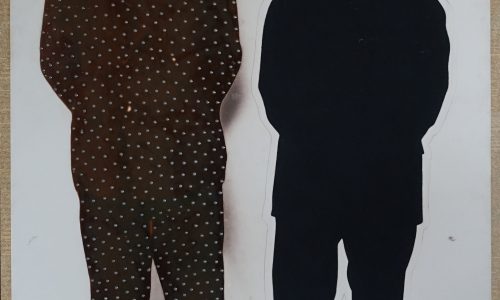
Canan Tolon, a resident of Istanbul and San Francisco, is a language graduate with a background in philosophy and literature from the French High School in Istanbul. In 1976, Tolon obtained a design degree from the Edinburgh Napier University. Building upon her educational journey, she pursued her studies in interior design in Germany before completing her interior design degree at the Middlesex University in London. In 1983, she further expanded her knowledge by receiving a graduate degree in architecture at the University of California, Berkeley. Tolon’s impressive body of work has gained recognition through inclusion in various collections and participation in numerous exhibitions both in Turkey and internationally.
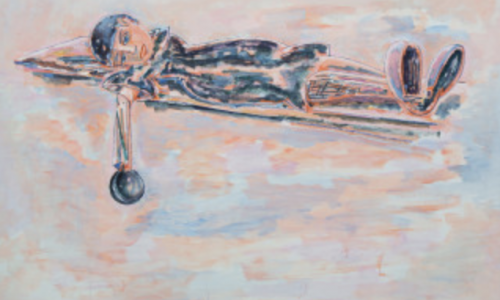
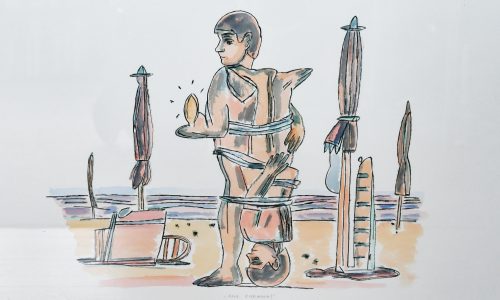
The painting process is demystified by the modest artist, who exhibits clarity in his work. The paintings, in terms of style, may shift between the figurative and the abstract realms. During the 1980s, the artist produced grand-scale abstractions, subsequently incorporating female nudes. In recent times, trees and architectural structures have been introduced by the artist, although the subject matter has always been significantly decontextualized through simplification. Herreros’ forms are intricate and distorted in various manners, resulting in harmonious juxtapositions such as supple versus edgy, recognizable versus unfamiliar, and so on. Just as the objects in his paintings undergo alienation, the figures themselves undergo transformation. They are flattened, showcasing vacant expressions and existing in a perpetual state of contemplation. The artwork exudes tranquility, bestowing upon it a metaphysical essence and a timeless allure.
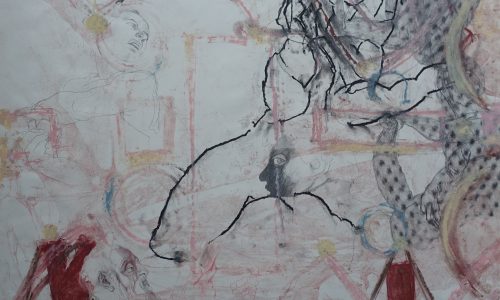
Jean-Robert Ipousteguy, a renowned French painter and sculptor, passed away on February 8, 2006 in Dun-sur-Meuse, his birthplace. Born on January 6, 1920, he adopted Ipousteguy as his artist’s pseudonym in the 1950s, taking his mother’s maiden name. Raised in Lorraine, he made the move to Paris in 1938. Seeking to hone his craft, Ipousteguy attended evening classes at the Robert Lesbo Unit, where he studied painting and drawing. Although he lacked formal academic training, his determination led him to become a self-taught artist, albeit largely underappreciated during his lifetime.
Following World War II, Ipousteguy immersed himself in painting and ventured into designing stained glass windows. In 1947 and 1948, he contributed two frescoes to the embellishment of the Saint-Jacques le Majeur in Montrouge. After relocating to Choisy-le-Roi in 1949, he shifted his focus exclusively towards sculpture, gradually transitioning from abstraction to a more figurative style influenced by surrealism. His talent as a sculptor earned him an invitation to participate in the prestigious Salon de Mai, thanks to the support of Henri-Georges Adam, one of its founding members.
In 1962, Ipousteguy held his first exhibition at the Galerie Claude Bernard in Paris, marking a significant milestone in his artistic career. He went on to showcase his works at Documenta III (1964) and Documenta VI (1977) in Kassel, Germany. Additionally, in 1964, he had the privilege of representing France at the Venice Biennale, where he received accolades for his exceptional artistic contributions. Recognition continued to pour in, as he was appointed Chevalier de la Legion d’Honneur in 1984.
Ipousteguy returned to his hometown of Dun-sur-Meuse in 2004, where he spent the final years of his life. His remarkable artistic journey came to an end in 2006, and he was laid to rest at the Cimetiere Montparnasse in Paris.
www.ftn-books.com has the Vweranneman and other catalogs on the artist now available.
The happiest and almost forgotten slapstick artist from Italy is Benito Jacovitti. He was introduced to the Dutch through his illustrations for the gigantic book Pinocchio, which was available in 1967 with a subscription to Margriet. Many must have enjoyed it since, without realizing that they were face to face with one of the most important Italian comic creators. In 1970 he appeared in the comics magazine Pep with his creation Cocco Bill and soon managed to divide the readers into extreme haters and loyal followers. Apart from Cocco Bill, two other of his comics were also published in Pep. The adventures of the little Indian Chicken Leg and a long adventure of Zorry Kid, a wrought-up parody of the famous TV series Zorro. Jacovitit’s popularity with his fans was so great,
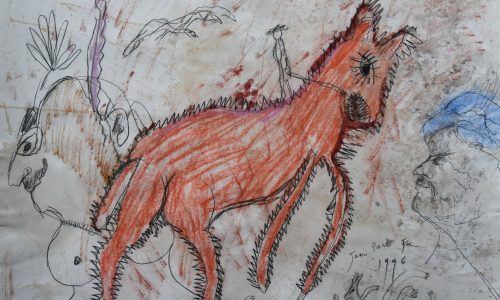
The drawing on the wall here dates from a later period, at the end of his career. In the 1990s he founded a fan club magazine in Italy, in which articles about his work and life alternated with reprints of old work. All that under a newly made cover. This cover of Jacovitti Magazine #4 shows everything that characterizes his work. The rubber figures with the big noses and even bigger feet, the busy composition sloshing against the edges of the picture, the exuberant use of sound effects (onomatopoeia) and the cheerful extras with which he filled every nook and cranny of his artwork. The only thing missing is a salami on bones, one of its absurd features. What you can also tell is the way he worked. Jacovitti always drew very large and he did not make the outline of his figures in one go. Instead, he drew each line twice, then filled in the center with a scratchy ink pen. He then generally did the coloring on the back of the drawing. This was possible because the thick black lines were visible through the paper. Dutch comics creators who claim to be influenced by Jacovitti René Uilenbroek , Mars Geringen and Mark van Herpen .
www.ftn-books.com has the classic PINOKKIO (Pinocchio) by Jacovitti and Collodi now available in Dutch
Peter van Poppel belongs to the post-war generation of new realists, which emerged in the seventies. He stood apart from any group and developed himself completely independently. He unfolded his own style by orienting himself to the great painters of all centuries and studying their masterpieces. He received his education in Utrecht (School for Graphic Arts) and still resides in the Dom City. The city of surrealism has not left him unaffected. Peter van Poppel paints with great attention to detail, with humor and tenderness, a loving and naive realism with alienations in form. He strings together a litany of small things and beloved people from his field of vision. He prefers to seek the child in the human being, as if he wants to offer the comforting feeling of paradise.
Started in 1966 at the Utrecht art market, followed by solo exhibitions every few years in Amsterdam at Galerie “Jurka” and Galerie “Petit”. Exhibitions in Utrecht at Galerie “De Reiger” and Galerie “Jas”.
Peter van Poppel is represented by Galerie Lieve Hemel at fairs such as Art Amsterdam, Realism, and Pan in Amsterdam, and Tefaf in Maastricht.
www.ftn-books.com has the GROOT ATELIER book published by Querido now available.
Born in Lomazzo, Italy, on August 6, 1926, Francesco Somaini embarked on his artistic journey after completing a law degree at the Università di Pavia in 1949. He sought guidance from Giacomo Manzù by attending his courses at the Accademia di Belle Arti di Brera in Milan. Making his debut in the world of art in 1948 at the Rassegna di Arti figurative sponsored by the Rome Quadriennale, Somaini made his first appearance at the Venice Biennale in 1950. During the mid-1950s, he crafted sculptures made of iron conglomerate, which foreshadowed his involvement with the Italian Art Informel movement.
Somaini’s artistic achievements took center stage during the late 1950s at both the Venice Biennale in 1956 and the São Paolo Bienal in 1959. His outstanding talent garnered him the First International Prize for Sculpture at the latter event. This success in Brazil led to numerous exhibition invitations throughout Italy, including a showcase of his work at the Italian Cultural Institute in New York in 1960. In 1961, he was honored with the esteemed French Art Criticism prize at the Deuxième Paris Biennale. Adhering to the principles of Art Informel, Somaini aimed to expand his sculptural language by incorporating a broader range of materials. He actively participated in a multitude of national and international exhibitions throughout the 1960s.
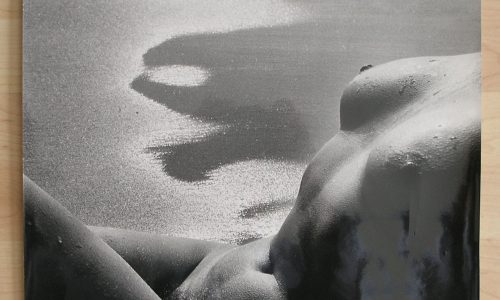
By the late 1960s, as his Informel phase neared its end, Somaini shifted his focus to creating large-scale works. In the 1970s, he produced a series of drawings and photomontages envisioning the integration of sculptural elements within urban settings. Notable among these were the Bridge–Square design proposal for Gustav Gründgens Platz in Düsseldorf (1980) and the Anthropomorphic Garden and Baignade for the Parc de la Villette in Paris (1982). Concurrent with these explorations, Somaini developed a novel carving technique utilizing high-pressure sand jets.
The dynamic element was introduced in his work during his Tracce series in 1975. This involved rolling a matrix along a clay trench, resulting in an imprint called traccia (trace). Somaini showcased these new works in his solo room at the Venice Biennale in 1978. From the mid-1980s onwards, the artist returned to creating large-scale compositions. Notable solo shows by Somaini included exhibitions organized by the Wilhelm Lehmbruck Museum in Duisburg in 1979, Palazzo di Brera in Milan in 1997, Castel Pergine in Trento in 2000, and the Somaini, Sculture, dipinti e disegni 1950-2001, exhibition held in Como in 2002. On November 19, 2005, Francesco Somaini passed away in Como. In 2007, the Galleria Nazionale d’Arte Moderna e Contemporanea in Rome hosted Somaini’s first retrospective exhibition after his death.
Jan van Herwijnen, a self-taught individual, grew up in a working-class family. At the young age of fourteen, he left for England, where he took on various jobs to earn a living. He even worked as a kitchen assistant aboard seafaring vessels.
His talent developed through copying paintings at the Rijksmuseum in Amsterdam. In 1912, he received a scholarship from jhr. Van Riemsdijk, the director of the Rijksmuseum, which allowed him to fully dedicate himself to painting and drawing. Van Herwijnen traveled extensively and spent some time in Paris and Southern France. In January 1920, he already had an exhibition at Heystee building on Herengracht in Amsterdam, showcasing his drawings among other works. In 1923, he exhibited in Collioure.
In 1919, he created a series of thirty large portrait drawings of psychiatric patients at Willem Arntsz Hoeve in Utrecht. He is also known for his portraits of the deceased in the mortuary of Wilhelminagasthuis in Amsterdam.
After working in Amsterdam, Arnhem until 1926, and Heemstede, he settled in Bergen in 1939, where his artistic style continued to evolve. Here, he painted landscapes, flowers, and still lifes, which belong to the Bergen School.
Jan van Herwijnen was a member of Arti et Amicitiae in Amsterdam and the KunstenaarsCentrumBergen (KCB) in Bergen.
In 2008, there was a major retrospective exhibition of his work titled “Jan van Herwijnen, self-preservation as a painter” at Museum Kranenburgh in Bergen. Art historian Caroline Roodenburg-Schadd, curator at the Museum for Modern Art Arnhem (now Museum Arnhem), wrote a monograph with the same title about Van Herwijnen. The exhibition was curated by Paul van Herwijnen, Jan van Herwijnen’s youngest son, and Ype Koopmans.
From September 19, 2021, to January 9, 2022, the exhibition “Drawing from Compassion” featuring portraits of the patients from Willem Arntsz Hoeve was on display at Museum More.
www.ftn-books.com has now the early 1973 publication on his KRANKZINNIGEN-TEKENINGEN available.
Born in Oisterwijk in 1963, Diederik Klomberg completed his graphic art education in 1989 at the Koninklijke Academie voor Beeldende Kunst en Vormgeving in Den Bosch. He then pursued a master’s degree at the Jan van Eyck Academie in Maastricht the following year.
Over the course of the past twenty-five years, Diederik Klomberg has established a formidable reputation for his site-specific artworks, which explore the illusory qualities of both two and three-dimensions. Klomberg pushes the boundaries of this illusional nature to its limits. Within Klomberg’s installations, visitors assume the roles of both spectators and actors, being challenged to reconstruct a deconstructed reality.
Noteworthy exhibitions of Klomberg’s works include showcases at Museum Boymans van Beuningen in 2016 and de Ketelfactory in 2018.
Raoul La Roche started in the 1930s loaning generously and even giving away some works from his collection. From 1932 onwards, the Kunsthaus Zurich was able to showcase a larger group of paintings. During the war years, which La Roche spent “under the most difficult circumstances in Lyon and later in Paris,” his house and collection were spared from losses. In 1950, the Kunstmuseum Basel received fourteen works as a long-term deposit, which resulted in the first donation of 24 works in 1952: four paintings by Picasso, nine by Bracque, five by Gris, four by Léger, and one each by Le Corbusier and Ozenfant. Two more donations followed in 1955 and 1963, so that eventually more than half of the collection, including paintings, works on paper, and four sculptures by Jacques Lipchitz, made its way to Basel.At the same time, nine significant works went to the Musée National d’Art Moderne in Paris, partly as compensation for the permission to export the rest of the collection from France.
In 1962, Raoul La Roche, who suffered from a severe rheumatic disease, abandoned his Paris residence and returned to his hometown, where he donated the “Maison La Roche” to the Fondation Le Corbusier. In the same year, the University of Basel honored him with an honorary doctorate.
He found his final resting place in the Wolfgottesacker cemetery in Basel.
www.ftn-books.com has the 1963 catalog on his gift to the Kunstsammlung Basel collection now available.
Jeanne Bieruma Oosting, driven and passionate in her artistry, powerful and vulnerable as a human being – she encompassed all of that and much more. She was one of those progressive women who fought for a free and independent life at the beginning of the 20th century.
Throughout her nearly hundred-year life, Jeanne Oosting experienced virtually all 20th-century modern art styles and movements. Her work was labeled as ‘impressionistic’ or ‘expressionistic’. It was considered ‘too masculine’ or ‘typical feminine’. She succinctly described it as ‘figurative’.
For Jeanne Oosting, her work was an essential life necessity. It was everything: “My entire life and thoughts revolve around paintings. It is my breath.” She was always busy, living according to her own rules, and wasting no precious time. The phrase ‘No time to lose’ epitomized her.
During her time in Paris, she spread her wings and her career soared. Particularly with her graphic work, Jeanne Oosting gained international recognition. She set the tone for a new vision of graphic art. And she did so with flair, thanks to her experimental approach, excellent craftsmanship, and daring themes.
Jeanne Bieruma Oosting – affectionately called Biertje by her friends – deserves to be (re)discovered by many. This comprehensive exhibition takes you through her long professional and personal life, featuring artworks, photos, and personal documents. This is made possible for the first time in this form thanks to the research conducted by Jolande Withuis, biographer of Jeanne Bieruma Oosting. The exhibition was initiated by Withuis and is based on her biography ‘No Time to Lose. Jeanne Bieruma Oosting 1898-1994’ (published by De Bezige Bij).
Artist and friend Otto de Kat about Jeanne: “I know few artists who possess as much entrepreneurship, enthusiasm, and courage as Jeanne Bieruma Oosting. Some qualities, which seem contradictory, she possesses in equal measure. She is both serious and nonchalant, bold yet sensitive, fantastic and commonplace. She loves reality but does not forget dreams.”
Artist/ Author: Oliver Boberg
Title : Memorial
Publisher: Oliver Boberg
Measurements: Frame measures 51 x 42 cm. original C print is 35 x 25 cm.
Condition: mint
signed by Oliver Boberg in pen and numbered 14/20 from an edition of 20