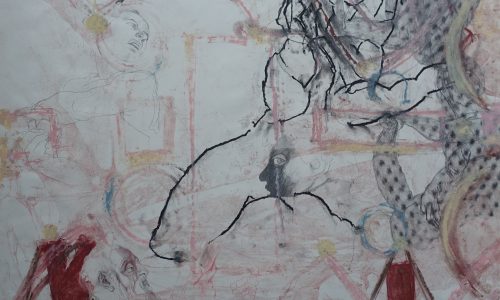
Kick Seiler was already involved with Mokum gallery before he started painting. He lived on the top floor above the gallery. When Duque took an afternoon off, Kick would sometimes sit in the gallery, surrounded by the art that so fascinated him. He liked the atmosphere, but what impressed him most was the intensity of the art. Duque inspired him and gave Kiku his first chance. It was not surprising to him that after some time his work began to hang on the walls of Mokum. Kik has been selling well since its premiere. After that, he received many commissions for portrait painting, which is a genre of painting, and mastered it brilliantly. But Kick deals with more than just portraits. He considers it his job to paint the whole world. He can also regularly admire his still life paintings, parts of cities, and genre paintings depicting multiple figures in specific settings.
www.ftn-books.com has the Drents Museum catalog on his paintings available.
The artistic aptitude of Fuchs was recognized early in his life. At the tender age of 15, he was granted admission to the esteemed Academy of Fine Arts in Vienna.
It was during his time there that he first encountered his fellow students, namely Anton Lehmden, Arik Brauer, Wolfgang Hutter, and Rudolf Hausner. Together, they established the revolutionary Vienna School of Fantastic Realism, a movement that would redefine the art world.
Under the guidance of Professor Albert Paris Gutersloh, Fuchs and his colleagues delved into the techniques of the Old Masters, seeking to imbue their work with a sense of clarity and intricacy. They also utilized allegory and religious symbolism to add depth to their pieces.
Inspired by the works of Austrian symbolist artist Gustav Klimt – renowned for his bold and textured paintings such as “The Kiss” – Fuchs began to develop his own distinctive style, characterized by an emphasis on texture and color.
Renowned for his revival of the traditional mixed technique, Fuchs employed egg tempera to create volume and added a glaze of oil paints mixed with resin to achieve a dazzling effect. His masterpieces can be found in the Jewish Museum in Vienna, Austria, showcasing his unparalleled talent.
In 1950, Fuchs relocated to Paris, where he resided for 12 years. During this period, he embarked on travels to Italy, Spain, England, and the United States, where he crossed paths with renowned artists like Salvador Dali, Giorgio de Chirico, and Jean Cocteau, forming meaningful friendships.
In 1961, Fuchs returned to Vienna and began writing about the art of painting, producing several books on the subject. By the mid-1970s, he had also become a highly sought-after opera stage director and designer, taking on projects such as Mozart’s “Magic Flute” and Wagner’s “Parsifal” and “Lohengrin.”
In 1972, Fuchs purchased and renovated the dilapidated Otto Wagner villa in Hutteldorf, transforming it into the renowned Ernst Fuchs Museum. Through his remarkable talents and unwavering dedication to the world of art, Fuchs left an indelible mark on the art world, etching his name into history.
After Anna Verweij stopped attending the art academy in the late fifties, she began to experiment with materials and techniques. In 1958, she decided to simply go by the name “Anna”. She used leftover materials to create jewelry and small wall hangings. Soon, she devoted herself entirely to textile, the material that would remain her faithful companion throughout her entire career. In the sixties, she delved into designing large, exuberantly colored wall hangings.
In the following decade, her textile work became increasingly detailed and acquired a more conceptual nature. During this period, the concept of textile as visual art was constantly under discussion. This material was still primarily associated with applied art. With her work, Anna gave an inspiring and relativizing twist to this discussion. For her, the boundary between the two “arts” was not a fixed concept.
My Place at the Table
One of Anna’s most notable works is My Place at the Table 2 (1972/73). A pristine white cotton tablecloth is laid over a wooden table, adorned with a refined black embroidered flower border. One of the narrow edges of the cloth culminates in a chaotic array of stitches. In an earlier work, Alice Writes to Alice (1971), Anna shows how a winding strip of fabric transforms into a mysterious script. With a light sense of humor, Anna comments on the contradictions in human behavior and the conflict between inner and outer appearances in pieces like this. Experimental use of flannel, jute, cotton, silk, and printers, in combination with plastic and foam rubber, is characteristic in these works. Her love for nature also makes frequent appearances in her oeuvre, for example in her design drawings of flower fields based on compositions by Piet Mondrian.
In the year of 1978, Anna fell gravely ill. In the final period of her life, transformations of shape take center stage. She creates silhouettes of female figures, modeled after her own body. An exemplary piece is The Leap (1979), which depicts a figure pole vaulting: a clear allusion to the transition between life and death. A large portion of her body of work was realized in the last two years of her life, with her most significant exhibitions also taking place during this time. In 1979, her solo exhibition opened at the Stedelijk Museum in Amsterdam, and in 1984, she was posthumously honored by Museum Boijmans Van Beuningen.
Rolf Nesch, hailing from Oberesslingen, Germany and residing in Oslo, Norway until his demise on October 28, 1975, was a German-born Norwegian printmaker and painter. An early adopter of metal collage in printmaking, Nesch was a pioneer in his field.
Having received his education from art schools in Stuttgart and Dresden in Germany, Nesch was profoundly influenced by the Expressionist extraordinaire Ernst Ludwig Kirchner, with whom he studied in 1924. He was also greatly inspired by the works of renowned Norwegian artist Edvard Munch. In 1925, Nesch began his experimentation with unconventional printmaking and painting techniques. Fleeing Germany in 1933 to escape the persecution of the Nazi regime, he found a new home in Norway, where he had always been drawn to thanks to his admiration for Munch’s work.
During the 1930s, Nesch pioneered a technique of creating deeply embossed graphics by attaching strips of soldering wire onto the printing plate. This novel approach eventually led him to incorporate metal, wood, coloured glass, and stones into his work, creating mosaic constructions that were masterpieces in themselves. Nesch’s ground-breaking methods in printmaking not only caught international attention but also established his reputation worldwide, leading to his selection as Norway’s representative at the renowned Venice Biennale of 1962 and the São Paulo Biennale of 1973.
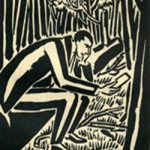
Ludwig Oswald Wenckebach (1895-1962), born in 1895 in Heerlen, began his apprenticeship with his uncle, the painter Willem Wenckebach, in 1910. He then continued his education at the Traditional Arts School in Haarlem. In 1914, he traveled to Vienna to study at the Academy of Fine Arts. Wenckebach was not only a painter, but also skilled in woodcuts, etchings, and lithographs. He returned to the Netherlands in 1919 and settled in Schagen. It was there that he met sculptor John Rädecker, who encouraged him to start sculpting. However, he did not completely abandon graphic art, as evidenced by his 3-cent stamp released in 1928 to commemorate the Amsterdam Olympic Games.
As a sculptor, Wenckebach was self-taught. Initially, influenced by his time in Greece, he worked in the classical Greek tradition. He created sculptures for buildings and monuments, as well as portraits in stone and bronze. In 1935, he was appointed as an extraordinary professor of modeling and sculpting at the department of Architecture at the Technical University of Delft. After World War II, Wenckebach created several war monuments (in Alphen 1949, Haarlem 1949, and Middelburg 1950). He also designed coins and medals, such as the 1950 coin featuring the portrait of Queen Juliana.
It was not until the 1950s that Wenckebach gradually developed his own figurative style, breaking away from the classicist tradition with its heroic, athletic, or archaic figures. He employed a subtle method of stylization, while still maintaining a certain strictness in his figures. Slowly, his free figurative sculptures gained their own character, featuring a sleek and stylized design with a gentle, everyday, and sometimes ironic, tone.
In 1955, Oswald Wenckebach was appointed Knight of the Order of the Dutch Lion. He passed away in Noordwijkerhout in 1962.
Nothing is as it seems in the deceptive photographs of Tjibbe Hooghiemstra. The photographer explores the experience of space, constantly deceiving the viewer and inviting us to see spaces in a new way.
With his camera, Hooghiemstra zooms in extremely close or out immensely far. This takes us from the unfathomable depths of the universe to extreme close-ups of our Earth. We see water, air, atmosphere, and stars.
What appears far away is actually dizzyingly close, and close-ups prove to be disorientingly distant, while seascapes resemble the cosmos. Tjibbe plays with space. He photographs photographs, prints that have been photographed again, close-ups of paintings, and thus sketches his own timeless spaces. He handles the camera similar to the way he paints, directly and impulsively.
Tjibbe Hooghiemstra (Tytsjerk, 1957) studied at the Minerva Academy in Groningen and the Sint Lucas Academy in Ghent. He works alternately in the Netherlands and Ireland. His work is exhibited worldwide in galleries from New York to Tokyo and at international art fairs such as Art Basel, Fiac Paris, and Art Forum Berlin. In addition to the Fries Museum, his work is also included in the collections of the Stedelijk and Rijksmuseum.
Jan Hofman has been working as a visual artist for almost five decades, focusing on graphic design and mixed media painting. His extensive body of work intrigues through its powerful visuals and refined use of color. The art of Jan Hofman has flourished through the application of new methods and techniques in printmaking. Early in his career, he explored various experiments with paper and developed unique printing techniques that require exceptional skill. He blends pigments and inks in his own distinctive way, which is why he personally prints his etchings – a time-consuming task that results in limited editions. Each print in an edition is truly one-of-a-kind, created under the same tension as a first print.
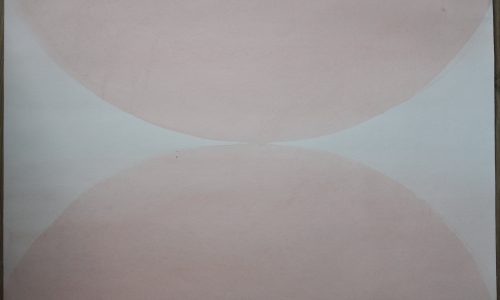
He delves into the relationships between circles and squares, selectively cutting and folding strips of material in a rhythmic fashion, producing a duplicate of the base figure outside the fixed edges of the artwork. He later perfects this playful process. With these objects, he strives for monumental forms of expression.
Large pieces of zinc with irregular shapes and frayed edges are painted and flow beyond the boundaries of a traditional frame. Characteristic leaves from trees and plants are prepared and coated with thick layers of paint, then combined to create a grand, harmonious composition.
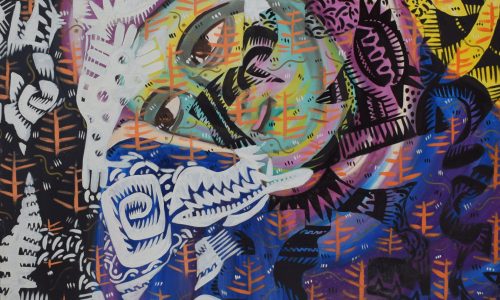
Hugo Kaagman can be considered an emblematic figure within the now not-so-short history of stencil art. Described as the Dutch Godfather of stencil graffiti, he has pioneered the use of the medium since the late 1970s, using the walls of Amsterdam to spread anti-establishment messages in a clear, iconic language imbued with humour.
Immersed in the Amsterdam underground scene, the first of Kaagman’s experiments with stencils were inspired by punk and reggae references. Soon though, he developed a personal language, irreverently mixing the most diverse visual and cultural influences. Very often, his work results in the juxtaposition of beautiful decorations with social critique. The possibility of endless repetition offered by the stencil has led him to develop his own recognizable style in various directions. He adopted motifs from his travels in Africa and the Middle East: among them the zebra design with which he decorated his house. From working illegally in a politically provocative way, he started receiving more and more commissions, while also exhibiting works on canvas in art galleries.
Since the 1990s he has developed his own very recognizable cipher – the Kaagware – a personal interpretation of Delftware, the traditional blue-and-white Dutch ceramic decorative style. From the early murals in Waterloo Square in Amsterdam to decorating the planes of British Airways, from illegal street spraycans to legal and established art, and from public space to art galleries, Kaagman’s artistic journey has anticipated and paved the path for a new generation of stencil artists.
Caravaggio, real name Michelangelo Merisi da Caravaggio (1571-1610), was an Italian Baroque painter. He is known not only for his dramatic lighting and intense realism in his paintings, but also for his eventful life and controversial personality. Caravaggio’s paintings often depicted religious and mythological scenes, but he painted them with a vivid realism that was unprecedented at the time. His chiaroscuro, or use of contrast between light and dark, created a sense of drama and depth that drew the viewer into his paintings. Despite his artistic talent, Caravaggio was also known for violence and involvement in various criminal activities. He was repeatedly arrested for assault and other crimes, and eventually had to flee Rome after killing a man in a fight. Today, Caravaggio is considered one of the most important Baroque painters, and his influence can be seen in the work of many later artists. His paintings are still admired for their realism, drama, and emotional intensity.
In 2010 the Museum het REMBRANDTHUIS had the last of the Caravaggio painting on exhibit and made a special catalog for this occasion which is now available at www.ftn-books.com
Iannone, born in Boston in the year 1933, was a literature graduate from Brandeis University. Her marriage to the wealthy investor and painter James Upham led to extensive travels across Europe and Asia from 1961 to 1967. As a fixture in the downtown art scene of New York, Iannone began creating cutout wooden portraits of prominent figures like Jacqueline Kennedy and Charlie Chaplin, which served as precursors to her later works.
In 1961, U.S. Customs confiscated Iannone’s copy of Henry Miller’s 1934 sexually explicit novel, Tropic of Cancer, at a New York airport. Her successful lawsuit filed by the New York Civil Liberties Union resulted in lifting the 30-year ban on Miller’s work.
Around seven years later, Iannone met artist Dieter Roth while on a trip to Iceland. She left her husband at the time to move to Reykjavik with Roth, who she considered her muse. During the 1970s, she created some of her most famous works, often depicting scenes from her and Roth’s intimate life.
In 1969, Iannone’s work was censored by the director of Kunsthalle Bern for its inclusion of genitalia. In response, Roth withdrew his work from the show and curator Harald Szeemann resigned. Iannone then created the comic book “The Story of Bern (or) Showing Colors,” reflecting on the experience.
Both Iannone and Roth became prominent figures in the Fluxus movement. They remained lovers until 1974 and close friends until Roth’s passing in 1998. In 1976, Iannone received a scholarship to move to Berlin, where she resided until her death.
Despite the art world taking time to catch up, Iannone’s controversial work was critically reassessed in the early 21st century. Her video sculpture “I Was Thinking of You” (1975), a human-sized box painted with an erotic scene and featuring a monitor screening a video of the artist masturbating, was recreated at the Wrong Gallery at Tate Modern in 2005 and for the 2006 Whitney Biennial.
Artist/ Author: Oliver Boberg
Title : Memorial
Publisher: Oliver Boberg
Measurements: Frame measures 51 x 42 cm. original C print is 35 x 25 cm.
Condition: mint
signed by Oliver Boberg in pen and numbered 14/20 from an edition of 20