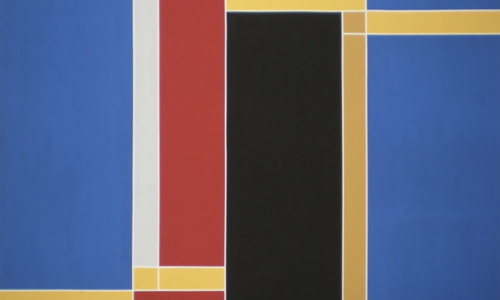
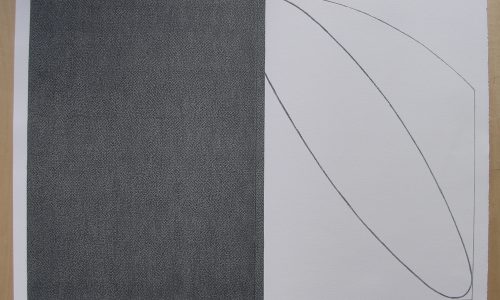
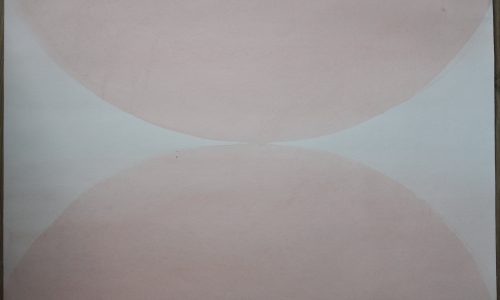
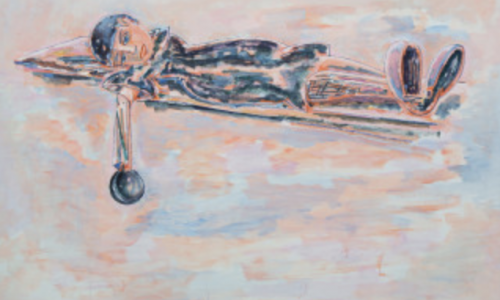
Peter Joseph had, over the course of decades, dedicated his practice to seeking the potential in constraint. He rose to critical acclaim in the 1970s for his meditative, two-colour paintings, which set one rectangle within a frame of a darker shade. These early works were characterised by perfect symmetry, where every decision about colour and proportion could be seen to be redolent of time, mood or place. While comparable to the work of Mark Rothko and Barnett Newman, Joseph’s was an anomalous strain of Minimalism: his allegiance lay as much with Renaissance masters as with his contemporaries. More recently his format had departed from his established ‘architecture’ to divide the canvas into two planes, horizontally or vertically, wherein loose brushwork, natural tones and patches of exposed canvas tap into new feeling. As Joseph said: ‘A painting must generate feeling otherwise it is dead’.
www.ftn-books.com has the Kent Fine art Inc. catalog now available.
Ian Whittlesea’s work has consistently been concerned with the intersection of language and space, using the lives, words and works of other artists as its source. He has been described as an artist of fascinatingly rigorous refinement and his work as a paradigm of concision and single-mindedness.
Collectively called Instruction Prints these works extend Whittlesea’s interest in the power of text to change the physical and psychic state of the viewer. Formally and conceptually they relate to the Statement Paintings that he made twenty-five years ago, but whereas those early paintings reproduced the didactic words of other artists the Instruction Prints use more generic and unattributed text. In their simplicity and directness they recall a parent’s instructions to a child, or perhaps the voice of a lover or a teacher. As with all of Whittlesea’s textual art they play on the tension between reading and looking, exploring the moment when language becomes object. As he has said of his earlier works:
When I first started making text paintings one of the important things was that it allowed me to side-step any debate about abstraction and representation. When you paint letters you are making the thing itself: as you paint a letter X you aren’t making a representation of a letter X, it just is the letter X.
www.ftn-books.com has the Marlborough catalog from 2013 available ( edition of 500 cps)
Readers know of my admiration for Willem Sandberg, who I can consider as one of the true geniuses of design. and ….typography. One who knows the series of publications on Typography : EXPERIMENTA TYPOGRAFICA, knows that he used these books to stretch the boundaries of typography, inventing in his own way a new series of fonts and designs. This series has been published over a period of some 10 years , making use of several publishers that supported the idea of the series. Andre Schwerz with Reflex and Galerie der Spiegel are among them. Some of these highly collectible titles are now available at www.ftn-books.com
Another resemblance. The slketch-like landscapes by Kees van Dongen vs the ones by Raoul Dufy. Almost the same period and both have the same feel . On the left van Dongen.
www.ftn-books.com has on both artists publications available.
Karl Otto Götz is one of the most important painters of the German Informel. His painting is non-representational, non-abstracting, not derived from nameable objects or landscapes. His painting is pure painting, quasi in its original state, fluid, spontaneous, expressive – without a depictive function or illusionistic depth effect. In the early 1950s Götz spreads his brush strokes and squeegee strokes completely freely, spontaneously and loosely over the canvas. Since 1954 his painting and squeegee rhythms follow certain pictorial schemes. These schemes are characterized by comparable divisions and rhythms, but can only be approximately named with words such as “vortex pictures,” “waterfalls,” or “grottos.” The speed of color application is extremely high. Instead of clearly delineated forms, the scraps of paint spatulaed and flung onto the canvas form transitions and interlocks everywhere beyond classical principles of form. He negates the constricting forms of the brushstroke of previous non-objective painting directions as well as the “cold abstraction” of constructed compositions. By exposing his artistic action very experimentally to the unreflective, spontaneous painting gesture, pouring the paint and distributing it with brushes or squeegees, he challenges the instantaneous happening.
www.ftn-books.com has several Gotz publications available. Among them one from the Kunsthof Vicht with a handwritten, signed and dedicated cover.
Kiki Smith was born in 1954 in Nuremberg, Germany. The daughter of American sculptor Tony Smith, Kiki Smith grew up in New Jersey. As a young girl, one of Smith’s first experiences with art was helping her father make cardboard models for his geometric sculptures. This training in formalist systems, combined with her upbringing in the Catholic Church, would later resurface in Smith’s evocative sculptures, drawings, and prints. The recurrent subject matter in Smith’s work has been the body as a receptacle for knowledge, belief, and storytelling.
In the 1980s, Smith literally turned the figurative tradition in sculpture inside out, creating objects and drawings based on organs, cellular forms, and the human nervous system. This body of work evolved to incorporate animals, domestic objects, and narrative tropes from classical mythology and folk tales. Life, death, and resurrection are thematic signposts in many of Smith’s installations and sculptures. In several of her pieces, including Lying with the Wolf, Wearing the Skin, and Rapture, Smith takes as her inspiration the life of St. Genevieve, the patron saint of Paris. Portrayed communing with a wolf, taking shelter with its pelt, and being born from its womb, Smith’s character of Genevieve embodies the complex, symbolic relationships between humans and animals.
Smith received the Skowhegan Medal for Sculpture in 2000, the Athena Award for Excellence in Printmaking from the Rhode Island School of Design in 2005, the fiftieth Edward MacDowell Medal from the MacDowell Colony in 2009, and has participated in the Whitney Biennial three times in the past decade. In 2005, Smith was elected to the American Academy of Arts and Letters. Smith’s work is in numerous prominent museum collections, including the Museum of Modern Art, New York; Walker Art Center, Minneapolis; Whitney Museum of American Art, New York; Solomon R. Guggenheim Museum, New York; the Metropolitan Museum of Art, New York; and the Museum of Contemporary Art, Los Angeles. Smith lives and works in New York City.
In 1991 Harald Szeemann described Spitzer as ”a master at installing this new sculptural quality that makes us so uneasy, that so shocks our perceptual habits …Everything has his own particular signature of commingling—sophistication in the guise of banality, circumspection and innovation brought back into the everyday language of elements screwed together.”
Objects and materials saturated with prosaic content—legal paper, industrial metal, recycled glass, wood, rubber—are re-contextualised in the space they inhabit, displacing and subverting their meaning. Formally precise, witty and direct, works such as Deadload/Deadlock (1985) foreground the processes and problematic economies of industrial production in their use of milled aluminium and rubber, while simultaneously engaging with their architectural context—About Sculpture (1984–87) is held by shock absorbers against the walls, while Corridor (Berlin) (1984) transects the gallery space and impedes the flow of viewers through the exhibition. Conversely, works using fused thread on legal paper, all Untitled (Law Blanks) (1994), challenge the conventions of perceptual representation by compelling us to read both the recto and verso at the same time, as the thread lines disappear through and re-emerge visible through the thin printed paper.
Serge Spitzer was born in Bucharest in 1951. His works have been exhibited in many museums and art institutions, among them Folkwang Museum Essen, 1979; Museum of Modern Art, New York, 1983; Kunstmuseum, Bern, 1984 and 2006; Magasin, Grenoble, 1987; Gemeentemuseum, the Hague, 1992; Kunsthalle and Kunstverein, Düsseldorf, 1993; IVAM Centro Julio Gonzales and Centro del Carme, Valencia, 1994; Westfälischer Kunstverein, Münster, 1995; Kunsthalle, Bern, 2003; (MMK) Museum fur Moderne Kunst, Frankfurt, 2006; Aldrich Museum of Contemporary Art, Ridgefield, Connecticut, 2008; and Palais de Tokyo, Paris, 2010. He died on 9 September 2012.
Spitzer participated in a number of international art exhibitions and biennials including Documenta 8, Kassel, 1987; Istanbul Biennial, 1994; Biennale de Lyon, 1997; Kwangju Biennial, 1997; Venice Biennale, 1999, Sydney Biennial, 2010.
His work is represented in public and private collections, among them Brooklyn Museum, New York; Fogg Art Museum, Cambridge, Massachusetts; Museum Folkwang, Essen; Haags Gemeentemuseum, the Hague; Kunstmuseum, Bern; IVAM Instituto Valenciano d’Arte Moderno, Valencia; Museum of Contemporary Art, Chicago; Musée d’Art Contemporain, Lyon; Museum für Moderne Kunst (MMK), Frankfurt am Main; Neue Nationalgalerie, Berlin; Staatliche Museen Neue Galerie, Kassel; Staatens Museum for Kunst, Copenhagen; Museum of Modern Art, New York; Menil Collection, Houston, Texas; Yale University Art Gallery, New Haven, Connecticutt.
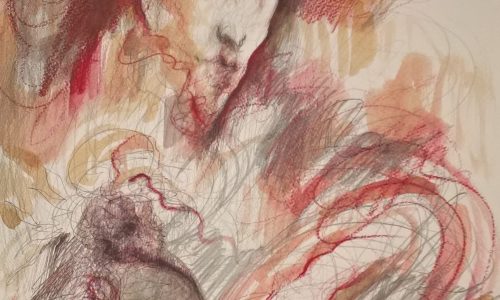
The process and act of painting are at the centre (stage). Both research and experimenting with selfmade ink and paint from colouring matters from collected or homegrown flowers or plants, are essential to me. Assembling ink and paint on paper and canvas is a surprising interplay of flowing and hardening, blending and rejection, predominating and submerging, fusing together and disintegrating. All this is influenced by my actions. Finding that things happen, come into being because I assemble materials, fascinates and inspires me. My works are not representations, but are the result of the way in which psychical actions and the used materials meet. My working method is consistent, the end result, however, is always not known beforehand. Form and content are free, but colour and the power of matter determine the image.
www.ftn-books.com has now 3 copies o the POWER OF DECAY available. all signed and numbered from the edition of 50 copies
Visually enticing, the paintings of Caio Fonseca illustrate the union of the artist’s two passions: art and music.
His paintings depict the juxtaposition of vibrant color and shallow space, where the relationship between each organic form reveals an acute sense of depth and proportion. Quixotic and alluring, Fonseca’s paintings illustrate the modest beauty of abstraction.
Fonseca explores the relationship between positive and negative space with his use of a carefully chosen palette. Rather than rendering dimension, he utilizes the properties of color to negotiate depth.
The artist divides his time between studios in Pietrasanta, Italy and New York City. A New York City native, he is the son of the sculptor Gonzalo Fonseca. Collected and exhibited internationally, his work resides in the collections of such institutions as the Metropolitan Museum of Art, the Brooklyn Museum of Art, the Whitney, and the Hirshhorn Museum and Sculpture Garden.
Artist/ Author: Oliver Boberg
Title : Memorial
Publisher: Oliver Boberg
Measurements: Frame measures 51 x 42 cm. original C print is 35 x 25 cm.
Condition: mint
signed by Oliver Boberg in pen and numbered 14/20 from an edition of 20