

Amédée Cortier stands as a monolith within the Flemish fundamental painting movement, a cohort shared with the likes of Marthe Wéry, Dan Van Severen, and André Beullens. Emerging amidst the mid-sixties, this aesthetic shift was a transnational phenomenon, tethered to the atmospheric depth of American colour-field pioneers like Newman, Rothko, and Reinhardt. Fundamental painting operated like a precise prism, refracting the act of creation into its elemental constituents: hue, texture, materiality, and the rhythmic rigor of the process itself. It mirrored the austere elegance of minimalism, finding a rhythmic pulse that echoed across the Atlantic to resonate within the studios of London, Dusseldorf, and Rome, where figures such as Robert Ryman and Agnes Martin were similarly interrogating the canvas.
His formative crucible was the Royal Academy of Fine Arts in Ghent, spanning the years 1936 to 1942. Necessity demanded he ply his trade as a house painter, a utilitarian toil that—much like an alchemist discovering hidden properties through repetition—etched itself into his professional DNA. This mundane labor birthed a dual obsession: a reverence for the tactile mechanics of the brush and an almost scientific fascination with how pigments dance across disparate surfaces. While his initial foray into the Latem school saw him tethered to the lyrical currents of expressionistic landscapes and still lifes, the experience functioned as a vital apprenticeship in the primacy of intuition. This instinctive pulse would later serve as his signature, marking a sharp departure from his Belgian contemporaries who favored a more surgical, clinical approach.
The year 1949 acted as a seismic fault line in his trajectory. An encounter with the geometric clarity of cubist masters sent him spiraling into a deep theoretical engagement, specifically with the rigorous teachings of André Lothe. Through the lens of the golden ratio, his canvases underwent a metamorphosis; the fluid became fixed, the organic turned architectural. During the 1950s, he orchestrated cubist compositions where the void held as much weight as the substance, pushing the background into a state of parity with the subject, thereby inviting the observer to navigate a landscape of balanced tensions.
By the mid-sixties, his canvases underwent a metamorphosis—abandoning the tether of representation to pursue a stark, abstract dialectic of chromatic weight, geometric tension, and tactile depth. He found a kindred spirit in the austere progression of Piet Mondriaan, mirroring that singular trajectory from figurative turbulence toward an unadulterated, analytical equilibrium.
Within the hallowed galleries of Amsterdam’s Stedelijk, the resonances of Barnett Newman, Ellsworth Kelly, and Frank Stella served as a vital validation of his internal artistic compass. A pilgrimage to New York in 1972 proved seismic; he became spellbound by Mark Rothko, whose canvases dissolved the threshold between hue and geometry, anchored in pure, visceral affect rather than the cold calculus of pragmatism. Consequently, Cortier’s visual vocabulary swelled, straining toward a monumental, spatialized abstraction.
He began to dismantle the traditional sanctity of the frame, hungering for a synthesis where the architecture of the exhibition space bled into – and breathed within – the work itself. He envisioned the artwork not as a sequestered artifact clinging to a partition, but as an unfolding phenomenon; an ontological event stitched into the fabric of daily existence. He argued that the boundaries between object and environment ought to erode, turning the very walls of our domiciles into living vessels for pigment. Yet, his sudden departure in 1976 prematurely severed this arc, leaving his grand ambition for an immersive, dwelling-bound art to linger as a ghost in the corridor of unfinished dreams.
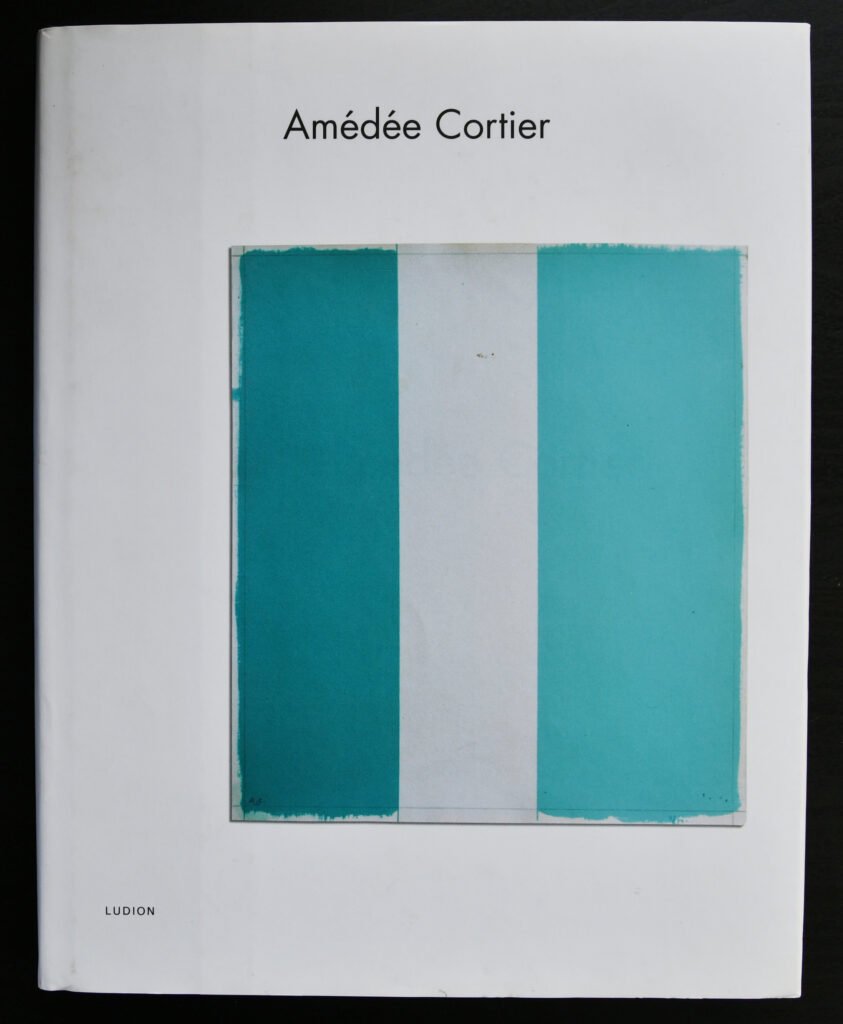
www.ftn-books.com has several Cortier titles available.