

ew contemporary Dutch artists have transformed light into an artistic medium as convincingly as Marc Mulders. Known for his expressive paintings, watercolours and monumental stained-glass windows, Mulders has built an oeuvre in which nature, spirituality and colour merge into immersive visual experiences. Among his early and defining stained-glass commissions is Een raam in Rhoon (“A Window in Rhoon”), a project that marked an important moment in his artistic development.
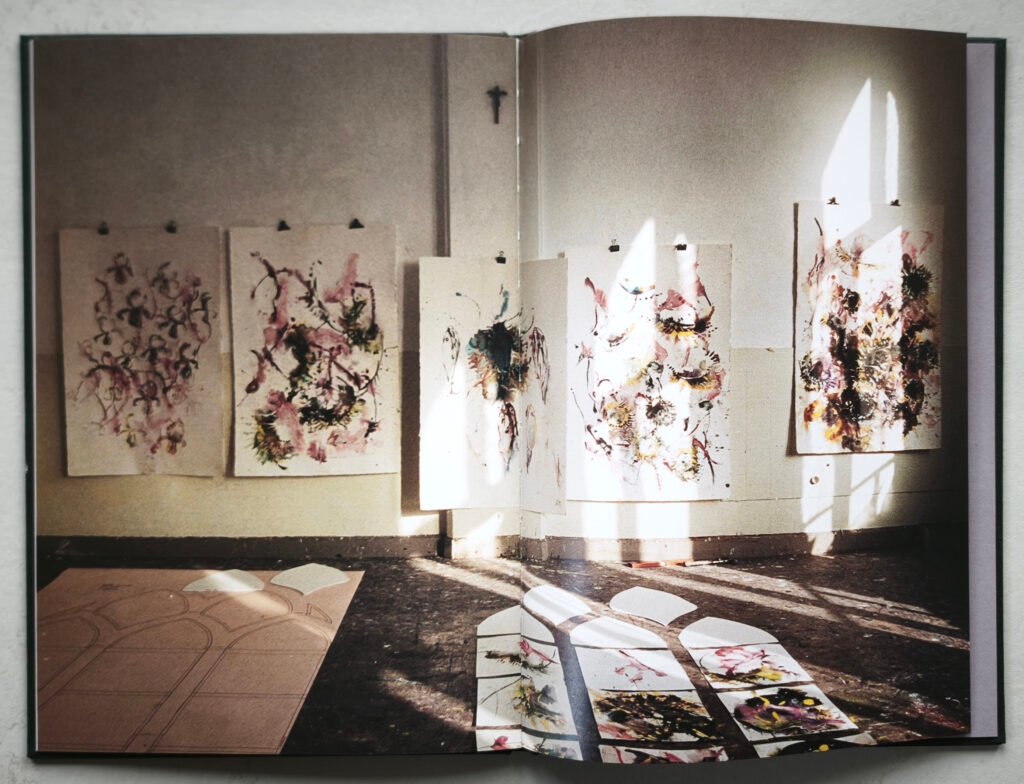
Installed in the Dutch Reformed Church in Rhoon in 2000, the window represented more than a new commission. It signalled Mulders’ transition from painting with pigment to painting with light itself. A publication titled Een raam in Rhoon accompanied the installation, documenting the project and its significance. The commission centred on a stained-glass window for the historic church, bringing contemporary art into dialogue with centuries of religious architecture.
Marc Mulders had already established himself as one of the Netherlands’ leading painters, but stained glass offered him something that canvas never could: the artwork changes constantly. As sunlight moves throughout the day and across the seasons, the colours shift, the atmosphere evolves, and the window becomes a living presence rather than a static image.
This dynamic relationship between art and light became central to Mulders’ practice. The Rhoon commission introduced visual motifs that would reappear throughout his later stained-glass projects: flowers, fish, flowing organic forms and symbolic references to creation and resurrection. Rather than illustrating biblical stories literally, Mulders invites viewers into an experience where nature itself becomes a spiritual language.
The Rhoon windows are rooted in themes of creation. Colour flows across the glass in rhythmic patterns, suggesting water, growth, light and life. Instead of clear narrative scenes, Mulders uses abstraction mixed with recognisable natural forms. Flowers bloom across the glass, fish swim through luminous fields of colour, and the composition evokes the unfolding of creation itself.
This approach reflects Mulders’ belief that the natural world is inseparable from the sacred. His work rarely separates spirituality from ecology; instead, the beauty of flowers, sunlight and changing seasons becomes evidence of something larger than ourselves.
One of the most remarkable aspects of Een raam in Rhoon is how naturally it inhabits a medieval church. Rather than competing with the building’s history, the window extends it.
The church in Rhoon already possesses centuries of architectural and religious heritage. Mulders’ intervention demonstrates that sacred spaces can continue to evolve through contemporary artistic expression. Later, a second stained-glass window, Ark van Noach – Regenboog, was added, creating an ongoing dialogue between historical architecture and modern art.
Looking back, Een raam in Rhoon occupies a pivotal place in Marc Mulders’ career. Shortly after this commission, he received increasingly ambitious projects for churches across the Netherlands, including the Stevenskerk in Nijmegen, the Nieuwe Kerk in Amsterdam, the Sint-Janskathedraal in ‘s-Hertogenbosch and the Sint-Janskerk in Gouda. These commissions established him as one of Europe’s leading contemporary stained-glass artists.
What began in Rhoon became a defining artistic direction: using stained glass not simply as decoration, but as an ever-changing encounter between architecture, nature and light.
In an age dominated by digital screens, Mulders reminds us that light itself can be art. His window in Rhoon cannot be fully captured in photographs because every hour presents a different work. Morning sunlight, cloudy afternoons and golden evenings all reveal new layers of colour.
That is perhaps the greatest achievement of Een raam in Rhoon. It is not simply something to look at—it is something to experience. The artwork lives with the weather, the seasons and the people who gather beneath it.
More than twenty-five years after its installation, the window remains an eloquent example of how contemporary art can deepen the meaning of historic spaces. Through colour, transparency and light, Marc Mulders transformed an ordinary church window into a meditation on creation, renewal and the enduring beauty of the natural world.
www.ftn-books.com has now the publication of an edition of 750 cps on the RHOON project available.