

M.C. Escher spent a lifetime turning flat sheets of paper into puzzles of birds becoming fish, angels becoming devils, and one shape sliding seamlessly into the next. It’s easy to forget that his art was made for the page — because so much of it seems built to wrap around something.
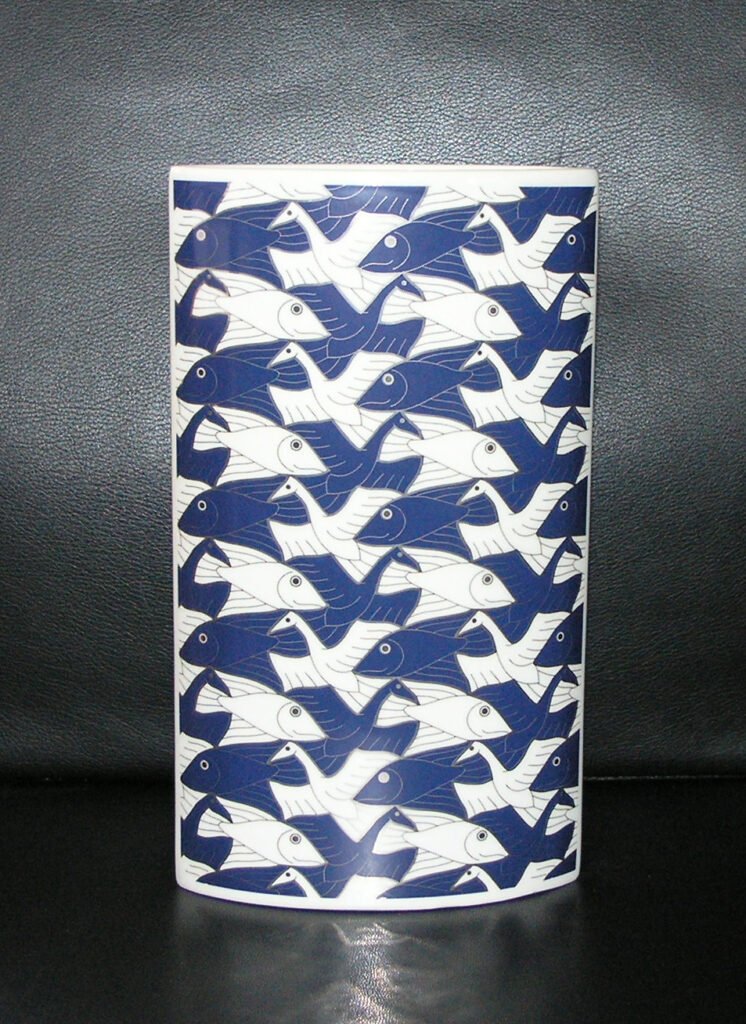
That instinct is exactly what a small run of porcelain vases capitalized on roughly 35 years ago. Produced under license from Cordon Art — the Baarn, Netherlands company that has held the rights to Escher’s estate since the 1960s — these vases took some of his most famous tessellations (Sky and Water, Birds, Regular Division of the Plane) and curled them around a cylindrical form.
Escher’s tessellating patterns are designed with no visible start or end point — one creature’s wingtip becomes another’s beak, endlessly, in every direction. On a flat print, that infinity is implied. Wrapped around a vase, it becomes literal: the pattern’s two edges meet at the seam and continue uninterrupted around the curve, so the eye genuinely can circle the piece forever without hitting a border. Few artists’ work translates to a three-dimensional object this naturally.
The vases were part of the Silhouette d’Art collection, a partnership between the Dutch company Parastone and British ceramics maker John Beswick, working under license from Cordon Art. Rather than simply printing an Escher image on a generic vase shape, the collection matched specific tessellations to vase silhouettes chosen to complement them — Sky and Water’s geese-into-fish metamorphosis on an elongated oval form, Birds on a rounder profile, and so on. Each piece was kiln-fired ceramic, glazed, and sold in its own gift box, positioning them as much as collectible art objects as functional vases.
These vases were never meant to rival Escher’s prints in significance — they were licensed merchandise, produced for an audience that wanted to live with his work rather than just look at it. But three and a half decades on, they’re a nice reminder of how thoroughly Escher’s ideas escaped the printmaking studio. His tessellations turned out to be genuinely portable: from woodcuts, to book covers, to building facades, to a vase on a shelf, still quietly proving that a plane really can be divided without end.
The vase is now on special offer at www.ftn-books.com