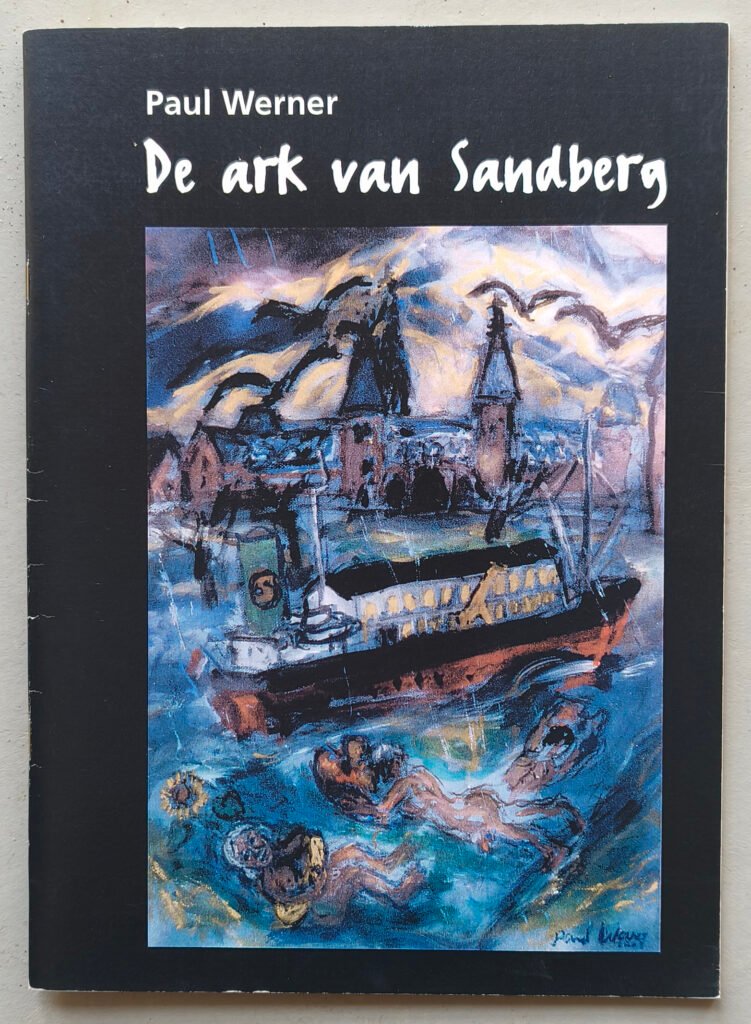


Werner functioned as an evocative auteur of topography, an expressionist who bled the vistas of the Low Countries, the Iberian Peninsula, and the Gaullish countryside onto his canvases with ravenous intensity. His gaze fixated upon the tectonic shifts of the city—the industrial skeletal remains of Amsterdam’s harbors, the claustrophobic grit of Oosterdok’s construction pits, and the desolate elegance of the KNSM-island, where his studio within Loods 6 served as a monastic cell for his creative rites.
Within his arsenal, gouache reigned supreme. It was a fluid, volatile medium, granting his wrist the license for a mercurial and spontaneous stroke. He habitually colluded with pre-tinted watercolor stocks, treating these chromatic foundations as the bedrock for his visceral compositions. His palette eschewed the pedestrian facsimile of nature; instead, he embraced a hyper-real, emotive chromaticism that acted as a prism, refracting the landscape into a heightened, psychological truth. Paradoxically, he remained tethered to the tangible. Werner refused to let the motif dissolve into the void of pure abstraction; his subjects possessed the stubborn vitality of a lighthouse piercing a fog. He walked—or perhaps drifted—in the lingering shadows cast by the tortured, gestural giants Vincent van Gogh and Chaïm Soutine, drawing sustenance from their frantic, incandescent legacies.
Occasionally, the mundane curtain of reality would tear, revealing a phantom, surrealist subtext. Under his brush, the jagged coastal crags and the stoic, ancient menhirs of Brittany underwent a metamorphosis, assuming a sentient, presque-vivant quality. Spiritual motifs sporadically permeated this creative bedrock; specifically, his late-career obsession with the transcendental—most notably the 2009 triptych honoring Saint Francis. Conceived in tandem with his younger compatriot Fons Heijnsbroek, the project crystallized after their shared immersion in Sofia Gubaidulina’s *The Canticle of the Sun* at the Muziekgebouw aan ‘t IJ. Those preliminary sketches, drafted by Werner’s hand, provided the structural bones for an opus that breathed the very air of theological reverie.
In 2003 Werner published a book in an edition of 50 copies on the new wing of the Stedelijk Museum.
this book is now available at www.ftn-books.com