

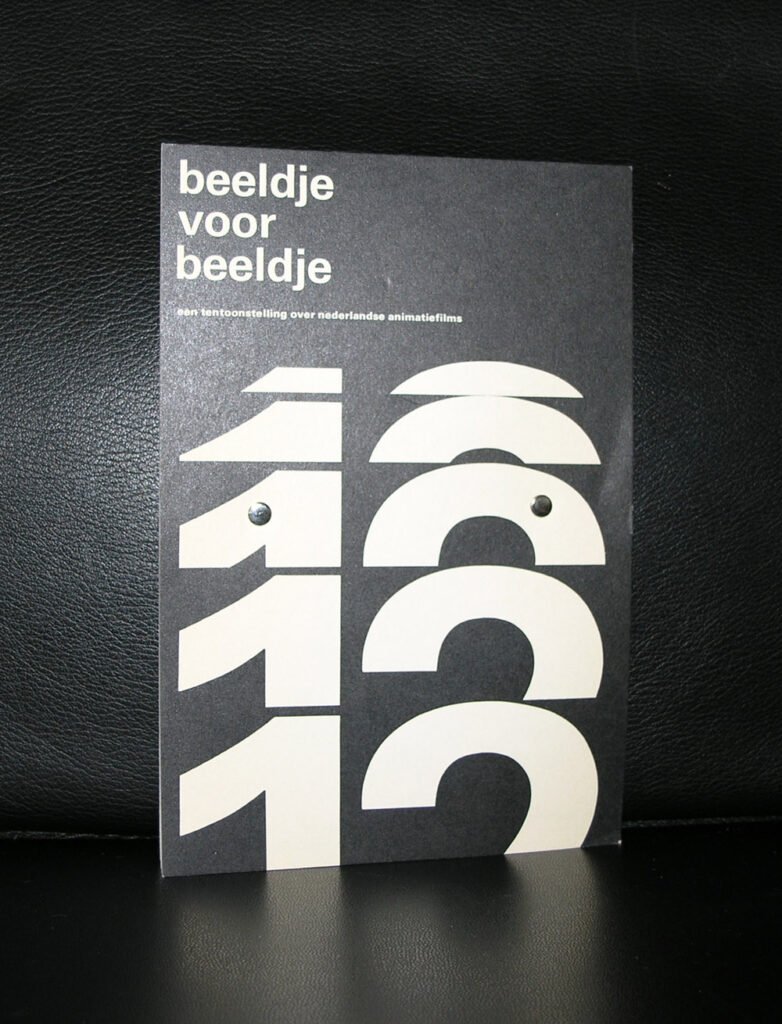
An iconic publication and to celebrate the new series of blogs i have made a special discount code for this publication : use BEELDJE40 until the 22nd of August 2026 to receive a 40% discount at checkout on this special Crouwel publication. Only 2 copies available.
Here is my short story on the BEELDJE VOOR BEELD JE book from 1974
Frame by Frame
The two rivets went in on a Tuesday, and after that the booklet could never again pretend to be one thing.
Wim Crouwel had drawn the grid the way he drew everything — with the certainty of a man who believed a page, like a letter, was made of units that either lined up or failed to. But this page would not lie flat and hold still like his posters did. This one wanted to move.
Beeldje voor beeldje, he’d written on the cover. Image by image. It was the only honest title for a catalogue about animation, where nothing exists except the gap between one drawing and the next, and the eye that’s fooled into filling it.
Daphne Duijvelshoff was the one who noticed the problem first. If you bound the flip-drawings the normal way — spine on the left, like a book — a thumb could only run them in one direction, and worse, the middle of the story would sit buried under everyone else’s ink. Verbeek’s little figure would have to march across Wiertz’s, and neither would ever finish.
So they put the spine in the center. Two rivets, cold and industrial, like something from Total Design’s drafting tables rather than a museum shop. The booklet stopped being a book and became two books that shared a middle. Riffle it from the left, and Verbeek and Wiertz’s creature stumbled into motion. Flip it over, riffle from the right, and Niek Reus’s own small drama unspooled from its own private ending toward its own private start.
There was no first page anymore. Only two edges, both of them beginnings, and a rivet in the center that refused to say which one came first.
At the exhibition — the fourth of October, 1974, Dutch animators hung on the Stedelijk’s walls in stills that could not move — visitors picked the catalogue up not knowing yet that it wasn’t a catalogue. Someone’s thumb would find the fore-edge by accident and the drawings would flicker to life between their fingers, twelve frames, thirty, and then stop, because paper always stops, and you had to go back to the beginning to make it happen again.
Crouwel liked that. He had spent his whole career insisting that a grid was a kind of honesty — that if you showed people the structure, the bones, they would trust the thing built on it. Here the bones were a rivet and a fold, and the honesty was this: animation is not a picture of movement. It is a stack of stillnesses, and you are the one who moves.
He never said so directly. He didn’t need to. He had put two rivets in the middle of a booklet and let the visitors’ hands do the rest.