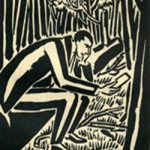
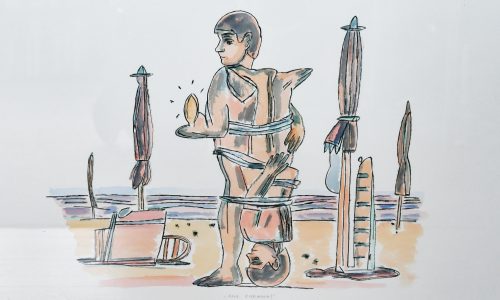
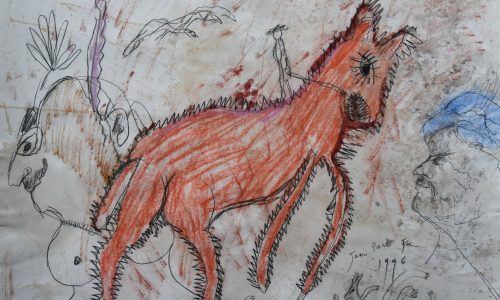
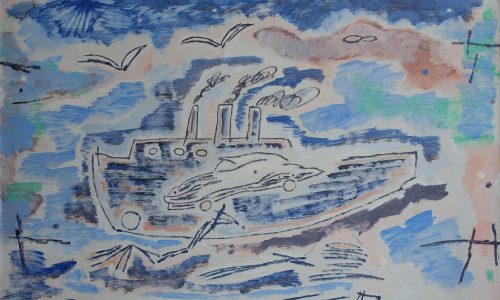
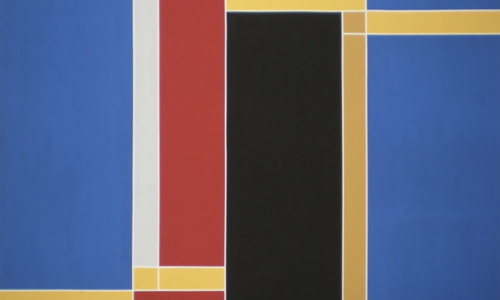
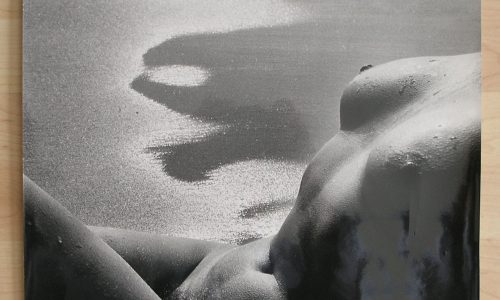
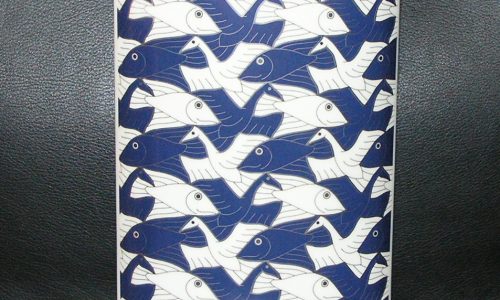
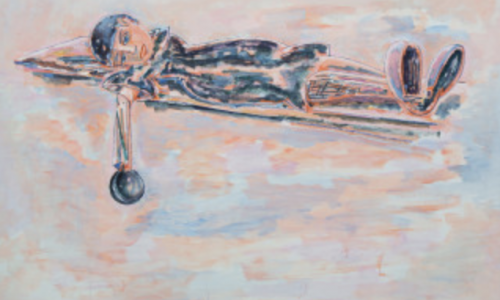
Frank van Hemert exhibition at the Gemeentemuseum Den Haag
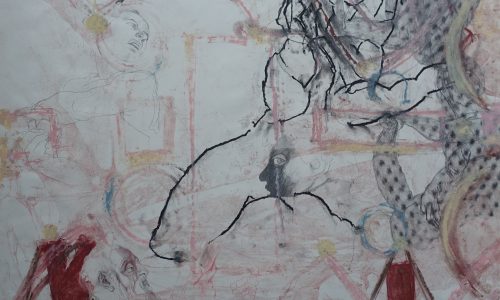
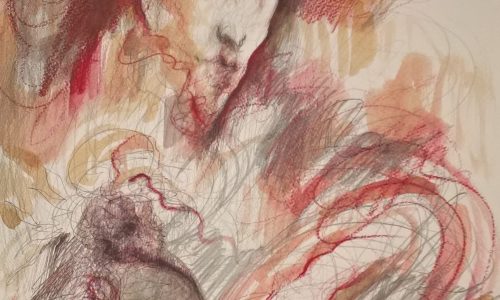
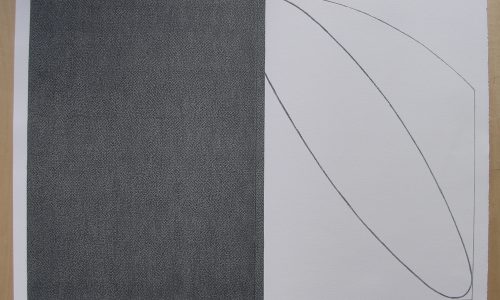
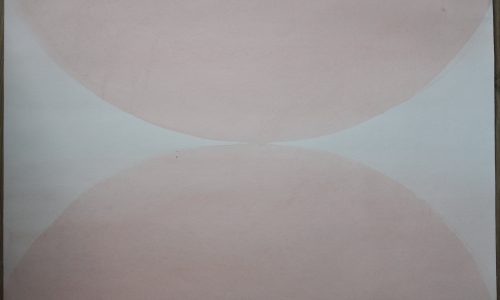
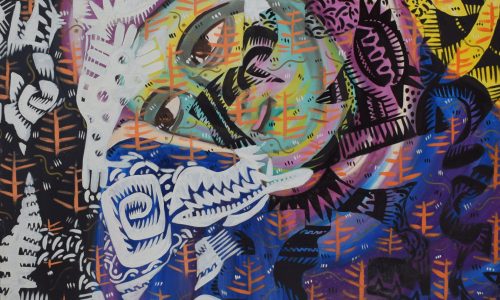
Today i have finished examining the series of Frank van Hemert pastel drawings I recently acquired. Examined them out of the frame. Photographed these without the glass protection and removed them from their backing board. Fresh pH free double sided tape and because I removed them, I had the chance to make the photographs. An impressive and beautiful series of which I will share in the coming days all pastel on paper drawings. Show the front, back and details.
First is ” BED” a pastel in red , white and black from 1987 which reminded me of the bed from the Frits Becht collection which was on show in the Nineties at the Gemeentemuseum Den Haag ( see picture above)
There are several Frank van Hemert publications now available at www.ftn-books.com
Yesterdays blog was devoted to Josef Albers and today it is time to focus on Anni Albers. Forced into weaving at the BAuhaus she has become one of the leading female artists of last century with her textile art.
For those not planning to go….. You will not be disappointed when you see these yourself…..enjoy.
Last week we visited the Josef and Anni Albers exhibition at the KUNSTMUSEUM ( Gemeentemuseum Den Haag). An absolute must visit for those interested in the Bauhaus and the Albers family. The highlight of the show was for me personally the last painting ever by Josef Albers, but the textiles by Anni Albers were the revelation. It is a once in a lifetime presentation and an absolute must visit for those interested in Modern Art and Minimalism. I have taken many photographs , but want to share in this and tomorrow’s blog some of the most important ones……and of course for publications on both artists visit www.ftn-books.com
The last finished painting by Albers
Tomorrow a series of Anni Albers at the KUNSTMUSEUM
First time i heard about Herold is when Rudi Fuchs introduced this artist at the Stedelijk Museum in 1993. With it came one of the most appealing catalogues from the 90’s.
Gracia Lebbink signed for the design of the catalogue, making it simple and informative, but still it has the signature of a great designed catalogue. This catalogue is now available at www.ftn-books.com
Georg Herold is a sculptor, painter, photographer, video and installation artist. He completed an apprenticeship as an artist’s blacksmith and was educated at the art academy in Halle. In 1974 he left the GDR and attended the Academy of Fine Arts in Munich for two years. He then went to Hamburg, where he graduated from the University of Fine Arts under the supervision of Sigmar Polke.
With a number of others he formed a close-knit group of “provocateurs”, also called enfants terribles or a bad boy group, who embraced the punk movement and flourished in the anarchist spirit of the late 1970s.
Throughout the 1980s and 1990s, Herold was influenced by the work of Albrecht Dürer and the Dada movement. A number of works “allude” to this or are “idiosyncratic provocation”. The ironic tendency of his work leaves room for interpretation. Characteristic of that period of his work is, ‘There is nothing more – There is no law’ (1992).
Georg Herold’s work is experimental and daring. For example, he uses cheap, often second-hand materials traditionally associated with construction, household, clothing and edible purposes. This led to his objects being compared to the Arte Povera. On closer examination, the influence of Joseph Beuys is evident, echoed in Herold’s approach and discussion of political, social and cultural paradigms. There are many references to language and art history in his work.
Blühendes Leben (2009) was the title of Herold’s work that was shown at ART ZUID in 2011. A pink dancer made of slats, screws, wire, canvas and lacquer, resembles a parody of a common title for kitsch paintings. The maker surprises the viewer, who has to decide for himself whether the pose is seductive or not.
Herold had many solo exhibitions in leading museums in Europe and beyond. Since 1999 he has been a professor at the prestigious Kunstakademie Düsseldorf.
The above item is really scarce and now available at www.ftn-books.com. At the time of publication Rudi Fuchs had a severe car accident in Italy and had to recover for a very long time. This annual publication was intended to be a series like the series of JAARBOEK publications he started in his time at the Gemeentemuseum. Those were designed by Gracia Lebbink and he had the idea to produce a same kind of annual publication on the Stedelijk Museum, but to my knowledge this is the only annual publication that was realised. Still …This is how an annual publication should be. It gives some great insight in the history of a large museum like the Stedelijk Museum and it reads like an adventure novel. It is a lot of work for any organisation to put a publication like this together, but for those of us , who are interested in the history of the Stedelijk Museum it is is nice that we can read what happened during the past year(s)
Text spoken by Ad van der Helm at the opening of the Opara exhibition at the Pulchri Studio in 2018
t is an extraordinary experience to contemplate the works of Vladimir Opara. I have been looking into his catalogue for some weeks and thought about the themes that he delivers us. These are religious themes. Not self-evident for an art gallery in a modern city like The Hague. For Vladimir heaven signifies a presence. It is for him a way of looking at the life of mankind. I also read his notes for this exhibition ‘Heavens’. Heaven is about mankind. Also about the catastrophes that might occur. Reflecting about heavens doesn’t mean to look away or deny these catastrophes. But looking at heavens gives consolation and offers the reason not to lose trust in mankind.
I want to share with you this afternoon the ideas and feelings that come up with me by the words and images of Vladimir. I want to share with you how I want to climb the ladder myself. Not in order to tell you how you have to do this yourself, but as an invitation to discover your own ladder and take hold of it.
What fascinates me in the words that Vladimir offers today, is living in the time of the eighth day. For us as Christians this eighth day returns every week when we celebrate Sunday. Sunday is the eighth day that follows the seventh day, the Sabbath. Sabbath is the restday of the Lord by with creation is completed. The Sunday after this restday is not the first day of the week, but it means the beginning of another life. The Sunday has therefor another, symbolic meaning. It is not about whether or not commercial Sundays are permitted; I don’t mind so much. For me it is not an issue anymore. I can do without them. But whoever gives him/herself the opportunity for a day different from the others, whoever makes room for the eighth day in his/her life, has started to climb up the ladder. He/she wants to rise above the ground level of our flat country. Our country is extremely flat. Vladimir is very impressed by the flatness of our country, and he also tells about the catastrophes that have occurred in the floods of 1953 and 1916. I am more negative on the flatness of the Netherlands: we can make our country so flat that there is no place to put our ladder.
Where else can a ladder find support than in heaven? Heaven is our focus for the other reality that surrounds us, like the oxygen that we breathe without seeing it. Heaven is like the huge firmament that opens up our regards to new distances and perspectives that we otherwise would ignore. I do not talk about looking up, because it is a misunderstanding that heaven is above us. Heaven is not a place, but an invitation to choose another perspective to contemplate our reality.
There is also another ladder that invites us and that you can find in the work of Vladimir Opara. That is the cross. Probably you are not used to see the parallel between a ladder and a cross. Yet the cross is also a ladder put against heaven. May be you will say: the cross is not a ladder, it is the end of life? Indeed it is a torture instrument used by the Romans for their slaves. The first Christians hesitated some centuries before they dared to show the cross as their symbol and sign of recognition. The apostle Paul struggles also with the meaning of the cross. It reveals itself not as an end, but as a passage. The cross is the ultimate paradox because with this instrument of torture love becomes visible. The ladder elevates us above our reality and gives another perspective on our own human life. On the cross, the climax of the life of Jesus Christ, it becomes clear to what love a person is capable of, even if life is made impossible and taken away. “Forgive them, because they do not know what they are doing” or “mother, see, there is your son; son see there is your mother” and other mysterious words and gestures make clear that on the cross life is not taken away, but life is given.
This is living on the eighth day. This is living in a world that is not flat. That is living in a world not threatened by a lack of vision about beauty. That is living in a world not lacking of a vision on real life. This is loving in a world not threatened by a lack of vision on what is lasting happiness. Of course there are catastrophes that menace the world and mankind. And people are angry with heaven: why this is done to us? But not heaven is to blame. Heaven is benevolent, and invites us to climb the ladder instead of lying down and remaining asleep like a depressive Jacob. We’d better get up and rise.
Vladimir Opara offers much more to reflect upon and to let feelings come up. It is up to us to understand what this means to ourselves and what ladder we want to climb. Lying down is no option. I hope that you discover by this exhibition what height, width and depth surround us en that in this universe the reality of life of the eighth day is opening up to us. This gives comfort, peace and trust in a restless and a cruel and sometimes ugly world. Life can be so beautiful!
The Opara book/ The Permanance of the Changing is now available at www.ftn-books.com
This is going to be a continuing story. I have known Frank van Hemert for over 3 decades now and from his earliest show at galerie Nouvelles Images I have followed his career and visited his exhibitions. From one of his very first solo exhibitions at the Haagse galerie Nouvelles Images I remembered a series of pastel drawings in the corridor of the gallery. A series od approximately 12 “pastel on paper” drawings. A nice series of drawings that were the sketches for the very large paintings at show at the gallery. I am not 100% sure, but I now have acquired what I believe to be part of the drawings that were on show at gallery Nouvelles Images. As I remember a great series and I am fortunate to add this to our growing Frank van Hemert collection.
www.ftn-books.com has also some nice Frank van hemert publications available
Elburg is mainly known for his poems, but since the mid NIneties his artwork ( Paintinsg and drawings ) is recognised as being important. He was not the most famous of all COBRA artist , but certainly he was one of the most original ones and because he was a teacher at the RIETVELD academy for over thirty years his influence is there for many genartions that attended the academy.
www.ftn-books.com has the VROEGER KOMT LATER publication available.
The following text comes from the Anne van der Waerden site:
More than to modern ceramic art, I’m attracted to the ancient, simple signs of mankind from all over the world as they are made in clay and baked in fire. In the world of modern ceramics the pot and vase forms seems to be out. Personally they constantly intrigue me. In that sense I feel connected with the English potter Hans Coper.
Throughout the years, integration of contradictions, expressed in form and shade, is a repeating theme in my work. I found ways to go from square to round, from dark to light, from inside to outside (see Introduction: first picture). Instead of objects from earlier years which are standing heavily on the ground, some vases from the eighties almost seem to levitate like balloons (see Introduction: last picture).
In 1985 Kees Hoogendam and I made jointly man-sized high pots. His quick way of working and his technical skills helped me to overcome my slow process of creation due to my own tendency towards perfection. Where our opinions about material and form diverted, it became a challenge to find joint solutions. This process resulted in a large series of vases.
Hans Paalman director of the Stedelijk Museum of Schiedam, said in 1988, at the opening of the exhibition Survey of the cooperative works of Anne van der Waerden and Kees Hoogendam: ‘Starting from discussion and experiments, it has developed into cooperation in the real sense
www.ftn-books.com has the Reekumgalerij catalogue from 1978 now available.
It is a rare occasion that i can offer a catalogue on Francesc Abad. The Spanish conceptual artist who at one time of his artistic career visited the Hague and where an exhibition at HCAK took place.. The project ABOUT CHAOS, was realised in Den Haag in 1992 and with this project a small but important book was published which is now available at www.ftn-books.com
The works of multidisciplinary artist Francesc Abad have always turned around a concern with the fragility of memory (individual and collective) and its recovery, and with manifesting how history is reconstructed and manipulated by each present. Using objects, audiovisuals, montages, photographs, installations, etc., Abad reconciles art and thought, often highlighting their contradictions, by recovering the words and texts of thinkers, writers and poets such as Walter Benjamin, Hannah Arendt, Simone Weil, Paul Celan and Primo Levi.
Outstanding among his most recent work is El Camp de la Bota, which takes its title from the site of execution of 1704 people by the Francoist dictatorship between 1939 and 1952, which was recently covered over and is now concealed by building for the Forum of Cultures. This work was awarded the 2004 City of Barcelona Visual Arts Prize.
Artist/ Author: Oliver Boberg
Title : Memorial
Publisher: Oliver Boberg
Measurements: Frame measures 51 x 42 cm. original C print is 35 x 25 cm.
Condition: mint
signed by Oliver Boberg in pen and numbered 14/20 from an edition of 20