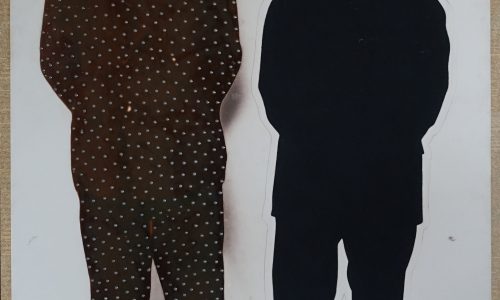
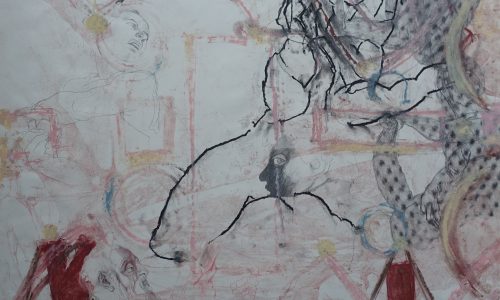
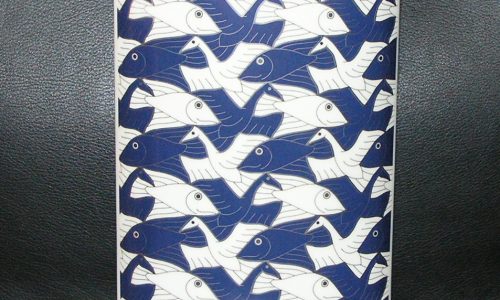
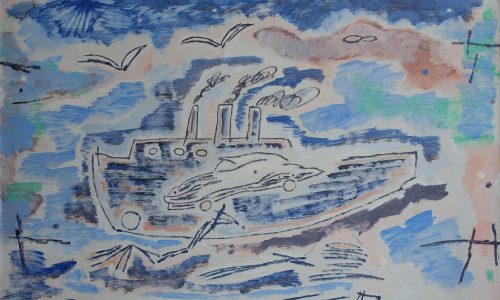
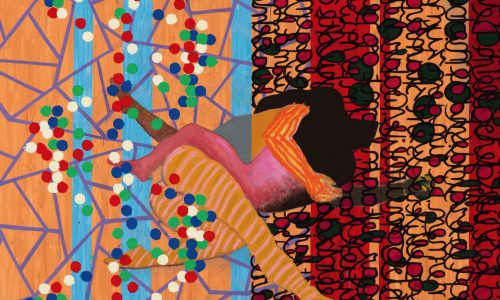
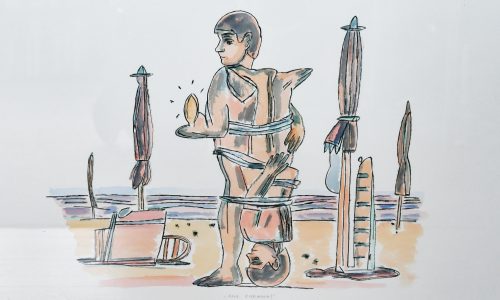
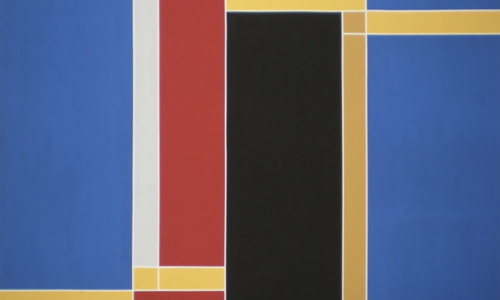
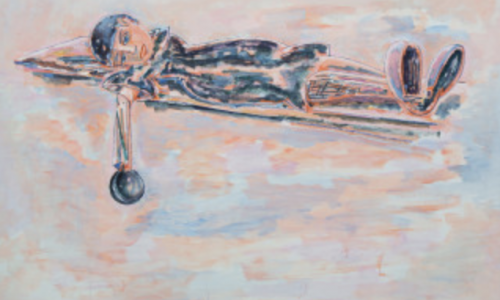
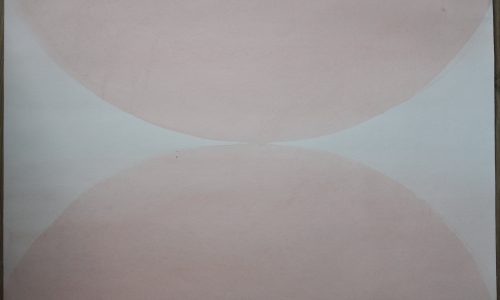
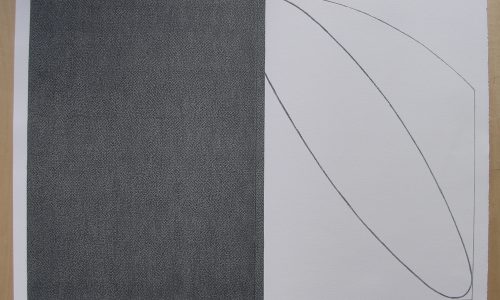
Last week we acquired an impressive work by Janpeter Muilwijk. Beside the 3 larger works we now have acquired a large silkscreened one from an edition of 30 copies. Numbered signed and a typical work from his earliest years. Linda and I are still fond of his works. They have a quality that I can not find among other artists from his generation. This is the work which is now for sale.
Richard Prince (born 1949) is an American painter and photographer. In the mid-1970s, Prince made drawings and painterly collages that he has since disowned. He began copying other photographers’ work in 1977. His image, Untitled (Cowboy), a rephotographing of a photograph by Sam Abell and appropriated from a cigarette advertisement, was the first rephotograph to be sold for more than $1 million at auction at Christie’s New York in 2005. He is regarded as “one of the most revered artists of his generation” according to the New York Times.
Starting in 1977, Prince photographed four photographs which previously appeared in the New York Times. This process of rephotographing continued into 1983, when his work Spiritual America featured Garry Gross’s photo of Brooke Shields at the age of ten, standing in a bathtub, as an allusion to precocious sexuality and to the Alfred Stieglitz photograph by the same name. His Jokes series (beginning 1986) concerns the sexual fantasies and sexual frustrations of white, middle-class America, using stand-up comedy and burlesque humor.
After living in New York City for 25 years, Prince moved to upstate New York. His mini-museum, Second House, purchased by the Guggenheim Museum, was struck by lightning and burned down shortly after the museum purchased the House (which Richard had created for himself), having only stood for six years, from 2001 to 2007. In 2008 the painting ‘Overseas Nurse’ from 2002 fetched a record-breaking $8,452,000 at Sotheby’s in London. Prince now lives and works in New York City.
Richard Prince was born on August 6, 1949, in the U.S.-controlled Panama Canal Zone, now part of the Republic of Panama. During an interview in 2000 with Julie L. Belcove, he responded to the question of why his parents were in the Zone, by saying “they worked for the government.” When asked further if his father was involved in the military, Prince responded, “No, he just worked for the government.” The Wall Street Journal later reported that Prince’s parents worked for the Office of Strategic Services in the Panama Canal before he was born. Prince later lived in the New England city of Braintree, Massachusetts, a suburb of Boston, and Provincetown on Cape Cod. In 1973, he moved to New York and joined publishing company Time Inc. His job at the Time Inc. library involved providing the company’s various magazines with tear sheets of articles.
Prince was first interested in the art of the American abstract expressionist Jackson Pollock. “I was very attracted to the idea of someone who was by themselves, fairly antisocial, kind of a loner, someone who was noncollaborative.” Prince grew up during the height of Pollock’s career, making his work accessible. The 1956 Time magazine article dubbing Pollock “Jack the Dripper” made the thought of pursuing art as career possible. After finishing high school in 1967, Prince set off for Europe at age 18.
He returned home and attended Nasson College in Maine. He describes his school as without grades or real structure. From Maine moved to Braintree, Massachusetts, and for a brief time lived in Provincetown. Ultimately he was drawn to New York City. Prince has said that his attraction to New York was instigated by the famous photograph of Franz Kline gazing out the window of his 14th Street studio. Prince described the picture as “a man content to be alone, pursuing the outside world from the sanctum of his studio.”
Geisler studied from 1985-89 at the ‘Gerrit Rietveld Academie, “and in 1991 at the” Beeldende Rijksakademie van Kunsten ‘in Amsterdam. She is a founding member of Media @ haarlem, the Institute for Media Arts in Haarlem . Kirsten Geisler lives in Berlin and Haarlem.
Kirsten Geisler employs in her work with the interface between the real and virtual worlds . They discussed how these worlds are increasingly flowing into each other. Kirsten Geisler developed virtual sculptures using 3D and virtual reality technology. The body, its materiality, its traces and its presence in the media are the issues that shape their work and inspiration. Her work includes only computer-generated 3-D sculptures. At the beginning created juxtapositions of real and virtual portraits of women such as “Who are You?”, 1996. Odle took it to the socio-political debate about the virtual and digital and the construction of identity in a digitally networked world. In the work of the series ” Virtual Beauties “, 1992-1996, the repertoire of the virtual 3-D characters, enhanced by the interaction with the viewer. The series focuses on the manifestation of feminine beauty ideals and reflects the obsession with beauty in a digitized and virtualized society. It works followed with full-length, stereotypical women’s bodies such as “Dream of Beauty ‘, 1997 – 2000, and” Catwalk I “-.” Catwalk II “, 2004, these virtual models created without photographic model you are the synthesis of ideal images of a woman, as they are given us by the media. . They correspond to the ideals of the fashion industry and plastic surgery . In “Catwalk II” moves the figure like a model on the catwalk and presented as in a film report from a fashion show. The development of this series with the version of “Brush Maya”, 2011, transcends the boundaries between the real world and virtual world. Moved as a fictional character, Maya Brush in two worlds: the first time, leaving a virtual sculpture, the museum and art institutions dares step into the “real” life in the public media and global communication networks. Kirsten Geisler responds with “Maya Brush” on the increasing interconnectedness of our world: a virtual sculpture, whose body consists of a network of data, combined with his advocacy in the real world of media symbiosis with the global networks of our world.
www.ftn-books.com has the Virtual Beauties by Geisler publication available.
In her undergraduate days, she belonged to a milieu of young artists who formed a counter-movement to official GDR art policy. The artists pursued new experimental paths and devised alternative presentation formats in studios and private homes. In the early 1980s, Cornelia Schleime drew, painted and wrote poetry, explored performance art and eventually began making films. Her broad definition of art and her unconventional works and shows resulted in 1981 in an exhibition ban. In 1984, after several applications to leave the country, she moved from East to West Berlin. Almost her entire oeuvre up to that date remained in the GDR and has disappeared.
In West Berlin from the mid-1980s she attracted much acclaim for her multi-facetted work. After recreating pieces left behind in the GDR in poetic works resembling landscapes, Cornelia Schleime has focussed since the 1990s on figures and large-format portraits. Sources of inspiration are glossy magazines, reproductions of all kinds, but also personal photographs or snapshots found at flea markets. Through the intuitive act of drawing or painting, she turns those she depicts into something creative of her own, projecting them in new roles, symbolically emphasising the poses encountered or highlighting aspects with a touch of fantasy and irony.
www.ftn-books.com has the Willy Schoots exhibition catalogue now available.
Jun Kaneko was born in Nagoya, Japan in 1942. He studied painting with Satoshi Ogawa during his adolescence. He came to the United States in 1963 to continue his studies at Chouinard Institute of Art when his introduction to Fred Marer drew him to sculptural ceramics. He proceeded to study with Peter Voulkos, Paul Soldner, and Jerry Rothman in California during the time now defined as The Contemporary Ceramics Movement in America. The following decade, Kaneko taught at some of the nation’s leading art schools, including Scripps College, Rhode Island School of Design and Cranbrook Academy of Art.
Based in Omaha since 1986, Jun Kaneko has worked at several experimental studios including European Ceramic Work Center in The Netherlands, Otsuka Omi Ceramic Company in Japan, Fabric Workshop in Philadelphia PA, Bullseye Glass in Portland OR, Acadia Summer Arts Program in Bar Harbor ME, and Aguacate in Puerto Vallarta, Mexico. Over the course of his career he has partnered with industrial facilities to realize large-scale, hand-built sculptures. The first was his 1982-1983 Omaha Project at Omaha Brickworks. Later sculptures include his Fremont Project, completed in 1992-1994, and most recently his Pittsburg Project completed in 2004-2007. Most recently, Jun has been working at the Cuernavaca Raku ceramics studio, experimenting with new glazes and the unpredictability of raku.
ww.ftn-books.com has currently the ‘DUTCH SERIES” book by Kaneko available
Since the late 1960s, Jackie Winsor (b. 1941 St. John’s, Newfoundland, Canada) has been making sculpture that expands a Minimalist vocabulary of simple geometric forms, using unrefined materials and grids to investigate process and labor. Working by hand and spending years on some pieces, Winsor produces intimate, tactile sculptures that engage the relationship between interior and exterior. In 1979, the Museum of Modern Art presented a mid-career retrospective of Winsor’s work, the first retrospective show of a female artist in the MoMA’s department of Painting and Sculpture since 1946; the retrospective traveled to the Art Gallery of Ontario in Toronto and the Fort Worth Art Museum in Texas. Windsor was included in the 1977, 1979, and 1983 Biennial Exhibitions at the Whitney Museum, and in 1984 her work was featured in American Art Since 1970 at the Whitney Museum. P.S. 1 inaugurated its newly renovated space in Long Island City, Queens with a retrospective of her work in 1997. More recently, her one-person exhibition Jackie Winsor: With and Within was held at the Aldrich Contemporary Art Museum, Ridgefield, CT in 2014 – 2015. Winsor’s work is in the collections of the Museum of Modern Art, the Metropolitan Museum of Art, the Whitney Museum of American Art, and the Solomon R. Guggenheim Museum in New York; The Art Institute of Chicago; the Detroit Institute of Art; and the Walker Art Center; among others.
www.ftn-books.com has currently the Domaine Kerguehennec catalogue from 1998 available.
I ahd to writeb this blog on a publication that is not expensive, not scarce, but very worth owning and collecting. It is a small Italian publication on the erotic drawings of Gustav Klimt, The publication is a hardback copy, linnen bound , excellent choice of paper , Immaculate printing and published by l’Ippocampo in 2008. Title is Carnet Erotici / iustav Klimt. This is an example how a popular subject by a popular artist must be published. Here are some example of the drawings in the book. The book is now available at www.ftn-books.com.
I recently discovered the works by KJan Battermann at auction. I did not know anything about the artist, but found that he was a master in small graphic works and his oils….some of them impressed me very much.
His works appear at auction regularly nowadays and when you consider the prices fetched these are outright cheap. Battermann is believed at this moment to be a “small master” but because of that title his paintings are in reach for many.
www.ftn-books.com has the Nobilis monograph on Battermann now available.
Last June i wrote a short blog on Judith Cowan and I am still impressed with her works from the last 40 years or so. But the book I added to my inventory last month confirmed it even more. Beautiful, impressive sculptures made me look at the other catalogue once again and once again i fell in love with these poetic sculptures.
Last week i added a scarce book on Andre Kestel to my inventory. I leafed through it and found the objects unique and amusing, but was also fond of the classic look of the book which is published by the Saarlandisches Kunstlerhaus in an edition of only 400 copies. I tried to learn more about the artist and this particular book and one German colleau in Koln could tell me that the main part of this small edition was considered to be destroyed. I can confirm that in some cases, when a book is impossible to sell , the remainder is destroyed to prevent it becoming available in the market at a too low price level and spoiling the market for future art books of the publishing museum. My guess is this is done with this publication by Kestel. Who knows, perhaps this is the only copy to become available for a very long time.
Born in 1969 in Burgstädt/Germany. In 1993, workshop project in Chemnitz/Germany. He attended the “Burg Giebichenstein Hochschule für Kunst and Design” in Halle/Germany, main course “Glass painting”, as auditor. Several exhibitions in Germany, Spain and the Netherlands.
Artist/ Author: Oliver Boberg
Title : Memorial
Publisher: Oliver Boberg
Measurements: Frame measures 51 x 42 cm. original C print is 35 x 25 cm.
Condition: mint
signed by Oliver Boberg in pen and numbered 14/20 from an edition of 20