Joel Shapiro is a sculptor and draftsman. He studied art at New York University, the city where he grew up and still lives and works. His works are recognizable, based on simple rectangular shapes of abstracted human forms. This makes him a representative of minimalism. This is reinforced by giving his works the designation Untitled.
A trip to India and acquaintance with the sculptural tradition there would prove decisive for his approach to sculpture. Shapiro has been researching space, volume, surface, and openness versus closedness all his life as an artist. This gives his sculptures an expressive power. Gradually, Shapiro’s work developed from extremely abstract to forms in which human figures are visible.
In Shapiro’s work the boundary between abstract and figurative is blurred. Prominent minimalist sculptors such as Carl Andre, Donald Judd and Richard Serra were his examples. Joel Shapiro’s work is a bit more playful and colourful.
His sculptures can be seen in all major museum collections, sculpture parks and private collections, especially in the United States. His sculptures can also be found in Australia and Europe. In 1999 Untitled was shown in Rotterdam during the sculpture route on the Westersingel.
Well known is Loss and Regeneration, a 1989 statue that was placed at the United States Holocaust Memorial Museum, not far from the National Mall in Washington. Joel Shapiro has long led a somewhat secluded life and is reserved with the media.
www.ftn-books.com has ao the Stedelijk Museum catalogs for the Shapiro exhibition available.
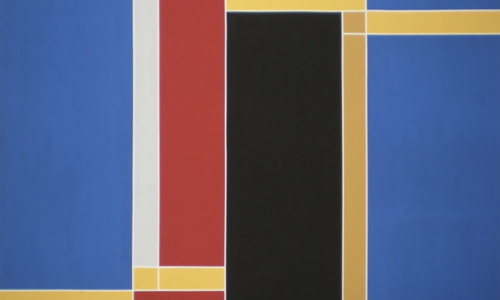
Sean Scully is one of the most important painters of his generation, whose work is held in major museum collections around the world. While known primarily for his large-scale abstract paintings, comprised of vertical and horizontal bands, tessellating blocks and geometrical forms comprised of gradated and shifting colours, Scully also works in a variety of diverse media, including printmaking, sculpture, watercolour and pastel. Having developed a style over the past five decades that is uniquely his own, Scully has cemented his place in the history of painting. His work synthesises a thoroughly international collection of influences and personal perspectives – ranging from the legacy of American abstraction, with inspiration from the likes of Mark Rothko and Jackson Pollock, and that of European tradition, with nods to Henri Matisse and Piet Mondrian, as well as references to classical Greek architecture. While monumental in scale and gesture, Scully’s work retains an undeniable delicacy and sincerity of emotion. \
The theme of self-depiction and identity has been a driving force behind his practice, which, at its onset in the early 1960s, advanced the Surrealist idiom yet proposed a radical departure from the presiding themes of Abstract Expressionism and Pop art.
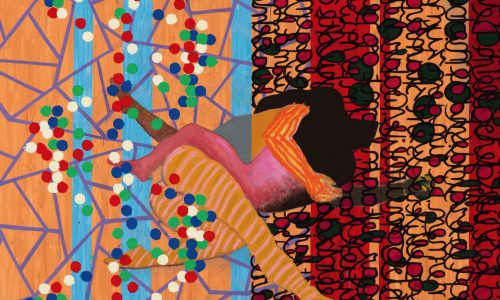
Samaras emigrated with his family from Greece to the United States in 1948, settling in West New York, New Jersey. He attended Rutgers University, New Brunswick, New Jersey, studying under Allan Kaprow and George Segal, and then at Columbia University, New York, where he studied art history under Meyer Schapiro. His interest in self-investigation began during this period, when he initiated painting self-portraits from the front and back using a mirror. He also gravitated toward the use of pastels, which enabled him to work quickly, exploring figurative and geometrical forms in rich colors and with luxuriant texture, characteristics that would reoccur throughout his work. He soon shifted toward objects, producing assemblage reliefs and boxes comprised of elements culled from his immediate surroundings and five-and-dime stores—cutlery, nails, mirrors, brightly colored yarn, and feathers—affixed with liquid aluminum or plaster.
His first New York exhibition was held at Reuben Gallery in 1959, which came on the heels of his first group show at the gallery, Kaprow’s 18 Happenings in 6 Parts. Through his involvement at the Reuben Gallery and his participation in Happenings, Samaras met Jim Dine, Red Grooms, and Claes Oldenburg. He had met Robert Whitman, another key figure in the Happenings movement, while at Rutgers and the two collaborated on performances. Samaras debuted his assemblage boxes in 1961 at Green Gallery, New York. For the artist, the boxes possessed elements of sculpture, architecture, and painting, amplified by the inclusion of objects such as mirrors and photographs—additions that situated Samaras as one of the earliest artists to emphasize his ego and corporeal self in his art. His early boxes led to his inclusion in his first institutional group show, The Art of Assemblage, held at The Museum of Modern Art, New York, in 1961.
In 1965, Samaras joined Pace Gallery, which mounted an exhibition of his works made between 1960 to 1966, that included Samaras’ immersive Room No. 2 (1966), also known as Mirrored Room. A culmination of his mirrored boxes, Room No. 2 was his first installation to become a part of a museum collection, acquired in 1966 by the Albright-Knox Art Gallery, Buffalo, New York. Samaras received his first major solo exhibition at The Museum of Modern Art, New York in 1969, which was followed by his first international museum exhibition, held at the Kunstverein Museum in Hanover (1970). By the mid-1970s, he had also received his first large-scale commission for which he produced Silent Struggle (1976), a sculpture comprised of Cor-ten steel, initially installed at the Hale Boggs Federal Courthouse in New Orleans.
In 1969, Samaras began to expand upon his use of photography, experimenting with a Polaroid 360 camera, which appealed to his sense of immediacy. His innovation further materialized with his use of the Polaroid SX-70 in 1973 in a melding of self-portraiture and abstraction, created by manipulating the wet-dye emulsions with a stylus or fingertip before the chemicals set. This processed progressed with digital art in 1996 when he obtained his first computer and began to experiment with printed texts on typewriter paper. By 2002, he had acquired a digital camera and the use of Photoshop became an integral component of his practice. These technologies gave way to Photofictions (2003), a series characterized by distorted self-portraits and psychedelic compositions.
Gesturing toward a larger investigation of (self) reflection in his work, found in his mirror rooms, self-portraiture, and use of digital mirror-imaging, Samaras’s oeuvre acts as an extension of his body while underscoring the transformative possibilities of the everyday—a true blurring of art and life.
One of my personal fascinations is model kit architecture and over the years I have collected many of the great architectural kits and put them up for sale. Most of these were sold to the US and the UK, but now I recently sold one to Paris and the client mentioned that he got his ideas from a book devoted to architectural model kits. During my last trip to France I discovered 2 copies of the book in Belfort and now one copy is for sale. There is not much literature on these kits, but the ones that are discussed in the book are true architectural classics. The book is now available at www.ftn-books.com
Karel Teige (Prague, 1900 – Prague, 1951), an avant-garde artist and writer, critic, experimental typographer, and cover and book designer, was one of the most important figures in interwar Czech modernism. His activity spanned the Devětsil group in the 1920s, whose monthly review ReD he edited and designed, to Surrealism in the 1930s and immediate postwar period. An indefatigable author of numerous essays on art and design, encompassing Romanticism to Constructivism, he is perhaps best known for authoring both Poetist Manifestos and his writing on functionalist architecture and the politics of housing, such as The Minimum Dwelling. Though an avowed Marxist, he was repeatedly pilloried in the communist press as a “degenerate Trotskyist,” and with the growing Stalinization of Czechoslovakia after 1948, complete with show trials and executions, Teige had reason to fear eventual arrest by the secret police (the journalist and film/theater historian Záviš Kalandra, a fellow Surrealist collaborator, was executed in 1950 as a Trotskyist following a show trial). Teige died of a heart attack in 1951 that was likely precipitated by the stress from the campaign launched against him.
www.ftn-books.com has now the most important Teige book from the last 4 decades available. Karel Teige / Praha 1900 1951
Bernardus Johannes (Bernard) Blommers (30 January 1845 in The Hague – 12 December 1914 in The Hague) was a Dutch etcher and painter of the Hague School.
He learned lithography early in his career, and then studied at the Hague Akademie under Johan Philip Koelman until 1868.His early paintings were mostly genre works depicting fishermen and their wives, heavily influenced by Jozef Israëls.The later works (from about 1890) are more loosely painted, although maritime and genre scenes remained the primary subject matter. His work was critically successful during his lifetime, being sought after by English, Scottish and American collectors.Blommers was also active as a teacher; among his pupils was the American painter Caroline van Hook Bean, who became his daughter-in-law in 1913
www.ftn-books.com has the Blommers catalogue for the Katwijk museum now available.
This is what i found Ruhenberg in his own words on his work:
Reiner Ruthenbeck in his own words
‘In my work I have often presented contrasts, polar elements, tensions, and tried to bring these into a formal unity. I have reduced formal structures as far as possible. The result seems to offer relatively little nourishment to the intellect. I would like thereby to bring the viewer to a contemplative, holistic acceptance of my art.’ –Reiner Ruthenbeck, 1986
‘I try to create something hovering, a balance. I want to maintain tranquillity. Everything can be traced back to polarity and unity – opposites that creation always builds on. Polarity has been a presence in my work almost from the beginning. Two different materials, hard and soft, or polarity based on colour, black and white. This pervades my whole work. We are moving towards immaterial art, yet we only approach it in small steps.’ –Reiner Ruthenbeck, 2006
Born in Buffalo, New York, in 1945, Susan Rothenberg became interested in art at an early age, inspired by her grandfather, a house painter, and trips to Buffalo’s Albright-Knox Art Gallery. After studying painting at Cornell University, she traveled, landing in New York, where she became involved in performance art, working with artist Joan Jonas. By 1974 Rothenberg painted her first picture of a horse, the animal that would soon become the subject of the iconic series of paintings she made over the next few years. “This image of a horse was also more emotionally charged,” she would later reflect. “People look at the image of a horse and they have associations—of power, movement, heaviness. It’s a living thing.”2 For the artist, the horse served as a device for undermining the prevailing conventions of painting. Though plainly representational, the subject allowed Rothenberg to experiment with new forms of abstraction, diverging from the largely minimalist and conceptual practices of her peers.
In 1975, Rothenberg had her first solo exhibition at 112 Greene Street, an artist-run space that was a nexus for artists in Soho. Comprising three large horse paintings, the show proved to be pivotal for the artist and was widely acclaimed by critics, who recognized then and now that Rothenberg’s paintings “introduced symbolic imagery into Minimalist abstraction.”3 The exhibition marked the beginning of Rothenberg’s 45-year career, and established her ability to translate nearly any subject matter into an emotionally charged and aesthetically innovative painting language.
By the 1980s, Rothenberg had expanded upon her horse motif and introduced new subjects, nearly always drawn from her surroundings: she painted disembodied heads and limbs, dancing figures, other animals, interior spaces. Throughout the decade she participated in many solo and group exhibitions, though never as the sole female artist: “I’m not going to tell them who they should put in,” she said in 1982. “But from now on I won’t be the only woman.”
Rothenberg moved from New York to New Mexico in 1990, joining her husband Bruce Nauman, who was living outside of Santa Fe. There, Rothenberg incorporated a new perspective into her painting, introducing a high vantage point inspired by the landscape. In addition to painting her environment and what she saw out of her window, she also began basing paintings on memories of observed events.
Rothenberg died in May 2020. Several years earlier, speaking to an interviewer about the public reception of her work, she remarked, “I certainly don’t expect to get a lot of applause for this. They getcha or they don’t.”
www.ftn-books.com has ao the Stedelijk Museum catalogue for the Rothenberg exhibition available.
Since the early 1980s, Rombouts has blurred the existing boundaries between words and objects. The idea of having objects speak for themselves, acts as a drive and utopic horizon behind his artistic practice. The result is a body of work that is idiosyncratic, poetic as well as conceptual. The artist’s very own bounded set of ideas has become a kind of art-producing machine: his ‘concepts’ make his works come about more or less automatically. The result is never egotistic, but invariably particular and tactile.Rombouts’ work — he is the son of a printer and trained to be a typographer — is rooted in a fascination with the shapes and the stuff language is made of. In the early ‘80s, when he made what could be viewed as his ‘primal’ work, he collected objects whose names consisted of three letters, and exhibited them in alphabetical order. Rombouts is probably best known for his Azart alphabet, which he developed in 1984 with his partner Monica Droste (1958-1998). The line-based alphabet allows words to take on an endless array of two/three-dimensional shapes.
Ever since it was first designed, it has served as a deliberately coincidental procedure for creating objects, sculptures, paintings etc.
Inspired by Azart, Rombouts has recently created new, graphic ways of translating words into images. Using the website www.azart.be, everyone can generate images in Azart.Guy Rombouts, (1949-, Geel, Belgium) seems to make a comment on how the flatness of letters and words can create a reality and make that reality non- existing without the words, in line with what the “linguistic relativity principle” suggests. Rombouts does this by inventing a new alphabet; the Azart, a name that refers to A-Z art, but also to the French word “hasard” meaning coincidence. In Azart each letter is translated by a corresponding line, on the basis of the first letter of the word which describes the line. A is angular, B is barred, C is curve, D is deviation and Z is a zigzag line. When the lines are linked together closed forms or word-images appear. What is going on quite literally on the paper when forming Azart words, goes on in our mind when forming realities of alphabetic words. The arbitrary letters of the alphabet also obtain meaning in our mind. Words written in Azart visually define them selves, forming isles of meanings, while words of the alphabet is defined by means of other words. These words, however, are formed by the same letters as the word they define. A circle of definitions are formed, referring again literally to the Azart circled words.
Artist/ Author: Oliver Boberg
Title : Memorial
Publisher: Oliver Boberg
Measurements: Frame measures 51 x 42 cm. original C print is 35 x 25 cm.
Condition: mint
signed by Oliver Boberg in pen and numbered 14/20 from an edition of 20