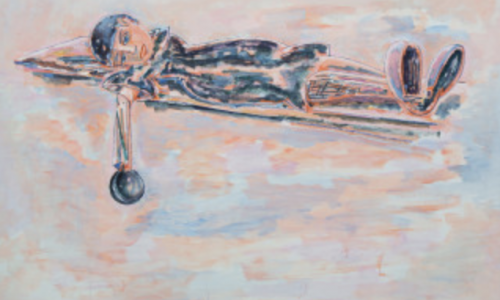
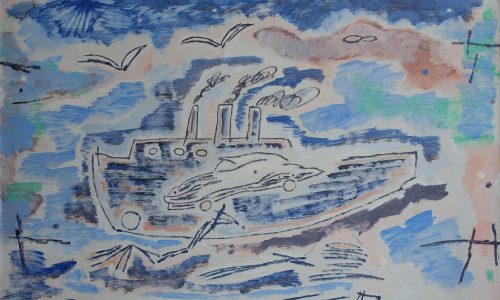
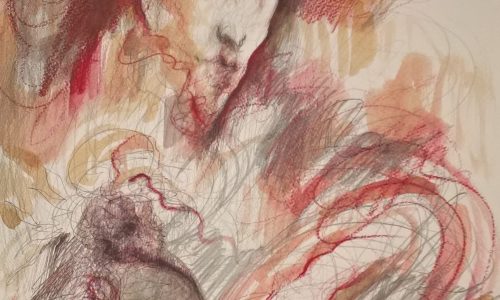
Vitaly Komar and Alexander Melamid are Moscow-born artists who emigrated to Israel in 1977 and then to New York in 1978. The two artists first collaborated on a joint exhibition entitled Retrospectivism in Moscow in 1967, and from 1972 started signing all their works with both names, regardless of whether they were made collaboratively. They continued to collaborate until the early 2000s, referring to their work as ‘not just an artist, but a movement’. Komar and Melamid are the founders of Sots-art (socialist art), a critical, nonconformist, conceptual form of pop art, based on the appropriation and subversion of socialist realist iconography and street propaganda, creating humorous, often grotesque, posters, paintings and banners. Both artists took part in the notorious ‘Bulldozer Exhibition’ held in a vacant plot in Moscow’s Belyayevo in 1974, which showcased nonconformist art by Moscow avant-garde artists that was swiftly destroyed by the authorities with bulldozers and water cannons.
www.ftn-books.com has some interesting Komar & Melamid publications available.
Walter Gropius was the founder of the Bauhaus and remained committed to the institution that he invested in throughout his life. He was a Bauhaus impresario in the best possible sense, a combination of speaker and entrepreneur, a visionary manager who aimed to make art a social concern during the post-war upheaval. After his departure as the Bauhaus’s director, Gropius recommended his two successors: Hannes Meyer and Ludwig Mies van der Rohe. The conservation of the Bauhaus’s legacy after its forced closure is another of Gropius’s accomplishments. He was also able to continue his career in exile in America as an avant-garde architect.
A native of Berlin, Gropius came from an upper middle-class background. His great-uncle was the architect Martin Gropius, a student of Karl Friedrich Schinkel, whose best-known work was the Königliche Kunstgewerbemuseum (royal museum of applied art) in Berlin, which now bears his name. In 1908, after studying architecture in Munich and Berlin for four semesters, Gropius joined the office of the renowned architect and industrial designer Peter Behrens, who worked as a creative consultant for AEG. Other members of Behrens’s practice included Ludwig Mies van der Rohe and Le Corbusier. Gropius became a member of the Deutscher Werkbund (German Work Federation) as early as 1910.
The same year, Gropius opened his own company. He designed furniture, wallpapers, objects for mass production, automobile bodies and even a diesel locomotive. In 1911, Gropius worked with Adolf Meyer on the design of the Fagus-Werk, a factory in the Lower Saxony town of Alfeld an der Leine. With its clear cubic form and transparent façade of steel and glass, this factory building is perceived to be a pioneering work of what later became known as modern architecture. For the 1914 exhibition of the Deutscher Werkbund (German Work Federation) in Cologne, Gropius and Adolf Meyer designed a prototype factory which was to become yet another classic example of modern architecture.
www.ftn-books.com has several titles on the Bauhaus available. Among them the 1971 BAUTEN UND PROJEKTE.
Jens Pfeifer studied fine arts at the Royal College of Art London and at the Rietveld Academie Amsterdam. Pheifer has a practice as visual artist, making sculptures, drawings and site-specific work. His work is represented in numerous collections. As an adviser and teacher he has been connected to various art academies, amongst which: Hochschule für Kunst und Design Halle, AKI Enschede, Sandberg Instituut and the Rietveld Academie, where he has been the head of the glass department since 2012.
www.ftn-books.com has the COLORING BOOK by Jesn Pfeifer now available.
Max Slevogt is one of the three important exponents of German Impressionism – the other two being Lovis Corinth and Max Liebermann (Fig. 1). Slevogt was a prolific and highly versatile artist who worked in a wide range of artistic media. He produced oil paintings, watercolors, drawings and prints. He also completed fresco schemes and stage designs for theater and opera. [1] Additionally, still life was one of his preferred genres.
In his early Berlin years Slevogt’s output of still lifes was small – he produced only very few after his move to the city in 1901 and then no more than a handful around the year 1914. His real interest in the still-life genre did not emerge until the 1920s when he was to produce some of his most vibrant and arresting compositions.[2] Floral still lifes were to be less frequent in his work than still lifes of vegetables or fruit.
Slevogt depicts two bunches of summer flowers in a pair of vases. These are seen from a slightly raised viewpoint and are placed in a sharp diagonal to the picture plane. They are set on the corner of a table jutting into the pictorial space. The jutting corner of the table is a spatial device also found in late nineteenth-century French painting. Despite the rapidity of Slevogt’s brushwork the flowers are botanically identifiable. Their striking color is reflected in the cut glass facets of the vases. The composition is dominated by the red roses in the larger of the two vases. Some of the roses have passed their peak and are already hanging their heads – suggesting the melancholy of an Indian summer. The smaller, chromatically more refined bunch in the foreground is still in full bloom.
Slevogt’s preoccupation with the still lifes of Manet was particularly marked during his Berlin years. Many of his still lifes reference elements of the compositional structure of Manet’s still lifes. This is still evident in his later works – an example is his predilection for diagonals.
www.ftn-books.com has the book on his complete graphic works now available.
British artist Jason Brooks is widely regarded as one of Britain’s best hyper-realist fine artists and is closely associated with the generation of artists who emerged in Britain in the early nineties to great international acclaim.
Brooks’ recent landscape works explore old masterpieces and anonymous found paintings by amateur artists that he has collected over the past couple of decades, adopting the same techniques, images that he reworks, crops and repaints. He combines airbrush, acrylic and oil paints in such a way as to explore all aspects of painterly language, as well as his own place in the canon of art history. Indeed, he argues it is a way of looking at art history through the eyes of others who have looked at art history. On a very simple level it affirms the continued faith that painters retain in the medium.
Brooks debuted among the YBAs in the 1990s with his black and white portraits.In and of itself, this may be an arbitrary fact, but it highlights an important point: Jason Brooks is a fine artist with an acutely-honed skill, but whose artistic vocabulary has more in common with the new Conceptualists and Postmodern punks.
Born in 1968 in Rotherham, U.K., Jason Brooks obtained an MA in Fine Art at Chelsea College of Art and Design and now works and lives in London. His work is held in private and public collections all around the world, including the National Portrait Gallery Collection, London where he had a solo exhibition of his work in 2008.
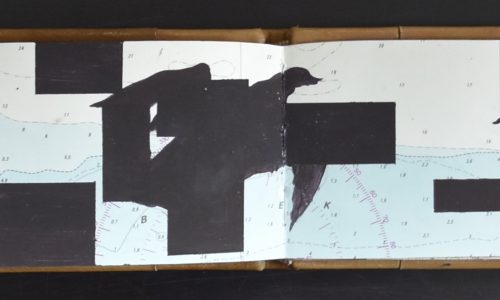
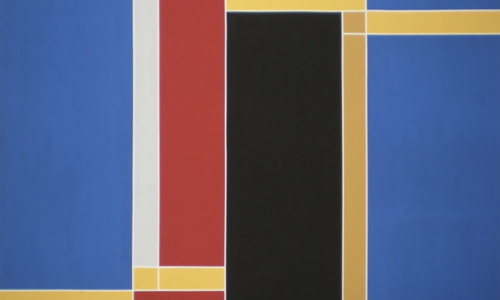
A few month ago i acquired another one of Siep van den Berg sketchbooks. This time it contained some 20 collages. It is great to see that some of these were actually realized as paintings , but the most part are highly interesting collages which give an idea of the paintings that were realized afterward. Most of these are not signed but some 60% contain fragments from his personal diary at the time Siep van den Berg was hospitalized. He barely could walk but sketched almost everyday and made some personal notes on the back of these sketches. One of these struck me. Because I know the painting COMPOSITION WITH BLUE well and had met Siep van den Berg at the time he was exhibiting at the Gemeentemuseum Den Haag. I concluded that this must have stuck in his mind, because there are some similarities between the 2. The collage is now available at www.ftn-books.com or please inquire at wilfriedvandenelshout@gmail.com.
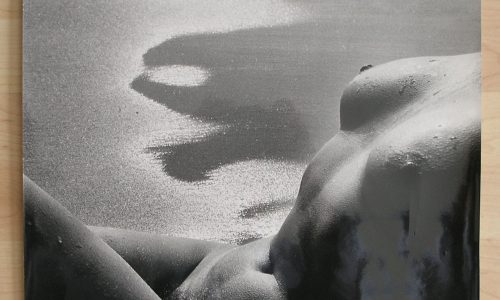
Dirk Braeckman has spent the past 40 years developing an impressive portfolio. Working with the medium of photography, he occupies a distinctive place within the visual arts.
Braeckman has taken part in numerous exhibitions both nationally and internationally. He has had solo shows at The Modern Art Museum of Fort Worth (USA), LE BAL (Paris), De Pont (Tilburg), De Appel (Amsterdam), S.M.A.K. (Ghent), BOZAR (Brussels), M (Leuven) and ROSEGALLERY (Santa Monica, CA). Braeckman’s works are part of important private and public collections around the world, including in FRAC Nord-Pas de Calais (Dunkirk), Sammlung Goetz (Munich), De Pont (Tilburg) and Fondation Nationale d’Art Contemporain (Paris), Central Museum (Utrecht), and Musée d’Art Contemporain et Moderne (Strasbourg). There are also several publications on his artistic practice and oeuvre.
In 2017, he represented Belgium at the 57th Venice Biennale.
In 2021 Braeckman was invited to take part in the 34th Bienal de São Paulo ‘Though it’s dark, still I sing’.
The Royal Family of Belgium commissioned a permanent installation in the Sphinx Room of the Royal Palace in Brussels.
Of the contemporary artists who came to prominence in the 1980s and went on to try their hand at filmmaking in the ’90s (among them Julian Schnabel and Cindy Sherman), Robert Longo seems like the perfect fit for the role of Hollywood-style director. His sleek, 1995 sci-fi feature Johnny Mnemonic, starring an already famous Keanu Reeves, was an experimental outgrowth of an aesthetic path that the New York artist had been pursing on paper for more than a decade. Longo is technically a draftsman—his signature large-scale works are amalgams of charcoal on paper, and the tactility of the medium is explicit when faced with the work. But Longo’s productions are arguably much closer to cinema, his chiaroscuro subject matter seemingly created out of shadow and light. And like cinema, Longo’s works straddle a line between hyper-realistic and disturbingly surreal—time is frozen or extended or simply disintegrates, as what happens in his work refuses to resolve. Over the course of his career, 70-year-old Longo has created images of nature (tumbling waves, great white sharks, tigers, flowers), of institutional power structures and political fallout (the U.S. Capitol, the American flag, a fighter pilot mask, the detonation of the atomic bomb), and of personal, psychic spaces (a woman’s chest, a sleeping child, the interiors of Sigmund Freud’s home). He has also created some of the most prescient and haunting images of our age. His twisting, falling business-suit figures from his early-’80s series Men in the Cities became a startlingly accurate artifact of fragility and human suffering after 9/11. (Even Johnny Mnemonic‘s fascination with a future where secrets are impossible to keep seems strangely prescient.) This month Longo takes on an ambitious double-barrel solo show in New York, with his recent series of charcoal drawings that replicate or re-address famous American abstract expressionist works showing at Metro Pictures, while exhibiting an American flag sculpture and work inspired by the riderless horse at John F. Kennedy’s funeral at Petzel Gallery. It’s a dual production that seems to drive straight for the center of American mythology and the coercive symbolism of a cultural superpower.
Not long ago i wrote a blog on Gunter Damisch on the occasion of a special publication I acquired, but here we are again……another blog on Damisch since I acquired SCHERZHAFTE ERWÄGUNG. A scarce publication from 1988 , published in an edition of 500 copies. What makes this special is that there is no printed text, only 1 on 1 pages from the sketchbook containing 51 pages from the sketchbook and the cover. This special publication is now available at www.ftn-books.com
Civil servants by day and voracious collectors by night and weekend, Dorothy and Herbert Vogel built a world-class art collection through modest means. Committed to discovering new work by up-and-coming artists, the Vogels amassed a collection of more than 4,000 objects by some of the most renowned artists of our time over the course of four decades.
In 1992, the Vogels formed a partnership with the National Gallery of Art in Washington, D.C., placing in its custody more than 1,100 works of art as gifts or promised gifts. As the Vogels continued to acquire works of art, it became unfeasible to gift their entire collection to any one museum, leading to the development of the Fifty Works for Fifty States project. This endeavor, which received support from both the National Endowment for the Arts and the Institute of Museum and Library Services, allowed the Vogels to place 2,500 works of art, including drawings, paintings, sculptures, prints, and photographs by 177 artists, in the collections of museums throughout the United States. The Vogels selected venues that they had built relationships with through exhibitions and affiliations, or, as in the case of the Buffalo AKG Art Museum, in cities that were of significance to them. (Dorothy Vogel was born in Elmira, New York, and attended college at the University at Buffalo.)
The Vogels’ generous gift to the museum included works by many artists who entered our collection for the first time, as well as works that enhance existing holdings. The Dorothy and Herbert Vogel Collection at the Buffalo AKG includes works by Richard Artschwager, Robert Barry, Lynda Benglis, Charles Clough, Koki Doktori, R. M. Fischer, Richard Francisco, Don Hazlitt, Gene Highstein, Bill Jensen, Tobi Kahn, Steve Keister, Alain Kirlli, Mark Kostabi, Wendy Lehman, Michael Lucero, Joseph Nechvatal, Richard Nonas, Larry Poons, Lucio Pozzi, Edda Renouf, Judy Rifka, Barbara Schwartz, Darryl Trivieri, and Richard Tuttle.
This is an example that great art cab be collected over the years at moderate prices. Art that in the end proves to be artistically and financially priceless.
www.ftn-books.com has now the BEYOND THE PICTURE , the ultimate book on the Vogel collection available.
Artist/ Author: Oliver Boberg
Title : Memorial
Publisher: Oliver Boberg
Measurements: Frame measures 51 x 42 cm. original C print is 35 x 25 cm.
Condition: mint
signed by Oliver Boberg in pen and numbered 14/20 from an edition of 20