Posted on Leave a comment

Jean Ipousteguy (1920-2006)

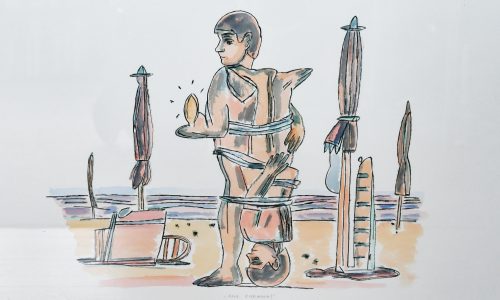
Jean-Robert Ipousteguy, a renowned French painter and sculptor, passed away on February 8, 2006 in Dun-sur-Meuse, his birthplace. Born on January 6, 1920, he adopted Ipousteguy as his artist’s pseudonym in the 1950s, taking his mother’s maiden name. Raised in Lorraine, he made the move to Paris in 1938. Seeking to hone his craft, Ipousteguy attended evening classes at the Robert Lesbo Unit, where he studied painting and drawing. Although he lacked formal academic training, his determination led him to become a self-taught artist, albeit largely underappreciated during his lifetime.

Following World War II, Ipousteguy immersed himself in painting and ventured into designing stained glass windows. In 1947 and 1948, he contributed two frescoes to the embellishment of the Saint-Jacques le Majeur in Montrouge. After relocating to Choisy-le-Roi in 1949, he shifted his focus exclusively towards sculpture, gradually transitioning from abstraction to a more figurative style influenced by surrealism. His talent as a sculptor earned him an invitation to participate in the prestigious Salon de Mai, thanks to the support of Henri-Georges Adam, one of its founding members.

In 1962, Ipousteguy held his first exhibition at the Galerie Claude Bernard in Paris, marking a significant milestone in his artistic career. He went on to showcase his works at Documenta III (1964) and Documenta VI (1977) in Kassel, Germany. Additionally, in 1964, he had the privilege of representing France at the Venice Biennale, where he received accolades for his exceptional artistic contributions. Recognition continued to pour in, as he was appointed Chevalier de la Legion d’Honneur in 1984.

Ipousteguy returned to his hometown of Dun-sur-Meuse in 2004, where he spent the final years of his life. His remarkable artistic journey came to an end in 2006, and he was laid to rest at the Cimetiere Montparnasse in Paris.

www.ftn-books.com has the Vweranneman and other catalogs on the artist now available.

Posted on Leave a comment

Benito Jacovitti (1923-1997)

The happiest and almost forgotten slapstick artist from Italy is Benito Jacovitti. He was introduced to the Dutch through his illustrations for the gigantic book Pinocchio, which was available in 1967 with a subscription to Margriet. Many must have enjoyed it since, without realizing that they were face to face with one of the most important Italian comic creators. In 1970 he appeared in the comics magazine Pep with his creation Cocco Bill and soon managed to divide the readers into extreme haters and loyal followers. Apart from Cocco Bill, two other of his comics were also published in Pep. The adventures of the little Indian Chicken Leg and a long adventure of Zorry Kid, a wrought-up parody of the famous TV series Zorro. Jacovitit’s popularity with his fans was so great,

The drawing on the wall here dates from a later period, at the end of his career. In the 1990s he founded a fan club magazine in Italy, in which articles about his work and life alternated with reprints of old work. All that under a newly made cover. This cover of Jacovitti Magazine #4 shows everything that characterizes his work. The rubber figures with the big noses and even bigger feet, the busy composition sloshing against the edges of the picture, the exuberant use of sound effects (onomatopoeia) and the cheerful extras with which he filled every nook and cranny of his artwork. The only thing missing is a salami on bones, one of its absurd features. What you can also tell is the way he worked. Jacovitti always drew very large and he did not make the outline of his figures in one go. Instead, he drew each line twice, then filled in the center with a scratchy ink pen. He then generally did the coloring on the back of the drawing. This was possible because the thick black lines were visible through the paper. Dutch comics creators who claim to be influenced by Jacovitti René Uilenbroek , Mars Geringen and Mark van Herpen .   
www.ftn-books.com has the classic PINOKKIO (Pinocchio) by Jacovitti and Collodi now available in Dutch

Posted on Leave a comment

Peter van Poppel (1945-2023)

Peter van Poppel belongs to the post-war generation of new realists, which emerged in the seventies. He stood apart from any group and developed himself completely independently. He unfolded his own style by orienting himself to the great painters of all centuries and studying their masterpieces.
He received his education in Utrecht (School for Graphic Arts) and still resides in the Dom City. The city of surrealism has not left him unaffected. Peter van Poppel paints with great attention to detail, with humor and tenderness, a loving and naive realism with alienations in form. He strings together a litany of small things and beloved people from his field of vision. He prefers to seek the child in the human being, as if he wants to offer the comforting feeling of paradise.

Started in 1966 at the Utrecht art market, followed by solo exhibitions every few years in Amsterdam at Galerie “Jurka” and Galerie “Petit”. Exhibitions in Utrecht at Galerie “De Reiger” and Galerie “Jas”.

Peter van Poppel is represented by Galerie Lieve Hemel at fairs such as Art Amsterdam, Realism, and Pan in Amsterdam, and Tefaf in Maastricht.

www.ftn-books.com has the GROOT ATELIER book published by Querido now available.

Posted on Leave a comment

Carlos Manrique (1951)

This is what Manrique says about himself…..

A brief introduction to myself. Originally from Venezuela, I pursued my studies at Gristobal Roja Art School in Caracas when I was 17 years old. Following that, I had an amazing experience furthering my knowledge of art by working in studios with three artists – Régulo Perez, Carlos Cruz Diez, and Luis Gevara Moreno. Among my various projects, one particularly exciting opportunity was to travel with an interesting group of artists directed by Jacobo Borges to present “Vision of Venezuela” in Peru, three months before moving to Europe in 1977. It was during my journey through Italy, Great Britain, Belgium, Norway, and Austria that I found my creative inspiration in the city of Cologne, Germany, when I was 26 years old. I continued my studies in graphic design at the Cologne Art School, under the guidance of Professor Pravoslov Sovak, and completed my degree. My art combines influences from African and Latin American cultures, along with cultural influences from Germany, where I have resided for over 30 years.

I would like to express my gratitude to Germany and its people for giving me the opportunity to further develop myself in the field of art.

It is my honor to present my artwork to you, and I hope you enjoy them. Thank you for taking the time to view my works.

www.ftn-books.com has the Museum Bochum catalog now available.

Posted on Leave a comment

Gustave Moreau (1826-1898)

I remember the year i was living in Paris to be filled with visiting museums. One of the first I visited was the Moreau Muzeum. I really do not know if it still the same venue. but I remember that I was impressed , pulling out large panels from the walls , filled with canvasses. Together with the Jeu de Paume and the Roding museum these are the museums I still remember very well and I was reminded of that visit when I listed the Stadsgalerij Heerlen catalog on Moreau, which is now available at www.ftn-books.com

Gustave Moreau, the French artist, gained his reputation as a painter of symbolic allegories. It was in 1864 at the Salon in Paris that Gustave Moreau first made a breakthrough with the painting ‘Oedipus and the Sphinx’. His most important works include ‘Salomé’ and ‘Saint Sebastian and the angels’.

Education
Born on April 6, 1826, in Paris, Gustave Moreau studied at the art academy in Paris and subsequently under Théodore Chassériau, a pupil of Jean-Auguste-Dominique Ingres, whose work is considered part of the romanticism movement.

Italy
Gustave Moreau made his debut at the Salon in Paris in 1852 with ‘Pieta Plaza’. This work clearly showed the influence of Théodore Chassériau and Eugène Delacroix. From 1857 to 1860, Moreau worked in Italy, where he studied the work of Andrea Mantegna, Benozzo Gozzoli, and Michelangelo. In 1881, he was commissioned to create illustrations for a collection of fables by Jean de la Fontaine. Moreau spent five years working on this project.

Mythology and Bible
Gustave Moreau painted a large series of artworks based on stories from mythology and the Bible. Towards the end of his life, he became a teacher at the art academy in Paris. Albert Marquet, Henri Matisse, and Georges Rouault were all students of Gustave Moreau at the École des Beaux-Arts.

Gustave Moreau passed away on April 18, 1898, in Paris. In his will, he left his house and studio along with all the artworks present there to the French state. His residence on Rue de La Rochefoucauld was opened to the public in 1903. The Musée Gustave-Moreau exhibits significant works by Gustave Moreau, such as ‘Jupiter and Semele’ (1895), ‘The Chimeras’ (1884), and ‘The Return of the Argonauts’ (1891-1897).

Posted on Leave a comment

Sylvie Zijlmans / Hewald Jongenelis

Recently i acquired a Boymans publication by these two artists.. T”en To ONE” is published like an artist book by Museum Boymans van Beuningen and deserves to be present in every collection of artist books and it occurred to me that the collection of special catalogs by Boymans van Beuningen is growing more important by the year. Many important publications were published in the last 3 decades and for me the Boymans publications are becoming more important than the ones the Stedelijk Museum Amsterdam published during the last 3 decades. Stil the 50’s, 60’s and part of the 70’s publications by the Stedelijk Museum are among the most important ever published.

the TEN TO ONE book is now available at www.ftn-books.com

Posted on Leave a comment

Art & Project , a History

a little promotion for an exhibition which must not be missed for those interested in conceptual art and the history of one of the most important galleries in the world from past century. Art & Project is arguably the most important galerie in the Netherlands from past century and has presented many of the nowadays great names in MOdern Art. They published over a period of 2decades a few hundred of important publications on MOdern art. Among these the famous bulletins of which 156 were published. The exhibition will be opened until the 25th of February 2024. A must visit .

www. ftn-books.com has 64 different bulletin titles available and furthermore, letters, invitations, publications and catalogs. Here is a selection of the Bulletin ‘s available

Posted on Leave a comment

Peter Bischof (1934-2021)

Peter BISCHOF, born in 1934 in Vienna, underwent his studies at the Academy of Fine Arts in Vienna during the 1950s under the guidance of Boeckl and Gütersloh. Peter Bischof’s artistic achievements were honored with numerous solo exhibitions, the first of which took place in 1959 at the Viennese gallery adjacent to St. Stephan. He was a valued member of the artistic inner circle surrounding Msgr. Otto Mauer. From 1958 onward, he actively participated in exhibitions and graphic biennials both nationally and internationally, including Europe, America, Japan, and India. As a member and later vice-president of the Vienna Secession from 1970 to 1971, he contributed to the development of the art movement. His early representations conveyed dynamic, almost dance-like physicality, which later transitioned into a contemplative and static portrayal of the human body. The artist resided and worked in Kösslwang, Upper Austria.

On August 5, 2021, Peter Bischof passed away.

www.ftn-books.com has the 1969catalog now available

Posted on Leave a comment

General Idea ( from 1969)

As part of the late 1960s Toronto counterculture, AA Bronson (b. Michael Tims, 1946, Vancouver), Felix Partz (b. Ronald Gabe, 1945, Winnipeg, d. 1994), and Jorge Zontal (b. SlobodanSaia-Levy, 1944, Parma, d. 1994) united in 1969 to form the single entity known as General Idea. From their earliest projects, such as the staging of The 1970 Miss General Idea Pageant, to later activist initiatives during the AIDS crisis, General Idea delved into multimedia, conceptual, and performance art as a means of engaging with mainstream culture and its repressions.

Currently touring from the National Gallery of Canada in Ottawa to the Stedelijk Museum in Amsterdam and the Gropius Bau in Berlin, General Idea’s definitive retrospective showcases their groundbreaking work. In addition to their well-known pieces, the group’s drawings have also received extensive recognition, exhibited at the Drawing Center in New York and MAMCO in Geneva.

While most of the group’s drawings have never been seen, they hold a significant place in General Idea’s collaborative and co-authored approach. Created by Jorge Zontal during brainstorming sessions, these drawings bear the “GI” signature, added shortly before Zontal’s death, and are considered to be a joint effort. After the group’s move from Toronto to New York in 1985, their drawings became more regular, reflecting their increasing isolation from the global art scene and the impact of the pervasive AIDS epidemic. As time passed, their initial joy was subdued by the loss of friends, as well as the deaths of Jorge and Felix themselves, which the group had to confront and incorporate into their work.

The hand-drawn nature of these motifs follows a logic reminiscent of General Idea’s affinity for mass production and reflects the virality of their AIDS-centric works. In their ever-changing and persistent nature, these drawings offer a captivating glimpse into General Idea’s unique artistic perspective and unconventional ideas of authorship, exposing the limitations of representation while acknowledging its pressing importance.

www.ftn-books.com has now this scarce publication available. It contains five off-set prints

Posted on 1 Comment

Roger Bezombes (1913-1994)

Roger Bezombes, a French artist specializing in painting, sculpture, medal-making, and design, underwent his education at l’École des Beaux-Arts in Paris. In his artistic endeavors, Bezombes adopted the vibrant color palette famously used by Henri Matisse. His paintings and studies of landscapes and figures often drew inspiration from his observations of exotic cultures, particularly those in the Mediterranean and North Africa. Bezombes had a strong affinity for travel, exploring countries such as Belgium, Germany, Italy, Greece, Crete, Israel, North Africa, and the United States. His works received regular exhibitions in Paris through prestigious events like the Salon d’Automne, the Salon des Artistes Independants, and Les Tuileries. Influenced by notable artists like Gauguin, Van Gogh, and Matisse, Bezombes developed a distinctive and widely cherished style that has captivated audiences around the globe. Additionally, he contributed to various artistic ventures, including tapestry designs for Aubusson, posters (such as the notable image employed by Air France), and costumes and sets for ballet performances at the Metropolitan Opera House in New York. Bezombes represents the quintessential French artist of our time — passionate, dedicated, and continuously engaged. These exceptional qualities resonated profoundly in his artwork, leading to its high demand and collection both within France and internationally.

www.ftn-books.com has now the Documents publication on Bezombes available.