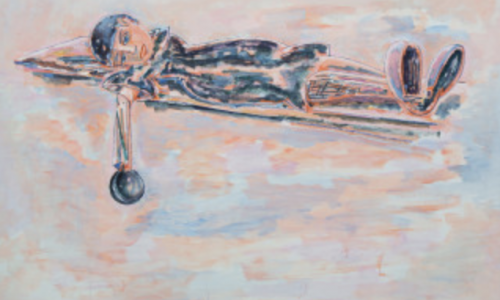
Braco Dimitrijević was born in Sarajevo (formerly Yugoslavia) in 1948 and currently lives and works in Paris, France. He graduated from the Zagreb Academy in 1971 and completed his post graduate studies at Saint Martin’s School of Art in London in 1973. Solo museum exhibitions have taken place at The State Russian Museum, St. Petersburg and Musée d’Orsay, Paris (2005); the Slought Foundation, Philadelphia (2007); Ludwig Museum, Budapest (2008), Musee d’Art Moderne de Saint Etienne (2009), Musee d”Art et d’Histoire Luxemburg (2011). He has participated in Documenta in 1972, 1976, and 1993 as well as the Venice Biennale in 1976, 1982, 1990, 1993, and 2009. His work can be found in approximately 70 public collections, including The Museum of Modern Art, New York; Tate, London; Musee National d’Art Moderne Centre Georges Pompidou, Paris; Museum Ludwig, Cologne; and The Israel Museum, Jerusalem, among others.
Dimitrijević has still a loyal following, but the large museums seem to have forgotten him. Maybe it is time to re discover him since his work is still fascinating.
The architect, urbanist and artist Luc Deleu sees architecture as a form of visual, sculptural and political thinking concerning the relationship between public and private space. In 1970 he founded ‘T.O.P. office’: a firm for the study of urban development and architecture. The firm’s motivation and goal were to question architecture and urban design and their position and function in society. Deleu soon became convinced that in many respects our cities would be improved if we built less. In his view, the rapid evolution of communication and mobility should make it possible to lead a more nomadic life again. His initial projects therefore emphasised the wealth of potential of mobility as against the rigid immobility of physical buildings. They argued against the privilege that immovable property enjoys as places to live and work. Together with his wife Laurette Gillemot (1946) and a few members of staff, Deleu is still generating visionary ideas on urbanisation, sometimes with a utopian tendency, which respond inventively to the ecological, economic, cultural, social, geographic and administrative-political reality and future.
www.ftn-books.com has two publications available on this artist
De Andrea is an artistic representative of Hyperrealism and the Hyperrealism school of art, and specializes in nudes, frequently lovers, which he makes from plastic, polyester, glass fiber with natural hair and painted after naturalistic gypsum castings. His work is often associated with that of Duane Hanson and George Segal.[5][6]
In documenta 5 in Kassel 1972,[7] he presented Arden Andersen and Nora Murphy, a hyper-realistic sculpture of a couple in the act of love-making, made from bodycasts rendered in polyester resin.[8][9]
This alienation between the lovers and their incurable misfortune becomes even clearer with his 1978 work on display in Aachen, entitled The Couple. The man is not only fully dressed and the woman naked, but she clings to him, while he touches her only minimally, in order to not induce an open rejection.[10]
De Andrea’s works based on the sculptor and his model are characterized by a sober, professional relationship between the man and the woman; the artist concentrates on his work or rather is shown in situations, where he withdraws within himself to a meditative posture, and retreats into himself, in order to collect his energy and concentration for further work.
While looking for info on this fascinationg artist i encountered a post by Voorlinden about the De Andrea in the Caldic collection. A great combination with the leather Barcelona chairs by Mies van der Rohe.
John De Andrea in the Caldic collection
www.ftn-books.com has some books on Hyperrealist artists available.
A principal figure of British conceptual art, Michael Craig-Martin probes the relationship between objects and images, harnessing the human capacity to imagine absent forms through symbols and pictures. The perceptual tension between object, representation, and language has been his central concern over the past four decades. In his early work Craig-Martin often incorporated readymades into sculpture and made knowing reference to American Minimalism. His elegant restraint and conceptual clarity is exemplified by An Oak Tree (1973), comprising a glass of water on a shelf and a text written by him asserting that the glass of water is, in fact, an oak tree. This interest in semantics, the play between rhetoric and object, continues to be a core theme in his work. In the 1990s Craig-Martin made a decisive shift to painting and developed his hallmark style of precise, bold outlines demarcating flat planes of intensely vibrant colors. Through exacting draftsmanship, he uses composition to explore spatial relationships by juxtaposing and layering color.
Craig-Martin was born in 1941 in Dublin. He attended Fordham University, New York, from 1959 to 1961, then Yale University, where he received a BA in 1963 and an MFA in 1966. In the mid-1960s he returned to Europe, becoming one of the key figures in the first generation of British conceptual artists. Craig-Martin taught at Goldsmiths College School of Art, London, from 1974 to 1988 and from 1994 to 2000. During this time he became a powerful influence on a generation of his students who would become known as the Young British Artists, including Gary Hume, Sarah Lucas, and Damien Hirst, among others. Craig-Martin’s work has been featured in solo museum exhibitions worldwide.
www.ftn-books.com has currently Craig Martin publications available.
Last week Linda and I went to Rotterdam and visited the Nederlands Fotomuseum. The museum made a selection of 99 of the most iconic dutch photographs from the last 160 years. Among them well known examples by famous dutch photogra[phers, nut some that i never had noticed before. The one photo that fascinated me most was the one Cas Oorthuys took in the Rotterdam harbour. The photo has everything. action, drama, mouvement and it gives a perfect impression of the Rotterdam harbour in the late Fifties.
Harbour of Rotterdam
Later this month i will select some more photographs from this visit, but this. is for now my personal favourite.
More Oorthuys and dutch photography books are available at www.ftn-books.com
Sophie Calle is a French artist who has exhibited extensively throughout the world since the late 1970s. Variously described as a conceptual artist, a photographer, a movie director, and even a detective, she has developed a practice that is instantly recognizable for its distinct narrative elements and frequent combination of images with text. Each of her projects can be seen as a chapter in a vast overall volume of references and echoes, in which Calle often blurs the boundaries between the intimate and the public, reality and fiction, art and life. Her work methodically orchestrates an unveiling of reality—her own and that of others—while allocating a controlled part of this reality to chance.
In the Netherlands we were fortunate that the Boymans van Beuningen organised an exhibition with her. This catalogue is now available at www.ftn-books.com together with some other important publications.
One of the most fascinating artists to emerge from the Belgium art scene in last century certainly is Thierry De Cordier
Thierry De Cordier is a philosopher, author and visual artist. He describes himself as romantic and melancholic. His work emanates from his personal quest: he strives to understand his own being and being human. ‘Back to nature’ is (also) De Cordier’s motto. There he is able to distance himself from our consumer society and there he tries to escape it. For a long time his garden represented the ultimate place where he found peace to reflect and work, in harmony with nature. He later went to live by the sea. Escaping the world and loneliness are recurring elements in De Cordier’s dark sculptures, drawings and paintings. Below is the project DE PONT developed with the artists. It shows the qualities of this hard to admire but fascinationg artist.
www.ftn-books.com has one publication on De Cordier now available.
LEO COPERS (° 1947, Ghent) is mostly known for his sculptures, installations and performances, and has since the beginning of his artistic practice obtained a unique place in the Belgian art scene.
Going against the tide, Copers started to reintroduce metaphors and symbols into a visually conceptual practice. By using antagonistic objects, in surreal and alienating combinations, he aims at creating tensions, both figuratively and literally. His objects and installations are on – and often over – the edge of being alarmingly dangerous and destructive and thus challenge our built-in expectations in a very visceral way. Water, fire and electricity for example are often connected in a way that makes us cringe with fear while being moved by its poetic beauty. On the verge of danger, on the edge of life.
For Copers the material results and their effect on the audience are superior to the mere thought process from which the work originated. He leaves behind the sterile, uninvolved conceptual art of his peers.
His work can be seen as a link between the minimalist visual language of his generation, fluxus and the Belgian legacy of anti-establishment irony and poetic surrealism.
Lauren Wiggers
In 2018 the leading Belgian art institutes S.M.A.K. Ghent, M HKA Antwerp, Middelheimmuseum Antwerp and BOZAR Brussels, celebrated Leo Coper’s 50th anniversary as an artist with unique solo exhibitions and the publication of a new book ‘Leo Copers, Dreams are made of this’, the most detailed overview of his work so far.
Luis Tomasello was an Argentine painter of Italian descent. He was born in La Plata (province of Buenos Aires, Argentina) on 29 November 1915 and died in Paris on 17 January 2014.
Luis Tomasello worked with his father as a bricklayer, joiner and painter. He attended evening classes in drawing from 1929 to 1931. He went to the Escuela Nacional de Bellas Artes Prilidiano Pueyrredón in Buenos Aires from 1932 to 1938 and continued his studies at the Escuela Superior de Bellas Artes Ernesto de la Cárcova from 1940 to 1944. Before traveling to Europe for the first time in 1951, he met painters Emilio Pettoruti and Carmelo Arden Quin. (He co-founded the Salón Arte-Nuevo with Arden Quin in Buenos Aires in 1954). He spent six months in Paris in 1951 before settling there permanently in 1957. He joined the Galerie Denise René in 1958.
“Luis Tomasello embarked on abstract art in 1952. His interest in kineticism was born in 1957. He started using relief in 1958 and dealt with light by means of structure and color. He took part in all major international events to do with lumino-kinetic art in the second half of the 20th century. But his art is also an intrinsic part of concrete art and possesses all the characteristics of that movement by virtue of its abstraction, the use it makes of systems and modules, repetition and series, the control exerted over all the elements, both before and during the work’s execution, and the neutral technique and mechanical manufacture.
Thus Luis Tomasello’s art is resolutely abstract: its chief characteristic is the way he works on and with light, creating play on light by means of reliefs arranged in regular order and painted a uniform white with colors placed within them. The latter are usually applied to the back or reverse side of the shapes or on their sides so that they are reflected onto the surface of the work, which itself is usually square. His relief works are entitled “Atmosphère chromoplastique.”
Their forms are made up of planes, squares, cubes, cylinders and sometimes rhombohedrons. In any given work, all these elements are identical. They jut out only a short distance and are placed in orthogonal patterns. The colors are red, yellow, blue and green and are sometimes fluorescent. Certain works belonging to certain periods do not conform to these overall rules: the planes are cut in a different way, occasionally overlap, and are composed in patterns. Many works comprise a single plane with slots cut into it to create a feeling of depth and permit the color to act. Black matt paint is applied to a few works, which are entitled “Lumière noire.”
By using relief in his paintings, Luis Tomasello was able to avoid flat surfaces, project shapes and make them jut out into space, play with light and cause color to reverberate outwards. On the basis of these results, he immediately sought to integrate his ideas into architecture.
Another of his aims was to represent movement. His paintings are built on protruding or receding structures and changes of direction which give rise to optical vibration and create the impression of movement. Though the elements are static, their appearance varies owing to the shifting light.
Thanks to his visible structures and his reflected colors, Luis Tomasello has become a master of relief and a magician of light.” (text by Serge Lemoine)
One of the nicest artist books i acquired recently was the book Edwin Janssen made for his van Abbemuseum exhibition in 1988. Book contains fold outs, original tipped in photographs . extra pages, see through pages. Book is published by one of the leading publishers from that era ” Bébert” and i can ot recommend it enough for all serious collectors of artists books.
Edwin Janssen studied at the Academy of Arts, Rotterdam and Ateliers ’63, Haarlem. His first exhibition, in 1985, was at the WP Gallery, Rotterdam. He has recently made installations for the Van Abbemuseum, Eindhoven, the Stadsgalerij, Heerlen and the Museum voor Hedendaagse Kunst in Ghent. The work combines images and objects from commercial and personal sources to comment on the transient qualities and clichés of his youth and family life.
Artist/ Author: Oliver Boberg
Title : Memorial
Publisher: Oliver Boberg
Measurements: Frame measures 51 x 42 cm. original C print is 35 x 25 cm.
Condition: mint
signed by Oliver Boberg in pen and numbered 14/20 from an edition of 20