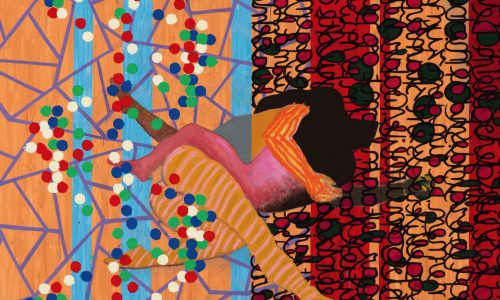
MISHIMA KIMIYO is one of the most prominent and widely exhibited woman sculptural ceramists. For the past forty years, her work has been shown at museums throughout the world. Like many women clay artists, she began as a painter. In her work, clay became the canvas for silk-screen and transfer renderings of “breakable printed matter”—discarded newspapers, magazines, cardboard boxes and posters. More recently, she has honed her techniques and enlarged her perspective to create monuments to popular culture, focusing on the theme of printed information and wastefulness in a comical, political, and critical fashion. Ever sensitive to the current state of the environment and the overwhelming flow of information in today’s world, Mishima hopes that her work will compel viewers to take notice and even action.
www.ftn-books.com has the ANNE MOSSERI MARLIO galerie catalogue from 2018 available.
As a graduate in biological sciences prior to his master degree in art & research, Mark Swysen reflects on human conduct. Yet the human figure itself mostly remains absent in his work: the artist primarily wishes to incite the visitor’s imagination.
Mark swysen embraces Joseph Kosuth’s basic proposition of conceptual art: “the idea is the most important aspect of the work”. Next Mark follows Arthur Danto’s credo of “art being an embodied meaning”. The artist is constantly in search of the most eloquent visual stimuli in order to mould content into an intriguing shape. He enjoys the freedom of using any material, object or phenomenon as an instrument in his visual language. Swysen snatches everyday objects out of their usual context and the result of his deconstruction and re-assembling charges them with new layers of meaning. His artefacts question the one-dimensionality of our perception and open new possibilities for interpretation.
Danto added a third aspect to his definition: a work of art is an awaken dream that can be shared with others. To Mark Swysen this is a major ingredient: it adds the indefinable sauce of poetry, mysticism, fantasy, disequilibrium and unpredictability that lifts a work of art. Because of its conscious and even more because of its subcutaneous impact on the human brain light and motion belong to Mark’s preferred mediums.
www.ftn-books.com has some of the most important flyers for from Swysen projects from the last decade
I wish i had seen this exhibition. Just a few years after Pettibon transformed the GEM museum in Den Haag into a true Pettibon paradise. The Che Guevarra poster is exhibited in the staircase of the CAC in Malaga. I tried to buy the poster , but there was only a small one available and besides….the shop was closed. So this is what remains. I have a feeling that Pettibon is becoming more and more important for modern art and i am lucky to have in my inventory the 3 comics that were published in an edition of 100 numbered copies at the GEM. www.ftn-books.com
This blog i write to let you know that I have decided to stop my regular blogs on Piet Dirkx. Not because I do not admire the artist any longer, but simply because I am out of material to publish on . In the past 5 years I have published blogs on all Piet Dirkx material that I have collected over the decades. I have published blogs on cigar boxes, special editions, books, small drawings, X-mas cards, paintings and invitations. Over 1000 blogs on the artist and his works. I promise….. i will not stop , but now I am dependent on the material I encounter on my searches. So the daily blog changed into a weekly blog, the weekly blog changed into a monthly blog and all are still available on my site.
Thank you all for reading and appreciating these blogs on Piet his works and hopefully I can still find more Piet Dirkx material to keep you updated on Piet Dirkx.
Anton Zoran Music was born in 1909 in Gorizia, a town then within the Austro-Hungarian Empire, and today on the Italian border with Slovenia.
The barren, dusty landscapes of the Dalmatian coast would have a profound influence on his palette throughout his career. He studied in Zagreb, and spent the years 1934-35 travelling. In Spain, he copied works by El Greco and Goya, but fled upon the outbreak of the Spanish Civil War in 1936.
In 1943 Music moved to Venice, where he was subsequently arrested and tortured by the Gestapo on the basis of his known political sympathies and suspicions that his artistic activities were a cover for espionage. Despite these charges, Music was invited to join the SS. He later recalled: “The idea of becoming an SS officer seemed so comical to me, in the state I was in, that I laughed outright. So they sent me to Dachau…”. During his time at the death camp Music secretly recorded the horrors around him, although he did not fully process his wartime experiences until many years later. A harrowing series of works on the subject titled We Are Not the Last was created during the 1970s, when the hilly landscape around Siena suddenly triggered memories of the piles of corpses that had surrounded him at Dachau. He exhibited extensively throughout the post-war period, dividing his time between Paris and Venice.
In 1956 he won the Grand Prize for Graphic Art at the Venice Biennale, and continued to paint unpopulated landscapes in dry, muted tones, in addition to a number of cathedral interiors, and a late series of moving and introspective self-portraits.
Thre is one famous publication that was designed by Willem Sandberg for the Music galerie de France exhibition in 1970. This publication is now for sale at www.ftn-books.com
At the age of seven, Alison Watt, the daughter of a painter, was deeply impressed by Ingres’ portrait of Madame Moissetier (1856). She graduated from the Glasgow School of Art in 1988, after winning the John Player Portrait Award the previous year, and was subsequently commissioned to paint a portrait of the Queen Mother, which was added to the collections of the National Portrait Gallery. Her first oils on canvas were mainly figurative portraits or female nudes in bright, luminous settings. On the occasion of an exhibition at the Fruitmaker Gallery in Edinburgh in 1997, her work began to focus increasingly on the rendering of fabrics. A. Watt works on large-format canvases, which she paints alone, using scaffolding. Her colour of choice is white, which she blends with ochre, sienna, vermilion, grey, and black pigments to produce realistically modelled draperies of an almost sculptural nature. The materials she depicts are heavy or lightweight, crumpled, knotted, or suspended, with sensual folds sometimes reminiscent of anatomical details, such as women’s genitalia inspired by Gustave Courbet’s Origin of the World (1866). She exploits the suggestive power of drapery, producing chaste evocations of the presence or absence of a body: the empty sheets on a bed, the pleats of a dress, the loincloth of Christ.
In 2000 she became the youngest artist to present a monographic exhibition, Shift, at the Scottish National Gallery of Modern Art. She then turned to a form of abstraction, exhibiting her polyptych Still and six other canvases at the Ingleby Gallery during the 2004 Edinburgh Festival. That same year, she exhibited the series Dark Light, which consisted of pictures of deep black swathes of fabric presented in a closed cubic space. From 2006 to 2008, she created a series of six large format pieces meant as reinterpretations of pieces from the permanent collection of the National Gallery in London: paintings by Ingres and Holbein, and Francisco de Zurbarán’s St. Francis in Meditation (1635–1639). Through her work, A. Watt goes beyond mere studies of drapery and reaches a dramatic, perhaps even mystical, dimension marked by the influence of the Masters.
www.ftn-books.com has one Alison Watt publication currently available
Erwin Eisch, a pioneer of the international Studio Glass movement, has helped establish the medium in Europe. His distinctively distorted glass vessels and imaginative sculptures of mould-blown glass challenge the distinctions between art forms and between realism and abstraction. Eisch began with functional vessels, including bottles, vases and steins, often distorting the hot glass, incorporating ceramic moulds and producing painted glass sculptures. Eisch uses glass, painting, drawing and printed graphics to overcome the borders between picture and sculpture. His later output includes drawings, paintings and prints. Eischs works incorporate vivid elements of imagination and fantasy, which supplement the reality that inspires him. This book includes essays, contributions by experts on his work, more than one hundred illustrations of Eischs work, and selected writings by the artist himself.
The book which is now available at www.ftn-books.com is one of the earliest publications on this artist.
Constantine Andreou was born in São Paulo, Brazil in 1917 to Greek parents who had immigrated to Brazil a few years prior.
In 1925, his family moved back to Greece where he settled in Athens until the end of World War II. During these years, Andreou dabbled in crafts and for a period worked as a carpenter making furniture while studying technical design.[6] He graduated in 1935.[5] In the same year, he started his study of sculpture,[5] the art form for which he would be most known later.
In 1939, Andreou participated at the Panellinio (Πανελλήνιο), but the judges disqualified his three sculptures.[6] In 1942], he tried again at the same competition and with the same artwork. The pieces were so lifelike, he was accused of cheating by copying nature. Three major personalities of the time in Greece, Memos Makris, John Miliades, and Nikos Nikolaou, came to his defense. As a result of the publicity, he had his first taste of fame and major exposure of his artwork.
In 1940, Greece entered World War II on the side of Allies, and by 1941, the country was under Nazi and Italian occupation. Andreou was initially drafted into the Hellenic Army in 1940 and during the occupation he was an active member of the Greek Resistance.
The war years and occupation did not stop Andreou from continuing his artwork and studies, and in 1945 he won a French scholarship to go to France.
Life in France (1945–2002)
In 1947, Andreou began using a new personal technique employing welded copper sheets. This new technique allowed him to create a new way to express his creation in a way completely unrelated to tradition.[6]
A major impact on Andreou’s method of expression and in the development of his personal “language” was his friendship with Le Corbusier. They first met in 1947 and worked together on and off until 1953.[6] At one time Le Corbusier asked Andreou, “Where did you learn how to work?” to which Andreou responded “I’m Greek, I carry the knowledge within me.”[6] This friendship instilled in Andreou Le Corbusier’s view of architecture as monumental sculpture and, conversely, sculpture subject to the laws of architecture.[8]
In the same period, Andreou became a member of a select group of philosophers, including Jean-Paul Sartre, who discussed various topics in Saint-Germain-des-Prés.
Andreou had his first exhibition in Paris in 1951, where he demonstrated the transformation of his style. In the group exhibition “Seven Greek Sculptors”, Andreou was characterized as “the most famous Greek sculptor in the capital with a rich, varied and successful work”. By the end of the decade, Andreou was widely known in the French art scene and considered an equal to Mondrian, Picasso and Gastaud. In 1982, he was given the lead as chairman of the Paris “Autumn Salon” for sculpture.
In 1999, the library of the town La Ville-du-Bois, where Andreou resided while in France, was named in honor of Constantine Andreou.
Throughout his time in France, he regularly visited his friends and family in Greece and many times exhibited his work in various cities and islands there. In 1977, Andreou bought a centuries old winery on the island of Aegina.[17] He converted it into a house, after being influenced to buy a house on the island by his long time friend and colleague Nikos Nikolaou.
Later years and return to Greece (2002–2007)
Constantine Andreou died on October 8, 2007 in his house in Athens.
www.ftn-books.com has the galerie R. Nidrecourt catalogue available
Those who have been lucky enough to view the Herman de Vries exhibition at the Stedelijk Museum in Schiedam in 2014, know about the impressive room with the floor covered with rosebuds. This is one of the most iconic IN SITU works I have ever witnessed. The walls covered with framed dried plants and the floor covered with rosebuds made the room feel like a magical place. After the exhibition the room was cleared and the rosebuds were transformed into 325 + XXXI multiples and sold. This was the third time the rosebud covered floor was transformed into a multiple. The first was in 1984 ( edition of 25 copies), the second time in 1990 ( edition of 100) both published by the Eschenau Summer press and the third, which I have now available at www.ftn-books.com, in 2015 . I love the works by Herman de Vries and the future will learn that his works and projects will belong to the most significant art projects in the world of art.
Artist/ Author: Oliver Boberg
Title : Memorial
Publisher: Oliver Boberg
Measurements: Frame measures 51 x 42 cm. original C print is 35 x 25 cm.
Condition: mint
signed by Oliver Boberg in pen and numbered 14/20 from an edition of 20