Posted on Leave a comment

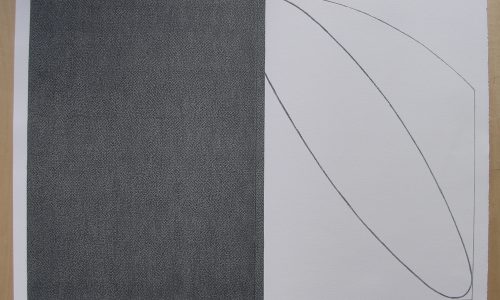
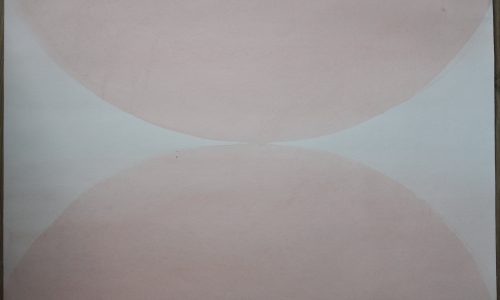
Jus Juchtmans (1952)

Known for his apparently monochrome paintings, and clearly related with minimal art, that rejected the dominance of visual perception and presented the idea of artworks as objects to be experienced, to be made aware of, and no longer to be seen for their visual impact, Jus Juchtmans works with a translucent painting that he applies to the canvas in different consecutive layers, not necessarily of the same color.

Sometimes there are even thirty different layers, and in this way, colors that we haven´t perceived at first sight appear under the apparently dominant color.

The result is an extremely shiny surface that resists the viewer, and looking at them is often a frustrating process that makes the spectator to feel uneasy. This reflection as well as the reflection of the gallery’s surroundings, is an integral part of the work. He wants the spectator to become conscious of the viewing conditions of his work, particularly the transitory and time specific nature of those conditions.

Born in Morstel in 1952, Jus Juchtmans studied Fine Arts and Design in Antwerp, where he has developed his artistic career from the beginning.

Since then, he has grown up to become a well-known artist, participating in different group shows in museums and institutions, among other ones the Ludwig Museum, with Callum Innes and Nicola Rae, the Kunsthalle of Recklinghaussen, and Budapest, the Kunstmuseum Celle, etc.

In the late years he has reinforced his career with individual shows in London, Munich, Cologne, Graz, Berlin, Paris and New York.

His works can be found in museums like the SMAK of Gante, The Contemporary Art museum of San Diego, the PMMPK of Belgium, the Karl Ernst Osthaus Museum of Hagen… and in collections like the Peter Stuyvesant Collection of Amsterdam, Fondation Carmignac, Porquerolles and F. van Lanschot Bankiers.

www.ftn-books.com has the DIPTYCHON IV catalog from Gent now available.

Posted on Leave a comment

Terry Winters (1948)

Over the last four decades, Terry Winters has expanded the concerns of abstract painting by engaging contemporary concepts of the natural world. Many of his earliest paintings depict organic forms reminiscent of botanical imagery. Over time, his range of themes expanded to include the architecture of living systems, mathematical diagrams, musical notation, and new orders of data visualization. His brilliant palette reflects his continual experimentation with materials. Throughout his paintings and works on paper a metaphoric sensibility reveals itself in the expressive language of resonant forms and figures. Winters has described being motivated to describe how “abstract processes can be used to build real-world images.”

Terry Winters (b. 1949) lives and works in New York City and Columbia County, New York. He has had one-person exhibitions at numerous museums, including the Whitney Museum of American Art in New York, the Whitechapel Art Gallery in London, the Kunsthalle Basel, and the Metropolitan Museum of Art in New York. Most recently, the Drawing Center in New York organized a survey of his drawings in 2018.

www.ftn-books.com has the PRINTED WORKS book from 2001 now available.
Posted on Leave a comment

Helen Britton (1966)

From a young age, Helen Britton used art as a form of communication and was soon making jewellery. She still has a cow horn bracelet she made when she was 12 and some earrings made from old beads and fuse wire.

As an artist-jeweller, Britton approaches her practice without distinguishing between forms of creative production: “Some bodies of work contain jewellery, sculpture and drawings; some only one or another — it depends on what I am trying to say.”

Britton is one of the world’s most established artist-jewellers and is known for creating colorful pieces that are just as likely to include recycled plastics as precious stones.

“Preciousness is a construct and culturally driven. All materials are interesting and carry their stories with them,” she says. “I choose the materials because of what they have to say and for no other reason.”

Over the years, she has set blackened silver rings with diamonds and sapphires, or combined silver and pearls with plastic or glass. Her creations are part of jewellery collections of museums such as the Metropolitan Museum of Art in New York and the Stedelijk Museum in Amsterdam.

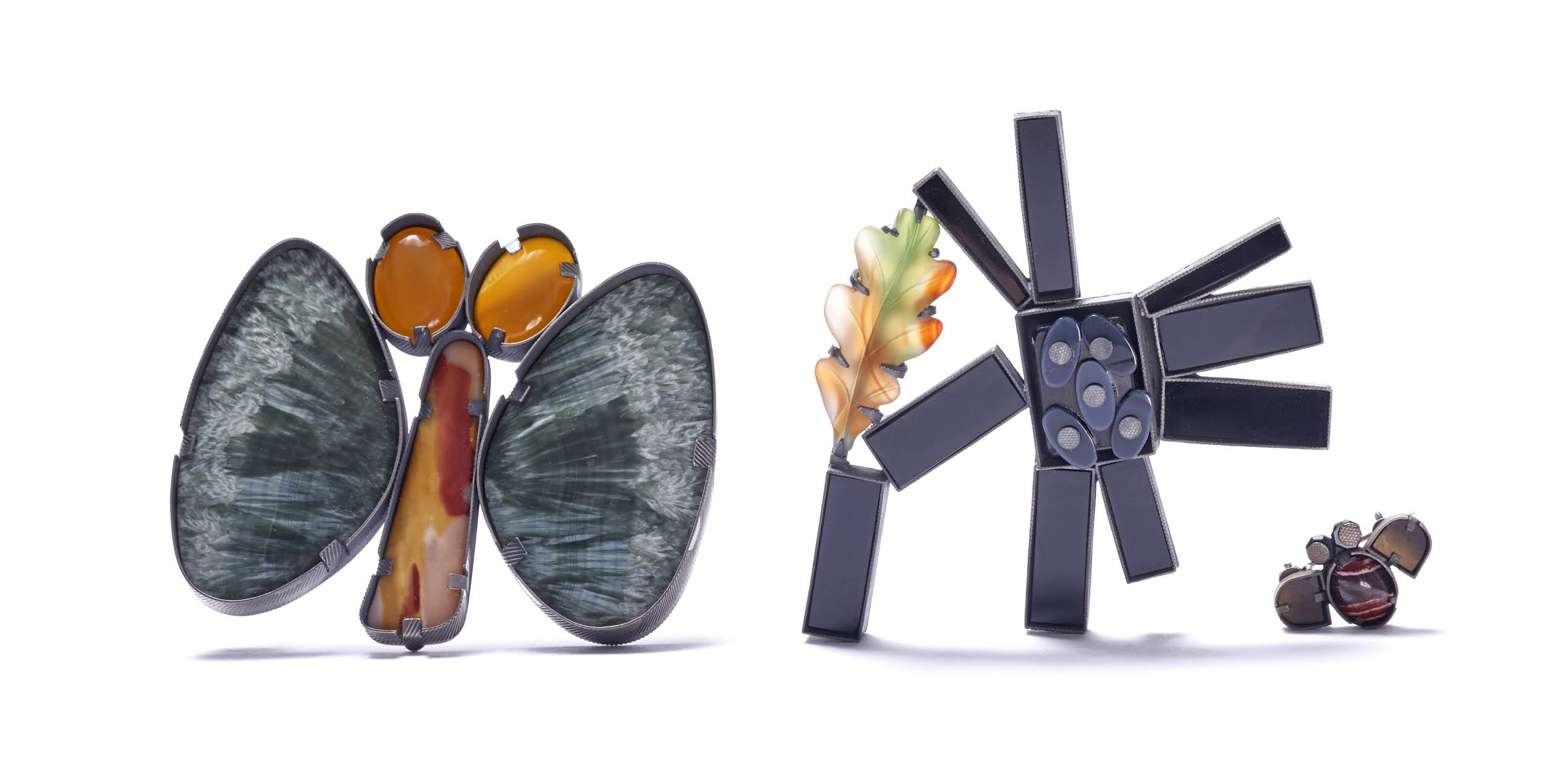
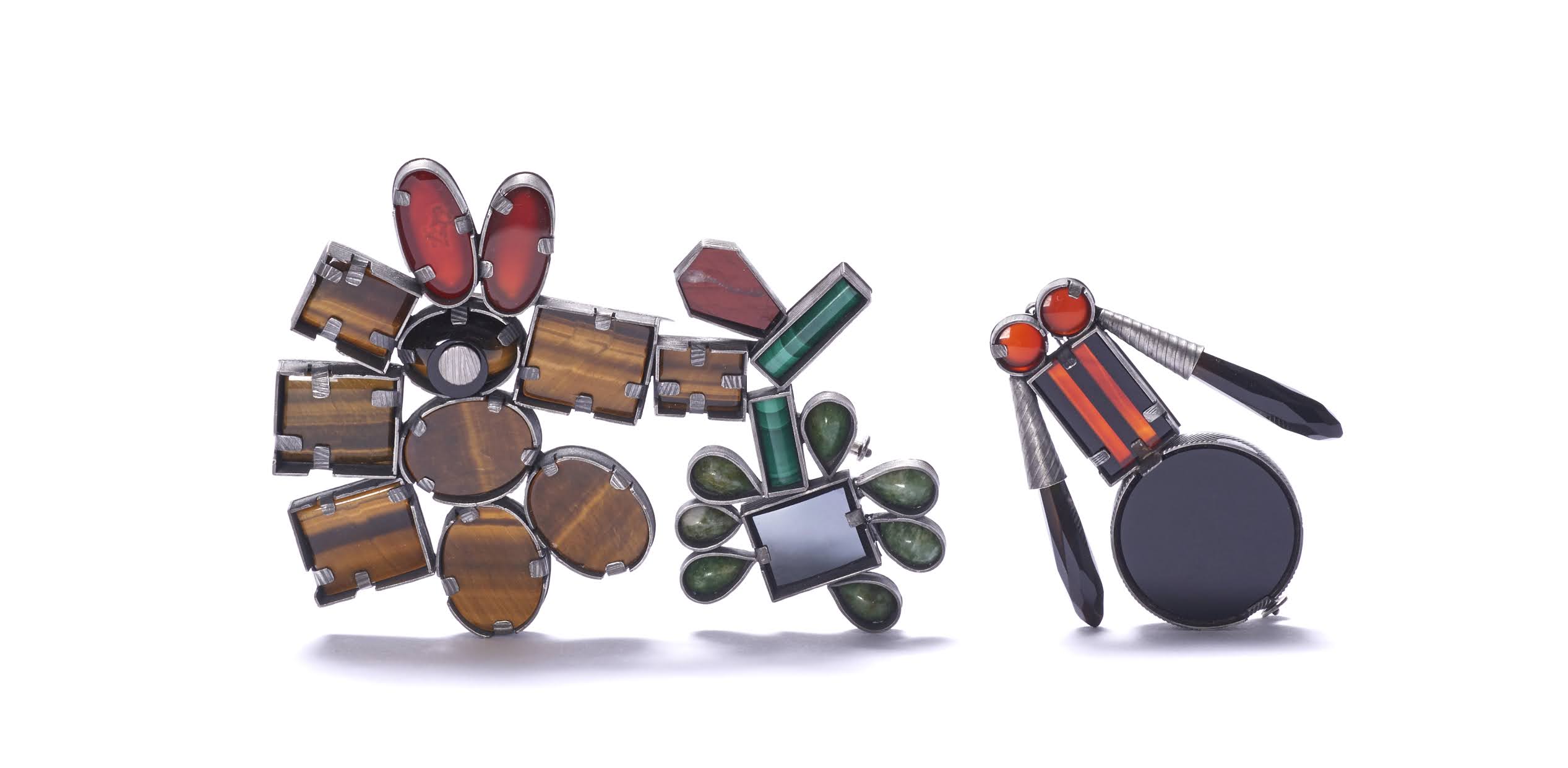
In her most recent body of work, Arachne’s Garden, Britton played with stones she had collected over her lifetime, such as jasper, agate, garnet, malachite and onyx. Like pictograms constructed in stone, she says the brooches and pendants formed on her table almost by themselves, “while sliding the piles around, animals and insects and flowers appeared, like watching clouds or reading tea leaves”

Britton’s preference for repurposing materials is deliberate and she notes that with our planet’s resources being constantly depleted, “it is difficult to justify the production of even more things. All I can do is carefully use up what I already have.”

www.ftn-books.com has now the catalog with Special cover from 2010 available.

Of her creative process, Britton explains: “It’s hard to say succinctly what I do. Sometimes I don’t know myself. I only know that the work wants to be made, that the selection of materials and choice of art form are dependent on the theme and when a work is finished, I can stand back and see if I have given it enough power and autonomy to live a life in the world without me. That’s the wonder of the creative process. A lot of it remains a mystery even to me.”

Sienna Patti, who has championed artist- jewellers since founding her gallery in Lenox, Massachusetts, in the late 1990s, remarks that while some artists who create jewellery as an extension of their practice have their work outsourced, Britton creates everything herself. Artist-jewellers like Britton, she points out, “choose to communicate their concept intentionally in a jewellery form as opposed to a painter or sculptor who decides to make jewellery”.

Posted on Leave a comment

Jason Brooks (1968)

British artist Jason Brooks is widely regarded as one of Britain’s best hyper-realist fine artists and is closely associated with the generation of artists who emerged in Britain in the early nineties to great international acclaim.

Brooks’ recent landscape works explore old masterpieces and anonymous found paintings by amateur artists that he has collected over the past couple of decades, adopting the same techniques, images that he reworks, crops and repaints. He combines airbrush, acrylic and oil paints in such a way as to explore all aspects of painterly language, as well as his own place in the canon of art history. Indeed, he argues it is a way of looking at art history through the eyes of others who have looked at art history. On a very simple level it affirms the continued faith that painters retain in the medium.

Brooks debuted among the YBAs in the 1990s with his black and white portraits.In and of itself, this may be an arbitrary fact, but it highlights an important point: Jason Brooks is a fine artist with an acutely-honed skill, but whose artistic vocabulary has more in common with the new Conceptualists and Postmodern punks.

Born in 1968 in Rotherham, U.K., Jason Brooks obtained an MA in Fine Art at Chelsea College of Art and Design and now works and lives in London. His work is held in private and public collections all around the world, including the National Portrait Gallery Collection, London where he had a solo exhibition of his work in 2008.

www.ftn-books.com has the 2013 ” ULTRAFLESH” catalog now available.
Posted on 1 Comment

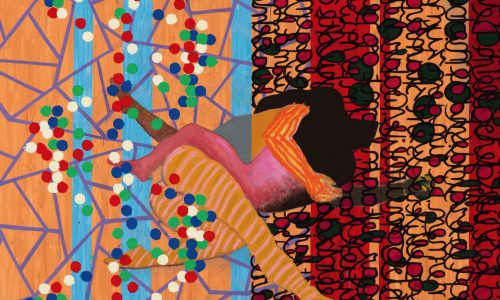
Caro Suerkemper (1964).

Berlin-based artist Caro Suerkemper (1964) shows no mercy. She undermines the fundamental contradiction between the position of the absolute and the dialectics of the relative and prompts us to replace a historically sufficiently legitimised, supremely untroubled self-confidence with a reflex action of self-mockery. However, what is apparent in the foreground of her work – obvious situations of bondage, women relieving themselves, constricting clothes, laced breasts, exposed buttocks, but also snub-nosed kids who make you smile – in short, appearances, the entire sphere of the empirical inner and outer world – is just a means and a form of pathos, leading us to the underlying realities. Subtly and efficiently in work of outstanding quality, using brush, crayon, and her fingers, Suerkemper manages not merely to question but also to unmask what not just the church and society have been attempting for centuries: to curb women’s tongues – mulierem ornat silentium (silence becomes a woman). She wants to take us down to the depths, down to the tectonic plates where social, normative, moral and aesthetic earthquakes interconnect in a complicated way. Kant’s idea that what is important in reception (or “aesthetic judgement”) is what we make of given ideas is preluded by Suerkemper to the extent that, although she makes the impression created by what is desirable or beautiful dependent on certain conditions, these in themselves are not the truth but merely a precondition. Suerkemper likes to point out that her work also contains some baroque elements. In fact, not only her drawings, china figures, underglaze painting and marble sculptures, but also the titles of her works (Anmut (Grace), Würde (Dignity), Gnade (Mercy), Carokoko, etc.) are extraordinary and for this reason alone baroque – though also ambiguous. Whereas we are gripped by the extraordinary in the art of Ancient Greece and Rome, it repels us in baroque art: we find it disturbing, an annoying ambiguity, e.g. a praying figure, bent over in convulsions, a woman of “baroque” proportions urinating in a wheelchair. Why these gestures, we ask ourselves. Why indeed? Have mercy on us, the recipients.

www.ftn-books.com has the Wasserfarben book published by CARO now available.
Posted on 1 Comment

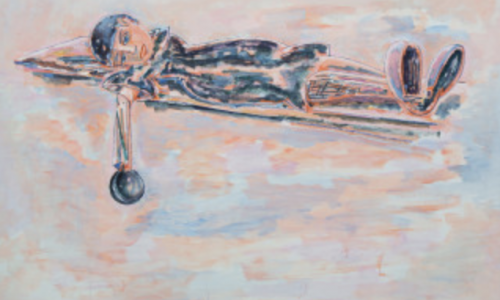
Daniel SIlver (1972)

‘I think all my interest in archaeology and work that was made a thousand years ago, thousands of years ago, still carries that humanity in it, and I hope my objects will carry this in them in times to come.’

The sculptures of Daniel Silver (b. 1972, London) explore the many forms and iterations of the human body. His practice is influenced by the art of ancient Greece, modernism and Freudian psychoanalytic theory. Silver uses concrete, bronze, marble, stone, wood and clay, and his sculptures often manifest as monuments or fragments, as if belonging to an archaeological excavation. Silver moves restlessly between styles, always examining the physical and emotional impact of the body and its representations.

Silver’s 2013 installation Dig, an Artangel commission, took place in a derelict London cinema, where he presented an imagined archaeological dig of sculptures looking both ancient and futuristic, conceived by the artist as a ‘history of sculpture’. In 2019, a commission for London’s Bloomberg Space resulted in a set of monumental, figurative works that spoke of the artist’s fascination with psychology as well as his profound interest in ancient cultures and archaeology. Recently, Silver has made a group of sculptures constructed from segments of unglazed ceramic, which he finishes with oil paint. In parallel with these sculptures, which he calls ‘totems’, the artist has created a series of ceramic heads. Once fired, each head is painted with oils, allowing the pigments to interact with the unglazed ceramic to create tactile surfaces and intimate expressions. Though his figures are fictitious, Silver regards them as familiar characters from anyone’s family. ‘I try to condense and carry the whole world into a person when I make them’, he says. 

www.ftn-books.com has the art angel published book DIG now available.

Posted on Leave a comment

Siep van den Berg and Piet Mondrian

SZep van den Berg in his Studio

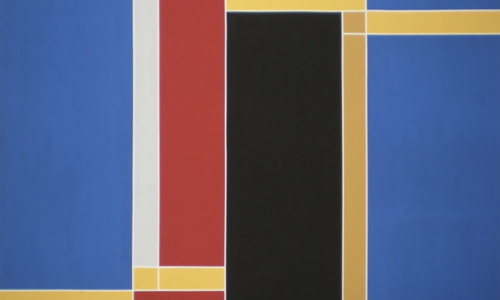
A few month ago i acquired another one of Siep van den Berg sketchbooks. This time it contained some 20 collages. It is great to see that some of these were actually realized as paintings , but the most part are highly interesting collages which give an idea of the paintings that were realized afterward. Most of these are not signed but some 60% contain fragments from his personal diary at the time Siep van den Berg was hospitalized. He barely could walk but sketched almost everyday and made some personal notes on the back of these sketches. One of these struck me. Because I know the painting COMPOSITION WITH BLUE well and had met Siep van den Berg at the time he was exhibiting at the Gemeentemuseum Den Haag. I concluded that this must have stuck in his mind, because there are some similarities between the 2. The collage is now available at www.ftn-books.com or please inquire at wilfriedvandenelshout@gmail.com.

left Mondrian / right Siep van den Berg

Posted on Leave a comment

Dirk Braeckman (1958)

Dirk Braeckman has spent the past 40 years developing an impressive portfolio. Working with the medium of photography, he occupies a distinctive place within the visual arts.

Braeckman has taken part in numerous exhibitions both nationally and internationally. He has had solo shows at The Modern Art Museum of Fort Worth (USA), LE BAL (Paris), De Pont (Tilburg), De Appel (Amsterdam), S.M.A.K. (Ghent), BOZAR (Brussels), M (Leuven) and ROSEGALLERY (Santa Monica, CA).
Braeckman’s works are part of important private and public collections around the world, including in FRAC Nord-Pas de Calais (Dunkirk), Sammlung Goetz (Munich), De Pont (Tilburg) and Fondation Nationale d’Art Contemporain (Paris), Central Museum (Utrecht), and Musée d’Art Contemporain et Moderne (Strasbourg). There are also several publications on his artistic practice and oeuvre.

In 2017, he represented Belgium at the 57th Venice Biennale.

In 2021 Braeckman was invited to take part in the 34th Bienal de São Paulo ‘Though it’s dark, still I sing’.

The Royal Family of Belgium commissioned a permanent installation in the Sphinx Room of the Royal Palace in Brussels.

Braeckman has been a KVAB member since 2019.

www.ftn-books.com has several Braeckman publications available

Posted on Leave a comment

Robert Longo (1953)

Robert Longo

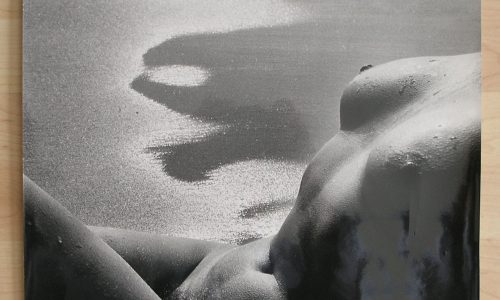
Of the contemporary artists who came to prominence in the 1980s and went on to try their hand at filmmaking in the ’90s (among them Julian Schnabel and Cindy Sherman), Robert Longo seems like the perfect fit for the role of Hollywood-style director. His sleek, 1995 sci-fi feature Johnny Mnemonic, starring an already famous Keanu Reeves, was an experimental outgrowth of an aesthetic path that the New York artist had been pursing on paper for more than a decade. Longo is technically a draftsman—his signature large-scale works are amalgams of charcoal on paper, and the tactility of the medium is explicit when faced with the work. But Longo’s productions are arguably much closer to cinema, his chiaroscuro subject matter seemingly created out of shadow and light. And like cinema, Longo’s works straddle a line between hyper-realistic and disturbingly surreal—time is frozen or extended or simply disintegrates, as what happens in his work refuses to resolve. Over the course of his career, 70-year-old Longo has created images of nature (tumbling waves, great white sharks, tigers, flowers), of institutional power structures and political fallout (the U.S. Capitol, the American flag, a fighter pilot mask, the detonation of the atomic bomb), and of personal, psychic spaces (a woman’s chest, a sleeping child, the interiors of Sigmund Freud’s home). He has also created some of the most prescient and haunting images of our age. His twisting, falling business-suit figures from his early-’80s series Men in the Cities became a startlingly accurate artifact of fragility and human suffering after 9/11. (Even Johnny Mnemonic‘s fascination with a future where secrets are impossible to keep seems strangely prescient.) This month Longo takes on an ambitious double-barrel solo show in New York, with his recent series of charcoal drawings that replicate or re-address famous American abstract expressionist works showing at Metro Pictures, while exhibiting an American flag sculpture and work inspired by the riderless horse at John F. Kennedy’s funeral at Petzel Gallery. It’s a dual production that seems to drive straight for the center of American mythology and the coercive symbolism of a cultural superpower.
www.ftn-books.com has some interesting Longo titles available

Posted on 1 Comment

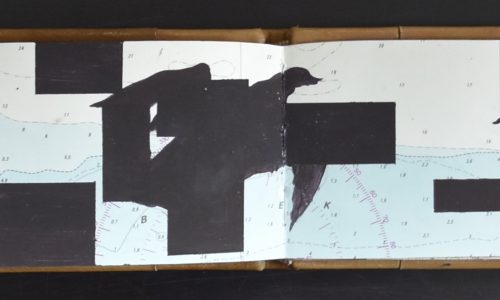
Gunter Damisch ( continued)

Not long ago i wrote a blog on Gunter Damisch on the occasion of a special publication I acquired, but here we are again……another blog on Damisch since I acquired SCHERZHAFTE ERWÄGUNG. A scarce publication from 1988 , published in an edition of 500 copies. What makes this special is that there is no printed text, only 1 on 1 pages from the sketchbook containing 51 pages from the sketchbook and the cover. This special publication is now available at www.ftn-books.com