

In the twilight of 1969, Shinkichi Tajiri ventured toward West Berlin, summoned by the beckoning of a professorship at the Hochschule der Künste. He chronicled the arrival with visceral clarity: “Upon reaching the urban core, a rhythmic, subterranean thrum permeated my senses.” To him, it felt akin to a transformer humming in isolation, severed from any mechanism capable of grounding its mounting, restless power.
As his vehicle approached the Brandenburg Gate, a hulking, concrete monolith choked the horizon—the Wall. He disembarked, pacing alongside that jagged incision in the earth. A chilling realization crystallized: the atmospheric tremor he sensed was merely the kinetic ghost of eight years of bottled history. Where metropolises typically exhale through grand boulevards and labyrinthine thoroughfares, West Berlin languished as a calcified island amidst a sea of dissent. Here, energy found no orifice for release and instead festered, saturating the air with a static, dangerous frequency.
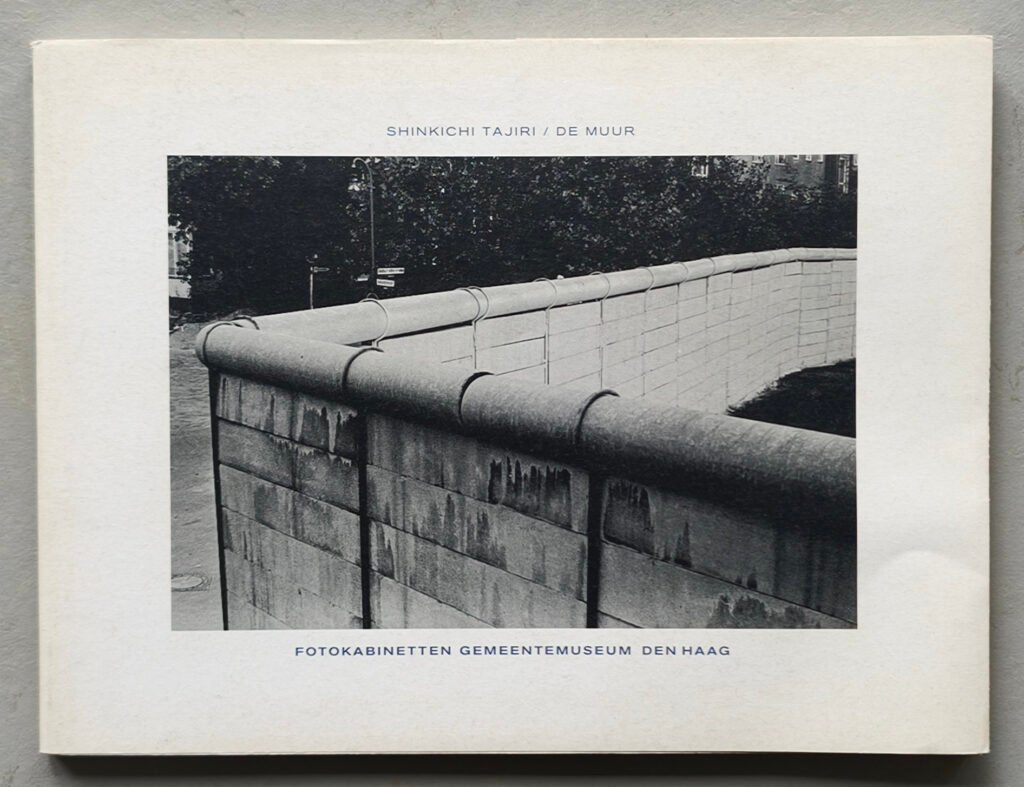
This observation serves as the cornerstone for Tajiri’s *The Berlin Wall*. Over two decades, his commute became a ritualized transit between his academic duties and the insurmountable barrier. The structure ensnared his imagination; he resolved to document its crushing 43.3-kilometer span in its stark entirety. Within a few months, the task was complete—a mosaic of 550 frames capturing the monolith’s grim silhouette.
These celluloid phantoms lay dormant for years, mere dust motes in the pre-digital firmament. It was not until 2003 that Tajiri, yielding to the encroaching tide of technology, digitized the archive. A dialogue with Tasha bv, a publisher anchored in his home province of Limburg, transformed these remnants into a tangible monument. Released in 2005, the resulting tome possesses the heft of a masonry block, a dense, architectural companion to the history it seeks to embalm.
Much like Mesdag’s panoramic odyssey, Shinkichi Tajiri distilled a singular reality through his own idiosyncratic lens, capturing a city imprisoned within its own concrete skin. Four decades removed—and two decades past the dissolution of the Iron Curtain—his work stands as an unflinching historical monument, a relic of an era defined by the GDR’s clockwork heartlessness. Where the frontier was etched, stone rose; along Bernauerstrasse, the jagged border clung to the very thresholds of domesticity, where lingering windowpanes shielded nothing but the suffocating proximity of raw brick. It was a tableau draped in surrealism, birthed not by a poet’s fevered imagination, but by the cold, logistical hand of an apparatchik.
Tajiri was a nomad of the urban labyrinth, drifting between the frantic pulses of Chicago, New York, Paris, and Amsterdam. I recall crossing his orbit at De Kring in the fifties, observing a man tethered to the explosive camaraderie of the Cobra brotherhood—Appel, Constant, Corneille. He salvaged the discarded viscera of industry, forging machine-limbed sculptures that carried his soul’s thumbprint. To mistake his tactile, serrated aesthetic for the whimsy of Tinguely or the cerebral tinkering of Panamarenko would be a failure of perception. Last weekend, he breathed his last in Baarlo, tucked away in the deep, verdant silence of Limburg.
I spent hours submerged in the pages of his chronicle. Like sepia-toned ghosts rising from the ink, the textures of the Cold War began to coalesce—an Eastern Bloc that exhaled a distinct, metallic scent, familiar yet fundamentally alien to our Western sensibilities. The Communist apparatus had somehow calcified the shadows of the Second World War, domesticating its trauma into the mundane fabric of daily existence. Within these pages, that bitter draft is served chilled. Tajiri saw it, parsed it, and held it steady for us to witness.
www.ftn-books.com has the DE MUUR publication now available.