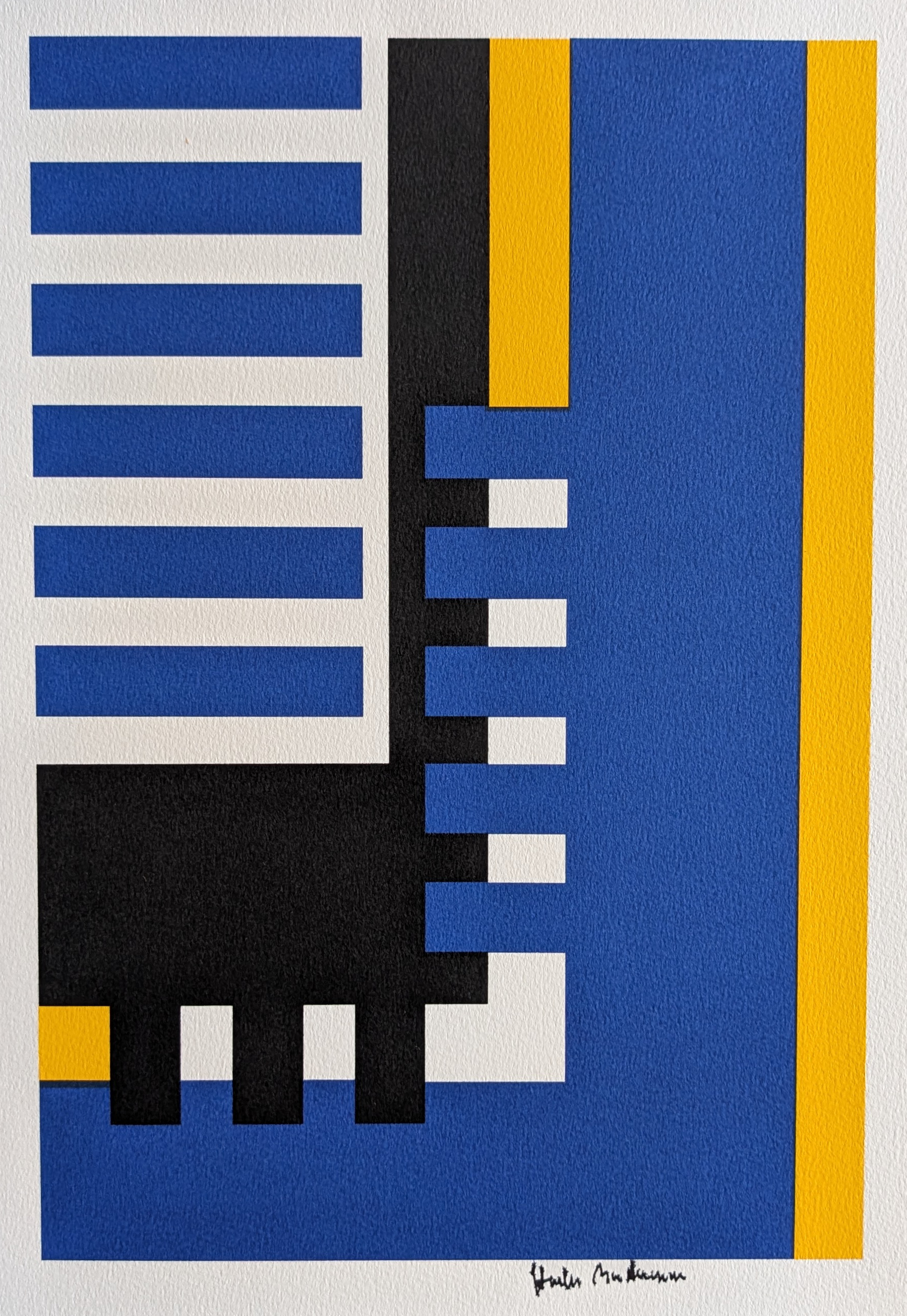
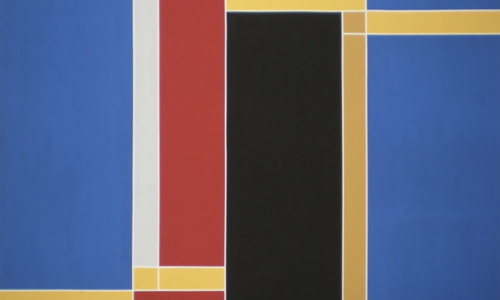
During the start of his artistic journey, Charles Biederman delved into the mastery of Cézanne, Post-Impressionism, and Cubism before fully embracing total abstraction. His time in New York (1934–40) and his initial expedition to Paris in 1936 had a profound impact on his art, bringing him into contact with the works of numerous European modernists, such as Arp, Brancusi, Léger, Miró, Mondrian, Pevsner, and Vantongerloo. His focus was particularly drawn to Constructivism, with its usage of industrial materials, and De Stijl, with its unfaltering geometry and primary color schemes – both movements that produced nonobjective, geometric images. By 1937, Biederman’s art evolved into a more sculptural form, and subsequent pieces, like New York, Number 18 of 1938, took the form of shallow, painted reliefs. These wall-hung panels – often featuring wood and plastic elements – could be viewed from different angles, with natural light and shadows adding to their visual impact. In this particular piece, the central portion of the rectangular box has a recessed center, forming multiple right angles; translucent plastic sheets placed within the hollow bring a burst of yellow to the otherwise white design.
These wall panels served as a bridge between Biederman’s early experimental paintings and his mature reliefs from the late 1940s onwards, which featured a grid of small, vibrant, and individual pieces seemingly floating against a backboard. Although such radically abstract works were not well-received in New York at the time, leading the artist to relocate to Minnesota (where he currently resides), a renewed interest in them emerged in the 1960s, during the height of the Op Art trend.
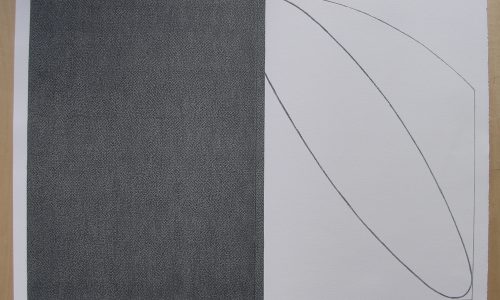
www.ftn-books.com has now an original Biedermann print for sale.