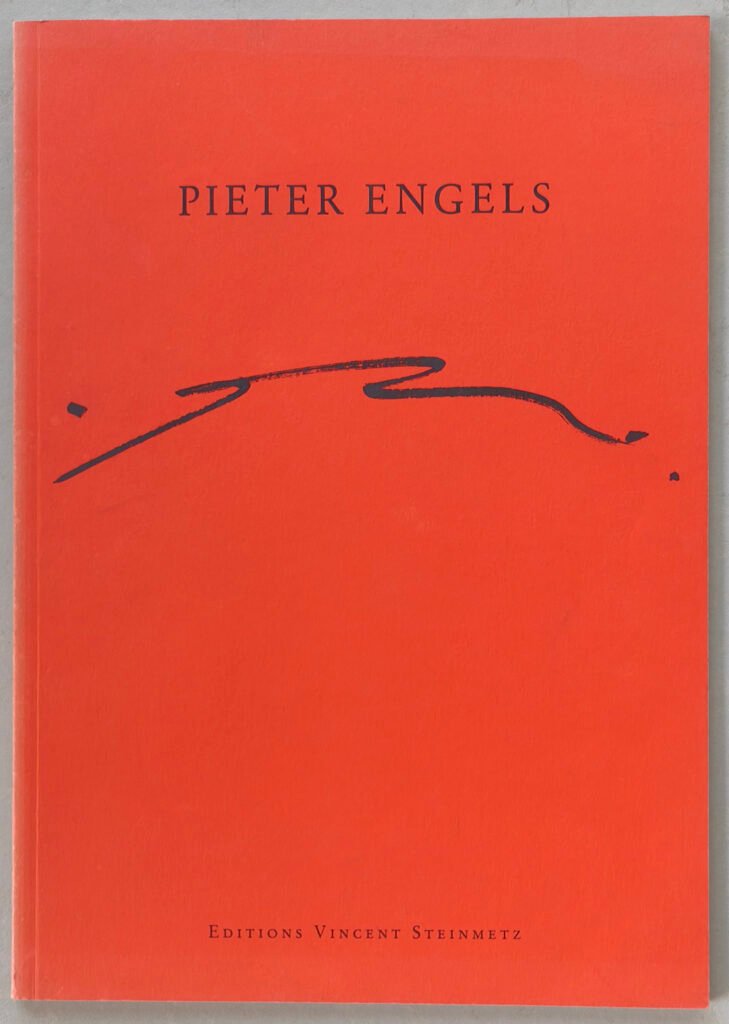


Pieter Engels (1938, Rosmalen) functions as an anatomical dissector of the art world, peeling back the epidermis of creative institutions to expose the pulsating machinery beneath. His oeuvre acts like a subversive mirage, oscillating between razor-sharp wit and an ironical detachment that stings the unsuspecting spectator.
In 1964, a conceptual metamorphosis solidified: the birth of the Engels Product Organization (EPO). Within this corporate simulacrum, Engels donned the mantle of director, while his clandestine shadow, Simon Es, operated as the sales manager. The venture mirrored a bona fide commercial entity, complete with glossy brochures, curated showroom aesthetics, and the stifling vernacular of boardrooms. EPO peddled an curious inventory—restored furniture, typographic constructs, and “wonder events.” Consider his “restored chairs”: timber skeletons severed at the joints and bound anew by hinges, transforming domestic mundanity into fractured sculpture. His *Letter Pieces* functioned as wall-mounted linguistic triggers, featuring mechanical flaps that revealed pedestrian commands like “hallo” or “kom maar,” stripping communication to its barest functional bones.
The “wonder events” occupy a more volatile territory. These were transactional performances—a binary of absurdity and complicity. For a fee, Engels would bifurcate a banknote, engage in transient dialogue, or mar the chassis of your vehicle with the promise: *“ENGELS DAMAGES YOUR CAR BEAUTIFULLY, price: from fl. 100,-.”* Each interaction serves as a mirror held to the witness; by participating, the patron crosses the threshold from observer to co-conspirator in the elastic redefinition of artistic legitimacy.
Language, in Engels’ hands, is not a vessel for meaning, but a playful obstruction. His *Situation Plates*—austere monolithic slabs of black acrylic punctuated by stark, white imperatives—demand a proximity to doors or electric outlets that borders on the fetishistic. This recursive logic finds its zenith in the 2009 assemblage *The absence of a painting framed by the absence of this painting*. It is a nested nihilism, a frame embracing a void, bound by its own self-referential nomenclature. Here, Engels suggests that the frame provides the reality, while the canvas remains a perpetual hostage to the absence itself.
*Ook Modern Art (Seascape) Piece (The Clothes of the Emperor)* (1967) performs a cartography of nothingness. Within its frame, the canvas is an absentee landlord; the void resides where pigment ought to congregate. By affixing the subtitle—a direct nod to the fable of the monarch’s invisible raiment—Engels constructs a linguistic trapdoor. These titular garments serve as a mirror to our collective gullibility, a phantom architecture upheld by consensus alone. Through this gesture, the artist dismantles the scaffolding of art while simultaneously fortifying its pedestal, demanding we interrogate the very ghost-logic that permits a vacuum to occupy a gallery wall.
“The exquisite virtue of a lie lies in its profound familiarity with truth.” Engels offers this axiom not as a barricade, but as a lens. It is a brittle statement, possessing the deceptive clarity of a shard of ice before it shatters into a thousand intricate paradoxes. Such is the signature of his inquiry. By shifting the angle of illumination upon the mundane, he forces a vertigo of the senses, a recalibration of how we weigh the aesthetic. His compositions function as deliberate punctures in the fabric of our routine observations—incisive interventions that compel us to grapple with the alchemy required to transmute raw space into the sanctity of Art.
www.ftn-books.com has some important Engels publications available.