

Emerging from the crucible of the late 1960s, Victor Burgin has carved a singular path, straddling the dichotomy between foundational artistic practice and the rigorous scrutiny of optical theory. He surfaced as a luminary of the Conceptual Art movement, an intellectual firebrand whose early interventions dared to challenge the sanctity of the static frame. By the 1970s, his oeuvre had solidified into expansive photographic sequences—wresting meaning from the collision of printed text and image, like a quiet skirmish between language and light.
Transitioning into the digital epoch of the 1990s, Burgin pivoted toward video, yet remained anchored in the grammar of the lens. He treats the digital canvas not merely as a medium, but as an inquiry into the ontological tension between stillness and fluidity. As critic Stephen Bann astutely observed, any fixation on the artist’s adoption of burgeoning technology pales in comparison to the monolithic stability of his core investigative concerns; the tools are fleeting, but the inquiry is eternal.
To gaze upon a Burgin piece is to inhabit the terrain Henri Bergson once charted: that liminal void where perception is not a sterile encounter, but a landscape saturated with the echoes of memory. Within the interstitial space separating the observer from the artifact, Burgin orchestrates a subtle subversion of the “real.” He insists that our vision is perpetually filtered through a prism of subjective myth—a refraction of narrative, recollection, and chimerical desire.
It is little wonder, then, that such profound inquiries into the mechanics of the gaze have secured his legacy. His contributions now form integral threads in the permanent archives of institutions as venerable as the Tate and the Museum of Modern Art, standing as silent testaments to an intellect that refuses to rest on the surface of the image.
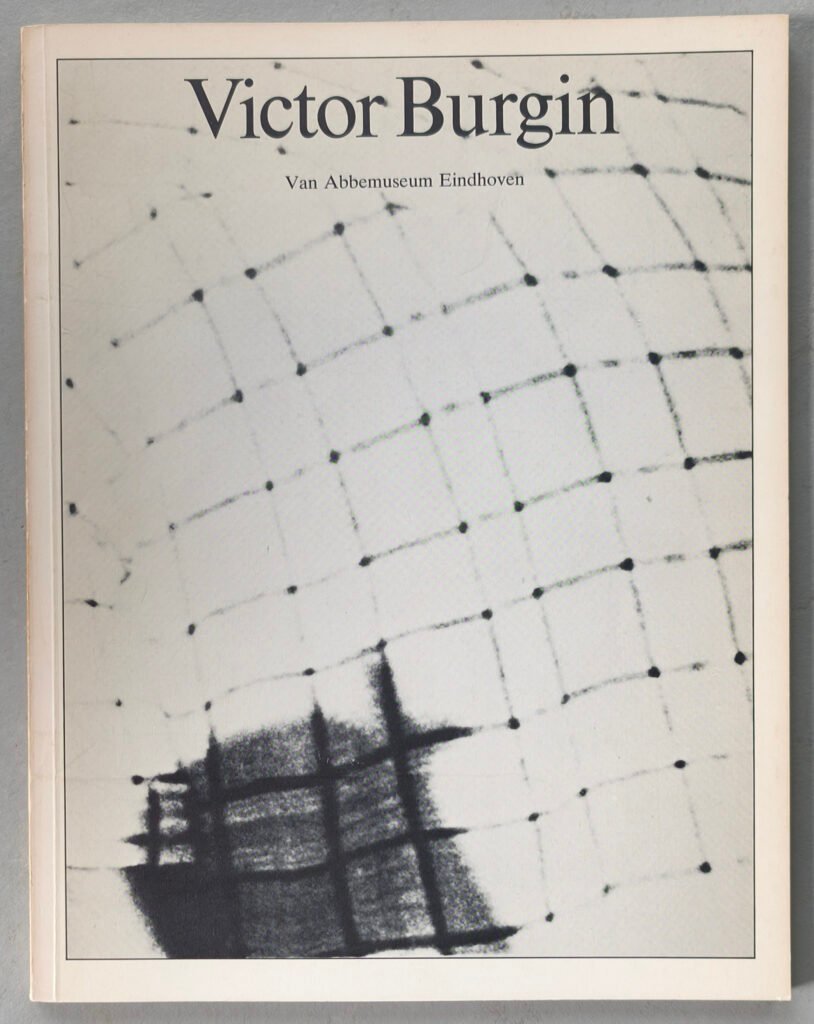
www.ftn-books.com recently added the scarce 1977 van Abbemuseum catalog on Victor Burgin.