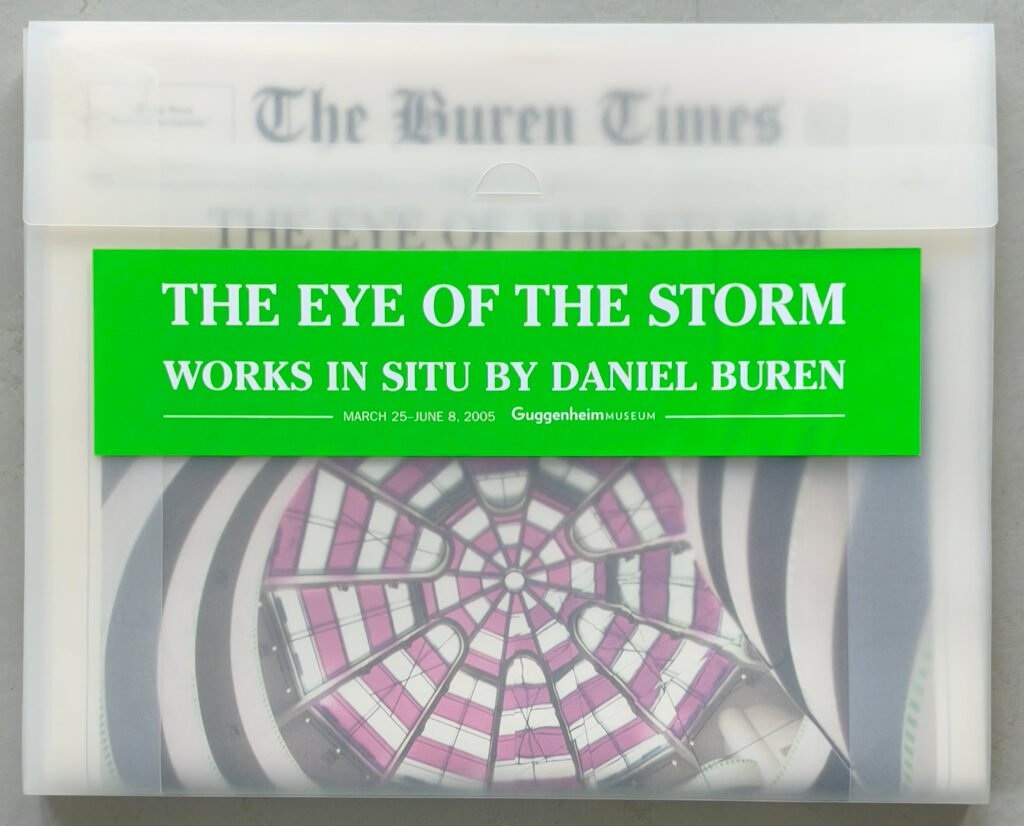


For his exhibition The Eye of the Storm: Works in situ by Daniel Buren, the artist has selected three areas of the Guggenheim Museum to display his work, creating different perspectives and new experiences, even for seasoned visitors.
Around the Corner (2000/05), Daniel Buren’s work for the museum’s central rotunda, exposes the powerful presence of the building’s architecture and the various ways it engages the art on exhibition. Buren has conceived an immense cube, part of which lies within the center of the Frank Lloyd Wright–designed architecture. Although only two walls are actually built, the rest of the cube is implied to continue outside the museum’s boundaries.
Visitors entering the Guggenheim usually encounter the museum’s landmark architecture first. For this exhibition, however, visitors pass directly into Buren’s towerlike structure, walk through the shadowy interior with its exposed scaffolding, and proceed through a doorway into the light-filled museum rotunda. Buren continues to challenge expectations by focusing his work in the rotunda, which is usually left empty and experienced as a void. The mirrored surface exterior of Buren’s massive cubic structure reflects the architecture of the museum and creates a kaleidoscopic experience. The ramps are left bare, revealing the architectural skeleton. The tower like cube reaches over the existing ramps and visitors walk in and out of the cube as they ascend. Buren’s signature stripes, in alternating vertical bands of white and bright green, adorn the parapet walls and draw visitors’ attention to the powerful character of the building itself.
Buren’s project builds on an earlier one conceived for the Guggenheim. In 1971 the artist was invited to participate in the sixth Guggenheim International Exhibition, which was designed to highlight new approaches to making art. Each artist was asked to select a portion of the museum’s unique space for displaying his or her work, which in most cases was made specifically for the show. Buren’s work was to comprise two large blue-and-white-striped banners: the smaller hung just outside the building on Eighty-eighth Street, the larger (66 x 32 ft.) suspended within the museum from below the skylight to just a few yards above the rotunda floor. When installed, this second banner bisected the void of the rotunda, obstructing views and angering several fellow exhibiting artists. It was removed, the exterior banner was never hung, and the ensuing controversy made Buren’s work legendary. Now, almost thirty-five years later, the Guggenheim has invited the artist to continue his engaging dialogue with the museum.
www.ftn-books.com now has the publication by Buren from 2005 available.