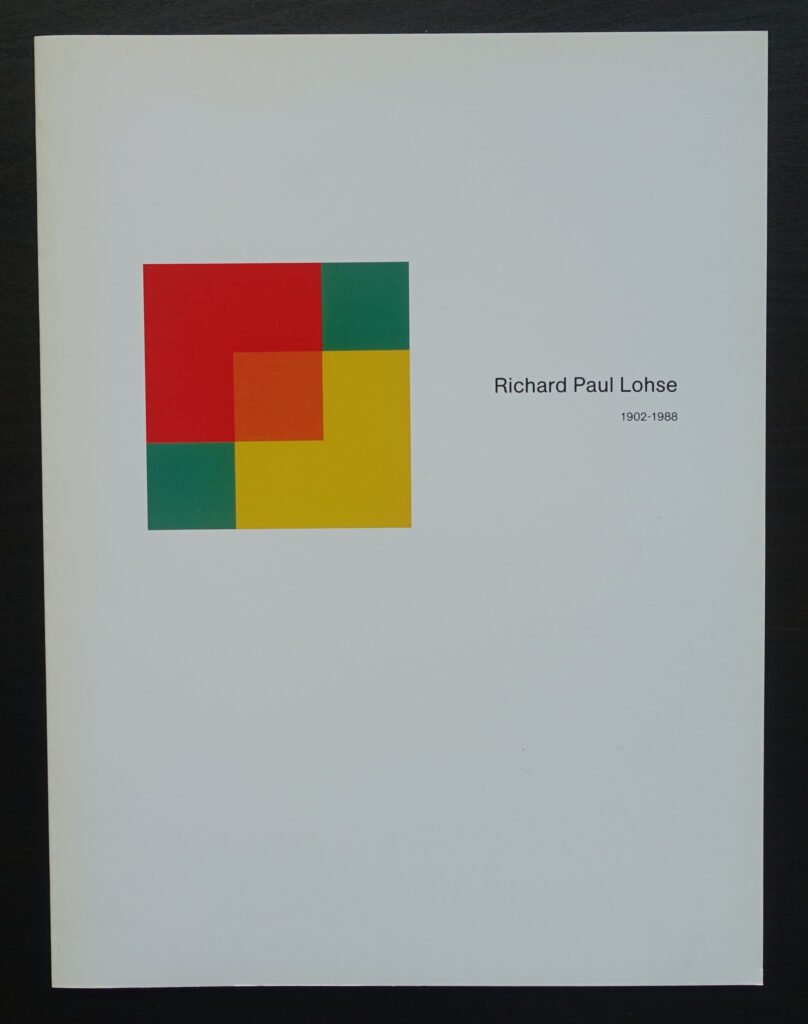


Richard Paul Lohse (1902–1988) was a Zurich painter and graphic designer, and a central figure of constructivist-concrete art. From 1943 he concentrated on orthogonally structured image fields, building systems with an ever wider colour spectrum, which for him expressed a modern, non-hierarchical society. His rigorous grids of colour modules are some of the most disciplined paintings of the 20th century.
Dutch curator Rudi Fuchs backed Lohse for years. He published Neun Quadrate with Lohse at the Van Abbemuseum in Eindhoven in 1978, and as director of documenta in 1982 he invited Lohse to show three large variations of Serial Row Theme in Eighteen Colours. Fuchs also contributed to Lohse’s major 1984 monograph.
Fuchs was also tied to Donald Judd’s world. He chaired the Chinati Foundation, which was established in 1986. Judd admired Lohse’s work, and the two men worked together on a show. A Lohse exhibition organized by Judd and Fuchs opened at Chinati in October 1988, then travelled to Judd’s 101 Spring Street in New York and on to the Gemeentemuseum in The Hague. It was Lohse’s first solo exhibition in the USA. The exhibition catalogue carried texts by Fuchs, Judd and Lohse himself.
Judd saw something in Lohse that went beyond a shared taste for geometry. In the catalogue he wrote that Lohse’s work marks the end of the European compositional tradition, “a good end”, and the beginning of much that is still developing. For a Minimalist who rejected European-style composition, that was high praise for an older Swiss painter. Lohse died in 1988, the same year as the exhibition, so the Marfa show became a late honour.
www.ftn-books.com has the Marfa catalog now available.