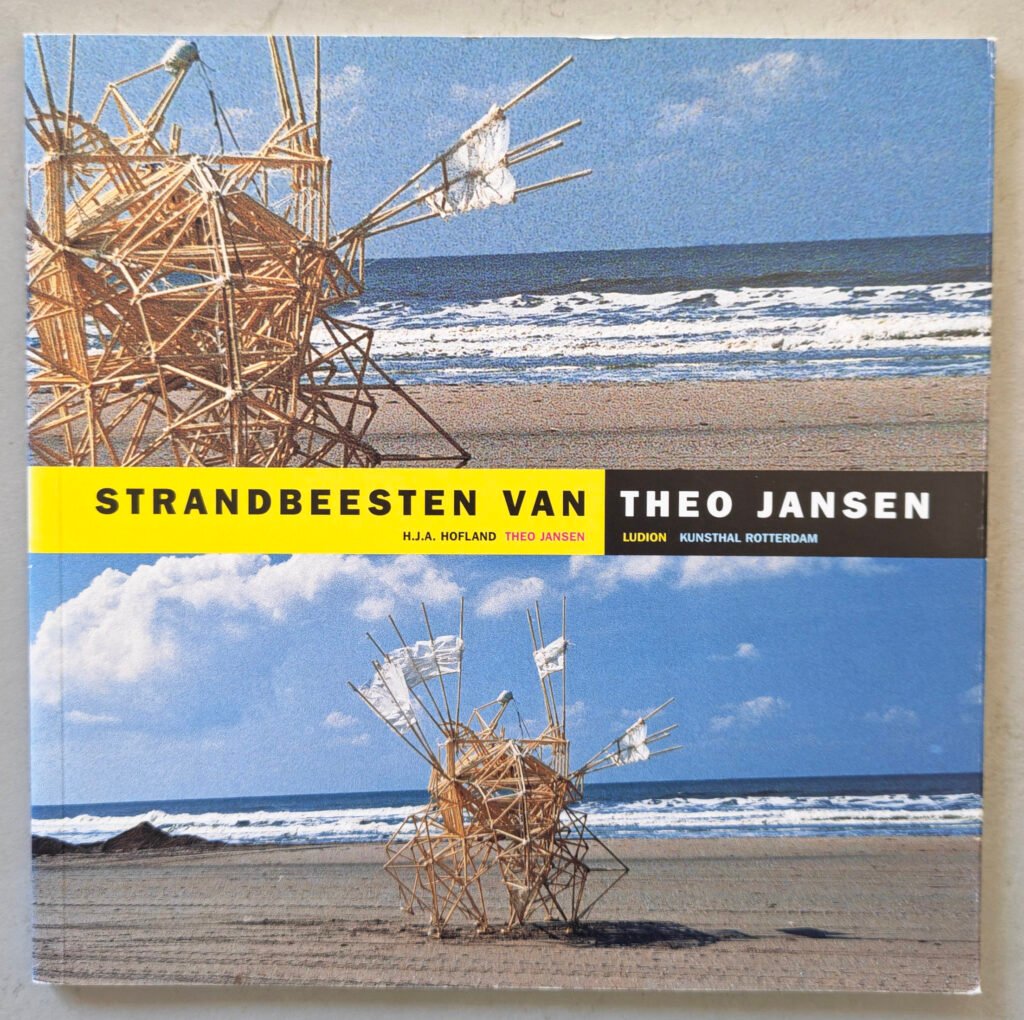

On the wide, windy beaches of the Netherlands, strange skeletal creatures roam. They have no muscles, no motors, and no brains. They’re made of yellow plastic tubing, and they walk.
These are the Strandbeesten (“beach beasts”), the creations of Dutch artist and engineer Theo Jansen. A physicist by training, Jansen began building them in 1990 with a bold ambition: to create new forms of life that could survive on their own. Not biological life, but a kind of artificial evolution made from PVC pipe, zip ties, and sails.
The secret of a Strandbeest is its leg. Jansen used a computer algorithm, evolved over thousands of generations, to find the ideal proportions for a walking mechanism. The result is a set of 11 numbers, which he calls the “Holy Numbers,” that define the lengths of the linkages in each leg. When a crank turns, the leg traces a smooth, almost organic stepping motion, with the foot lifting, swinging forward, and pressing back against the sand.
Wind fills the sails, pushes the beast forward, and the legs do the rest. Some of his later creations even store air pressure in recycled plastic bottles, letting them keep moving when the breeze dies down. Others have simple sensors, such as a tube that detects water and makes the beast turn away from the sea, so it doesn’t get swept away.
Jansen speaks about his creations as if they were animals. He describes them as having stomachs (the bottles), nerves, and even the ability to avoid danger. His long-term dream is to release herds of them onto the beaches, living out their lives without human help.
The designs have changed over the decades, from clunky early prototypes to elegant models like Animaris Rhinoceros and Animaris Umerus. Each generation is a refinement of the last, and Jansen treats the process like natural selection, only with himself as the environment.
Strandbeesten sit in a rare space where engineering, sculpture, and philosophy meet. They are beautiful to look at and ingenious to study, and they ask a quietly profound question: what is the line between a machine and a living thing?
If you ever get the chance to see one in motion, take it. Watching a skeleton of plastic pipes stride across the sand, powered by nothing but the wind, is a little like watching evolution in fast-forward.
www.ftn-books.com has now the 2002 publication on STRANDBEESTEN available.