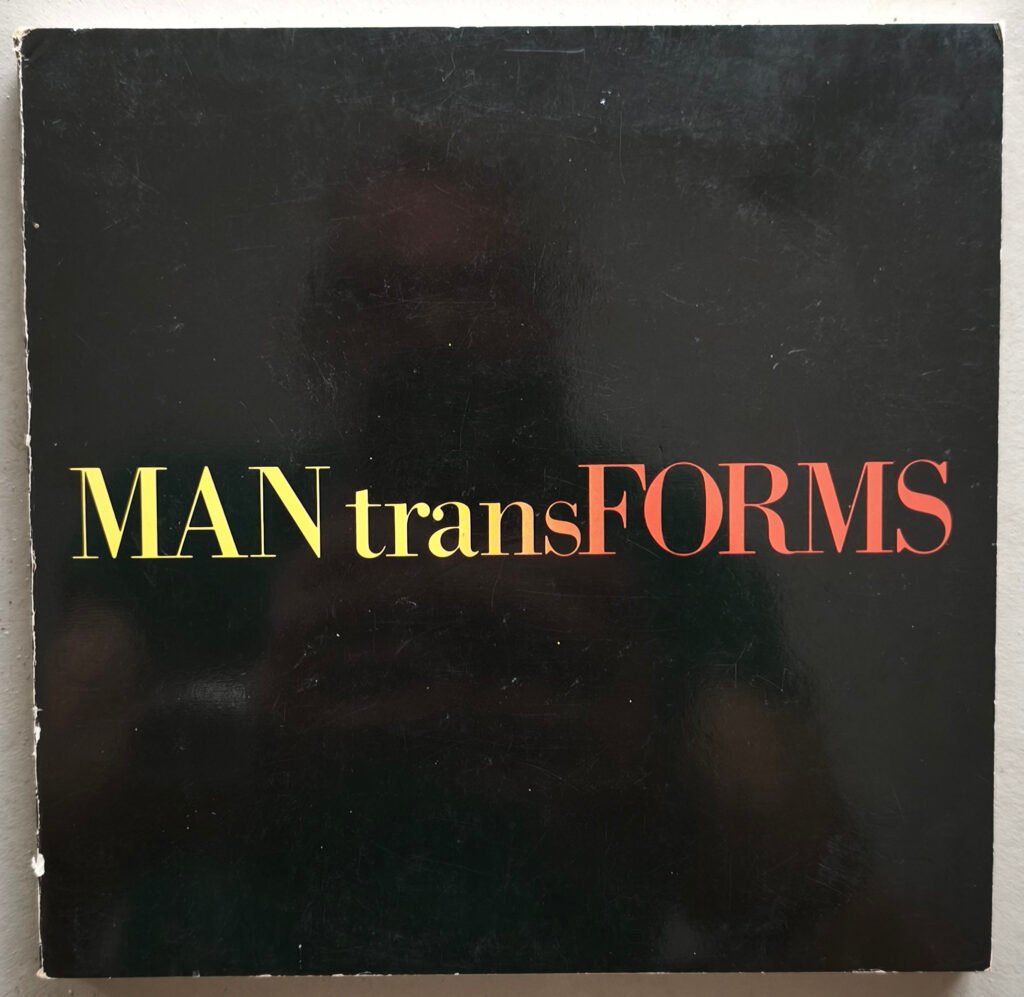


MAN transFORMS: The Show That Reinvented a Museum
In October 1976, a mansion on Fifth Avenue reopened as something entirely new. The old Andrew Carnegie residence, long home to the Cooper Union Museum for the Arts of Decoration, became the Cooper-Hewitt, the Smithsonian’s National Museum of Design. Its inaugural exhibition, MAN transFORMS: Aspects of Design, was less a display of objects than a declaration of intent — one that still shapes how design museums think about themselves today.
The exhibition was conceived by Austrian architect Hans Hollein, working closely with the museum’s director, Lisa Taylor. Rather than lining up artifacts behind glass, Hollein treated the entire museum as a single environment — a place where visitors would experience design ideas rather than simply look at labeled objects. It was an audacious founding statement: design, the show argued, is not a category of pretty things, but a fundamental human activity.
Hollein didn’t work alone. He invited an international group of architects and thinkers to each build their own installation exploring a theme, including Richard Buckminster Fuller, Arata Isozaki, Richard Meier, Ettore Sottsass, and Oswald Mathias Ungers. Nader Ardalan and Karl Schlamminger contributed a piece on sacred space. The result was a constellation of individual “environments” under one roof rather than a single curatorial voice — installations built around everyday, almost mundane subjects: bread, hammers, cloth, stars, an “angel cage,” a room of Plexiglass. Each contributor used a familiar object or motif as a lens onto larger questions of culture, ritual, and meaning.
Critics and historians have since pointed to MAN transFORMS as an early landmark of architectural postmodernism — a moment when the discipline’s boundaries were visibly loosening. The show didn’t just present design history; it used the exhibition format itself as a tool for building theory, blurring the line between curator and artist, museum and stage set.
Its influence outlasted its four-month run. In 2016, ETH Zurich mounted MAN transFORMS: The Documents, an exhibition entirely devoted to the archival sketches, proposals, and plans behind the original show — testament to how significant a single opening exhibition could be in redefining what a museum of design was for.
Nearly fifty years on, MAN transFORMS still reads as a bet that paid off: that a museum could ask “what is design?” and answer it not with a timeline of chairs and teapots, but with an experience built by a dozen different imaginations, all circling the same question from different angles.
www.ftn-books.com now has the scarce catalog for this exhibition available.