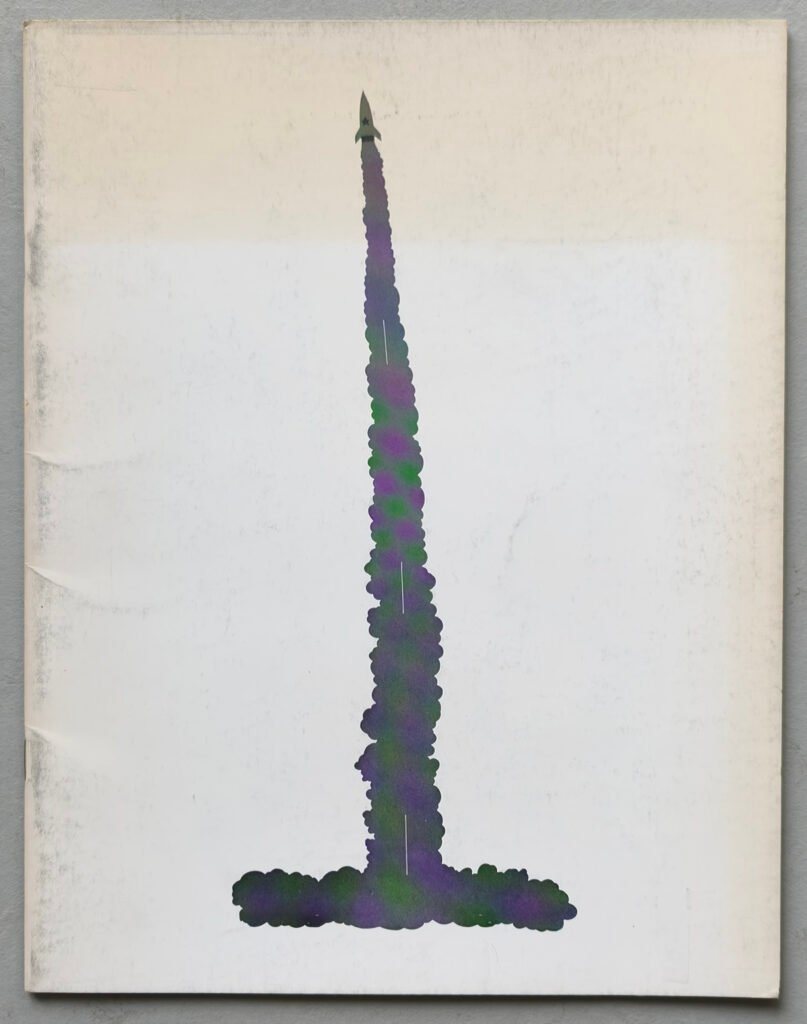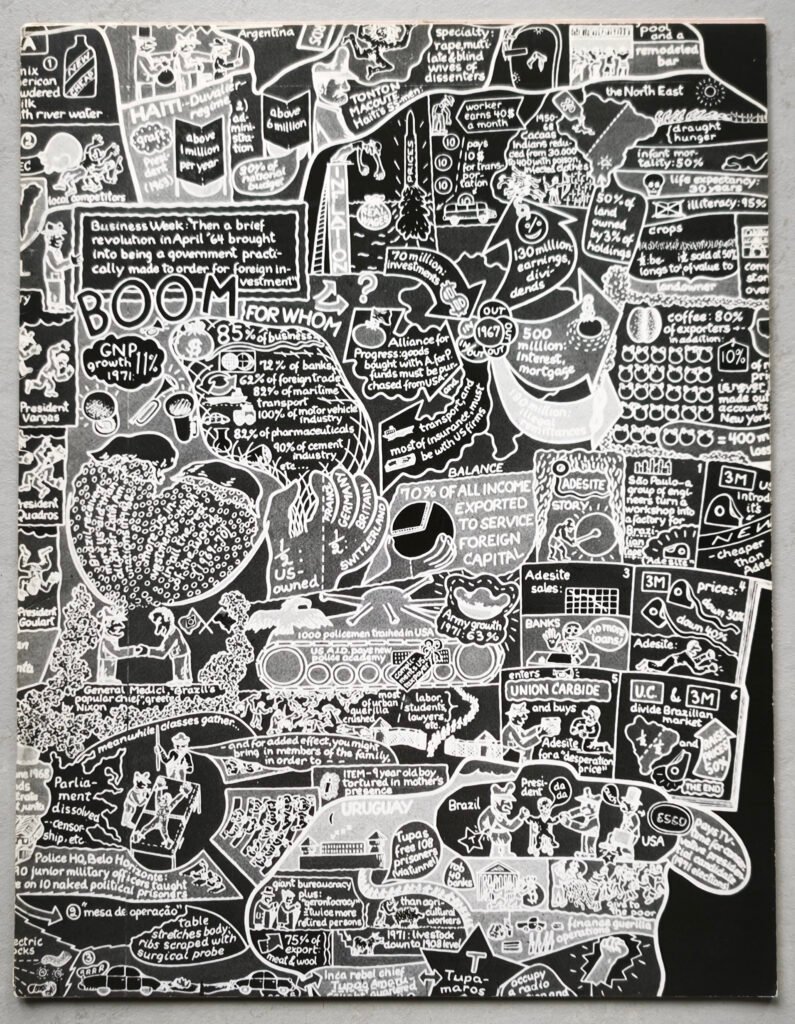


Öyvind Fahlström—a nomadic luminary born in the humid sprawl of São Paulo and destined for the Baltic chill of Stockholm—has long languished in the footnotes of art history. Critics tethered him to the neon-drenched coat-tails of European Pop Art, yet such labeling feels like describing a tempest as a mere breeze. Beneath his aesthetic appropriation of mass-media static and the grimy undercurrents of counter-culture, Fahlström’s oeuvre throbs with a labyrinthine moral urgency; it is less a collection of objects than a rigorous, intellectual siege against complacency.
This meticulously curated exhibition bridges the chasm between archival silences and public reception, pulling over seventy disparate artifacts from the shadows of private vaults. Much of this assembly draws its bracing, unfiltered vitality from the artist’s own personal caches, recently entrusted to the custodianship of the MACBA.
To engage with Fahlström is to abandon the passive slouch of the gallery-goer. He demands a spectator-as-decipherer, an initiate willing to untangle the knotted polyphony of his semiotic skirmishes. Like an alchemist presiding over an exorcism of societal ills, his work functions as a kinetic playground for the liberated mind. From the early, nascent abstractions of *Opera* to the cacophonous, sprawling ambition of *The Little General* and the tactile irreverence of *Meatball Curtain*, he weaponized the “operatic” impulse. He shattered the walls between disciplines, fusing cinematic drift, sonic friction, and the jagged edge of political polemics.
*Event Horizon: MACBA, October 17th.*
This vital retrospective does not intend to remain static. It is a migratory phenomenon, destined to traverse continents: from the austere halls of Malmö Konsthall through the pulsating cultural crossroads of the Bienal de São Paulo, finally finding a home at the BALTIC Centre for Contemporary Art as the decade turns.
Öyvind Fahlström’s inaugural grand retrospective serves as a prism, refracting the kaleidoscope of his unrelenting versatility. This curation endeavors to exhume the irreducible singularity of his trajectory—a career that deftly sidesteps the gravitational pull of facile categorization or sterile artistic movements. His oeuvre functions as a labyrinthine mirror, mirroring the fractious paradoxes of his epoch while brazenly ensnaring the spectator within the volatile fabric of the creation itself.
Though tethered to the superficial iconography of Pop art through the appropriation of mass-media detritus—the comic strip, the gaudy magazine scrap, the frantic pulse of the daily gazette—Fahlström’s intellect operated within a rarefied stratosphere. His praxis was not merely aesthetic but a relentless crucible of moral and political inquiry, systematically dismantling the ossified dogmas that govern our perception of reality.
The gallery path bifurcates into a triptych of thematic currents. First, the specter of the “Citizen of the World,” a wanderer’s cosmopolitanism born from a disparate geography stretching from the cradle of Brazil to the war-torn sanctuary of Sweden and eventually the frantic, neon-drenched metropolis of New York. Then, the dialogue between Art and Poetry, where the boundaries of signifier and visual artifact become beautifully blurred. Finally, the nexus of Art and Information emerges, illuminating the rigorous ethical architecture that anchored his radical social engagement, solidifying his legacy as an artist who transmuted the raw data of existence into a potent, biting indictment of the mundane.
Within a zeitgeist where stylistic plurality, the fluid kinetics of interpersonal dynamics, and the systematic dismantling of grand narratives reign supreme, Öyvind Fahlström’s oeuvre vibrates with a startling, present-tense urgency. His creative lexicon serves as a cartography of the ephemeral, remaining as vital today as it was during its inception.
The forthcoming retrospective unfurls like a sprawling, multifaceted organism. It encapsulates the full spectrum of his artistic endeavors: subterranean video transmissions, kinetic charcoal testimonies, and those signature “variable” canvases—interactive gaming apparatuses that transmute the passive viewer into an orchestrator of shifting paradigms. These pieces span from his monumental 1953 *Opera*, a sprawling eleven-meter expanse of terrestrial inscriptions, through to the elegiac complexity of his swan song, *Garden. A World Model (1973)*.
Unearthing the provenance of this collection necessitated a rigorous excavation of the MACBA-housed archives. Like an archaeologist dusting off fragments of a forgotten civilization, our curatorial team has waded through a mire of previously unexamined manuscripts, personal bibliographies, and dense marginalia. This trove of ontological blueprints—private scrawlings and interpretive keys—will serve as the backbone for the exhibition. Consequently, the accompanying catalogue transcends mere documentation; it acts as a luminous conduit, granting the public an uncensored ingress into the labyrinthine psyche and taxonomical classification of Fahlström’s singular universe.
Öyvind Fahlström’s oeuvre unfurls as a phantasmagoria of mercurial inventiveness, simultaneously microscopic in its fixation and cyclopean in its reach. It is a kaleidoscopic synthesis; he wove the delicate filaments of intimate arcana into the structural ribbing of canonical grandeur, all while gorging upon the gluttonous data-streams of mass media and the subterranean tremors of low-brow aesthetics. While the monumental titans of his storied epoch have been meticulously dissected under the clinical scrutiny of academia, Fahlström’s legacy remains a terra incognita, a wild, shifting frontier awaiting its cartographers.
He suffers not from obscurity, but from a profound misalignment within the cultural firmament. Critics frequently pigeonhole him as a quirky satellite orbiting Americanized Pop, an aesthetic stray tethered to the sixties. This reductionism is a cage. To truly perceive his trajectory, one must cast aside the parochial lenses of traditional art history and embrace a geopoetic expansiveness—the same nomadic, borderless fluidity that dictates the sprawl of his own cartographic variables.
This exhibition acts as a corrective, a crucible wherein his odyssey is reconstituted. It tracks a restless spirit, traversing the geopolitical fissures and cultural tectonic plates separating Europe from the Americas—a frantic, intellectual pilgrimage sketched across the latitudes and longitudes of a splintered global consciousness.
www.ftn-books.com recently added 3 catalogs from the Seventies from the Sidney Janis gallery to its collection