

Leisgen, Conceptual Art, and the Art of Jumping Over the Horizon
There is a particular kind of vertigo that comes from looking at a horizon line — the sense that it marks an edge you can see but never actually reach. For the German artist couple Barbara and Michael Leisgen, that edge became a lifelong subject. Across four decades of photographs, films, and staged gestures, their work turned the horizon from a passive backdrop into an active partner: something to trace, to answer, to merge with, and — in spirit if not always in the literal act — to jump over.
Barbara Leisgen (1940–2017) and Michael Leisgen (born 1944) trained originally in painting and sculpture in Karlsruhe before abandoning those disciplines to work jointly, and largely self-taught, in photography. What emerged from that shift was a practice sitting at the crossroads of photography, performance, and land art — one deeply invested in the relationship between the human body and the natural world. Their work appeared at documenta 6 in Kassel in 1977, and has since been the subject of retrospectives and exhibitions from the Maison Européenne de la Photographie in Paris to WIELS in Brussels.
Crucially, the Leisgens developed their language in the 1970s as a kind of counter-current to the dominant conceptual photography of the time, epitomized by Bernd and Hilla Becher’s cool, typological studies of industrial architecture in Düsseldorf. Where the Bechers catalogued the built world with detached precision, the Leisgens went the other way: into open landscapes, using the body itself as an instrument of measurement and mark-making.
The clearest expression of this is a video work called Übungen (“Exercises”), made between 1972 and 1974. In it, Barbara Leisgen appears from behind, a silhouette standing in the landscape, her arms stretched outward to follow the undulating line of the hills behind her — as if her own body were drawing the horizon, or being drawn by it. After several minutes she lowers her arms and walks away from the camera, receding smaller and smaller until she is swallowed by the picture plane itself, vanishing between the folds of the land.
This gesture recurs throughout their broader body of work, sometimes called the Mimesis or Paysage mimétique series: a figure whose outstretched limbs echo the contour of hills, or trace an arc that follows the sun’s path across the sky in their Sunwritings. The body here isn’t posed in front of nature as a subject before a scenic backdrop. It is folded into nature, made structurally continuous with it — a living instrument tracing lines that the landscape itself seems to write.
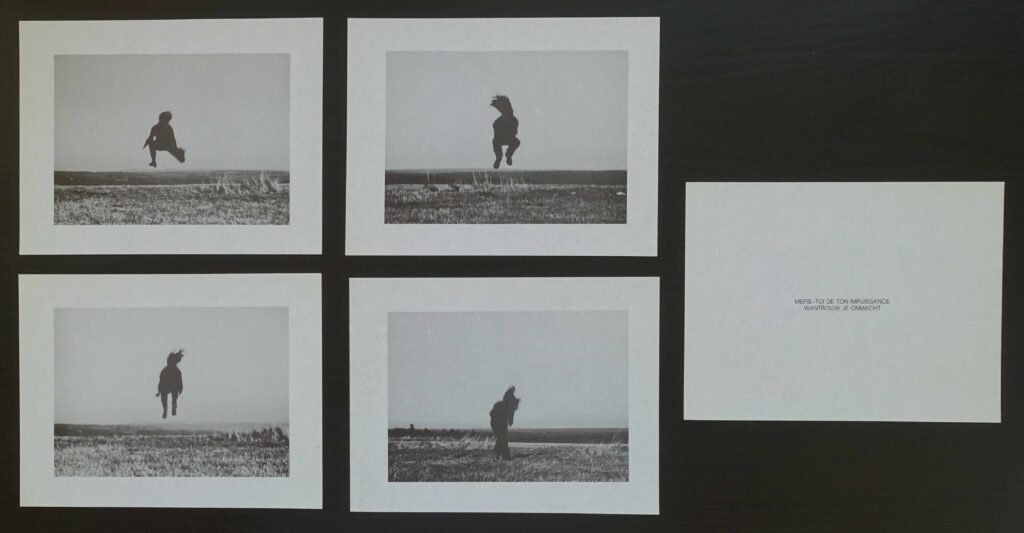
It’s tempting, looking at this work, to think purely in terms of stillness — silhouettes, outstretched arms, slow accumulation of gesture. But there’s a leap embedded in it too, one worth naming directly: the horizon in the Leisgens’ photographs is never simply scenery. It’s a limit, and their work is essentially a set of proposals for what it might mean to get past that limit.
Sometimes that’s literal continuity — a body’s arms becoming, for a moment, indistinguishable from a ridge line. Sometimes it’s more mythic. Their engagement with the sun — its arcs, its burn, its capacity to inscribe light directly onto film — inevitably conjures Icarus, the boy who tried to close the distance between earth and sky and was undone by it. The Leisgens’ work carries some of that same audacity, minus the catastrophe: an insistence that the boundary between figure and horizon, self and landscape, is not fixed, but negotiable, even performable.
This is really the deeper move conceptual art makes when it turns toward landscape. A horizon is, definitionally, the point past which vision fails — the edge of what a single vantage point can show you. To “jump over the horizon” as a conceptual gesture is to refuse that failure as final. It’s to say: the frame of what’s visible, sayable, or containable in a single image is not the frame of what’s real. Land artists of the same generation — Robert Smithson spiraling a jetty into a lake, Ana Mendieta pressing her own silhouette into earth and fire — were making versions of the same wager: that the body, staged correctly against scale and landscape, could gesture toward something larger than what any photograph could hold within its edges.
What keeps the Leisgens’ work compelling, decades later, isn’t nostalgia for 1970s land art. It’s that the horizon problem they were working on hasn’t gone away. We’re still, constantly, negotiating the edge between what we can directly perceive and what we know — or suspect — extends beyond it: in ecological crisis, in the limits of a single image or dataset to represent a system, in the simple fact that a photograph is always a fragment cut out of something continuous.
The Leisgens never resolved that tension so much as they staged it, patiently, body by body, horizon by horizon. Their work doesn’t claim to have jumped over the horizon and landed somewhere on the other side. It captures the attempt — arms outstretched, a figure walking until it disappears into the land it’s tracing — and leaves the rest, appropriately, just past the edge of the frame.
www.ftn-books.com has this scarce publication now available.